Highs & Lows

Here’s a little SoCal geography to set you up for my trip to the Salton Sea.

If you were standing at the edge of the beach in San Diego, you’d be at what altitude?

Sea level. Right.

But if you go 15 miles inland, to El Cajon, where I live, you’d be at an elevation of 435 feet.

What happens if you keep going? Suppose you go in another 15 miles, to Alpine. What would the elevation be then?

If the rate of the slope is constant, it’d be 870 feet, but the rate isn’t constant. Alpine’s official elevation is 1735 feet, or thereabouts. Actually, the situation is more complex because the way Alpine’s borders work, you hit the 1000 elevation mark just before the city limits and the 3000 elevation mark just after you pass the city limts, so you’ve got a 2000 foot jump in just about the course of one town (spread out as it is).

A bit further on, about 60 miles inland, you hit the 4000 foot mark, and you stay above that level for another 60 or so miles, though it never gets much above 4200 feet. Then it drops off again. 

FAST!

In six or so miles you drop from the 4000 foot mark down to the flat plane of the Imperial Valley, which is basically about sea level again.

The largest town along the highway is El Centro, which has an elevation of a measley 45 feet above sea level.

So as you move inland from the beach, you get a moderate climb up to El
Cajon, then a really fast climb up through Alpine to a high,
mountainous region that drops off suddenly to the desert floor.

As you make the transition through the mountainous region, you pass
through a number of different small mountain ranges: the Cuyamaca
Mountains ("KWEE-ah-MAH-kah"), the Laguna Mountains ("lah-GOO-nah"),
the In-Ko-Pah Mountains ("In-Ko-Pah"), and the Jacumba Mountains
("hah-KUM-ba"), in that order.

It’s a wild ride! (More on that tomorrow.)

But what happens if you turn north at El Centro to go up to the Salton Sea?

You keep heading downhill.

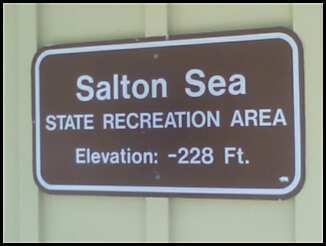
The slope is gradual, but when you get to the Salton Sea the elevation is:

Salton_sea_elevation_1

Yes! That’s right! The Salton Sea is actually below sea level!

In fact, the lowest part of the sea is even lower. It’s got a maximum depth of 48 feet, the lowest point in the place is 276 feet below sea level.

That’s just a fathom shy of being the lowest point in North America, which is 282 feet below sea level.

And where would that be?

A site just up the road from the Salton Sea . . . Death Valley.

Becoming An Apologist

A reader writes"

I am a Catholic, faithful to Rome, who lives in the heart of anti-Catholic USA (thank you, Jimmy Swaggert).  I would like to become an apologetic, but I am having difficulty knowing where to start.  The nine book series by Fr. Frank Chacon and Jim Burnham looks good.  Do you have any recommendations for me?  Thank you for your assistance.

The Beginning Apologetics series by Chacon and Burnham is indeed a good place to start, and I’d recommend it.

It’s also recommend these things:

  1. Read the Catechism of the Catholic Church
  2. Read the Bible
  3. Read Catholicism & Fundamentalism by Karl Keating
  4. Read The Salvation Controversy by me
  5. Listen to Catholic Answers Live (online or via radio)
  6. Interact on the discussion forums at Catholic.com
  7. And, of course, read my blog. 🙂

Robert Spencer Interview

There’s an interesting interview with Robert Spencer (a Catholic author on Islam) over on CatholicReport.Org.

EXCERPT:

Pope Benedict is taking a different   direction from Pope John Paul II. I don’t think we will see Pope Benedict XVI kiss the Koran as Pope John Paul II did. I think Pope John Paul II tried to reach out to Islam but the Jihadists have made it clear that Rome and much of Europe will eventually be in Islam’s possession. I think Pope Benedict XVI realizes the seriousness of these statements.

GET THE STORY.

SoCal vs. The Smog Monster

SmogI grew up in the mountains, away from any large cities, and so smog was something I only heard about.

I knew it was bad. I knew it was in the atmosphere over cities. I knew it was caused by pollution.

But I didn’t know that you could see it.

I found out otherwise when I moved to San Diego and noticed a certain haze that appeared on some days. Someone then identified it for me: That’s smog.

I had no idea.

California take extensive measures to try to cut down on smog. You have to get your car checked on a regular basis to see whether it meets the state’s automotive emissions guidelines (or they won’t renew your license tag). There are ads for "Smog Check"s at virtually all of the filling stations that aren’t tied to a convenience store.

Apparently the smog is much better these days than it was back in the 1970s. It’s also better in San Diego than it is in Los Angeles.

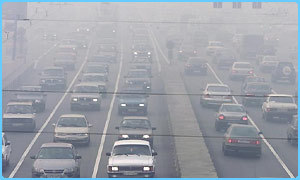
But lately it’s been really bad where I live, in El Cajon (on the outskirts of San Diego). It’s not as bad as in the picture above (that’s of a Moscow rush hour), but it’s bad enough that I can’t see the hills the way I’m supposed to be able to. There’s a haze between me and the hills, and there’s so much haze between me and the most distant hills that I can barely make them out.

It’s not normally this bad, but it’s no fun for allergy sufferers with all that particulate matter in the air.

While I was researching this subject I found a government-run web site that contains air quality forecasts and maps for the whole country.

CHECK IT OUT!

Yesterday we had an unexpected set of thunderstorms (rare phenomena here in SoCal), which washed a lot of it out of the air, so we had a better day today. The previous couple of weeks, though, the haze was really bad.

Like the day I drove out to the Salton Sea.

It was interesting to note that as soon as I got out of El Cajon and drove up in the mountains to Alpine (15 miles away and about 1500 feet higher above sea level), all the smog had vanished and you could see the hills clear as a bell, no matter how far away they were.

More on the trip later.

Ente bTaref `Arabi?

That’s a question that some in St. Blog’s need to be asking themselves. If they don’t understand the question then the answer is "No" or, more properly, La’.

The question means "Do you understand Arabic?" and the reason that they need to ask themselves this is that some folks in the Catholic blogosphere have been freaking out over the fact that Cardinal McCarrick has (again) used the word "Allah" when referring to God in a speech made to a Muslim audience.

To tell you the truth, I wasn’t happy when I saw the transcript of his remarks. Since it’s vanished from the main server at CUA, here’s what he said:

Remarks by Cardinal Theodore McCarrick
Archbishop of Washington and CUA Chancellor

CUA Columbus School of Law

Sept. 13, 2005

Your Majesty, King Abdullah

Your Majesty Queen Rania

Prince Ghazi

Members of the delegation from the Hashemite Kingdom of Jordan

Father President

Distinguished guests from many faith communities

Dear friends all,

Your Majesty,

A few months ago, when I was privileged to pray for you on another occasion in this capital city, I asked Allah, the compassionate and merciful Lord of all the world, to bless you and to help you make your country a bridge across which all nations might walk in unity, fellowship and love.  As I listened to your words today, I believe my prayer is being answered.

Indeed, the Amman Message of November of last year is a blueprint and a challenge not only to the great world of Islam, but to the whole human race.  Your thoughtful leadership is a stirring invitation to all of us, especially to the people of the Book, the family of Abraham, who share so much and who are called to be brothers and sisters in God’s one human family.

You have taken to heart the words of Pope Benedict XVI when he addressed the Muslim leaders gathered with him in Germany last month and invited them all to join him in eliminating from all hearts any trace of rancor, in resisting every form of intolerance and in opposing every manifestation of violence.  As you quoted in your splendid talk to us today, Pope Benedict called his listeners, in this way, to turn back the way of cruel fanaticism that endangers the lives of so many people and hinders progress for world peace.

Your Majesty’s call and that of the Holy Father are in so many ways the same.  May Allah, the merciful and compassionate, continue to guide your steps along this noble path.  May He guide and protect you, your family and your beloved country and may peace and justice come to all lands and all peoples through your efforts, your vision and your courage.

In the name of Allah, the merciful and compassionate God, we pray.  Amen.

Now the reason I wasn’t happy when I read this is that I knew it would be taken the wrong way by a great many Catholics. Had he asked me if he should refer to God in this way in this speech, I would have advised against it. I suspect that the confusion it would cause would outweigh whatever slight diplomatic edge it might give the talk.

But one should not freak out about this, as some in the blogosphere have been doing.

The fact is that Allah is simply the standard Arabic word for "God." It is used by Arabic-speaking Muslims and Christians alike–including Arabic-speaking Catholics. If you read an Arabic New Testament, it’s going to have Allah where "God" appears in the English version. When they say prayers in Arabic (e.g., the Rosary) and the prayer refers to God, they use the word Allah.

I have more experience on this point than many English-speakers do since I have a lot of Arabic-speaking Catholic friends (Chaldeans, Maronites, etc.). I hang out with their priests, go over to their houses, spend time at their churches, go out to lunch with them, work on projects with them, discuss the situations in their home countries, inject snatches of Arabic into talks I give at their parishes, etc., etc., etc.

And this is just not a big deal.

Not only do Arabic-speaking Christians use Allah amonst themselves, they use it when speaking to Muslims . . . just like Cardinal McCarrick did!

So no freaking out is required over this issue. In fact, it’s counterproductive.

Then there are some folks who see past the word "Allah" but are bent on committing the genetic fallacy, claiming based on dubious historical arguments that the word "Allah" is originally derived from the name of a pagan mood god. This is open to severe objection, but even if it were true it would prove exactly nothing regarding whether the word today is being applied to the true God or not.

Fact is, it doesn’t matter where the word came from. It matters how it’s used. If the word is today used for the true God then that is what it refers to when people today use it. It doesn’t matter how their ancestors may (or may not) have used it.

If it did, we’d be in big trouble because parallel arguments can be made that the divine names Yahweh and Elohim were also based on terms originally applied to pagan deities.

When it comes to the question of whether the word Allah is being used today by Muslims to refer to the true God (y’know, the one who created the universe and appeared to Abraham), not only does the Qur’an indicate that the answer is yes, the Catechism of the Catholic Church does, too (CCC 841).

The Catechism doesn’t always say things perfectly, and I’d say that this passage is one that itself could stand some clarification, but the basic conclusion is correct: Whatever flaws Muslims have in their understanding of God (e.g., failing to believe that he is a Trinity, as our Jewish friends also don’t when they worship the true God), they still intend by their use of the word Allah to pick out the being who created the universe and who appeared to Abraham, and that’s a definite description of the true God.

So one can, if one wants, think it ill-advised for a churchman to use this term for God in a public address given in English, but one does not have grounds for freaking out as if the term Allah were itself anathema or as if the Cardinal were deviating from what Church teaching is regarding the question of whether Muslims (however imperfectly) worship God.
Quick MoBleg

A piece back I was looking at some sites that allowed you to call in from a phone and have the results posted as an audio moblog. Unfortunately, I can’t seem to find these sites at the moment.

Can anyone point me to them?

Also, anybody know of a combination cellphone-to-podcast service?

Unhappy Western Schism Day!

Today, September 20th, back in the year 1378, was the day that the Great Western Schism started.

Y’know . . . that thing where there were two and then later three guys purporting to be pope at once. . . . Threw all of Europe into confusion. . . . Was a precipitating cause of the Protestant Reformation. . . . All that bad stuff?

Well,

GET THE STORY.

Includes a handy chart of the popes and anti-popes of the period!

More Rumor But . . .

Folks are speculating that B16 will soon allow the former rite of Mass to be celebrated by priests of the Latin rite without special permission from their bishops.

In fact, folks have been speculating that for a while since Pre-16 was open in stating that he thought greater permission should be given for this.

What’s new is that Cambridge professor Eamonn Duffy has been speculating the same thing, in public, and with the addition of a timetable:

In remarks to the National Conference of Priests of Ireland, Eamonn Duffy said that he thought the Pope would make the policy change in October, during the meeting of the Synod of Bishops. The topic for Synod discussions is the Eucharist.

GET THE STORY.

I wonder if the good professor is being overly optimistic. I fully expect that B16 will make sure that the subject is discussed during the Synod, but I don’t know that he’s prepared to simply make the decision at this point if there is strong opposition to the proposal, much less do I think it’ll be announced during the Synod. That’ll take a while even if he carries through on the plan.

If he does, it could help facilitate a healing with the schismatic SSPX, which might then schism itself, with part coming back to the Church and part not.

Or so one might suppose from the comments of jerkboyrogue Bishop Richard Williamson, who’s already out spinning the issue.

GET THE OTHER STORY.