The Nature Of Purgatory

A reader writes:

As a perspective convert to the faith Purgatory is a doctrine that has been giving me a lot of trouble. I struggle with the visions the saints had of purgatory. They are different and do not all agree.

There is a big difference between St. Mary Magadeline de Pazzi’s graphic vision of various tortures in purgatory to St. Catherine of Genoa’s vision in which she says, "the ‘fire’ of purgatory is God’s love ‘burning’ the soul so that, at last, the soul is wholly aflame. It is the pain of wanting to be made totally worthy of One who is seen as infinitely lovable, the pain of desire for union that is now absolutely assured, but not yet fully tasted”. She says that fire burns away sin’s rust which is on the souls not tortures like molten lead, pressers, sharp swords, and ice.

Are the various tortures graphic metaphors to warn us of the damage of sin and the holiness of God or should we take them literal?

That is the way they are commonly understood these days, not as things we would literally encounter in purgatory but–to the extent such images have validity–as symbolic expressions that try to convey what the experience is like.

I don’t see how you can go from a vision telling us how the purifying fires of purgatory reflect God’s love to a visions with demons, fearsome animals, and graphic torments.

This is why I throw in the caveat about "to the extent such images have validity." The images that you are talking about (demons, fearsome animals, graphic torments) are not part of Church teaching. They are things that some visionaries have reported in private revelations but, given the way private revelation works, there is an admixture of the visionary’s own consciousness and cultural background and it can be difficult to untangle what the motions of divine grace the seer was experiencing signify and to what extent they were colored by the visionary’s own consciousness.

This is a special problem when dealing with visions of the afterlife, because the afterlife is so fundamentally different from our embodied experience. There is a much higher risk of "filling in the details" with this-worldly things that are not meant to be understood literally. (Just as angels don’t literally look like men, though that’s how they often appear in Scripture.)

The Church has generally warned people off of some of the more graphic and detailed speculations about purgatory because they are not part of the faith. The Council of Trent (which was occurring at the same time as St. Mary Magdalen de Pazzi was having her visions) specifically warned bishops to be vigilant against people getting too concerned with such matters. The Decree on Purgatory states:

The more difficult and subtle questions [regarding purgatory], however, and those that do not make for
    edification and from which there is for the most part no increase in piety, are to be
    excluded from popular instructions to uneducated people. Likewise, things that are
    uncertain or that have the appearance of falsehood they shall not permit to be made known
    publicly and discussed. But those things that tend to a certain kind of curiosity or
    superstition, or that savor of filthy lucre, they shall prohibit as scandals and
    stumbling-blocks to the faithful [SOURCE].

I should also mention something else: St. Catherine of Genoa’s understanding of purgatory also is not Church teaching. It’s permitted speculation, but not something the Church teaches. It is, however, closer to the way the Church today tends to conceptualize purgatory. The Catechism of the Catholic Church, for example, stresses the difference between purgatory and the sufferings of the damned. Some older writers spoke as if purgatory were the same as hell except that it was temporary instead of eternal. The Catechism goes out of its way to reject that idea:

1030
All who die in God’s grace and friendship, but still imperfectly purified, are indeed
assured of their eternal salvation; but after death they undergo purification,
so as to achieve the holiness necessary to enter the joy of heaven.

1031
The Church gives the name Purgatory to this final purification of the elect, which
is entirely different from the punishment of the damned
[SOURCE].


So even though Catherine of Genoa’s understanding isn’t Church teaching (i.e., the fire of love stuff), it is much more in line with the way the Magisterium is talking about purgatory these days than the former graphic tortures stuff.

When it comes down to it, what is Church teaching is rather modest and might be summarized briefly in a few propositions, such as: (1) There is a purification that occurs after death for the saved who are in need of purification before entering heaven, (2) the faithful on earth can assist those experiencing this purification by their prayers, through Masses, etc., (3) at least some people do not need this purification before heaven, and (4) the purification involves at least some kind of suffering. (Propositions 3 and 4 are more open to question, though, that propositions 1 and 2.)

I know that there is great suffering in purgatory but what is the best theological view on purgatory ecspecially all the theological thought throughout the last century.  Such as Cardinal Ratzinger’s (Pope Benedict) view on purgatory.

I can’t tell you what the best view is, but I can tell you what the Church teaches (see the link to the Catechism above as well as THIS ONE). I can also tell you that Cardinal Ratzinger’s view is much more along the lines of St. Catherine of Genoa’s understanding. In his textbook Eschatology, he conceived of purgatory as an existential encounter with Christ that transforms one. He spoke in these terms:

"Purgatory is not some kind of supra-worldly
concentration camp where one is forced to undergo punishments in a more
or less arbitrary fashion. Rather it is the inwardly necessary process
of transformation in which a person becomes capable of Christ, capable
of God [i.e. capable of full unity with Christ and God] and thus
capable of unity with the whole communion of saints… Encounter with the
Lord is this transformation.  It is the fire that burns away our dross and re-forms us to be vessels of eternal joy."

Hope this helps!

Bye, Claudius

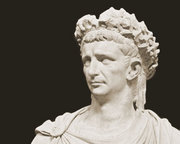
ClaudiusToday–October 13–back in A.D. 54, the Emperor Claudius was poisoned by his slimy fourth wife, Agrippina, who served him a dish of poisonous mushrooms.

Why’d she do it?

So her slimy son, Nero, could become the next emperor and the Beast of Revelation (though she didn’t know about that part).

GET THE STORY.

In other history news, today in 1307 there were mass arrests of the Knights Templar.

GET THAT STORY, TOO.

Now This Is Good News

I don’t know if y’all’ve heard, but they found this letter that al-Qa’eda’s Number Two Goon, Ayman al-Zawahiri sent to Number Three Goon, Abu Musab Zarqawi (the head evil dude in Iraq).

If you read between the lines of the letter, things sound really good. Good for US, that is. BAD for al-Qa’eda.

Zawahiri is diplomatically warning Zarqawi that he’s screwing things up.

He has to be diplomatic about it, though, because their organization is so weak that he (a) has no effective control over Zarqawi and (b) is so hard up for cash that he politely asks for Zarqawi to send him a donation.

He also outlines what al-Qa’eda’s larger plan is.

I was thinking about doing a detailed mark-up of the letter to point out just how bad things seem to be going for al-Qa’eda–as well as what we in America have to be on guard against–but I had a really LONG day yesterday and don’t have the energy to do a detailed piece of writing at the moment.

FORTUNATELY, JOHN HINDERAKER HAS ALREADY DONE A GOOD ANALYSIS.

YOU CAN ALSO READ THE FULL TEXT OF THE LETTER.

The Effects Of The Accidents

A reader writes:

I have a question about the Atkins Diet.  I sincerely am not trying to be sacrilegious when I ask this.  I believe in my heart and soul that what I receive in Communion is the body, blood, soul and divinity of our Lord and Savior Jesus Christ, but do the accidents affect my blood sugar?  If I am on Atkins and am a daily communicant (which I am not, because we don’t have daily Mass here in the sticks), would there be a problem?  I can’t imagine a problem because Jesus is all Good and cannot hurt us.  I guess I am just asking about the accidents or maybe you could explain it better.

There is no sacrilege involved. You’re simply asking for knowledge.

It’s true that Jesus won’t hurt us, but that doesn’t mean that our bodies will respond the right way to the accidents of bread and wine.

When we receive Communion, our metabolism looks at the elements and responds the same way that our eyes do, saying, "That’s bread and wine!"

This is not a problem as long as you can handle bread and wine, but some folks can’t.

People with celiac disease, for example, may have a toxic reaction to the accidents of bread if they contain too much gluten (if I may put it that way).

People with alcoholism can be subjected to temptation from receiving the accidents of wine from the cup.

If a single minister is consuming what remains of the Precious Blood after Communion and he drinks enough then he will get tipsy.

This is because the physical properties (accidents) of the bread and wine remain. If I may put it this way, the change in the elements is metaphysical (a change of their inner substance), not physical (a change of their outward properties).

This means that your metabolism will treat them as if they contain carbohydrates. If your metabolism is such that you can handle the amount of carbohydrates that the unconsecrated elements contain then you’ll be able to handle the accidents of the consecrated elements.

On the other hand, your metabolism is sensitive enough that you’ll stop losing weight from receiving a certain quantity of the unconsecrated elements then the same thing will happen when receiving the accidents of an equivalent quantity.

So it really depends on your own metabolism and how many grams of carbohydrates you can ingest per day and still continuing to lose weight.


The Call Of Cthulhu!

Cthulhu0A BIG, Texas-sized CHT to the reader who e-mailed me a link to the just-released DVD of The Call of Cthulhu!

For those who may not know, The Call of Cthulhu is one of the keystone stories of early 20th-century weird fiction writer H. P. Lovecraft.

The story dates from 1926, and now the H. P. Lovecraft Historical Society has adapted the story to film–done in the style of a 1926 silent film!

This was an outstanding choice.

Though there have been a number of Lovecraft film adaptations, they are generally regarded as unworthy by Lovecraft fans. Too much of Lovecraft’s ability to create mood depends on his narration, and when you have characters speaking to each other in naturalistic dialogue, the same effect just can’t be created. Also, many filmmakers who have adapted his stories have been notoriously unfaithful in doing so, changing elements left and right so that the film bears little resemblance to what Lovecraft wrote.

This film, being done by a historical society, is extremely faithful to the story and, by chucking out naturalistic dialogue in the manner of a silent film, it is able to capture the eerie mood of a Lovecraft story through the power of image and music.

This film is a REALLY good adaptation. Lovecraft (who did go to the movies and even had a job as a ticket salesman at a movie theater for a while) would have LOVED this flim if it had been made in 1926 so that he could have seen it. He would have raved about it in his letters to friends.

Continue reading “The Call Of Cthulhu!”

Cyborgs ‘R Us?

A reader writes:

Hi, Jimmy,

How much of a person could you replace with prosthetics before they cease to be human?

Okay, first a caution. I hope that you are asking this question for purely theoretical reasons and are not planning on acting on the answer. Doing so is likely to result in unpleasant consequences like imprisonment and damnation.

Arms and legs? Digestive tract? Lungs? Heart? A percentage of the brain?

Yeah, all of those can go and still leave a person human. The key one is the brain, which is the indispensible one. Clearly people can lose parts of their brains and remain human, but if you totally get rid of the brain then you ain’t got a human anymore. A brain in a vat would qualify as a human (albeit a severely disfigured human), but an adult body with its brain cut out would not. How much of the brain one could lose and still have a human well . . . there’s not a single identifiable chunk that you could take out–probably you could take out a lot of different chunks–but if you took out so many that as a whole the disembodied brain experiences systemic failure and irretrivably dies then you’ve taken away so much that what remains ain’t a human. It’s a brain corpse.

(NOTE: See previous remarks on "brain death" for the complexity of this question.)


Supposing that you could replace a living body with 100% artificial organs (leaving aside problems of consciousness) – would it continue to be a person but cease to be human?

I’m not sure what you mean here: Do you mean replacing the entire body with synthetic organs INCLUDING the brain or EXCLUDING the brain?

If the former then the resulting brain-in-a-synthetic-body is still a person and a human (although a severely prosthetized human).

If you mean the latter then the question becomes: What do you mean by "synthetic organs"?

If you mean ordinary human organs with a human genetic code that you’ve grown synthetically (e.g., from a stem cell shoggoth) then you could grow an entire person synthetically, which would be either a clone or a designer clone. Such individuals would be both persons and humans.

You might mean something else by "synthetic organs," though. For example, you might mean mechanical organs (like a mechanical heart) or organs that are made of inorganic material or even organic material as long as they don’t have a human genetic code.

If that’s what you mean by synthetic organs then if you totally replace the body, including the critical parts of the brain needed to keep it a live and functioning whole, then what you have is not a human any more. It’s an android or a synthezoid, but not a human being.

Would it be a person, though?

Maybe.

You don’t have to be a human being to be a person, as illustrated by angels and the three Persons of the Trinity. If the resulting entity had a rational intellect then it would be a person.

The problem would be telling a genuine rational intellect from a false one, though. Computers may some day be sufficiently advanced that they can pass the Turing Test and intellectually pass for human beings. Should that ever happen, though, I’m with Justice Katherine Pulaski that they still ain’t persons and have no rights. They’re not really thinking–exercising an intellect–they’re just following very complex programming.

Sorry, no "Android Rights" for Mr. Data!

It could be, though this is a practical impossibility, that someone could design a non-human life form (possibly even based on inorganic molecules) that would have a rational intellect. Such a being would be a person.


Would thus replacing your body be considered suicide?

If you replace the whole thing, including the brain, yep. That’s killing you. It doesn’t matter if you transfer your memories to a new medium. The death of the old medium is the death of YOU, and that’s suicide.

If you’re just talking about replacing everything except the brain, then no. That’s not killing you and so is not suicide. It is, however, immoral to do that without a very good reason (and some might argue that it would be immoral even though, though it wouldn’t be suicide).


How would such a person relate to the church? The sacraments? They’d lack a human nature …

How non-human physical persons would relate to the Church is a theologically open question. I suspect that if they asked for the sacraments on their own then they would be given them, at least conditionally.

How your brain in a synthetic body would relate to the Church is a more clear matter. You would be able to receive the sacraments, but since some sacraments depend on physical contact (e.g., baptism, confirmation), you’d have to let your brain be touched as part of the process. I highly recommend using sterilized water and oil in a sterilized environment for that due to the risk of viral or bacteriological infection.

Would their salvation depend on their status before becoming a machine? Would nothing they do after transformation effect their chances of getting to heaven?

If what you’ve got continues to be you (the brain in a synthetic body model) then you can continue to act as a moral agent and affect your salvation.

On the other hand, if it continues to be you but there’s an accident of some kind so that you can’t function properly mentally (e.g., your brain accidentally gets cooked in the process of transferring it to the new body) then your situation is like that of anybody who goes into a coma during a medical procedure. If you went into it with unrepented mortal sin on your soul, you’re doomed. If you went in with attrition for your sins and receive the anointing of the sick then you’re saved. If you went into it with contrition for your sins or no mortal sins then you’re all set.

If what you’ve got is a synthetic but nonetheless real person then he is capable of acting as a moral agent and affecting his salvation.

Similar considerations apply for a synthetic person who is mentally impaired (as when you went into the coma in the previous example).

If what you’ve got is an imitation person that does not have a real intellect (e.g., a Mr. Data) then he is a non-person and thus has no salvation to gain or lose, regardless of how good an impression of a human being he’s able to pull off.

This applies even if the android (or whatever) thinks that it’s you because your memories have been loaded into it.


Prophetic Shopping Advice?

A reader writes:

In light of the recent events (Katrina, Rita, etc.) some folks are attaching prophetic significance to daily events pointing toward a culmination, and encouraging people to store up 6 months worth of food, among other things.   Some of this was given out (verbally) at our prayer meeting. 

I told the people to use a lot of caution and discernment for such a message.  I privately corresponded with the person who gave the message and told her I had some major problems with it, including making definitive statements about God chastising New Orleans and the US. 

My wife is from a country affected by the tsunami and they lost 15 to 20 K children in the tsunami.  Who was God chastising for that?  I just don’t think we can make specific judgments about these things.  This person is also making connections between withdrawal from Gaza and hurricanes/natural disasters (I believe some of that may be coming from 700 Club and others).

I told the person that if they really believed these warnings and instructions were from the Lord the they should be shared with a priest/bishop in union with the Magisterium of Rome.  If that priest/bishop concluded that this was "from the Lord", then perhaps ( and only perhaps) some credibility could be lent to them.

Do you have any thoughts on this?   We went back and forth with this person by email about five or six times and still she keeps defending the storing of food, etc.  My wife was wondering how in the world most of the poor nations would be able to store up anything, particularly when they generally don’t know where there next meall is coming from.

Since I’m not familiar with the messages, I don’t know if they were meant for folks in other countries or just for the U.S. (i.e., is this supposed to be a worldwide disaster that necessitates the food storing or just one that hits the U.S.) I’d also think that the advice would be "Store it if you can," but in parts of the world where folks can’t, that’s obviously not an option.

That being said, it sounds to me as if you have a pretty good take on the situation. Skepticism here is warranted, and any kind of warning this dire ought to be run past the bishop before people are told to do something as dramatic as storing up six months worth of food for their families.

Not that it’s a bad idea to have that much food in reserve. You never know what may happen in this day and age, and it’s not at all unreasonable to have some food an water available as emergency supplies. Virtually everybody could be hit with a disaster of some kind–natural or artificial–in which they might need supplies until disaster relief can get established.

As regular blog readers know, my grandmother is living in such a situation RIGHT NOW due to Hurricane Rita, and I could join her at any time since the San Andreas Fault can have "The Big One" at a moment’s notice.

No matter where you live, something like that is a possibility (even if it’s just fallout being blown over from from terrorists detonating a nuke in a city a couple of states away).

I therefore consider it advisable for folks to have a certain amount of emergency food and water on hand–at least a few days to a couple of weeks worth–as well as other disaster survival equipment (medicines–particularly prescription medicines you need to take–flashlights, radios, matches, maps, weapons, batteries, iPods, etc.).

Six months, though, is a LONG TIME, and it would require something REALLY AMAZINGLY HUGE to disrupt the economy so severely that anybody would need six months of food. I mean, we’re likely talking about someting on the order of a civilizational reboot at that point (it can’t take FEMA that long to get supplies into the area following a lesser disaster; you only need six months of food if you expect government aid to not be there for six months, and it’s hard to see how that could happen in the current media and political environment without a civilizational reboot in progress). The only things that springs to mind that would be that severe would be something like an asteroid strike or a nearby star going supernova or a doomsday bug or something.

So it sends a really scary message to be telling folks that they need six months of food, and anything that alarming–and EXPENSIVE for a family–ought to be run past Church authorities. That’s not just so people won’t be put to needless worry, it’s also so that if there really WERE a huge disaster coming, folks could be warned.

Of course, there’s no guarantee that the bishop will rule the right way, but one needs to turn to the authorities  that Christ has given his Church.

Furthermore, skepticism regarding any message so dire is the appropriate strategy. The accuracy rate of people with dire messages like this is remarkably LOW, and that has to take that into account when evaluating new cases of folks with dire warnings–particularly if they have no track record of accurate predictions or other evidence that their messages are anything other than the product of their imaginations.

Hope that helps!