A Stray Thought. . . .

I was thinking about how the different meat industries have their own slogans, like:

BEEF! It’s What’s For Dinner!

Or

PORK! The Other White Meat!

Or

CHICKEN! . . . (Actually, I don’t know if there’s a chicken slogan.)

But maybe the meat industry as a whole needs to have a slogan to put up a united front against the ravening hordes of vegetarianism.

Homer Simpson’s shrewd observation could be a good one:

If God didn’t want us to eat animals, he wouldn’t have made them out of meat.

But then it’s good advertising practice to advertise new and improved features of your product (even if they aren’t new and improved), so maybe something like:

ANIMALS! Now With A Yummy, Meat-Filled Center!

Just a thought.

What would your meat industry slogan be?

Ministry & Mental Illness

A reader (who extended permission up front to blog this) writes:

I have been struggling lately with several serious
problems doing with mental health. You see, I was
headed for a Religious community and the seminary
until recently, when I was hospitalized again due to being
suicidally depressed.

Earlier, I just thought that my mental illness was
major depressive disorder, with no psychotic features,
and something I very possibly could recover completely
from (I have completely recovered from this before).
Although I had attempted suicide in the past, the
community I was looking at was going to attempt to get
me a waiver on the canonical impediment to Orders.

All of this has changed, because I recently was given a diagnosis that caused me to realize that
my depression was not just going to lift, and that I
will probably struggle with severe depression for the
rest of my life, and it is very posssible in a fit of
depression that I either attempt suicide again or
succeed in committing it. So I decideded that there
was  no possible way that I had a vocation…

First of all, I want to say that I understand what a painful time this is for you. I know what it’s like to have to give up on a career that you wanted very much to pursue. To have reached that conclusion under your circumstances is even more painful, and I want to encourage my readers (who number in the thousands) to pray for you.

I also want to give you two compliments right up front:

First, you had the courage and presence of mind to ask for help and to write a very thoughtful series of questions, which I will address below. You should feel good about yourself for that.

Second, you volunteered to allow me to blog on this very sensitive matter. That means that the answers I give you will be out there in cyberspace where they can help other people as well. This was a very courageous and generous thing, given the sensitivity of the matter, and you should feel especially good about yourself for having made the offer.

Remember those points.

Also remember that you are a child of God and that he loves you enough to die for you on a Cross. Remember that especially. He died, so you don’t need to.

And he will eventually bring something wonderful out of your suffering, because that’s what he does: He turns suffering into redemption and glory. Your cross in this life may be heavier than many, but that means that your crown in the next life will be all the more glorious.

You can already see God redeeming your suffering right now, by the fact that you volunteered to let me blog this, so your suffering is leading to help for others who are similarly suffering, so they can be comforted as well as you.

Not many people would volunteer in that way.

You are a very special person.

To what degree am I morally responsible for my actions
and my illness?

To the extent that your condition impedes your ability to function normally, it diminishes your responsibility for your actions. If it is not significantly impeding you at the moment then you are more responsible. If it is significantly impeding you then you are less responsible. If it is totally impeding you then you are totally not responsible.

Since you mention (below) that you are the child of two schizophrenic parents, I would assume that your condition is genetic, which means that you are not responsible for your condition AT ALL. Don’t worry about that. Don’t take that burden on yourself, because it is not your burden.

What you are responsible for is how you manage your condition. This means taking your medications and seeking appropriate psychological help, up to and including checking yourself into a hospital when needed.

It also means doing your best to turn away from the dark thoughts when they come to you, to set them aside and think about something else. When you sense them starting to come, do your best to think about something else–something happy. Try to remember what I’ve said in this post pointing out how special you are and how much God loves you.

Also, cultivate habits that will help you keep a good mood. Let me make several specific recommendations:

1) This may sound strange but . . . try a low-carb diet. You are likely to find that your energy level and mood are better if you aren’t having to deal with the insulin spikes and blood sugar lows caused by eating the large amounts of carbohydrates that most Americans consume.

2) Get exercise. Find something you like and throw yourself into it.

3) As a form of enjoyable exercise, I especially recommend dancing, especially highly energetic and chaste dancing that puts you in a large group of people so you have social contact with others. Energetic dancing is a form of exercise that you won’t even perceive as exercise.

I know that I’m a square dancing enthusiast, but I would especially recommend square dancing, because it meets those three qualities in spades: It’s highly energetic (making it a better workout and causing your brain to release endorphins that will make you feel better), it’s chaste, and it is a highly social form of dancing that will let you meet a whole group of people rather than a single partner. Also, handshakes and hugs are part of the politeness rituals associated with square dancing, and having that kind of friendly, positive contact with others will also help improve your mood.

4) Use positive language to describe your condition. Using positive language will help you think positive and thus feel positive. For example, you may want to express what you are doing in terms of "managing a condition" rather than "suffering from an illness." Both of these modes of language point to the same underlying reality, but they put different spins on it. If you focus on suffering and illness then you are likely to feel worse, like a victim who has little control. But if you think of yourself as managing a condition, you are no longer focusing on suffering an illness. Instead of being a victim, you’re a manager–someone who has power over the thing you’re managing, someone who can make a difference in what happens to him, who doesn’t just have to sit back and take it. That’s the reality of what you are, so reflect that reality in the language you use to yourself and others, and you’ll find that you have more power over your situation than you thought.

I am also involved in Church ministry,
and should I leave? (More than one priest who are
generally orthodox in their opinions think that as
long as at the time of ministry, I am ok, that it’s
all right.) I have my doubts, and my self-esteem and
trust of myself is at an all time low.

I don’t know what ministry you are involved in at present, so I can’t give an opinion on whether it is the right one for you at the moment, but I think I can be of help.

The main piece of advice I would have is this: Don’t think in terms of leaving ministry. Think in terms of finding the best ministry for you to pursue.

We are all called to minister to the corporal and spiritual needs of others. We are all reciprocally called to have our corporal and spiritual needs ministered to by others. It’s part of the design for how Christ set up his mystical Body.

The question, therefore, is not whether we should be doing or receiving ministry. The question is finding the particular ways in which we can best minister to others and finding the ministries of others that will best help our corporal and spiritual needs.

Even people who are full-time patients in psychiatric institutions are called to do what they can to minister to the patients and doctors and staff members around them, just as the others in that environment are called to minister to their needs.

It is the same in the outside world. No matter where we are, what our life situation is, we are called both to minister and to be ministered to (the latter also includes letting others know of your needs so they can help).

So your call is not to stay in or leave ministry. It’s to find the best ministry for you to pursue.

What that is depends on your inclinations, aptitudes, and circumstances.

I’d therefore ask myself what you like doing (your inclinations) and what you’re good at (your aptitudes) and use that as a pointer toward what you should explore.

Once you have that in mind, consider your circumstances. There are two things to consider here: The needs of others around you and your limitations.

The needs of others (which is what ministering is all about) are an important factor here. Suppose, for example, that you enjoy being an extraordinary minister of Holy Communion a lot and you also enjoy singing in the choir. But suppose that your parish already has tons of extraordinary ministers (more than it needs). That would be a signal–based on your present circumstances–to spend time in the choir rather than as an extraordinary minister. You might enjoy being an extraordinary minister more, but that’s not what the people around you need the most right now, and what their needs are is what ministry is about. You can put your talents to better use in the choir for the moment.

Notice that I said "for the moment," because circumstances change, and what ministry is the best for you right now will change over time.

This comes in particularly in view of your condition, since it changes over time. Everyone in ministry has to know his limits–otherwise he will exhaust himself and minister poorly to others. Your condition sounds like it changes significantly with time. When you’re in a long-term, stable period there would be more forms of ministry that would be appropriate to you than if you’re having a significant episode of depression.

I would say that, if you feel a significant episode coming on you should consider whether you need to step back from some of the forms of ministry you may be undertaking, and if you feel that you have entered a stable period then it makes sense to step forward and explore new forms.

Because of the changeability of your condition, I would also look for forms of ministry that don’t require permanent or long-term commitments. You need to be doing things that you can step back from if a significant episode arrives.

I also wouldn’t think of ministry exclusively in terms of a parish setting. Lots of ministry happens outside of Mass. Sometimes people who have a great desire to minister narrow their options by thinking exclusively in terms of parish-centered ministry. If you consider a broader palette of options then you’re more likely to find the right colors you can paint with.

In this regard, let me make a suggestion: You’re obviously a very bright guy (something else you should feel good about), and I know from things I edited in your e-mail to conceal your identity that you have an intellectual bent, so may I suggest . . . blogging?

Blogging would allow you to help others using your intellectual talents, but it would also allow you the kind of flexibility that you need to accomodate potential changes in your condition. For considerations of your privacy, I would blog under a pen name, and I would be open with your readers about your condition so that if you need to take time away from blogging they will know why and will be able to pray for you.

If you choose to go this route, you’ll need to be patient while you build a readership. It will take time, and in the early days you won’t have a big readership.  But if you apply yourself then, like any other blogger, you can cultivate a readership. Also if you go this route, send me another e-mail and let me know, and I’ll try to recommend your site to my readers.

This is
doubly painful, because I am the child of 2
schizophrenic parents who have had significant accomplishments.

I undertand your pain, and I’m going to turn this one around on you to show you what is possible: The fact that your parents have had significant accomplishments (which I’ve edited out for reasons of your privacy) shows you that a person with your condition can achieve things! Your own parents did, so you can too! Feel good about that!

Also, more than one friend have attributed this
illness to the work of Satan, which I reject because
it has a biological basis and the Catechism explicitly
teaches that psychological illness should never be
used as a basis for an exorcism. To what degree could
the devil be involved in this?

One can’t eliminate the possibility of some involvement from the opposition, but you’re taking the right attitude, and the attitude which the Church would have you take (as illustrated by its exorcism policy). Your condition has a known physiological basis, and that is what you should look to in explaining it to yourself. You will serve yourself better if you don’t go looking for supernatural explanations and simply trust Jesus and Mary to protect you from supernatural interference.

Also, can I receive the
anointing of the sick when I am doing very badly, as
it is a form of illness that is seriously life
threatening? (I think Psychiatric illness that causes
serious suicidal thoughts and can lead quickly to
actions is life threatening, would you?)

This matter has not been authoritatively settled, but sound pastoral practice would indicate that you should be able to receive the anointing of the sick if you at the onset of a significant episode (or if a significant episode gets worse).

The Church’s documents speak of people who begin to be in danger of death due to sickness and do not further specify the nature of the sickness. If the danger is caused by a condition of the heart or the brain, it should not make any difference. Mental illnesses are real illnesses, and they should count under this provision just as much as illnesses that affect other organs and bodily systems. The fact that it is processes in the brain rather than elsewhere in the body that causes the danger should not matter.

I’d also note that the English-language text of the ritual for anointing of the sick (which Rome approved) has a pastoral note stating that those with serious mental illnesses may be anointed, and the Code of Canon Law contains a canon (c. 1005) that encourages the reception of this sacrament when there is a case of doubt about whether the conditions for it are fulfilled. This, at the very least, signals that the Church wants a generous application of the sacrament so that people can get the help they need from the sacrament.

I hope this helps, thank you again for writing and for allowing me to help others by blogging this. You will be in my prayers and, I’m sure, the prayers of numerous readers. So be encouraged, and feel good about yourself!
Can We Please Stop Using This Argument?

People can rationally come to different conclusions on what should be done about the presence of millions of illegal aliens in the United States, but as that matter is debated, we should at least try to avoid some of the most obviously absurd arguments.

I therefore propose that we, as a nation, retire the "Illegal aliens take jobs Americans won’t do/don’t want" argument.

This is patent nonsense.

Anybody using this argument either has no grasp of economics or is being disingenuous due to the presence of an ulterior motive. (Them’s yer two choices, so take yer pick, Mr. Bush.)

To see the absurdity of this argument, let’s cast it in its starkest form: Food.

Before we do that, though, let me issue

THE BIG RED DISCLAIMER: The following treatment has nothing to do with ethnicity. It has to do with economics. In what follows I will talk about two groups of people–illegal aliens (whatever their ethnicity) and Americans (whatever their ethnicity). The fact that most (but by no means all) of the illegal aliens in this country are Latino in origin is irrelevant to the economic principles involved, as is the fact that many Americans are also of Latino origin. If you need to, swap the terms "America" and "Americans" for those of a random country somewhere else on the planet. The economic principles apply no matter where you are.

Now . . .

It is often noted that illegal aliens play a large role in the construction, landscaping, and domestic service industries, but nice buildings, nice landscapes, and nice domestic services are luxuries. Our most pressing survival-related need is for food, and so the "Jobs Americans won’t do" argument can be cast most starkly if we look at the role of illegal aliens in the agricultural industry.

Suppose that all of the illegal aliens working in the agricultural industry decided to quit their jobs. What would happen to the U.S.?

Will we be seeing headlines in the New York Times like this one? . . .

Food Rots In Fields As The Nation Starves!!!

Of course not.

Americans are not going to starve themselves to death because they "won’t do" the job of harvesting the food.

Americans have been harvesting food ever since there have been Americans (otherwise they would have all starved long ago), so they are certainly capable of it.

Why, then, are so many illegal aliens taking the place of Americans in the agricultural industry?

Because they come from a different economic background and are willing to do the jobs for less.

The effect of illegal aliens in the agricultural industry is not that they do work that otherwise wouldn’t get done. It’s that they depress the wages in the agricultural industry to the point that such jobs are unattractive to Americans.

It’s that whole supply-and-demand thing.

When you’ve got a greater supply of something than you have demand for it, the price will go down. If manufacturers make loads of DVD players and start to outstrip the demand for DVD players then the price of DVD players will go down as part of competition for customers.

Same thing happens in labor markets.

If the supply of agricultural workers outstrips the demand for agricultural workers then the wages attached to such jobs will go down as part of competition for employment. When the wages are depressed past a certain point, some of the workers will say, "Y’know, I could do better in a different industry" and they decide at that point that they "won’t do" the agricultural jobs at the depressed wages being offered for those jobs.

But what happens if the labor pool shrinks? What happens if all the illegal aliens decide to quit?

When the supply of agricultural workers shrinks so that it no longer outstrips the demand for agricultural workers and employers start raising wages in order to attract the workers they need, and the work gets done.

Trust me, Americans are not going to starve themselves to death if they have no illegal aliens to harvest food.

What will happen instead is that the wages offered for such jobs will rise, Americans will start valuing such jobs more as a result (instead of looking down on them), and they will start doing them. The food will get harvested, and when it is sold to the public the added labor costs will be passed on to consumers in the form of a modest increase in food prices.

But there will be no massive wave of starvation in the U.S.

Something similar applies to the jobs in other industries that currently have high levels of involvement by illegal aliens. If the supply-and-demand situations of those industries were readjusted then Americans would be attracted to jobs in them as well, and the work would still get done. People might economize in some areas (e.g., taking care of the kids yourself instead of hiring an illegal alien to serve as a nanny), but we won’t see headlines like:

American Buildings Rot Due To Lack Of Construction Workers!!!

Landscaping Crisis Dwarfs Hurricane Katrina!!!

Absence Of Domestic Services Causes American Family To Fall Apart!!!

People who want to maintain the status quo on illegal immigration–or who want to legalize the status quo via amnesties and guest worker programs–may still argue for these on other grounds (e.g., that there is an overall positive economic impact from having millions of low-paid foreign workers in the U.S. or that it’s a practical impossibility to remove them all), but whatever you want to see done about illegal immigration, you’ll need to argue it on grounds other than the "Jobs Americans won’t do" notion.

That one’s a non-starter, Mr. President.

P.S. BTW, Mr. President, do you realize how arrogant and insulting you are being when you use the "Jobs Americans won’t do" argument?

This argument can be parsed one of two ways: (1) "Such jobs are beneath us as Americans, so we need to import foreigners to do these lowly tasks for us" or (2) "I preside over a nation of such hopelessly spoiled brats that we need to just cave in to their juvenile refusal to do such jobs."

The first is arrogant and insulting to people from other countries. The second is arrogant and insulting to Americans.

Since it can be parsed both ways, the argument is arrogant and insulting no matter what your nationality.

The Coming War With Iran

Military historian Victor Davis Hanson has an interesting analysis of the coming with with Iran and the reasons behind it.

Interestingly, he ends the piece with a direct appeal to Iranian president, Mahmoud Ahmadinejad (who may well be one of the hostage-takers from the 1970s Iran Hostage Crisis) to change his course before war becomes inevitable. He writes:

Ever since September 11, the subtext of this war could be summed up as something like, “Suburban Jason, with his iPod, godlessness, and earring, loves to live too much to die, while Ali, raised as the 11th son of an impoverished but devout street-sweeper in Damascus, loves death too much to live.” The Iranians, like bin Laden, promulgate this mythical antithesis, which, like all caricatures, has elements of truth in it. But what the Iranians, like the al Qaedists, do not fully fathom, is that Jason, upon concluding that he would lose not only his iPod and earring, but his entire family and suburb as well, is capable of conjuring up things far more frightening than anything in the 8th-century brain of Mr. Ahmadinejad. Unfortunately, the barbarity of the nightmares at Antietam, Verdun, Dresden, and Hiroshima prove that well enough.

So far the Iranian president has posed as someone 90-percent crazy and 10-percent sane, hoping we would fear his overt madness and delicately appeal to his small reservoirs of reason. But he should understand that if his Western enemies appear 90-percent children of the Enlightenment, they are still effused with vestigial traces of the emotional and unpredictable. And military history shows that the irrational 10 percent of the Western mind is a lot scarier than anything Islamic fanaticism has to offer.

So, please, Mr. Ahmadinejad, cool the rhetoric fast — before you needlessly push once reasonable people against the wall, and thus talk your way into a sky full of very angry and righteous jets.

That’s just the conclusion, though.

READ THE BUILD UP TO IT.

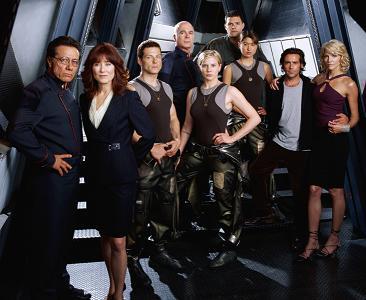
Galactica Season Three

GalacticaWell, we’re now well and truly into the gap between Galatica season 2 and season 3, so pretty much everybody who wants to see the season 2 finale has done so.

(If you haven’t, you can download it from iTunes and watch it in iTunes, even if you don’t have a video iPod.)

This gives me a chance to speculate on what we’re going to see in season 3.

One of my favorite things to do when watching or reading a story is to predict where it’s going and then seeing if I’m right or not.

So let’s see how I do with my predictions for BSG season 3. . . .

Continue reading “Galactica Season Three”

More On The Gospel Of Judas

It’s nice to see Catholic news sources getting the message out there that all the "Gospel of Judas" hype is, well, hype.

HERE’S A GOOD PIECE FROM ZENIT.

AND ANOTHER FROM CATHOLIC NEWS SERVICE.

One of the refreshing things about these pieces is how utterly contemptuous the experts being interviewed are about hullabaloo over the Gospel of Judas.

When asked whether the document will "shake Christistianity to its foundations," the Zenit expert replies:

Certainly not. The Gnostic gospels, of which there are many besides this one, are not Christian documents per se, since they proceed from a syncretistic sect that incorporated elements from different religions, including Christianity.

From the moment of their appearance, the Christian community rejected these documents because of their incompatibility with the Christian faith.

The CNS expert is even more blunt:

"It was junk then and it is junk now," he said.

Overcoming RadTrad Temptations

Part Two

As promised in my post Overcoming Temptations to RadTradism, here are some more ideas for taming the spiritual fruitchucker in you. (For those of you who may have missed the article that inspired the spiritual fruitchucking metaphor, click here.)

Once again, more suggestions, in no particular order.

Accept that you don’t Know It All. In my original article in this series, Surviving Sunday Mass, I led into this series by recalling the problems at a recent Sunday Mass in my parish. Turns out, not all of the problems that bothered me actually were problems. At least one thing that occurred was a legitimate option. Which goes to show that however well informed you think you are about the Catholic faith, it is possible (indeed, even likely) that you may have some misconceptions. When you become upset at a perceived abuse in the Church, assuming that there is a possibility that you could be mistaken about what the faith requires can spare you a lot of frustration and resentment. And acknowledging that popes, cardinals, bishops, priests, and religious are more likely than you to be better informed about what the faith requires is a simple act of humility.

Don’t rely on hearsay. Awhile back I read a post by a St. Blogger who was fuming because he had stumbled across an online article reporting on an apparently dubious action taken by a province of a religious order in dealing with alleged abusive members in their ranks. In reading the article to which my fellow St. Blogger referred, I too was concerned, but, unlike my fellow St. Blogger, I personally knew a member of that religious order’s province and so I asked him about the story. His explanation of the province’s action threw entirely new light onto the story and made the previously mystifying action reasonable.

The moral of this story is not to try to track down the Other Side Of A News Story. You probably won’t have the kind of contact I did with an insider willing to speak to you “off the record.” You also probably won’t have the time or resources to invest in researching all such stories like that on your own. The take-away lesson here is to be dubious of what you read in the media. Even when a journalist has all of his factual ducks in a row — which is not always the case — he may be unable to obtain comment from all parties to the story. Especially in the case of religious news stories, authorities with a diocese or a religious order may be unwilling to speak to the media — not out of a nefarious desire to cover up truth but because they are unable to comment on a particular case for any number of justifiable reasons. It will be far easier on your spiritual peace to assume that there is a reasonable explanation that could be offered if the circumstances existed in which it could be offered than to allow yourself to become scandalized over every headline you read on the Internet.

Seek out the good. In the comments to Surviving Sunday Mass, some commenters were perplexed over why I should be grateful that my parish has far fewer liturgical abuses than others. The implied concern was that I should instead seek out liturgical perfection and be satisfied with nothing less.

Liturgical perfection is a meritorious goal. No denying that. But when a parish that has had significant problems is making strides toward liturgical orthopraxy to nitpick over the wrinkles that remain rather than appreciate the work that has already been done is uncharitable. It’s one thing to continue to hope for more ironing; it’s another to refuse to be satisfied with nothing less than instant transformation according to your specifications. Sure, if I were a pastor, there would be things that I’d do differently at my parish than are already done. Fortunately for the parish, that’s never going to happen. And fortunately for me too, because then I’d be on the field exposed to “quarterback sacks” rather than calling the plays from the comfort of my armchair.

Appreciate the concept of spiritual fatherhood. A religious order priest once told me the story of how a parish that was staffed by his religious order decided to offer a pre-Vatican-II Latin Mass to their parish. The priests became more and more concerned because RadTrads in the parish were causing problems because they had to share the parish with “Novus Ordo” Masses. Finally, when the RadTrads demanded that only hosts consecrated at the Latin Mass be offered at the Latin Mass — they did not want hosts consecrated at a “Novus Ordo” Mass — the priests had had enough. In short order the pre-Vatican-II Latin Mass was cancelled and the RadTrads were further embittered over what they perceived to be “persecution.”

But look at it from the priests’ viewpoint: They are spiritual fathers charged with developing Christians into spiritually-mature adults. As an analogy, let’s assume that you were a parent and in your home your family had very specific ideas about what they would eat for dessert. Because you love them, you usually try to accommodate the children’s desire for Haagen-Dazs. But one night you run out of Haagen-Dazs and all you could offer was no-frills, off-brand vanilla. What would you do if your children screamed for Haagen-Dazs and refused to be satisfied with the dessert that you offered? If it were me, the children would be lucky to get fruit for dessert that night, and that would probably be the last they’d see of Haagen-Dazs for quite awhile.

This is an imperfect analogy, but the point is this: Sometimes the otherwise inexplicable actions of the Church become more clear when we remember that clergy are not our employees who must be expected to provide us with what we demand but our spiritual fathers who are charged to provide us with what we need — whether or not we want it.

Please feel free to contribute your suggestions to the combox.

The Evil Of RealPlayer

A reader writes:

I wrote was in response to a comment you made on Catholic Answer about realplayer.  You made a comment that you thought they were evil (like in dante evil).  I was trying to find out what you meant by that comment.  Working for Sun, (M$FT Sworn enemy 😉 ) kind of rules out using Windows media player, and not being a  great fan of iTunes, I had defaulted to realplayer. Is there something really intrinsically evil about real that I should try to avoid?

Yes, RealPlayer is one of the most evilest software applications ever created in the pits of hell.

RealPlayer has been one of the most consistently evil applications over a long stretch of time. As users have complained about one set of evil behaviors on the part of RealPlayer and they get "fixed" by the company, the company just goes and introduces new evil behaviors. Among those the evil behaviors that RealPlayer has been discovered going over various versions are these:

1) It will try to take over your system and become the default player for every type of audio and video file that exists.

2) It will make it very difficult for you to stop it from doing this. You will have to manually uncheck almost a hundred boxes in order to limit RealPlayer to being the default player for only Real’s proprietary formats.

3) It will constantly nag you to register until you finally give in and tell it a phony e-mail address.

4) It will constantly nag you to upgrade to the paid version.

5) It will constantly nag you to upgrade to the latest paid version (for which you will have to pay again).

6) It will try to push content at you that you don’t want.

7) It will push advertisements at you, making it a form of adware.

8) It will stick in your system tray when you turn it off, and you will have to go to extra efforts to get it out of your system tray.

9) It will modify your system registry so that it will put itself BACK in your system tray on startup and you’ll have to get it out again.

10) It will install parallel programs that you don’t want, like AIM and RealJukebox.

11) It will send individually identifying user strings back to the network so that Real can track what music you as an individual (not as an unidentifiable part of a group) are listening to.

12) After you turn off the advertising options so that you won’t get hit with advertising, it will TURN SOME OF THEM BACK ON AUTOMATICALLY so you get hit with ads anyway.

13) It will constantly bombard you with e-mails from Real (unless you gave them a fake address).

14) It will crash your system.

15) It will sacrifice babies to Moloch.

I am NOT kidding about that last one.

After the above, it comes as no surprise to discover that RealPlayer was designed by the Easter Bunny as part of his never-ending war against humanity and should be avoided at all costs!

MORE HERE.

JP2 And The Quran

John_paul_ii_quranA reader writes:

I had never heard you address this on your show or Blog – though I’m certain you are familiar with it and have covered it before.  But what gives about the story of JPII kissing the Koran?!  I’ve seen it mentioned enough times by serious Catholics to accept this must have happened.  However, I don’t know the context of this event or any other details so I can only wonder what our late Holy Father might have been thinking…  Your thoughts?

This question has come up over the years, and I know that I’ve addressed it on the show (though I don’t have the faintest idea in what episodes), but I don’t seem to have done so on the blog, so here goes. . . .

First, I’ve reprinted the famous picture of the event above so that people can see what is being talked about.

Based on the picture alone, I would not be sure what is happening. The book is ornate and could be something other than the Quran. From the looks of it, it could be a book of the gospels.

However, the former Chaldean patriarch–Raphael Bidawid–was present at the meeting where the event occurred, and in an interview with the press service FIDES, he said the following:

On May 14th I was received by the Pope, together with a delegation composed of the Shi’ite imam of Khadum mosque and the Sunni president of the council of administration of the Iraqi Islamic Bank. There was also a representative of the Iraqi ministry of religion. I renewed our invitation to the Pope, because his visit would be for us a grace from heaven. It would confirm the faith of Christians and prove the Pope’s love for the whole of humanity in a country which is mainly Muslim.

At the end of the audience the Pope bowed to the Muslim holy book, the Qu’ran, presented to him by the delegation, and he kissed it as a sign of respect. The photo of that gesture has been shown repeatedly on Iraqi television and it demonstrates that the Pope is not only aware of the suffering of the Iraqi people, he has also great respect for Islam [SOURCE].

What, then, is one to make of the event?

It seems that there are a number of possibilities:

1) The FIDES news agency misquoted the patriarch.

2) Patriarch Bidawid was mistaken about what happened. It was not the Quran but something else.

3) John Paul II kissed the Quran but didn’t know the nature of the book he was kissing.

4) John Paul II kissed the Quran and knew that this is what he was doing.

I would love to think that either option (1), (2), or (3) was the case, but I have no evidence that any of them was the case.

The most likely one of the three, to my mind, would be (3), because so far as I know, John Paul II was not an Arabic speaker and may not have understood the nature of the book that he was being presented with.

People shove all kinds of books into the pope’s hands at audiences, and if the pope was under the impression that the thing to do with a gift in Iraqi culture is to kiss it as a sign of respect to the one who gives the gift then he might have kissed it reflexively, not even understanding the nature of the book.

While this is possible, I think it likely that an interpreter explained the nature of the gift that was being given on this occasion. This still leaves the possibility that the pope kissed it as part of Middle Eastern politeness rather than as a gesture of respect for the book itself.

I have heard claims that in some Middle Eastern cultures that this is a typical gesture of respect for one giving a gift, but I have asked Chaldean friends of mine whether this is the case in Iraqi culture and the answer was a definite "No." "The pope put his foot on the neck of all Chaldeans with this action" was the response I was given. (Just to make things clear, putting your foot on the neck of someone is a bad thing in Iraqi culture.)

Still, the pope may have been under the mistaken impression that this was the appropriate thing to do when receiving a gift in their culture. He can’t be an expert on every culture in the world, and he could get this wrong.

Or maybe he didn’t.

Maybe he knew it was the Quran and kissed it anyway, not as a customary gift giving response, but for some other reason.

What might that reason be?

It certainly wouldn’t be that he believes in Islam or believes that Islam is on a par with Christianity. If he believed either of these two things then he (a) wouldn’t be the earthly head of the Christian faith and (b) wouldn’t have approved the publication of Dominus Iesus, which asserts the salvific universality of Jesus Christ and the Church.

Any attempt to represent him as thinking one of those things doesn’t even get out of the gate.

So what might he have been thinking?

We’re only speculating here, but two things spring to mind as what JP2 might have been thinking:

1) The Quran does contain some elements of truth (as well as grave elements of falsehood) and he might have wanted to honor the elements of truth it contains.

2) Showing respect in this way could foster world peace and interreligious harmony.

Of these two, I would conjecture that the latter would have been uppermost in John Paul II’s mind, though the former may not have been absent.

John Paul II was a man who was enormously concerned with world peace and interreligious harmony. As a young man he lived through the horrors of World War II, which had a permanent effect on him and his generation and their views about war and peace.

As a mature man he lived through the Cold War that repeatedly brought the world to the brink of nuclear disaster, and this also had a permanent effect on him and his generation and their views about war and peace. The constant threat of nuclear warfare hung particularly heavily over Europe–which would have been the chief battleground in a conflict between the Soviet Union and the West–and (particularly on the heels of WWII) it deeply impressed the "find peace at any cost" message on his generation.

As a result of the Cold War, the nations of western Europe were forced into an alliance (NATO) whereby their centuries-long enmities (as between France and Germany) had to be suppressed for the sake of common survival. Negotiation became the key to survival in western Europe, and the same message was driven home to those in Eastern bloc countries, such as John Paul II’s native Poland.

By letting the US shoulder the main burden for the military defense of Europe (during and after the Cold War), many Europeans of John Paul II’s generation absorbed the idea that negotiation was paramount and could solve virtually any problem. It wasn’t until the events of the Global War On Terror that this idea began to be seriously called into question many in European circles.

As a result, as a man of his generation, John Paul II–for the best of motives–may have overestimated both the need for and the utility of gestures such as the one exhibited in the Quran-kissing event.

If the former pontiff did understand that the gift was a Quran and if he wasn’t under the impression that kissing a gift was a standard response in Iraqi culture then I would suppose that he did so out of a desire to foster peace and interreligious harmony, but it would still have been a mistake to my mind.

The Quran, whatever elements of truth it contains, also contains venomous attacks on the divinity of Christ and on Christian doctrine and these make it inappropriate for the Vicar of Christ to kiss it under any circumstances.

John Paul II also may not have been attending to the gravity of the false elements in the Quran. Even if he knew them, he may not have been thinking about them and may have acted on the spur of the moment, without fully thinking through his action.

Fortunately, the infallibility of the pope and the indefectibility of the Church do not extend to such actions. A pope is not attempting to make anything remotely like a dogmatic definition in an act of this nature. And so, however misguided the action may have been and however good the motives for it may have been, it would constitute an error that does not touch upon papal infallibility or ecclesial indefectibility.

It would be one of the mistakes that all fallen humans are heir to, even the vicars of Christ.

JewishEncyclopedia.com

Welcome news for anyone with an interest in Judaica! The Jewish Encyclopedia has gone online and is a free service:

"This online version contains the unedited contents of the original encyclopedia. Since the original work was completed almost 100 years ago, it does not cover a significant portion of modern Jewish History (e.g., the creation of Israel, the Holocaust, etc.). However, it does contain an incredible amount of information that is remarkably relevant today."

SEE THE SITE.

(Nod to Modern Orthodox Woman for the link. MOW also notes that JE.com is soliciting help in updating the encyclopedia, an effort that could lead to "the beginning of a Jewish Wikipedia.)

By the way, for any who may be unaware of it, the original Catholic Encyclopedia is also online. Now we just have to get started on a Catholic Wikipedia….