The Smoke Of Satan Homily

Fr. Stephanos Pedrano was kind enough to translate from Italian the famous "Smoke of Satan" homily from Italian, allowing us to see the quote in its original context. I’ve put the entire homily in the below-the-fold part of this post, and I’ll offer some analysis of it here.

FIRST, HERE’S THE ORIGINAL ITALIAN FOR THOSE WHO WANT TO LOOK IT UP IN THE ORIGINAL.

Now for the analysis:

1) A strange thing about this homily is the way it is presented. It isn’t simply the text of his remarks, which is the normal way today for presenting the text of a papal homily. Instead, it’s a kind of narrative summary of what he said, with occasional direct quotations attributed to him. I’ve never seen this way of presenting a papal homily before, but perhaps it was the way they did it back in the early 1970s. It’s unfortunate, from my perspective, because the narrative summary format introduces a new layer of ambiguity into the document. If we don’t have the pope’s exact words, but someone’s narrative re-telling of them, or if we can’t tell precisely when we have the pope’s exact words and when we don’t, it makes it that much harder to determine exactly what the pope meant.

The phrase “from some fissure the smoke of Satan has entered the temple of God” is, apparently, directly attributed to Paul VI, but it’s embedded in a big narrative block that narrates what he said in this part of the homily, but we don’t have–or can’t know that we have–his exact words. This means that there must remain a question mark over the correct interpretation of this phrase.

I hereby register my opposition to this manner of presenting papal remarks. Let the pope speak for himself.

2) Despite the above point, if the summary that is offered is remotely accurate, we can get a sense of what the pope meant. Here’s the paragraph in which the quotation occurs, as well as the following one:

Referring to the situation of the Church today, the Holy Father
affirms that he has a sense that “from some fissure the smoke of Satan
has entered the temple of God.”  There is doubt, incertitude,
problematic, disquiet, dissatisfaction, confrontation.  There is no
longer trust of the Church;
they trust the first profane prophet who
speaks in some journal or some social movement, and they run after him
and ask him if he has the formula of true life.  And we are not alert
to the fact that we are already the owners and masters of the formula
of true life.  Doubt has entered our consciences, and it entered by
windows that should have been open to the light.  Science exists to
give us truths that do not separate from God, but make us seek him all
the more and celebrate him with greater intensity; instead, science
gives us criticism and doubt.
  Scientists are those who more
thoughtfully and more painfully exert their minds.  But they end up
teaching us:  “I don’t know, we don’t know, we cannot know.”  The
school becomes the gymnasium of confusion and sometimes of absurd
contradictions.  Progress is celebrated, only so that it can then be
demolished with revolutions that are more radical and more strange
, so
as to negate everything that has been achieved, and to come away as
primitives after having so exalted the advances of the modern world.

This state of uncertainty even holds sway in the Church.  There was
the belief that after the Council there would be a day of sunshine for
the history of the Church.  Instead, it is the arrival of a day of
clouds, of tempest, of darkness, of research, of uncertainty.
  We
preach ecumenism but we constantly separate ourselves from others.  We
seek to dig abysses instead of filling them in.

In the next section the subject of the devil is further expounded upon:

How has this come about?  The Pope entrusts one of his thoughts to
those who are present:  that there has been an intervention of an
adverse power.  Its name is the devil, this mysterious being that the
Letter of St. Peter also alludes to.  So many times, furthermore, in
the Gospel, on the lips of Christ himself, the mention of this enemy of
men returns.  The Holy Father observes, “We believe in something that
is preternatural that has come into the world precisely to disturb, to
suffocate the fruits of the Ecumenical Council, and to impede the
Church from breaking into the hymn of joy at having renewed in fullness
its awareness of itself.
  Precisely for this reason, we should wish to
be able, in this moment more than ever, to exercise the function God
assigned to Peter, to strengthen the Faith of the brothers.  We should
wish to communicate to you this charism of certitude that the Lord
gives to him who represents him though unworthily on this earth.”
Faith gives us certitude, security, when it is based upon the Word of
God accepted and consented to with our very own reason and with our
very own human spirit.  Whoever believes with simplicity, with
humility, sense that he is on the good road, that he has an interior
testimony that strengthens him in the difficult conquest of the truth.

From this–as well as other elements in the rest of the homily–a fairly clear picture emerges of what Paul VI meant. This can be summarized as follows:

The Second Vatican Council did its work to renew the Church and to bring a new day of light. However, the Council’s work has been frustrated by an attack by the devil by means of broader sociological currents that were present in the late 1960s and early 1970s, such as secular social experts and social movements and scientists who lack faith and political and cultural revolutionaries. These sociological currents ("the smoke of Satan") have infected the Catholic community and caused many to doubt and trust the Church and turn away from the eternal answers it has to offer and folow after passing modern ideas that are hostile to Christian thought. In this way the devil has thwarted the work of the Council in bringing in the day of joy and renewal that should have followed the Council.

3) It is thus clear–if the reportage of what Paul VI said is even remotely right, that he was not claiming that there were Satanists in the Vatican (as some have claimed), nor is he linking the "smoke of Satan" with the Second Vatican Council itself or the liturgical reforms that followed it or anything like that. He perceives the work of the Council as a good thing that has been thwarted–or partially thwarted–by the social crisis that was breaking out in the developed world at this time. In other words, he’s responding to the cultural crisis of the late 1960s and early 1970s and its impact on the Church using a poetic image and attributing it (rightly) to the work of the devil, but he is not making the kind of sensationalistic claims that some have used to interpret this phrase.

People who have been claiming the latter need to get their tin foil hats adjusted properly or go back on their meds.
Continue reading “The Smoke Of Satan Homily”

Bodily Depilation

A reader writes:

I found your site through a Google search a while ago when I was in
the throes of depression, anxiety, and the terror known as
scrupulosity.  First and foremost, thank you for your advice; your
site is great and full of very helpful information.

You posted an e-mail on your website (http://www.jimmyakin.org/
2005/04/a_crown_of_thor.html
) that I could totally relate to, and it
helped me realize that I am a scrupulous person.  I strive to live
life the way that God wants me to, so this brings me to the
meaningful part:

Is it a sin to shave one’s body hair? I bought a
Norelco body groomer and use it to shave my chest, back, and stomach
on occasion.  Can this be considered sinful, or is my scrupulous mind
trying to lure me into something akin to super-sensitivity?

When I
went to confession, I told my confessor that I shave that area and
asked for forgiveness (if it is indeed a sinful act).  He didn’t have
any advice, so I figured I’d ask you.  Please help.

First of all, thanks for writing, and I’m glad that my site has been helpful. Most people go through scrupulosity at various points in their lives (at least morally thoughtful people), and some have a chronic problem with it. So, you’re not alone. As always, I recommend Scrupulous Anonymous for those who need help.

Regarding your question, it had not really occurred to me that a man might want to shave his body hair. I’m afraid that when it comes to personal grooming, I’m a retrosexual (see picture top left).

I did a little thinking and research, though, and realized that body builders often shave their body hair for competitions, as do swimmers, and probably some male models and movie actors do, too. I discovered also that some men today apparently shave their body hair as part of a metrosexual personal style.

That being said, what’s the morality of it?

Well, despite the fact that we naturally grow hair, this is something that God has put within our control. It is not a sin for a man to shave his beard or his scalp–if it were then the Church would have told us this long ago, and would never have required the tonsure–and so it is not in principle a sin to shave hair elsewhere on one’s body.

I would put this in the same category as other stylistic/appearance related things: It’s a matter of cosmetics, and God has given us the authority to make cosmetic decisions regardiung our bodies. We can’t mutilate our bodies–that is, tamper with them in a way that interferes with their basic functions–but we can do cosmetic things to them like cut our hair in particular ways, have pierced ears, tattoos, and even circumcision (which was even the mark of God’s covenant with the Jewish people). None of those things harm bodily function, at least not in an impermissible way, as long as they’re done properly, and shaving one’s body hair is mild by comparison to some of these.

Of course, individuals can develop an unhealthy preoccupation with cosmetic matters, but for a scrupulous person the greater danger is becoming unhealthily preoccupied with whether or not one is unhealthily preoccupied.

The thing to do, then, is to stand up to one’s scrupulosity and not worry about it.

Do not confess this. Do not worry about it. Devote as little thought to the subject as possible. Stand up to your scrupulosity and realize that this is not a sin. Period.

20

More On Mars & Venus

A reader writes:

I certainly agree generally that there is this difference…but this raises a question:

In the observation on the difference in the Roman vs American approach to law–where does that leave those who are engaged in liturgical abuses etc?

Can it not be said then that well…Rome does not REALLY mean for the rubics etc to be so fully followed….etc???  Does that not just undo everything?

I assume this would not be the case…enlighten us.

Indeed, it is not the case, but this is one of those situations where enlightenment comes only with difficulty.

While Rome-written law is more prone to unwritten exceptions and legamorons than America-written law is, we both have them, and you just have to have a feel for them based on your knowledge of the culture in question.

Thus in America laws against speeding usually function as legamorons but laws against homicide do not.
The government isn’t nearly as serious about enforcing the speed limit as it is laws against murder. Americans know this instinctively because they have the experience of living in their culture and noticing the difference in seriousness with which the two cases are treated by the government. Unsolved murders give rise to extensive police investigations. Unsolved violations of the speed limit do not.

Roman law, being produced by a high-context culture, has more unstated exceptions and legamorons than our laws, but this does not make Roman law meaningless any more than the unstated exceptions and legamorons in American law make it meaningless.

The real question is how to know when Roman law contains an unstated exception or legamoron.

That’s something that the folks in the Vatican–who are actually immersed in the culture that wrote the law–tend to pick up by experience. It’s part of the context they bring to the interpretation and application of the law–the same way Americans observing their own culture figure out that murder laws are intended more seriously than speed limit laws.

For those who don’t work at the Vatican, courses in canon or liturgical law at seminaries and universities are meant to impart that context–or as much of it as possible–to students so that they begin to acquire the context, too.

If you haven’t had those courses but work extensively with canon and liturgical law, you can begin to absorb it that way as well.

That’s the category I’m in. I’ve worked enough with canon and liturgical law over the years–talking to canon lawyers and liturgists, reading books on the topics, reading documents that Rome issues dealing with them–that I’ve absorbed enough of the context to have something of a "feel" for where some of the exceptions and legamorons are.

Sometimes documents that Rome issues point to these directly. For example, Redemptionis Sacramentum has a three-fold classification of liturgical abuses as graviora delicta ("more grave delicts"), "grave matters" and "other abuses." What they put in what category tells you what they are going to be the most strict about.

Similarly, there was a letter by the CDW a while back in which it was pointed out that while the laws regarding posture at Mass are intended to provide "to ensure within broad limits a certain uniformity of posture" but not to "regulate posture rigidly in such a way that those who wish to kneel or sit would no longer be free." That kind of response screams legamoron or unstated exception.

And so the posture laws at Mass admit more flexibility than those regarding the graviora delicta, such as throwing away the consecrated species.

After you have enough experience watching Rome apply its law in concrete cases, you start getting a feel for what they’re really concerned about and where they’re only gesturing in a general way at what they want to happen.

The posture of the laity at Mass laws are gesture laws. They really don’t care if everyone else is standing and you choose to sit or kneel. As long as the laity are in the pews and not being disruptive, they aren’t going to get worked up about what posture you’re in.

That’s why you may hear me say on the radio that Rome really won’t mind if a family or group of people at Mass holds hands voluntarily–even though that posture is not mandated in the liturgical books–but it will be more concerned if people are being forced to hold hands against their will. That’s interfering with others–it’s disruptive and gets people upset, and they don’t want the laity acting disruptively.

I’m not sure how to put this next point, but one of the reasons for this is that Rome doesn’t expect that much from the laity. It wants them to be at Mass and watch and listen and hopefully sing and pray and not be disruptive. It doesn’t expect them to have an intimate familiarity with liturgical law and its punctillious observance.

This grows out of a mindset which is in some way a hold over from the Middle Ages, when the laity were almost uniformly uneducated peasants, and you can’t ask too much of them. From an ecclesiastical perspective, we laity are in a sense just in from slopping the pigs, and while it is praiseworthy if a few pigsloppers take enough interest in the Mass to learn the details of liturgical law, this is the exception and not the rule–and always has been.

So as long as the laity are in the pews and relatively calm and not shouting or brandishing pitchforks, Rome doesn’t so much mind if they’re not all in the same posture.

But not all laws connected with the laity display that level of flexibility. For example, the laws against lay folks preaching the homily are meant seriously. Letting lay folks preach homilies starts to blur the line between the priests and the pigsloppers, and that is a Bad Thing.

You can tell that they really mean those laws because of how frequently they reiterate them.

And so, over time, one can develop a sense of what laws are strict ones and what laws aren’t, but it takes work and careful attention.

Which raises Ed Peters’ point about whether for a global organization a high-context approach to the law is the best way to go. Given that the vast majority of Catholics–and even bishops–do not and cannot share all of the context that suffuses the Vatican itself, it could make what Rome wants a lot more obvious if they were more clear and explicit in the way they write law.

Why 2004 Was Important

The supreme court just heard a case involving whether partial-birth abortion can be banned without a health exception.

Six years ago, they heard a smiliar case involving a Nebraska law, and five of the injustices voted that it was unconstitutional: Darth Breyer, Darth Ginsburgh, Darth Souter, Darth Stephens, and Darth O’Conner.

But Darth O’Connor ain’t there no mo.

Now there’s Justice Alito.

And also Justice Roberts.

Will they vote with Justices Scalia and Thomas–and even Darth Kennedy?–who voted in favor of upholding the Nebraska ban on partial-birth abortion in an apparent rare moment of being torn between the Light Side and the Dark Side.

GET THE STORY.

Stomach In A Bowl

When it comes to the culinary arts, presentation is not everything, but it is something.

Kentucky Fried Chicken seems to have forgotten this.

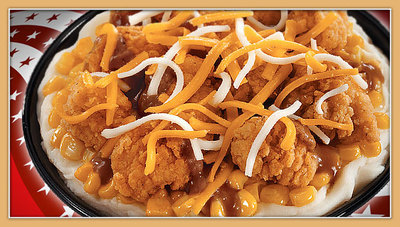
Lately I’ve been seeing ads for what KFC calls its "Famous Bowls."

That itself is offputting. I always hate it when marketers suddenly proclaim some newly invented product that nobody has ever heard of before "famous." Fame is not something you can simply proclaim right out the gate. It is something that only can be known with the passage of time, and it is a form of dehumanizing marketing that treats consumers as objects rather than subjects to proclaim something "famous" from the very first moment it is released to the public.

Same thing goes for declaring things "hits" or "best-sellers" before they are, in fact, hits or best-sellers. I remember back in 1978, when the original (and ultra-campy) Battlestar Galactica was about to debut and I saw an add in a sci-fi magazine for some product (a toy or something) based on the "hit" TV show Battlestar Galactica–which wasn’t a hit at all in that it hadn’t even hit the airwaves yet!

Didn’t like this kind of deceptive, dehumanizing marketing then, and don’t like it now.

I suspect, however, that KFC’s "Famous" Bowls may come to be regarded with time as its infamous bowls–and for reasons that have nothing to do with the adjective.

The fact is, the product strikes me as simply disgusting. Basically, they’ve taken everything they happen to already have on hand at KFC and jammed it all into a bowl. It’s like taking everything you might eat at a KFC meal and mixing it all up together (especially onces your spoon, or fork, or spork starts digging into it).

Here’s how their web site describes it in an attempt to make it sound appetizing:

We start with a generous serving of our creamy mashed potatoes, layered with sweet corn and loaded with bite-sized pieces of crispy chicken. Then we drizzle it all with our signature home-style gravy and top it off with a shredded three-cheese blend. It’s all your favorite flavors coming together.

Seeing the thing doesn’t make it seem any more appetizing:

Bowls_potato

If you see them layering these things together one at a time in a TV ad, it’s even more disgusting.

This morning at Catholic Answers, two of my colleagues and I were discussing this, and we were all appalled at the fact KFC would even consider marketing something like this. One of my colleagues referred to it as "a heart attack in a bowl."

(Which is not surprising since sudden, massive jolts of carbohydrates can cause arrhythmias–one of the reasons heart attacks spike after Thanksgiving and Christmas.)

They don’t exactly make finding the nutritional information on this monster easy, but if you poke around enough, you can come up with it. Here are the stats:

Calories: 720
Fat: 32 grams (that’s half the fat the USDA wants you to have in a day)
Saturated Fat: 9 grams (again, that’s half the saturated fat the USDA recommends for a whole day)
Cholesterol: 65 milligrams
Sodium: 2390 milligrams (that’s all the salt you’re supposed to have for a whole day)
Carbohydrates: 81 grams (it takes me three days to eat that many on my diet)
Protein: 29 grams
SOURCE.

So . . . you wolf one of these things down at lunch and your system gets hit with a massive load of fat, carbohydrates, and salt all at once. Just what your heart and circulatory system needs.

This bad boy is thus high-fat, high-carb, high-salt. It doesn’t get much worse than that.

But the most startling thing is not how unhealthy the "Famous" Bowls are. It’s the idea that KFC would think that people would actually find this combination appetizing.

Yes, I know that when you eat a meal it all goes to one place and gets mixed up there, but–as I noted at the outset–presentation is an important part of the culinary arts, and this product completely ignores that fact in a lazy attempt to get a new product by simply dumping ingredients they already have on hand into a bowl.

I might not have had a problem (when I was on a high-carb diet) eating deep-fried, breaded chicken and mashed potatoes at the same meal, but I didn’t want deep-fried breaded chunks of chicken in my mashed potatoes. Nor do I want gravy on corn or cheese on gravy.

YUCK!

So while what you eat does all go to one place, I have no desire whatsoever to eat a KFC version of "Stomach in a Bowl."

Now, I know what you’re thinking: De gustibus non disputandum est, interpreting rhe de gustibus part quite literally in this case.

I’m sure that KFC has done some market research that shows at least some people will like this thing. Some here on the blog may even find it appetizing. But I can’t shake the feeling here that we’re looking at a potential marketing disaster.

I mean, not one of "New Coke" caliber, but . . . say . . . the kind of product flop that met Ray Kroc when he found his burger sales plummeting in Catholic areas in Lent back in the 1950s and–since he didn’t want to allow his McDonalds’ restaurants to sell fish sandwiches so that fish would be "stinking up the place," he proposed an alternative and let the customers decide which they preferred.

Which did they prefer?

Let’s just say that McDonalds started serving Filet-O-Fish sandwiches.

Americans Are From Mars; Romans Are From Venus

John Allen has a very good piece on the culture gap between America and Rome and how it affects relations within the Church. The article sums up a lot of the differences that you find out if you spend serious time studying Rome and how it operates and is well worth reading.

Allen initially explains the cultural difference like this:

It would be flip to say that “Americans are from Mars, Romans from
Venus,” but there’s more than a smidgen of truth to the perception of
being on different planets.

As an illustration, he compares the American and Roman attitudes toward time:

To take just one small but telling example, consider the difference between American and Roman views of time. In the United States, we have a “microwave” culture. If we perceive a need, we want that need satisfied immediately. If there is a problem, we want a plan to resolve it by the close of business. If you don’t have such a plan, it’s either because you’re lazy or you’re in denial, and either way it’s unacceptable. Our motto tends to be that of Homer Simpson who, when told that it would take 30 seconds for a fried meal, responded: “But I want it now!”

Rome, on the other hand, is a culture notoriously accustomed to thinking in the long term. Its motto tends to be, “Talk to me on Wednesday, and I’ll get back to you in 200 years.” Rome is in that sense a “crock-pot” culture. The idea is that the food simmers for a much longer period of time, but if you get the ingredients right, it will be much more satisfying.

Although Allen doesn’t use the terms I’m about to, America (like England and Germany) has what some anthropologists have called a "low context" culture, while Italy (like the Middle East) has what is called a "high context" culture.

The difference has to do with how much background knowledge you are expected to have in order to function successfully in the culture. Low context cultures don’t require you to know that much of the local cultural lore in order to function successfully. That’s why, in America, if you can speak English and obey a few basic laws which are easy to look up, you can get along well. You don’t have to know all of the unwritten laws and lore and customs and tribal alliances that you would have to in a high context culture.

High context cultures, by contrast, assume that the individual does know the local lore. Among other things, this allows high context cultures to communicate in a way that is less explicit, more allusive. This is one reason that the Bible is as mysterious as it is: It was written in a high context culture that assumed the reader already knew the background to the documents, so it doesn’t waste time explaining that background. If you don’t have that background, the resulting document can seem obscure and mysterious.

(That background, or at least the theoogically salient bits, are preserved in the form of Sacred Tradition, which is why Sacred Tradition is needed to correctly understand Sacred Scripture. It’s the missing background material you need to make sense of Scripture. It’s also notable that sola scriptura arose in a low context culture of Germany, which assumes you don’t need extensive background information to understand a document.)

One of the ways in which high and low context cultures differs is in how they write law: Low context cultures spell everything out in detail in law since they aren’t relying on people to use their knowledge of the unwritten law in interpreting the text. They write law rigorously and, as a result, they expect it to be rigorously obeyed.

High context cultures, by contrast, use law to gesture at what they want to happen, but they admit a thousand unwritten exceptions. Consequently, the laws of high context cultures abound in legamorons.

Allen describes the situation like this:

For Anglo-Saxons, law is a lowest common denominator of civil behavior, and hence we assume that laws are meant to be obeyed. If we find that people aren’t obeying a given law, it’s a problem, and we either crack down or change the law. In Mediterranean cultures, on the other hand, law is more an expression of an ideal, and there’s tremendous room for subjectivity in interpretation and application in a concrete set of circumstances. Anyone who’s ever driven the streets of an Italian city knows what I’m talking about. The bar tends to be set high, with the implicit understanding that most people, most of the time, will far short to varying degrees.

This is a constant source of misunderstanding when the Vatican issues a draconian-sounding decree, which immediately elicits howls of protest from the United States about it being unrealistic or inhumane. Vatican officials are routinely exasperated by the reaction, since they fully expect that pastors and bishops will exercise good judgment about how it ought to applied in individual cases. Most recently, we saw this dynamic with the document from the Congregation for Catholic Education on the admission of homosexuals as seminary candidates. No one in Rome, including the authors of the document themselves, believes that it means absolutely no candidate with a same-sex orientation should ever be admitted to Holy Orders. They saw it as a call to careful discernment, not a blanket ban. (Admittedly, American Catholics can to some extent be forgiven the protest. As the old joke goes, we often have the worst of both worlds – Roman law applied by Anglo-Saxon bishops!)

Ultimately, Allen concludes that America and Rome–despite their culture gap–need each other, and he’s right.

GET THE STORY.

Way To Go N.Z. Bear!

Over at TruthLaidBear, N.Z. Bear has developed an election tracker that nicely consolidates the info that most folks will be concerned with nationally in the election results: Which parties will control which houses.

I’d much rather check this thing periodically than wait for the behemoth MSM networks to get the chattering nabobs of nothingism to shut up long enough to give us actual data.

USE THE TOOL.
(CHT: Instapundit.)

And there was this story out of Kentucky about a poll worker choking a voter.

Turns out it wasn’t over a Dem/Repub thing, though. The guy didn’t want to fill in his ballot on the judicial races since he didn’t know enough about the judges and the poll worker told him he had to or he couldn’t vote. Things got worse from there.

It raises a question, though, that I wondered about myself: Do you actually have to fill in those things? You shouldn’t have to, but . . .

I voted early by absentee ballot, and I found myself not wanting to leave those blank since I had no idea what the judicial philosophy was of the judges. On the other hand, I thought California might have a crazy rule that would disqualify my ballot if I didn’t vote one way or the other, so–figuring California judges will be a bunch of kooks as a rule–I voted against all of them.

I’d still like to know about the mandatoriness of whether you have to vote in each race, though.