2009 . . . The Year We Make Contact (Sorta . . . Maybe . . . We’ll See)

Methane-mars
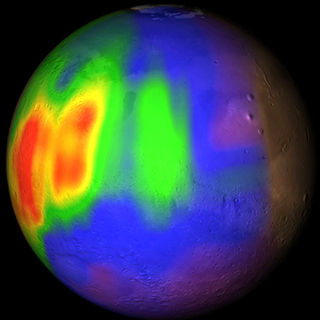
The picture on the left is the planet Mars–not as it usually looks (dirty red), but as a false color image to show the presence of something very interesting on the red planet.

Or rather, something very interesting above the surface of the red planet.

The red and yellow patches represent zones of the martian atmosphere in which there is an strong presence of methane.

Why is that significant?

Methane is a compound that is released by life.

And a few other things, such as mud volcanoes. (MUD VOLCANOES! WOO-HOO!)

But there are no known mud volanoes, or active volcanoes of any sort, on Mars.

So that raises the possibility that this stuff is caused by life. Specifically: By underground microbes.

In fact, we see a phenomenon a lot like this on earth. Here on terra firma there are various places where large pockets of underground microbes that produce large plumes of methane in our atmosphere. (Which is one reason why the pluming effect seen above is significant; the stuff isn't even spread throughout the martian atmosphere. Something down on the surface–or below–is generating it.)

In fact, there's one such place not too far up the coast from me in Santa Barbara.

The pattern is also cyclical, with the methane plumes appearing in the martian spring and summer . . . just when the planet is getting warmer and life might be more active . . . and disappearing in the martian fall and winter.

So there are some NASA scientists who are really stoked and talking publicly about this as a possible sign of life.

And it's not the first we've had. In the 1990s there was that meteorite from Mars that showed (debatable) fossils of microorganisms, and back in the 1970s one of the Viking probe tests for life gave a positive result (though other tests didn't).

So . . . who knows? In the photo above you may be looking at the atmospheric signature of life on Mars . . . or not. There are geochemical processes that could produce the same thing.

We'd need to do more tests to know.

I'd love to know the answer on this, but even if there is life, I'd like to know the answer to another question: Where did it come from?

Even if Mars has life, it may not be native to Mars. It may have come from . . . Earth.

As Martian meteorites (there's more than one!) illustrate, matter can pass from one planet to another in the solar system, and here on Earth we have microorganisms that are extremophiles–able to live in very inhospitable environments.

These could be carried to other planets due to impact events that blow chunks of Earth rock into space, or (for all I know) they could be high in the Earth's atmosphere and get carried to other worlds by the solar wind (and Mars is definitely downwind from Earth).

So far as I can tell, we may find extremophile organisms from Earth all over the solar system–living ones where they find a suitable niche and the dead remains of them elsewhere.

So, I've still got questions: (1) Is there really life on Mars? and (2) If there is, where did it come from? Earth? Mars? Or somewhere else?

Thursday NASA had a presser on all this, but they don't have embeddable on-demand video of it on their web site at this point (stupid government agency!) and nobody has yet posted it to YouTube, but

HERE'S A GOOD LIVE-BLOGGING SUMMARY OF IT.

MORE FROM SCIENCE MAGAZINE.

MORE FROM THE HOUSTON CHRONICLE.

New Apparitions Document?

For the last week or so, I've been following a story that has started to gain traction in the English-language press and blogosphere.

The gist of the story is this: A new document is going to be released from the Holy See governing the way in which Marian and other apparitions (or private revelation in general) is handled. This will be an updating of the guidelines privately circulated to bishops since the 1970s.

The document is reported to be a vademecum (a brief guide, not an exhaustive tome), and it's being presented as something that will create a "crack down" or a "gag order" on visionaries.

There are several reasons to be cautious about this story.

First, even assuming the basic facts of the story are true, it's being represented with an anti-apparition spin that the Holy See would not approve.

The Holy See has always been receptive to genuine apparitions, which are gifts of God's grace. As St. Paul said, we should not despise prophecies, but test everything and hold fast to that which is good. The Holy See in no way would want to send the signal that it wants to "crack down" on legitimate visionaries or put a "gag" on them.

It may well want to discourage false reports of apparitions, and it might institute disciplinary norms requiring greater circumspection on the part of those reporting apparitions (as was the case before the 1960s, when there was a liberalization of the procedures visionaries were obliged to follow in making their reported revelations public). However, the language of "crack downs" and "gag orders" and similar idioms is not the Holy See's intent.

Second, and equally fundamentally, there is a problem with the sourcing on this story.

Basically, the only source on this at present is an Italian website called Petrus.

Petrus would appear to have a source that has at least read a draft or heard a summary of the vademecum, perhaps in the CDF, but who knows?

The problem is that the Italian press is often filled with rumors about that Vatican that turn out to be completely untrue or grossly distorted. There is a lot of gossip in Rome, as there is in every city, and a lot of it isn't reliable.

Reports of a new vademecum on apparitions, especially one to be made public, must therefore be treated with caution, especially when there is such slender sourcing on the claims.

It may well be that there is a new vademecum or other document on the subject. It may be in a draft stage or a final stage. It may possibly include provisions like those described in the Petrus article. It may even be made public in the future.

But we don't know any of that at this point, and people should be cautious in how they handle the subject.

MORE FROM JOHN ALLEN.

EARLY REPORTING ON THE STORY.

TRANSLATION OF ORIGINAL PETRUS PIECE.

ORIGINAL PETRUS PIECE.

And the Final Cylon Is . . .

Mystery-person_3The final ten episodes of Battlestar Galactica start airing this Friday, and the producers plan to answer a bunch of questions, some of which have been around since the beginning of the show and some of which were only recently introduced: What happened to Earth? What are the Virtual "Head" beings (e.g., Head Six, Head Baltar) that only some people see? Can Human and Cylon live together? Who lives and who dies? And, of course, who is the final Cylon?

I'm going to tell you.

Or at least I'm going to tell you who I think it is.

I've made a significant number of BSG predictions before and gotten more than my share right, so I'm going to put my cards on the table here and tell you who I think the clues point to.

If I can shift from a cards metaphor to a dice metaphor, sometimes you have to roll the hard six, so here goes.

Continued below the fold for those who don't want to read this speculation.

Continue reading “And the Final Cylon Is . . .”

Appreciating Beauty vs. Concupiscence

A reader writes:

This is regarding “looking at girls”.I am very clear that obviously pornography is a grave matter.

I also am clear that deliberately engaging in lustful thoughts, lustful desires, or trying to arouse yourself (outside marriage) with full knowledge and full consent is also mortal sin.  Of course thoughts without these aspects are either venial or not a sin.

What I still struggle with is the question of “deliberately looking at an attractive or shapely girl”.  And liking to do so.

I had understood that one could deliberately look at an attractive girl and admire her beauty -even the beauty of her form- and that the non-sexual pleasure one finds in seeing her beauty and shape was not sinful to consent to and one could just ignore any “reactions of concupiscence” that happen.

Of course one must take care ..and know yourself …as well as at times use custody of the eyes –particularly if she is very immodestly dressed.

Also that one could even look at a work of art that is nude etc (that is not lustfully done –that shows the dignity of the person) and admire the form and beauty and ignore any “reactions of concupiscence”.

Is this treating a girl as an object? Am I wrong in doing this? Is it sinful?

In this context, treating someone “as an object” mean improperly treating a person as an instrument of sexual gratification and thus not properly recognizing the dignity of the person.

There are also other ways one can (non-sexually) “object”-ify a person, e.g., treating a spouse as merely a means of getting certain tasks done (breadwinning, household management, whatever).

In general, treating someone merely as a means to an end and not respecting the fundamental dignity of the person results in the objectification of that person. Sexual objectification is just one species in a larger genus.

But you know what doesn’t belong to this genus?

Recognizing a person’s good points.

If someone is beautiful or handsome or smart or prudent or a good breadwinner or a good household manager or a good square dance caller or has any other good points, it’s fine to recognize and appreciate those facts.

If they are manifest, it would even be contrary to reason not to do so.

So recognizing and appreciating the beauty of the human form–in general or in a specific case–is not a sin.

At least you couldn’t guess it from the statues and paintings that the folks at the Vatican have all over the place. They sure seem to be on board with this idea.

I mean, just look at the Sistine Chapel!

Just look at the Last Judgment!

And this is where they elect popes!

So it seems to me that one is on pretty safe ground saying that it’s okay and not-automatically-objectifying if you recognize and appreciate physical beauty or any other good attribute that a person has.

It becomes objectifying if you reduce the person’s worth to just their good or useful qualities.

Of course, in the area of appreciating physical beauty–especially of the opposite sex–we have to be careful.

It’s one thing to be looking at a marble statue of a nude woman.

It’s another to be looking at a color photograph of a nude woman.

It’s another yet to be looking at a real live nude woman.

These represent different levels of moral risk, and the greater the peril, the more stringent efforts must be taken to avoid it or escape from it.

Because people are different and subject to different levels of temptation, they will have to determine based on their own self-knowledge and personal history what situations are too dangerous for them to allow themselves to be in.

For some–particularly males at a particular stage of life–even looking at artistic representations of nudes may be too much.

As normal in risk management–which is what avoiding temptation is, since it’s not possible to completely eliminate the risk of temptation (given the mind’s ability to produce temptation on its own)–one must avoid two extremes: under-estimating the risk that a situation poses and over-estimating it.

For most people the laxist approach is the greater danger, which is why Jesus told us to seek the narrow path.

For other people, particularly those subject to scrupulous tendencies, the rigorist approach is a danger.

Neither approach is what we are called to.

What one must do is evaluate the risk a particular course of action poses for one and act accordingly.

In some cases temptation will arise despite one’s efforts. That’s the nature of risk. As long as the risk isn’t zero–and it never is in this life–sometimes temptation will arise.

The thing to do when that happens is relax, ignore the temptation, and move on to something else.

The “relax” part is important, because if one allows oneself to become anxious about temptation then it only reinforces the temptation.

Temptation is deprived of its power if you refuse to get anxious about it and simply move on.

Because I’m not the reader, I can’t say precisely what courses of action are too risky in his case, but I can say that it’s not sinful to simply recognize and appreciate beauty. (As opposed to dwelling on or studiously contemplating the details of a particular person’s physical form, which is going to increase risk.)

I can say that it is not sinful to be exposed to any and all levels of non-zero risk. (Zero risk of temptation is impossible in this life.)

And I can say that if he tries to instantly avert his eyes from every single pretty girl he sees then he will foster an anxiety about temptation that will actually feed the temptation he is seeking to minimize.

The better thing to do is avoid situations that are known to be dangerous (i.e., that pose a significant risk of significant temptation) and to otherwise relax and move on when temptation does appear.

Sign of Peace Update

I know I said I'd do some reader question next, and I will be doing those shortly, but I ran across something in the CDW Newsletter that I thought I'd pass on while I was thinking about it.

Remember back in 2005 when Pope Benedict presided over the Synod of Bishops that was addressing the Eucharist?

Good.

Well, the post-synodal apostolic exhortation document that came out after that was widely anticipated, particularly because of Pope Benedict's known interest in the liturgy and improving it and . . . the document was largely a let-down. It took forever to come out (even Benedict complained publicly about how long it was taking the people doing the prep work to get it done), and when it came out there was very little that was new or noteworthy in it.

One thing that was noteworthy was relegated almost to a footnote (in fact, if memory serves, it may actually have taken the form of a footnote).

That was the announcement that the question of where the Sign of Peace is located in the Mass had been forwarded to the Congregation for Divine Worship and the Discipline of the Sacraments. (Actually, I think it referred to the appropriate dicasteries, but the CDWDS would be the key one.)

The idea, which Benedict himself wrote in support of when he was still Pre-16, is that the Sign of Peace isn't optimally placed in the Mass, coming as it does right before Communion. Placed there, it can be disruptive (especially when priests go romping all over creation to hug people and slap them on the backs, though this seems to have abated some in recent years) and takes the focus off of the Eucharist just when we're about to receive.

So the proposal has been floated to move the Sign of Peace earlier in the Mass, after the Prayer of the Faithful.

That would be a good move, to my mind.

And the move wouldn't disturb anything fundamental to the structure of the liturgy. In fact, there was no individual exchange of peace prior to the liturgical reform that followed Vatican II. It was added (as an option, I might mention) to the Latin liturgy based on parallel (but not identical and, in my mind, superior) practices in some of the Eastern Churches.

But it turned into a big, distracting celebration of "us"-ness.

Anyway, it's been going on four years now and I've heard nothing about the proposal to move the Sign of Peace.

Until now.

I was just reading the newsletter of the U.S. Bishops' Committee for Divine Worship (formerly the Bishops' Committee on Liturgy) and ran across this item:

Survey of the Sign of Peace at Mass

The Committee [for Divine Worship] reviewed the findings of a survey requested of the USCCB by the Congregation for Divine Worship and the Disicpline of the Sacraments regarding the placement of the Sign of Peace at Mass. Of the 89 Bishops who responded, 66% supported moving the Sign of Peace after the Prayer of the Faithful and before the Presentation of the Gifts, 32% recommended retaining the Sign of Peace at its current location before the Agnus Dei, and 2% offered alternative opinions. A report from the USCCB was submitted to the Congregation's then-Prefect, Francis Cardinal Arinze.

Cool. Good to hear that there is some motion on this and that the bishops seem to be responding favorably.

Some More Good News

Now that I've been able to report that my relative is doing better, I thought I'd also talk about something I've been hoping to share with readers for some time.

Long-time readers of JA.O know that one of my hobbies is square dancing. It's something I started doing several years ago as a way of getting exercise, having something to do evenings and weekends, and enjoying the simple pleasure of moving to music that God built into human nature.

I also do other forms of dancing, such as round dancing (ballroom dancing with cued instructions) and a little bit of contra and line dancing, but square dancing is the form I enjoy most. It's dynamic, cooperative, social, and basically just good, wholesome fun.

It's also liquid geometry set to music.

And these days, it goes way beyond its country roots, using a blend of musical styles including rock, jazz, world beat, and others. (Maybe sometime I'll put up some brief, non-copyright-infringing samples so you can hear what I'm talking about.)

What I haven't talked about on the blog up to now is a project I've been working on for some time.

Basically, I've learned to call square dances.

This has been a very difficult skill to acquire. The only thing of comparable difficulty that I've ever tried is studying another language.

In fact, square dance calling is a lot like speaking a language. Depending on what what level you're calling at, you have up to 100-200 (or more) commands that are part of the square dance "vocabulary." You then inflect them by indicating which dancers you want to do them (similar to the way we change the form of nouns and verbs to indicate who or how many). And there is an overall "grammar" governing how the commands are strung together so as to make sense, the same way we have to put words together a certain way for a statement to be intelligible.

Another aspect of modern square dance calling that is language-like is that it is generative, meaning that you make it up as you go. Neither the dancers nor the caller tend to know what is coming next. Callers usually don't plan a sequence of calls rigorously in advance any more than speakers of a language rigorously plan their sentences in advance. Callers and speakers both generate meaningful strings of words in a spontaneous manner.

That spontaneity adds excitement and is part of what makes modern square dancing fun.

On top of the ability to generate meaningful choreography on the fly, square dance calling also involves a number of related skills, including being able to time the choreography to the music, showmanship, humor, and the ability to sing (something I didn't previously know if I'd be able to do; turns out I can).

So . . . learning how to do this has been something of an accomplishment, and I wanted to share it with readers.

To give readers a sense of the task, most people who try calling give it up without ever calling a gig.

A minority end up breaking through to the "working caller" level (meaning: you're doing gigs on a regular basis).

To attain full membership in the main professional association of square dance callers–CALLERLAB–one needs to call at least 12 gigs a year for three years.

I haven't been doing this for three years yet, but in the 2008 I called approximately 50 gigs, so about once a week on average.

I'm scheduled to do at least that number in 2009, because–and this is the reason I decided to talk about calling now–I've just crossed a new threshold as a caller. In addition to being a working caller, I'm also a club caller.

That means that a square dance club has asked me to call for them on a regular basis. I'm now calling the regular Friday dances for the Alpine Squares of Lakeside, California.

Being a club caller is considered the hardest job in square dance calling since you can't just have one "act" that you do. You have to be able to regularly come up with new material to keep the dancers entertained.

It'll be an interesting challenge!

As I've been learning this skill, I've been taught and mentored and given opportunities by some of the best in the business, and I owe them an enormous debt. I can't begin to thank them enough.

If anyone is in the San Diego area (or knows someone who is) who would like to see what square dancing is like, or who would like to see me call, my club is having a series of community dances in January (no experience needed, no partner needed).

LET ME KNOW YOU'RE INTERESTED and I'll get you the pertinent details.

Up next . . . answers to some questions from readers.

Good News for the New Year

I want to wish everyone a blessed celebration of Mary, Mother of God and also a Happy New Year.

I'd also like to share some good news and thank everyone who has been praying for my close non-Catholic relative.

I'd also like to give a special thank you to SDG and Tim J, who have been providing their always-welcome contributions to the blog, and particularly while I've been dealing with my family situation and the on-top-of-it-all busy holiday season (December was already going to be a massively busy month for me even before the family situation arose).

The news is that, although my relative has a very unusual condition, whose cause is unknown, but which responds well to treatment.

Although my relative is still in a precarious position, and will need months to recover, my relative is no longer in imminent danger and is making steady if slow improvement. My relative has been moved from ICU in an acute care hospital to a physical therapy center. It is expected to be quite some time before the relative could go home, however, so prayers are still very much appreciated!

Best of all, after my relative regained consciousness I was able to explain the anointing of the sick, and my relative requested and received it.

I am very thankful to all who have been praying. Being able to make sure that my relative's sacramental needs are met is truly an answer to prayer, and I am profoundly grateful.

Praise God, and thank you all!

Up next . . . more good news

The Surplus Population

One less "useless eater" to worry about.

The
"bio-ethicists" and ivory-tower academics who blithely discuss an
ethics of utilitarianism and openly promote ideas like euthanasia and
infanticide can take partial credit for this man's murder. By abusing
their positions of trust, they help create a culture of death. The same
way the Bush administration is blamed for sending signals and pulling
strings to create a culture of tolerance (if not enthusiasm) for
torture.

Peter Singer, this man's blood is on your hands.

Check Out Tim Jones’ New Daily Painting Blog!

Hey, Tim Jones, here.


Today marks the *official* launch of my long anticipated (by me, anyway… I always was a procrastinator) Daily Painting blog.

Now, "daily painting" doesn't mean necessarily a painting a day
it just means I plan to paint daily, and I'll offer that work on
the new blog (via e-bay). In practice I look for this to shake out at about
3 paintings a week, though that may increase as things progress.

These are mainly small – even miniature – pieces, but made with all the care I would give to any of my larger artworks.

I will also soon be offering some very special pricing on some of the art from my old fine art website, as I move into this new strategy.

Up
until very recently, making a living in original fine art was mainly a matter
of finding gallery representation (in viable commercial galleries) and
building a reputation (and generating income) that way. Finding
publicity through art competitions and art publications could help to
make you more attractive to these galleries. But the whole process of
vetting and courting galleries – in addition to actually trying to get
any work done (on top of having, like, a day job) – has been like hiking through molasses. One needs almost
to work full time just on marketing, scheduling competitions,
hob-nobbing and the like. It doesn't help that I'm such an intense
introvert.

With the advent of the internet, though, there are now
more and more artists taking their work directly to the public. It's a
transition I've been turning over in my mind for some time, but
hesitated to jump into.

I have now made the jump. That means that
the prices I had on a lot of my artwork will be reduced because I no
longer need to consider the requirements of a third party (the
galleries) or worry so much about impressing collectors that might drop
by. So, in addition to the small daily painting pieces, watch for some
larger work as well.

The long and short is that I would rather
paint – and make my living from painting – than not. If that means
pricing my work so that it will be more accessible to a wider audience,
then that is a change I am happy to make. It could even be seen as very
Chestertonian… a Distributist approach to fine art.

I'll be
offering occasional opinions and commentary on my work interspersed
with with the new paintings, but the next several posts at the new blog will just be
new paintings offered for your viewing pleasure, with a link to the
e-bay auction page for each piece.

Do check in often. I hope you like what you see.

Oh! Also please feel free to drop a line in the combox.

Visit Timothy Jones' Daily Painting Blog