Jimmy was born in Texas, grew up nominally Protestant, but at age 20 experienced a profound conversion to Christ. Planning on becoming a Protestant seminary professor, he started an intensive study of the Bible. But the more he immersed himself in Scripture the more he found to support the Catholic faith, and in 1992 he entered the Catholic Church. His conversion story, "A Triumph and a Tragedy," is published in Surprised by Truth. Besides being an author, Jimmy is the Senior Apologist at Catholic Answers, a contributing editor to Catholic Answers Magazine, and a weekly guest on "Catholic Answers Live."
You just know when you see a headline that begins "Vatican Says" that you're about to read something that almost certainly does not represent an official statement on the part of the Holy See but instead simply represents something that somebody who works there said in an interview.
Same thing is true when the headline starts with something like "Vatican Laments," which is how the piece starts in THIS CASE.
It's a pretty lame, little piece, but it does have one particularly interesting sentence:
[Archbishop Mauro Piacenza, secretary of the Congregation for Clergy] says the Vatican plans to publish this year a kind of handbook on confession to drum up enthusiasm among Catholics toward the sacrament.
One can never be sure with a story as imprecise as the ones the AP cranks out, but the use of the word "handbook" could mean that a new vademecum is being prepared, in which case it might be an actually useful document.
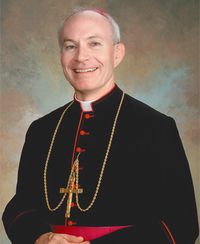
George Lucas has been appointed the fifth archbishop of the Archdiocese of Omaha, Nebraska.
He succeeds Archbishop Elden Curtiss, who had shepherded the archdiocese since 1993 but who passed the age of 75, when bishops must submit their resignations to the pope, in 2007.
A biography of Archbishop Curtiss can be found HERE (WARNING: Evil file format [pdf]).
As incoming archbishop, George Lucas plans to use computer generated imagery, dynamic visuals, and a lifetime's experience in filmmaking to develop a new media relations effort for the archdiocese and . . .
and . . .
Oh, wait. It's not that George Lucas.
It's this one . . .
Bishop George Lucas, formerly of the diocese of Springfield, Illinois.
Some British scientists have done some research that appears to
solve one of the problems of a particular theory of RNA synthesis that
makes this theory more plausible as a possible explanation of the
origins of DNA and organic life on earth. That is all.
The three best visual illusions in the world were chosen at a
gathering last weekend of neuroscientists and psychologists at the
Naples Philharmonic Center for the Arts in Florida.
The winning entry, from a Bucknell University professor, may help explain why curve balls in baseball are so tricky to hit.
There are a couple of other cool illusions shown, as well as the design of the award trophy, which is clever.
Well, I finally got around to seeing the new Star Trek film–the first film I've seen in theaters in I don't know how long.
I know SDG has already covered this topic but . . . this is my blog, so here we go again.
I'll put spoilers in a forthcoming post and just have a few non-spoiler comments in this one.
The good news is that I basically liked the film.
It was fun.
It met my expectations, which were as follows: (1) I wanted it to be fun, (2) I wanted it to be a viable relaunch of the franchise, and (3) I wanted it to be fundamentally though not scrupulously faithful to the original.
I thought it substantially met those goals, so I liked it.
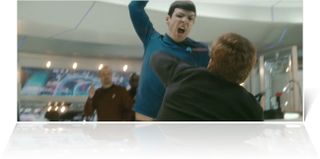
This is not to say that I hadn't been concerned. Some of the stuff seen in trailers had me worried. For example, the Kirk-Spock conflict depicted in the photo. That had me concerned. The film could have mindlessly ramped up the characters' emotions without providing a good reason for Spock's outburst. (Not unlike many episodes of the rebooted BSG, which over-milked the pathos factor).
Fortunately, there is a good reason Spock is blowing his stack in this picture. The conflict isn't overdone, and it works in context.
I understand that the film may not be to the taste of some die-hard fans of the original series. And that would be true no matter what for the simple reason that no movie is to everyone's tastes.
Personally, while I have a soft spot for TOS, I don't regard it–or any Trek series–as an artistic masterpiece. All of the series have some real stinkburgers as episodes (e.g., just to name one from each, TOS: Spock's Brain, TAS: The Terratin Incident, TNG: Skin of Evil, DS9: Sons of Mogh, VOY: Threshold, ENT: A Night In Sickbay). Some of them have many stinkburgers.
So I don't regard the original Trek as sacrosanct. The recasting doesn't bother me, as long as it's good recasting (and it seemed to be; especially Zachary Quinto as Spock).
Since the original Trek wasn't perfect, the new movie doesn't have to be perfect for me for it to be an okay successor.
There were things in it that didn't work for me (see forthcoming post). The movie does have plot holes and dumb things.
But on balance it's a fun film. It has lots of spectacle. A good treatment of the established characters (with one notable exception that some object to; see forthcoming post). It has some nice new and sorta-new characters. (In particular, I liked Captain Pike and Scotty's assistant.)
And it has this going for it: It's the best chance for more Star Trek that we're going to get.
Prior to this film, the franchise had gotten really, really stale. In the post-DS9 era the producers made mindblowingly bad decisions.
Voyager had horrendous problems, with the climax of many episodes simply being characters standing over consoles spouting technobabble in an elevated tone of voice, trying to create drama.
And though they started to turn it around in the third and especially the fourth season, Enterprise as a series was fundamentally blown from the get-go, with the producers not realizing what kind of story they needed to tell (the Romulan War, leading to the founding of the Federation). And that was before we got to the disastrous final episode.
The producers just completely didn't understand what they were doing.
As a result, they wore out the franchise. They painted it into a corner from which nothing could rescue it.
Except a reboot–a fresh start.
It's really hard to see how much more could have been done in the previous continuity and keep the franchise financially viable.
Theatrical film based on any of the previous series or a combination of them?
Not going to reach beyond the existing, shrunken fan base and thus not going to be financially successful.
New TV show?
In the previous continuity, what's left to do that would reach out beyond the existing, shrunken fanbase? Even telling the story of the founding of the Federation would be too close to ST:ENT (which is why that series' misfire is such a huge debacle; the producers blew their one chance to tell a pivotal story).
Any new ST series based on the old continuity would have almost certainly not made it as many seasons as ENT did.
So I'm willing to cut the filmmakers some slack. I don't feel that I have to agree with all of their decisions (and I certainly don't expect them to honor every single bit of micro-level continuity from the previous shows–which didn't themselves honor their own micro-level continuity).
If they give me basically fun new Star Trek that holds the prospect of resulting in more basically fun new Star Trek, that'll be good enough.
This means that–maybe–the Star Trek Curse is broken.
The curse, stated in its strongest form, is that all of the odd numbered Star Trek movies are bad and all of the even numbered Star Trek movies are good.
Taken in a weaker form, the curse would be that all of the odd numbered Star Trek movies are lesser in quality and all of the even numbered ones are more good (or mo' better, as they say).
Up to this point, the strong form of the curse is arguable. Whether it's true depends on whether you regard any of 1 (V'Ger), 3 (Search for Spock), 5 (Search for God), 7 (Kirk Dies), and 9 (Insurrection) as technically, on-balance good or not.
But they're certainly not as good as 2 (Kahn), 4 (Whales), 6 (Berlin Wall Comes Down), 8 (First Contact), and 10 (Nemesis–weakest of the even numbered ones).
The curse in its weakened form is true . . . at least up to the newest film.
A lot of people might find the new Trek better than Nemesis, in which case we'd have an odd numbered film (technically, the new one would be Trek 11) that is better than an even one, in which case the curse would be broken.
But perhaps there is a way to reformulate it that would result in its still being true. How about this: Each odd numbered Star Trek film is weaker than the film that follows it.
In that case, the curse may still hold true. Thus far each odd film has been weaker than the one that followed it.
So the curse will hold true if J.J. Abrams and such can produce a sequel to this film that is even better.
Can they do it?
Now that the origin story is out of the way, I think there's a chance they can.
Most of the talk in the Catholic blogosphere right now regarding President Obama concerns his shameful appearance at Notre Dame. This is conversation that needs to be had, and I hope that it leads to a tougher statement from the U.S. bishops on the honoring of pro-babykilling figures and to a thorough housecleaning at Notre Dame.
Anyone who favors babykilling on demand should not be honored by a Catholic institution. Period.
Any Catholic university official who honors such an individual deserves to be removed from his position. Period.
While this issue is developing, though, I also want to talk a bit about how horrendously frightening Obama's spending spree is.
Bush's spending spree was bad. Very bad. But Obama's is unprecedented and threatens to do horrific things to our economy and, thus, to our nation.
As a downpayment (pun intended) on that discussion, here are two intersting ways to visualize just how much debt and just how little savings we're talking about.
This post is going to be about the current dustup in the blogosphere regarding Christopher West and the recent ABC News piece on him.
Before I get to the controversial stuff, though, let me say a few words about the task Chris is undertaking.
Christopher West has a difficult job. As a chastity speaker, he's got to juggle several things at once:
1) He's got a very sensitive subject
2) On which different audiences have different sensibilities
3) The audience that most needs his message is very hard to reach
4) Part of the reason why they're so hard to reach is that they have a pre-existing stereotype of Christian sexual morality that they think gives them a license to tune out anything a Christian says on the subject
5) To reach this group you have to effectively batter your way past this anti-Christian prejudice and get them to take you seriously while simultaneously
6) Not offending the sensibilities of those who already take Christian sexual morality seriously
7) Some of whom have rigorist views on the topic
That's a tall order. It is humanly possible to juggle seven things at once (SEE HERE), but it's not easy.
Sometimes the task is especially treacherous, such as when being interviewed by the mainstream media, which is going to try to sensationalize every subject it deals with, but especially the subject of sex.
They'll also selectively edit the stuffing out of an interview with you and leave the audience with carefully chosen, out-of-context quotations.
That's what happened to Christopher West in this ABC Nightline piece . . .
I've been interviewed by the press, and misquoted by it, often enough that when I first watched this piece, I employed the only safe rule when dealing with an MSM story of this nature: Ignore everything that doesn't come out of Chris's mouth. Do not rely on summaries of his position offered by the reporter.
The summaries that reporters use to link quotations are key means by which they distort, sensationalize, and just plain get stuff wrong.
And, as one would expect, the most controversial stuff in the piece is not stuff that Chris says but that the reporter attributes to Chris in a summary.
The statement that Hugh Hefner is one of Chris's "heroes" or "muses," for example, is something the reporter says–and it's exactly the kind of erroneous "observation" that a reporter in search of a sensationalistic angle would make.
Similarly the statement that Hefner and John Paul II, each in their own way, "rescued" sexuality is something that the reporter says, not West.
Even when one eliminates reportorial summaries and observations, though, and just sticks to the quotations of an interview subject, there is a significant risk of out-of-context presentation.
I know that firsthand because back during the priestly sex abuse scandal I was interviewed by a news program that took an answer I gave to a question on one subject and juxtaposed it with video that made it appear that I was commenting on something that I had never even been asked about.
I was livid.
And so I've always got in the back of my mind, "What's the context for the quote I'm seeing? Could this be taken out of context?"
An example of that is West's statement "I love Hugh Hefner."
Jerkily introduced, without seeing the discussion that led to this statement, after the reporter has just been telling you that Hefner is one of West's heroes, the quotation creates the impression that West endorses Hefner.
But . . . c'mon. I'm guessing that Chris West loves Hefner in the same way that Fundamentalists love Catholics–that is, they love them so much they want them to repent of their lifestyle.
And that's hinted at by what West says next: "I really do. Why? Because I think I understand his ache. I think I understand his longing because I feel it myself. There is this yearning, this ache, this longing we all have for love, for union, for intimacy.&q
uot;
So this is not an endorsement of Hefner and what he's doing. It's compassion toward him, a recognition that there is something broken in Hefner–and all of us–that needs to be addressed.
The language about "feeling his ache" doesn't strike me as the best way to say this. I don't really want to get into Hugh Hefner's head in quite that way (though that's what the language invites me to do).
And there is a danger of spiritualizing away the sexual urges to which Hefner caters if they are presented as just longings for love, union, and intimacy.
But it's clear that West intends to be expressing a sentiment of Christian love towards a broken individual with whom we all share various forms of brokenness.
The response was awkwardly phrased–as likely would be the case when hit by a reporter with a "What do you think of Hugh Hefner?"-type question (you don't want to feed prejudices by coming off as a stereotypical, venom-filled Christian bigot by saying "He's a son of hell," so it's easy to fall back on unnuanced Christian love-type language)–and I think West would be well advised not to make "I love Hefner"-like statements in interviews in the future since we've seen how easily they can be taken out of context or otherwise misunderstood–but it's clear that West is not proclaiming his membership in the Hugh Hefner fan club.
If you want to see what West has to say about Hefner when he's in control of the message, take a look at this video . . .
So I think folks in the blogosphere should cut West some slack and remember that he's on the side of the angels.
At the same time, I think West should use this as a learning experience and take the occasion to purify his message so that he can be even more effective in the future.
Just as a general matter, it's important to keep in mind that there is more than one audience that needs to be (basically) comfortable with what's being said.
Getting through to the people who most need the message of chastity is so difficult that it is easy for chastity speakers to spend so much effort focusing on how to get into that audience's head that not enough attention is paid to the already-convinced crowd and to what will–in the classic Catholic phrase–"offend pious sensibilities."
I think that's at the root of what happened here.
In the TV and YouTube age, the pious crowd is going to see the message being presented to the unpious crowd, and if the sensibilities of the message are too oriented toward the unpious folks then one's relationship with the pious ones ("the Base") will be injured.
Injuring one's relationship with the Base is not a good thing, as our recent former president found out.
The trick, the thing that makes the kind of work West is doing so difficult, is not settling for messages that just please the Base or that just please the worldly target audience. What one has to try to do is find ways of reaching the unchaste without simultaneously alienating the chaste.
That's the challenge.
And it can be done!
You can't please everybody every time, but it is possible to craft messages that will reach the unchaste while not unnecessarily offending pious sensibilities.
In that regard, what I'm about to say isn't specifically applicable to Christopher West. In various points it may or may not apply. It just consists of observations that I've made after listening to the tapes of a lot of different chastity speakers as part of my job.
This is about a week late, but I wanted to let JA.O readers know that several pieces of my work are
inexplicably featured in the current edition of a well-respected online literary
journal, The Christendom Review.
This has been in the works for a while, and the actual date of publication sort of snuck up on me.
Many thanks to William Luse and to editor Richard Barnett for the
opportunity to be featured in this fine magazine. The Christendom Review also regularly showcases some
great poetry, essays, editorials, etc…
Don't worry, I didn't really bribe anybody. What I did do was send an e-mail saying, "This is a nice literary magazine you got going here… it'd be a shame if anything happened to it…"
Pope Benedict XVI walked out of an ecumenical gathering prematurely in Jerusalem this evening.
The pontiff's abrupt departure was occasioned by an unscheduled tirade by Muslim official Sheikh Tayseer Tamimi (sitting to the right of Pope Benedict in the picture; incidentally you'll also see Tamimi's first name spelled Taysir and Tatzir in some stories due to the intricacies of Arabic spelling; the vowels can be represented differently, and there's a consonant in the middle of his name that we don't have in English; but it's the same guy).
Tamimi basically commandeered the microphone and launched into a heated, ten-minute tirade in Arabic.
The speech, as you would expect, was anti-Israeli.
The pope waited until the tirade was over, got up, shook Tamimi's hand, and unceremoniously left the gathering, which was not yet formally over.
Details are still sketchy, but let's look at a few questions that may arise as a result of this:
1) If the pope decided to leave the event, why did he wait until after the tirade was over? Why not walk out in the middle of it?
Several possibilities suggest themselves:
a) So far as I know, the pope does not speak Arabic, and it does not appear that realtime translation was being provided. It may not have been clear to the pope precisely what was being said and whether it justified walking out. After all, it's one thing to walk out on an impassioned and impromptu anti-Israeli tirade. It's another to walk out on an impassioned and impromptu plea for peace. Between the two are a whole host of possibilities, and the bottom line is you want to make sure that sufficiently severe line has been crossed before you walk out. The pope may well have been waiting to find out from an Arabic-speaking aide precisely what had just been said.
Also, the Jerusalem Post notes that the pope "was visibly uncomfortable with the tone of Tamimi's discourse" while it was underway.
b) If you're going to walk out, you do so knowing that your actions will likely call more attention to the incident than it would otherwise have and that they will be portrayed by some as a slap not just against the angry tirader but against the constituency he represents. Given that, if you are trying to be a peacemaker, you want to send a measured message that will make the point without further inflaming the situation. It thus could be prudent to wait until the tirade was over and thus deny pro-Tamimi people the ability to say, "The pope didn't want to hear what was being said; he walked out before the sheikh was even finished; the pope can't handle the truth." In any event, just after the tirade would be a logical point to depart for diplomatic reasons.
c) In the heat of a moment like this, it may have simply taken the pontiff time to decide what to do.
I therefore don't see serious cause from criticism regarding the timing of the pope's departure, though I have seen people in pro-Israel parts of the blogosphere acting indignant that the pope didn't take an ultra-macho stance and walk out sooner.
2) Why did the pope shake Tamimi's hand?
a) Assuming that report is accurate (and I assume it is), see answer (b), above. The pope was trying to send a measured message. He's trying to make a point by leaving but not slam the door shut on dialogue with the Muslim and Palestinian communities. Even if Tamimi has shown himself to be an unacceptable dialogue partner, simultaneously rebuffing him by leaving but also shaking his hand sends two messages to the communities he represents: This kind of behavior isn't acceptable but I'm still trying to be nice to you and want to preserve possibilities for the future.
b) See also reply (c), above, regarding the heat of the moment and trying to figure out what to do.
c) As far as I know, the pope likely also shook the hand of the rabbi who was in attendance, which would create a message of "I'm trying to show respect for both your communities here."
3) Should Tamimi have been stricken off the guest roster due to his past behavior?
I have more sympathy for criticism of the Vatican Secretariate of State on this one. A Google search reveals that Tamimi is a known advocate of terror bombing. Why the Secretariate of State would think he was an appropriate individual to appear alongside the pope, I don't know.
On the other hand, if you're trying to advance the cause of peace via negotiation, you need someone to negotiate with, and it may well be that the Palestian leadership is so dirty with respect to terrorism that there simply are no leaders–religious or secular–who haven't made positive remarks about terror bombing.
On the third hand, Tamimi has a specific history of doing precisely this kind of thing. The Jerusalem Post notes:
Tamimi staged an identical verbal attack against Israel during Pope John Paul II's visit in March 2000.
"Well if he did that, why on earth would they invite him back?" was the question that immediately raised itself to me.
A little checking, however, revealed that there was more to the story.
Back in 2000 Tamimi did indeed make a similar outburst during John Paul II's visit, but–and I haven't seen this mentioned elsewhere in the blogosphere yet–he did so only after a rabbi at the same event had made provocative pro-Israel remarks in which the tried to co-opt John Paul II as a tool against Palestinians.
So their reasonining may have been that Tamimi was provoked on that occasion and, perhaps, he'd sent signals that he would behave this time.
On the other hand, Tamimi's behavior overall at the prior event seems pretty slimy–and he himself walked out of that event early, so there's some poetic justic in Pope Benedict walking out on him!
I don't know enough about Tamimi and what assurances he may or may not have given the Secretariate of State to be able to make a decision here, but it the situation makes me uneasy.
Hopefully the Vatican Secretariate of State has learned it's lesson with Tamimi, and he won't get invited to anything in the future.