Queen Mary in the Mists

Queen_mary

Perhaps there is some odd synchronicity with Tim J's haunting post, but this is a picture I was moved to take from my hotel hallway early Sunday morning as I was getting reach to leave the Long Beach National Square Dance Convention for the drive back to San Diego.

That drive should be only two hours, but with traffic it can be four five (and has been!), so I wanted to get an early start, and I happened to get up early enough that there was a lot of fog in the area.

The fog was so bad that when I got on the toll road to bypass a bunch of early traffic, I could not read the signs announcing the oncoming toll booths, making me wonder about traffic safety. Nevertheless I got home fine, despite all the fog.

The kind of fog you could hit an iceberg in. 

This post isn't about that, though. It's about the ship that you can see between the palm trees in the center of the picture (look for the black and red smokestacks; click to enlarge). 

The ship is the Queen Mary, which sailed as part of the Cunard-White Star Line in the mid-20th century before being retired and permanently anchored in Long Beach as a tourist spot.

I've never been aboard the Queen Mary. That'll have to wait for another trip (traffic and all, y'know). But I have encountered it in various ways.

For example, its gorgeous interiors were used as the setting of the outstanding and cinematically dazzling X-Files episode Triangle (one of the very best of the whole series).

Beyond the way the X-Files treated the ship, it's also reputed to be haunted, with various reports of ghostly happenings since it was permanently moored in Long Beach, with past guests supposedly making posthumous appearances, including soldiers who were housed on the vessel when it was used as a troop ship during World War II. (Bunks, apparently, were stacked in the central ballroom, with some bunks reaching almost to the ceiling.)

On that basis, it's also the location of the climax of Tim Powers' novel Expiration Date, which is one of my most favorite Tim Powers novels. It's simply marvellous–chocked full of audacious inventiveness, action, and humor. I love it!

It also mentions the billeting of troops that took place on the ship during World War II.

And the ship has a connection (believe it or not) to my square dancing life.

One of the past presidents of my square dance club was named Vic. He passed away a couple of years ago, when I was president of the club (before I was its caller), and I spent time with Vic during his final illness, trying to provide companionship and making whatever conversation he felt up to.

One of the things he talked about was the fact that he had been housed on the Queen Mary during World War II. He was one of the soldiers billeted in the ball room. 

Of course, I told him about Tim Powers' novel as part of passing the time.

And so, though I haven't yet been aboard the Queen Mary, it still has a special status for me. I look forward to going aboard and seeing it for myself.

This weekend, though, I couldn't resist snapping a picture of it through the morning mists.

Oh . . . and what's that ghostly ring of light around the ship in the picture? An electronic image artifact? A reflection in the hotel hall's window of the iPhone's circular camera, caused by holding it close enough to the window that the hall lights wouldn't get in the picture? A spectral manifestation of Koot Hoomie Parganas, Thomas Edison, Sherman Oaks, or (shudder) Loretta deLarava?

You decide.


Startling Pattern Emerges

Cemetery
It's like they're all just waiting for us…

Hey, Tim Jones, here.

I
think my grandfather's death was the first that really affected me as
it happened, though I understood the concept of death, having seen a
lot of T.V. westerns, along with media coverage of the Vietnam War, the
Kennedy assassination, the Munich Olympics and other deadly events.

I've
seen a number of deaths, since, and taken note of many more, but the
tight grouping of celebrity deaths in the last week has made me look
back over my experiences of death, and I have begun to sense a pattern.

Stay with me, here. I'm no conspiracy nut, but it begins to appear that no one
is safe, and that the chances of death for any one of us – by my rough
figures – approaches 100%. For instance, the older I get, the more
people in my general age group pop up on the news, having died in one
way or another and it is most often treated as a surprise, if not a
shock.

But the shock, to me, may be unjustified. I don't want to start a panic, but it looks to me like we may all be headed for the cemetery.

"Teach us to number our days aright,
that we may gain a heart of wisdom."

Psalm 90:12

Last
week we heard first, of course, of Ed McMahon, then Farrah Fawcett,
then Michael Jackson… next, Billy Mays and this morning I read that
Fred Travalena and Gale Storm passed away.

I have no great
observations to make, except to say that the only genuine shock for me
would have been if Michael Jackson had somehow lived to a ripe old age.
I did not see how he could manage much longer. Over the past few years
he appeared to be a shell.

I have good memories of Fred Travalena, who often appeared on Johnny Carson's Tonight Show, was all over the variety show circuit, and also starred with Rich Little, Frank Gorshin and other master impressionists on The Kopycats
– a comedy show (which I never missed if I could help it) built around
impressions. He was also an extremely prolific and successful voice
actor.

Most people may not know anything much about Gale Storm, but my wife will remember My Little Margie (which was old already when we watched it) from our days as college students, when we could count our TV channels on one hand.

For
a long time, when driving by a cemetery, I have had the distinct
and unshakable sense that those dwelling under the tombstones are
watching and waiting and maybe chuckling a little… laughing at the
living and their frantic and petty preoccupations. Sometimes, I can't
help but laugh, too.

This idea of the connectedness of the living
and the dead runs deep in the human heart, and is confirmed in the
doctrine of the Communion of Saints… which is just the Church
expounding on the teaching of the Lord that "He is not the God of the
dead, but of the living, for to him all are alive."  (Luke 20:38).

(This post has been carefully cross-posted by hand at Tim Jones' blog Old World Swine, for double your blogging pleasure)

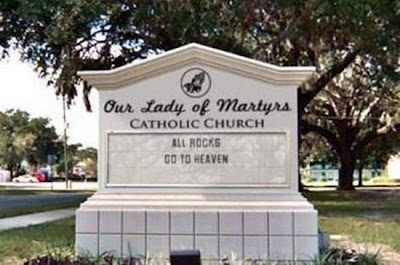
The Great Chain of Being Goes To Heaven

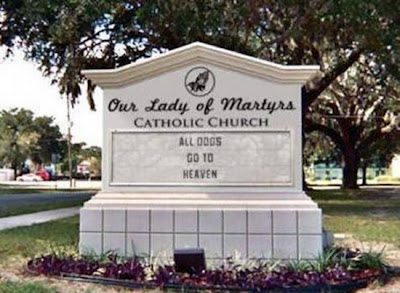
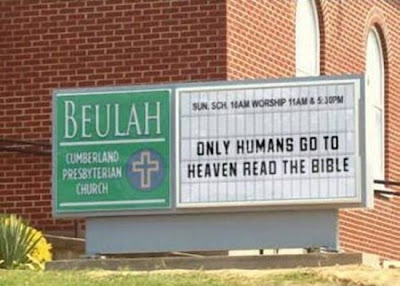
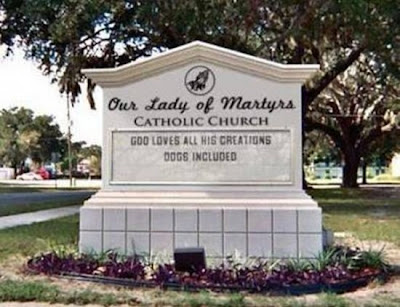
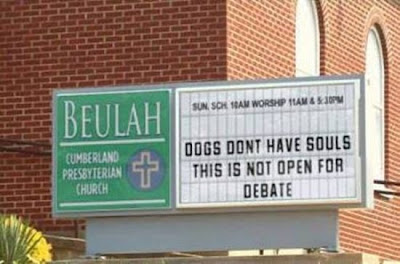
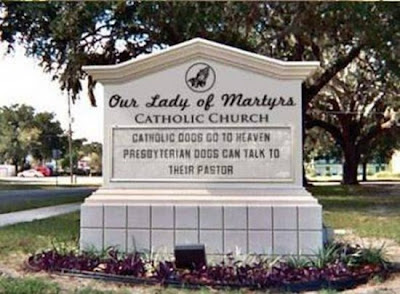
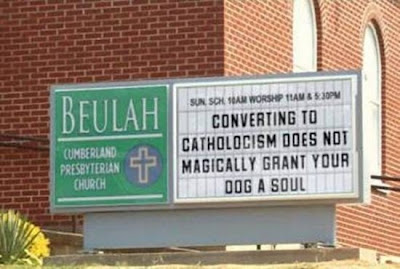
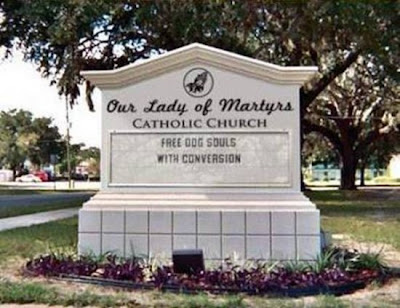
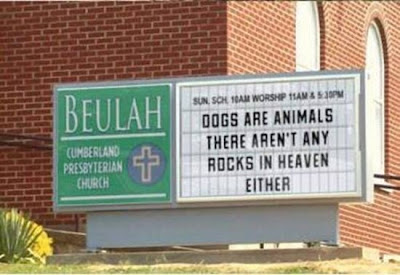
CHT to the reader who sent in the following church sign debate. It's currently being circulated around the Internet in the form of an e-mail that suggests it's real, but it's not (note that the leaves of the plants don't move from one picture to another). That doesn't stop it from being hilarious–if you don't take it (or its theology) too seriously.


Workplace Copyright Scruples

A reader writes:

I have a dilemma at work. I work in a school. Part of my job is to do photocopies for teachers. I am sometimes asked to make photocopies of worksheets whose legal status – whether they are copyrighted or not – is unknown to me. The teachers, who don't seem to know about the copyright issue, generally intend to distribute the copies at a later time. That gives me the chance to do a little research to check the legal status of the document and get the nerve to refuse to do something which is certainly wrong, if it is the case.

This situation of uncertainty gets thougher to deal with when, out of the blue, one of the teachers asks me to copy a worksheet for a kid who was absent at the time the sheet was distributed, on a previous day. The teacher expects me to come back as soon as possible so that this kid can do his work like the others.

If the copying were clearly a violation of the author's copyright, I could stand up to the teacher and diplomaticly say "I'm sorry but I cannot do this because …". And if it were okay, I'd go ahead and make the copy.

But in a case of uncertainty, what should I do ? Is it a case of remote material cooperation with evil with a proportionate reason, the proportionate reason being the need for the kid to get an education ? I do not want to infringe copyrights nor make a trouble in class without "sufficient" reasons.

Also, I wonder if making a copy of a collection of images previously copied by the teacher herself would change anything in the remoteness of my cooperation. (Pffeeww! I hope it is clear to you).

First, I'm pleased to say that I think I can cut the Gordian knot on your dilemma by noting that in U.S. copyright law fair use is considered to include significant copying of copyrighted works for classroom distribution. According to the U.S. Copyright Act of 1976:

Notwithstanding the provisions of sections 17 U.S.C. § 106 and 17 U.S.C. § 106A, the fair use of a copyrighted work, including such use by reproduction in copies or phonorecords or by any other means specified by that section, for purposes such as criticism, comment, news reporting, teaching (including multiple copies for classroom use), scholarship, or research, is not an infringement of copyright.

So . . . work sheets, collections of pictures, whatever . . . if you're making copies for educational purposes, it looks like the activity is covered by fair use. I thus wouldn't scruple about it.

While this would seem to take care of the reader's issue, not everybody works in a school, so let's look at the moral principles that would apply if one's employer asks one to copy copyrighted material and it is not covered by fair use. What then?

If one is not approving of the act then one is not formally cooperating, which satifies one element of the moral calculus. One's cooperation would be material.

For material cooperation in evil to be justified it is traditionally held that it needs to be remote rather than proximate and that there needs to be a compensating reason of sufficient weight. Also, the act you are doing must not be intrinsically evil.

Making a copy is not intrinsically evil–it's something that can be justified by the circumstances, so that criterion seems satisfied.

What is not satisfied is the traditional remote/proximate distinction. One's action in this case is not remote. If the law one is breaking is against copying and if you are the one doing the copying then your action seems proximate (or more than proximate), violating the traditional requirement that the cooperation be remote.

So I don't think that at least the traditional understanding of the doctrine of cooperation provides a defense.

What I do think provides a defense, morally speaking (the civil law is another matter), is this:

Copyright violation is a species of theft, and the definition of theft is as follows:

CCC 2408 The seventh commandment forbids theft, that is, usurping another's property against the reasonable will of the owner. There is no theft if consent can be presumed or if refusal is contrary to reason and the universal destination of goods. This is the case in obvious and urgent necessity when the only way to provide for immediate, essential needs (food, shelter, clothing . . .) is to put at one's disposal and use the property of others.

Now, if you're in a situation where the copying your employer is asking you to do will not strongly affect the income of the copyright holder then you could presume the consent of the owner. Few copyright holders would want people to lose their jobs or be denied promotions because they stood up to their bosses and refused to do the copying. I know I wouldn't want someone losing a job or being denied a promotion because they were defying their boss in defense of the copyrights I hold. My problem is with the boss issuing the order, not the employee carrying them out.

But suppose that you know you're dealing with an inflexible, irrationally strict copyright holder, or suppose you're doing something that will substantially impact the copyright holder's income–like making ten thousand illegal copies of the latest Hollywood blockbuster. What about those cases?

The irrational copyright holder situation is taken care of by the "reasonable will of the owner" condition. He's not reasonable, so you can act on what a reasonable owner would say.

That leaves the case of substantially affecting his income. Here you might have to refuse the order even at the cost of a promotion or a job. The decision would be based on the relative harm to you of having to find another employment situation versus the harm being done to the copyright owner. That's something that could go either way. 

I point it out not to encourage people to scruple over this question–quite the opposite. The great majority of the time one will not be morally at fault for complying with an employer's orders, for the reasons specified above. I merely mention it to point out that these considerations would not (apart from extreme circumstances) justify one working for a business whose principle purpose is copyright piracy, like a mass video or software bootlegger.

That, of course, all deals with the moral aspect of the question, apart from considerations of civil law. If you break the civil law you still run the risk of getting nailed by the authorities.

Translation Questions

A reader writes:

I have this nagging question regarding the revision of the English translation of the Roman Missal. After reading the following: http://www.catholicculture.org/commentary/blog.cfm?id=424, I was curious whether this new translation could eventually lead to either the use of, or the creation of, a biblical translation at Mass other than the NAB. 

This is just speculation, but my sense is that this is not likely to happen soon–unless the Holy See decides to mandate it, which doesn't strike me as that likely in the near future.

The reasons are twofold:

1) What translation of Scripture is used at Mass is normally left up to the local conference of bishops. You don't have to get the approval of a whole group of bishops' conferences (e.g., those of all the English speaking nations) to get approval for a Scripture translation for the Mass. 

That's why there are different lectionaries in use in different English-speaking countries. Here in the U.S. we use one that is generally based on the New American Bible, but they don't use such a one in England.

For there to be a new translation here in America, without a Vatican mandate, the American bishops would have to mandate one themselves, which leads to the second contributing reason I suspect there won't be one soon . . . 

2) The retranslation of the Roman Missal is a hugely contentious undertaking and after it's done both sides are likely to want a period of liturgical peace. The attitude will be, "Well, that was very unpleasant. Let's not do anything like that again for some time."

Fundamentally re-doing the lectionary would be just such an undesirable task. Oh, sure, they might tinker with it. But to do a major revision would open too many wounds.

I suspect that the Holy See is unlikely to mandate a new lectionary in America for similar reasons–though you never know.

Also, could any of this lead to a similar reworking of the Liturgy of the Hours? 

I see this as more likely. After completing the retranslation of the Sacramentary, it would be logical for the Holy See to say, "Now let's fix the translations of the other rites," including the Liturgy of the Hours.

I read somewhere that there was movement afoot to gain acceptance of the RSV-CE 2nd Edition in the liturgy, is that true? Is it feasible?

I am aware of some movement in this regard, and it could happen, though I'm somewhat skeptical of its chances in the short run.


The best one could hope for along these lines would be permission to use the RSV:CE in addition to the NAB lectionary at Mass. A replacement of the NAB with the RSV:CE would be seen as too direct a repudiation of the bishops' work since the NAB translation was produced at their behest and under their authority.


And I think the odds of getting even permission to use the RSV in addition to the NAB is not great.


It took long enough for the U.S. bishops to get everyone on the same lectionary page. They're likely to want to leave that page unturned for a while.


So, while things can always change, I suspect that we're stuck with our current lectionary translation for a while.

BTW, the link the reader provides is a good one. READ THE WHOLE THING.

In Utero Baptism

Baby_in_mothers_womb A reader writes:

I was listening to you on podcast and was very interested to find the document about in utero baptism. As a labor and delivery nurse, this info would have made a world of difference (had I know it) for some of the families I have led thru their losses. Could you direct me?

Sure, no problem. I got a number of queries after I mentioned on Catholic Answers Live that there was a document from the Holy Office (the predecessor of the Congregation for the Doctrine of the Faith) that expressly allowed for in utero baptism.


First let me note that even if the document didn't exist, there would be no barrier to baptizing children in utero in emergency circumstances. They're babies. They need baptism in a hurry (because it's an emergency). The Church hasn't forbidden it. They can be baptized. It's as simple as that. We wouldn't need express permission to do this; we'd just need to apply the standard principles to the situation and make sure we were doing it in a valid fashion.

But we do have express warrant from the Holy Office acknowledging the practice. The document is rather old–it came out in 1901, so just over a century ago–but the conclusion has not been repudiated (not that I'm aware of) and the same principles would apply.

So, here's the text of the document, which takes the form of a responsum ad dubium (a response to a question), which in this case was posed by the Archbishop of Utrecht in the Netherlands. Here is the response as printed in the last edition of Denzinger (before Denzinger-Schonmetzer) and published in English as Sources of Catholic Dogma:

The Matter of Baptism 

[From a Decree of the Holy Office, August 21, 1901] 

The Archbishop of Utrecht relates: 

[D 1977] "Many medical doctors in hospitals and elsewhere in cases of necessity are accustomed to baptize infants in their mother's wombs with water mixed with hydrargyrus bichloratus corrosives (in French: chloride de mercure) [in English: mercuric chloride–ja]. This water is compounded approximately of a solution of one part of this chloretus hydrargicus in a thousand parts of water, and with this solution of water the potion is poisonous. Now the reason why they use this mixture is that the womb of the mother may not be infected with disease."
Therefore the questions: 

I. Is a baptism administered with such water certainly or dubiously valid? 

II. Is it permitted to avoid all danger of disease to administer the sacrament of baptism with such water? 

III. Is it permitted also to use this water when pure water can be applied without any danger of disease? 

The answers are (with the approbation of Leo Xlll): 

To I. This will be answered in. II 

To II. It is permitted when real danger of disease is present. 

To III. No. 

On Catholic Answers Live I mentioned this decree and also discussed how the baptism could be performed. One way would be to apply the water of baptism to the baby through a syringe, as is used in amniocentesis

I also speculated that it might be possible (i.e., was at least arguably possible) to perform baptism by administering water to the amniotic sac or the placenta, since these are composed of the child's cells and are ephemeral organs that humans have at one stage of life but then lose (the way a tadpole has a tail that goes away when it becomes a frog).

In practice, though, I would not recommend administering the water to these and would stick with the safer option of administering the water to the conventionally-recognized body of the baby and, especially, its head. 

The reader also writes:

Beyond the amnio idea, I have wondered about baptism as the cervix is examined. Once the amniotic sack is ruptured, the child can be felt and an angiocath with a water-filled syringe could be used to deliver the water (sterile) to the child for baptism. A relatively easy procedure for L&D staff.

If I understand the reader correctly, this would also be a valid way of administering baptism. The key for validity is to get the water in contact with the child. The specific means by which that is accomplished can vary.


The reader also mentions the use of sterile water, which I gather is readily available today to labor and delivery staffs, and this might moot the question of whether one should use a disinfectant in the water to prevent disease. (I don't know how realiably people had access to genuinely sterile water in 1901; I know they knew about boiling, but this is an aspect of medical history I haven't researched.) 


In principle, though, it would still be legitimate to add small amounts of antiseptic (mercuric chloride or something else) or other anti-infection agents. Whether these would be needed or whether just sterile water would be okay would be a medical decision I'm not qualified to speak to. 


I'm an apologist, not a doctor, dangit!

St. Gilbert of Beaconsfield?

Hey! Tim Jones here.

Chesterton-4 

Saint Gilbert?
Bereft of any terribly original or helpful thoughts of my own, I would like to draw your attention to recent posts by Sean Dailey at the Blue Boar, and Eric Scheske at The Daily Eudemon, as well as this news story at Catholic Online, all highlighting a small but solid and growing movement for the sainthood of G.K. Chesterton.

It seems clear to me, and to many of Chesterton's readers, that of course
he was a saint, but it is not clear to all. Old stereotypes die hard,
and for some the picture of a rotund, hearty, jocular, wine-bibbing
Englsih journalist does not fit their idea of sainthood – never mind
the luminous spirituality underlying his prose and poetry, and the many
people (like C.S. Lewis) he inspired to see afresh the truths of the
ancient creed.

He was not a missionary or a cloistered religious.
He was not a priest, a theologian or a martyr. He was enthusiastic
about books, beer and bacon. He was no slayer of infidels, but a slayer
of heresies… he slew them with his pen. We hardly need to look around
for definitive arguments against the modern heresies that most plague
the people of the West… G.K.C. dealt them the death blow a century
ago, though many of them continue to walk around like zombies. For the
most part, in all seriousness, we need not invent new arguments against
these varied insanities, we need only to blow the dust off of
Chesterton's eloquent defense of reason and common sense.

I
remember well the moment at last year's Chesterton conference when the
audience was rather stunned to hear from speaker William Oddie that not
only was there no "cause" being championed for G.K.C.'s sainthood in
his home country, but that the idea was pretty well dismissed with a
kind of condescending chuckle by church officials in his home diocese.
It seems they, too, were influenced by stereotypes, or perhaps were too
close to Chesterton's roots to consider the idea… "Only in his
hometown and in his own house is a prophet without honor.".

For
my part, I find myself more often, now,  calling on G.K.C. for prayer
and intercession, along with other favorite patron saints (Fra
Angelico, Catherine of Bologna, Luke the Evangelist, Augustine…). I
think I might also add J.R.R. Tolkien to that list, if I am going to
teach. I am pretty confident that he, too, is in a position to hear and
to help.

(Cross-posted on Tim Jones' blog Old World Swine, for double your blogging pleasure)

Post-Confession Feelings

A reader writes:

Today, I went to confession…the priest remained silent the entire time I was confessing…which I kind of like, because it allows me to recount all of my sins without distraction.  

Agreed–at least as a general rule.

I will not go into details, but I did have a couple of things I thought would warrant a good chastisement from the priest.  All he told me at the conclusion of my confession was to make an act of contrition and say 1 "Our Father" as my penance…

What warrants a chastisement from the priest is a tricky thing. The priest's job in confession is to make an assessment, to the extent possible, of whether your are repentant and what will help you spiritually. While there can be room for admonishments and penances, the fundamental orientation of the sacrament is toward administering the mercy of God.

I wouldn't read too much into the failure of the priest to chastise you. Even if he should have on this particular occasion, it has nothing to do with the validity of the sacrament.

I honestly and whole heartedly feel I made a good confession…but if that is the case, why do I feel like a huge weight is still on me?  I still feel as if I am in mortal sin?  Do you think it was the lack of participation/chastisement on the part of the priest?  Could it be something else?  

If you honestly and wholeheartedly think that you made a good confession then I would chalk your current feelings up to the dynamics of human emotion. Sometimes we feel like we need to be punished–chastised or rebuked or humbled in some way–and this feeling can remain for reasons that aren't rational.

Survivor guilt is an example of that. Sometimes people feel guilty at living longer than someone who has passed on. They feel like they ought to be punished or that things shouldn't go well for them. But this is not rational. If two people are in the back seat of a car during a crash, and one lives and the other dies, it is neither's fault that the crash occurred (neither was driving), and the survivor shouldn't feel guilty–though the survivor often does.

In the same way, even when we are guilty–the feeling that we need to be punished can remain even after we have made reparations or after we've been to confession. Sometimes we can even have a morbid feeling that we need to be punished that is out of all proportion to the facts or that we still feel no matter what we do.

When this happens, the situation is unhealthy. 

I don't know that you are in such a situation, but it's not uncommon for people to have lingering feelings of guilt even after they've been absolved and done their penance. Feelings are quirky things, and everybody experiences that from time to time.

Unless there is an objective reason to think one made a bad confession, though, one should not dwell on the matter. Even if the priest didn't say exactly the right thing or give you exactly the right penance, don't question matters. Trust in God's mercy.

Is it possible it is my mind giving me a hard time, because as of late, I have been confessing the same thing frequently…so possibly, I feel crummy because I feel as if I am abusing the sacrament by confessing the same thing over and over again.  I don't know if I need to go again and confess all the things over or what?  

If, as you say above, you think you did make
a good confession then I would strongly recommend that you
not scruple about this. Unless you think you made a bad confession then you should not go and confess these things all over again. That way lies scrupulosity.


It is understandable that you have the kind of feelings you do if you are presently dealing with a besetting sin–something that you struggle with regularly. 

But one can licitly approach the sacrament even when one is dealing with this kind of sin. What is required is that when you are in confession that you will not to commit the sin in the future. You may foresee that you are going to experience temptation toward the sin in the future. You may even realize, intellectually, that you are likely to give in to that temptation in the future. But if, at the time you are confessing, your will is against committing the sin, the sacrament will be valid and you are making a good confession even if you don't feel like you are.

To quote from the Vademecum for Confessors (which deals specifically with conjugal chastity, but whose principles are applicable to sins in general):
While I don't know the details of the reader's situation and therefore can only give general answers, I would encourage him to trust in God's mercy and his grace–both through the sacrament and apart from it–for resisting and avoiding temptation in the future. With perseverance, growth in holiness can and will occur. If there are setbacks, he should resolve to do better, even if he cannot offer himself or his confessor "humanly impossible absolute guarantees of an irreproachable future conduct."

If feelings persist after making a good confession that he should have done more penance or been chastised by the priest, I would encourage him not to scruple about this, and not to worry whether the punishment exactly fit the crime. In matters of mercy, it never does. Trust God's mercy and accept the self-humbling of going to confession and naming the sin in the first place, as well as the penance done, as being enough.

NOTE: This is a Rule 20 post.