And Then There Were Five!

This man definitely deserves his props for trying to top Chris Bliss!

Jason Garfield’s performance is very impressive! So much so that it raised in my mind the question of which of the two was better, and I thought I’d throw the question open to y’all for debate.

Here are some of the considerations that occurred to me:

1) The addition of more balls or higher energy performing does not automatically make the performance better or more beautiful. Sometimes less is more, as they say.

2) Bliss also deserves credit for the originality of coming up with the idea of using Golden Slumbers/Carry That Weight/The End (assuming it was his idea), and Garfield’s performance at times seems to be derivative of Bliss’s (particular in The End).

3) On the other hand, his performance is really impressive and he pulls off some surprising moves that Bliss doesn’t attempt.

It could be that one performance could be judged the better according to one standard and the other the better according to a different standard (e.g, which is the more beautiful, the more original, the more dazzling, the more energetic).

So whadda y’all think? You know what they say: De gustibus disputandum est!

Oh, and once again, we have further proof of the amazing difference between homo sapiens and every other species on earth.

WE’RE #1! . . . WE’RE #1! . . . WE’RE #1!

CHT  to the reader who e-mailed (e-mail being yet another human accomplishment).

And Then There Were Two

Nametag2Recently I did a post about square dance "dangles" and how I had just received my first one.

For those who may not have seen that post, dangles are small items hung from a dancer’s nametag that signify various things, such as offices the person holds or has held, special dances that the person has attended, or just things that the person finds fun. The latter are known as "fun dangles."

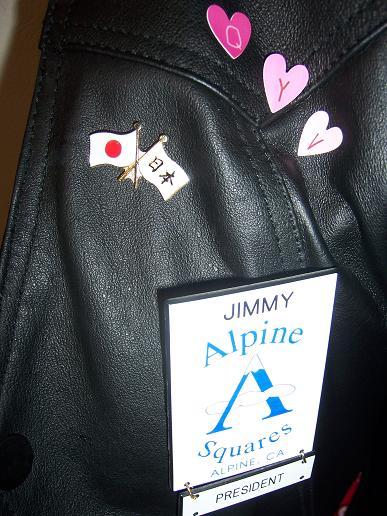
Sometimes pins are used for the same purpose, and I recently received a pin (pictured), which now also adorns the vest I wear when I’m dancing.

The occasion on which I received it was a recent International Friendship Dance that was held here in San Diego between local American dancers and a group of dancers from Japan.

Some of the Japanese dancers were giving out pins to commemorate the event, and I was lucky enough to receive one. The pin has two flags on it, one of which says (in Japanese) "Nippon," which is the Japanese word for Japan, and the other of which is the Japanese national flag.

It was a very well attended dance. We had almost fifty squares (a square is eight people) crammed into the auditorium. The room was so packed that squares were jammed right up against each other, and there were even squares dancing in the foyer to relieve a bit of the pressure.

Most of the dancers, of course, were Americans, but at least three squares were visitors from Japan. The local Japanese dancers who live in San Diego (there are several) were also there, and it was nice seeing them serving as a bridge between the two dance communities.

Most of the dancers didn’t speak each others’ languages, but some did, and I got a chance to practice a little of my Japanese (which is very rudimentary), saying "Kon ban wa" ("Good evening") and "Sumimasen" ("Excuse me") and things like that, to the delight of the Japanese folks I was dancing with.

There were three callers at the event, all of them with international reputations: Ken Bower of California, Bob Baier of Texas, and Mac O’Jima of Japan.

Before the dance I was curious to see how well the two groups would be able to dance together. I knew that when Modern Western Square Dancing is done in other countries (and it’s done in quite a number of them!) it’s always called in English, so in theory the two groups should be able to dance together, but one can never be certain.

It turned out that everything worked just fine. The Japanese dancers had no problem following calls from the American callers, and Mr. O’Jima’s English was exceptionally good. He had a little L/R blur in his accent (to be expected since Japanese doesn’t have the distinction, just like English doesn’t distinguish between two P sounds that–say–Hindi does), and I noticed he had a little singular/plural issue since Japanese doesn’t inflect words for this either (thus he’d say "Join all your hand and circle to the left" instead of "Join all your hands and circle to the left"), but his English–including his accent–was really, really good. At times, his accent sounded a bit Scottish to me, and I wondered if his English teacher was from Scotland or somewhere in the British commonwealth.

Mr. O’Jima also complimented my pronunciation of Japanese, FWIW.

All three of three of the callers were outstanding. Ken Bower and Bob Baier related a story about when the two of them had visited Japan for a friendship dance over there, and some confusion had arisen over Ken’s name. At one point (if I have this right), someone said "Kon ban wa" to Bob Baier, who misheard and replied, "Ken Bower? Oh, he’s not here right now." (I got a real kick out of that since I’d been saying kon ban wa to people all evening, and the similarity had never occurred to me.)

BTW, here’s a YouTube with Ken Bower (who is a super nice guy) being interviewed about the dance:

So that’s the story of how I got my second square dance dangle/pin/thingie.

(Incidentally, the hearts you see on the vest were temporary stickers from a recent Valentines Day dance around the same time, where there was a "king of hearts" competition in which the lady dancers awarded them to the male dancers of their choice. I got four. The winner got six, if I’m not mistaken.)

Showmanship!

It’s not the number of balls the juggler uses; it’s the way he uses them.

Just goes to show what you can do with three tennis balls and probably the best music the Beatles ever wrote.

It also goes to show the difference between humans and every other life form on earth. Only we could do anything even remotely like this.

CHT to the reader who e-mailed!

Model Citizens

Hey, Tim Jones, here.

X1model1 I had the pleasure, lately, of spending a little time with some family who came to visit us from Germany, including a young nephew. I was looking after him for a few hours, and in my increasingly desperate quest to keep his active mind occupied, I discovered that he was interested in model building.

In paroxysms of geeky rapture, I dug out from our junk room a collection of dusty model projects, in various stages of completion. I had begun them with my son, and had worked on them mostly during holiday breaks, but found that he was not such a big fan of model building… at least not the patient assembling, painting, and following directions part. His participation in the actual building process quickly settled into a routine of checking in every half-hour or so to see how things were progressing.

Yeager Because I was partly motivated by dreams of bonding with my son over the smell of model cement and enamel paint, I put the projects aside, time being at something of a premium for me.

Now, in my five-year-old nephew, I saw another potential victim model-building buddy on whom I could hang my pathetic hopes with whom I could share my enthusiasm.

In the end, he did help me glue a couple of pieces, but the most fun was just watching his obvious fascination with the idea of models, and with the finished products.

Rockets While he was here, I managed to complete one project (the X-1) and get started on another that had been in mothballs for years (the U.S. Moon Shot series). I hope to complete a model of every aircraft or spacecraft featured in the movie The Right Stuff, which is one of our family’s favorite films. Both my son and I are aviation buffs. His childhood hero was Chuck Yeager. We have a lot of happy memories tied up in these particular models.

Getting back into my model building was a great deal of fun, brought back some memories for my son and me, and made me feel like a kid again. It also got me to wondering what exactly was the appeal of spending so many precious hours, so much money and frustration on some plastic reproductions that could much more simply be bought on E-bay, or some such.

It occurred to me that in the act of building the models, one gets to know the subject much more thoroughly than before, and becomes more appreciative of the aspects of the project that the builder found attractive to begin with. It also struck me that my admiration for the people involved in the history of these machines – Chuck Yeager, Alan Shepard, John Glenn, all the the Mercury Seven and the Apollo astronauts – was analogous to the way Catholics take the saints as role models… with love and respect for the attributes that made them saints (and that helped them shape history) while remembering that they are human beings. We don’t need to approve of every aspect of a saint’s (or a hero’s) personality in order to give proper recognition to those traits that made them superlative examples from whom we can take inspiration.

Apollobits Having these models around brings to mind the courage, tenacity and brilliance of the men associated with them, just as having images of the saints around helps us to remember the heroes of the faith who came before us. Of course, for Catholics, the Communion of Saints carries the additional dimension of family affection. The saints are our kin. We can call on them for prayers and help, in addition to finding inspiration from their example. Sort of a big spiritual two-fer. In addition, we will one day get to meet the saints in heaven, if we persevere.

I certainly hope to meet these astronauts and pilots in heaven, too. It would be a shame, after spending so much time exploring the heavens, for any of them to miss out on the real thing.

“Vell, He’s Just Zis Guy, You Know?”

Br_guy
I’m sure that’s what his private brain care specialist would say about Br. Guy Consolmagno, who’s part of the Vatican’s crack astronomy team or "Astro Force."

CHT to the reader who e-mailed THIS STORY from the Concord Monitor about Br. Guy.

EXCERPTS:

"Science is a way of praising God," he said in an interview yesterday afternoon.

As the Vatican’s curator of meteorites, Consolmagno sends meteorites where requested for exhibits or experiments. The crown jewel, he said, is a fist-sized meteorite that landed on and killed a dog in Nakhla, Egypt, in 1911. It was once a part of Mars. [FLASH! MARS ATTACKES EARTH DOG!] He also conducts his own research, has traversed Antarctica collecting meteorites and takes daily walks in the [Castel Gandolfo] palace gardens. [MARS ATTACKS ANTARCTICA! ARE PALACE GARDENS NEXT?]

Consolmagno said every physical scientist starts with three inherently "religious assumptions": The universe exists and is not a figment of the imagination. The universe is dictated by discoverable rules. And discovering those rules is something that’s worth doing.

That third tenant is tied to intuition. When a scientist, even without data, pursues a hypothesis based on intuition, he blends faith and science.

"You say, ‘That is so elegant that I’m willing to bet two years of my life following this up,’ " he said. "That is something that comes from the soul. That’s not something that a computer can work out."

The second tenant may be a statement of fact today. But hundreds of years ago, the basic laws of science had not yet been discovered.

"It’s interesting to note that those people, the first scientists, were all monks, they were all clerics," he said. "And their sense that the universe makes sense came from, first of all, their belief that God created the universe in a logical way."

Consolmagno said many Catholics have been taught that Catholicism and science don’t mix, though they always have. The Big Bang theory that the Earthuniverse originated in an extremely dense and hot space and expanded was developed by a Belgian priest. Though many people believe that Galileo was shunned by the Church for saying the sun was the center of the universe, he was close to many church leaders. Consolmagno said church officials don’t advocate for a strict interpretation of the book of Genesis, which includes the Christian creation story.

"The cosmology of Genesis is not only not the cosmology of the 21st century. It wasn’t even the cosmology of the second century," he said. "The Romans knew that the world looked different from a flat plane with a bowl over it and water above and below. And that didn’t seem to bother them."

The conflict between evolutionary science and creationism in the United States comes from the Protestant tradition, not the Catholic one, he said.

"American Catholicism is in a Protestant culture," he said. "We borrow a lot of our attitudes, along with a lot of our hymns, and not always the best of either."

"The Heavens proclaim the greatness of God," he said. "That’s why we study the heavens."

GET THE STORY.

Apostolic Exhortation Next Tuesday?

Catholic News Agency is reporting:

After over a year of work, the Holy See will release the post-Synodal Apostolic Exhortation on the Eucharist, titled “Sacramentum Caritatis,” on Tuesday, March 13th.  The document, which flows from the 11th Ordinary General Assembly of the Synod of Bishops, held in October of 2005, has been highly anticipated in ecclesiastical circles.

A press conference for the document’s release will be held in the Press Office of the Holy See, led by Cardinal Angelo Scola, patriarch of Venice and relator general of the 11th Ordinary General Assembly of the Synod of Bishops, and Archbishop Nikola Eterovic, secretary general of the Synod of Bishops.

The document is rumored to be a profound reflection on the Sacrament of the Eucharist and may call for a proposal and plan for liturgical reforms, including a greater use of the Latin language, Gregorian chant, classical polyphonic music.  According to one source, the document may also call for “more decorum and liturgical sobriety in the celebration of the Eucharist, excluding dance and, as much as possible, applause.”

SOURCE.

All I can say is, "It’s about time! The apostolic exhortation from the Synod on the Eucharist has been inexcusably delayed." (And not through B16’s fault; the holdup has been on the part of others, and even B16 has obliquely complained about it.)

Actually, that’s not all I can say. I can also say that I’ll be very interested to read it, and I would not be at all surprised if the items highlighted in blue turn out to be in the document, though we’ll have to see.

Also note that, if the title dof the document is correct, Pope Benedict is continuing his theme of love. The title translates as "The Sacrament of Love" or "The Sacrament of Charity."

UPDATE: Catholic News Service is reporting:

Meeting pastors from the Diocese of Rome Feb. 22, Pope Benedict said he was about to sign the document, which he hoped would "help in liturgical celebrations, in personal reflection, in preparing homilies and in the celebration of the Eucharist."

He also said he hoped it would "serve to guide, enlighten and revitalize popular piety," especially eucharistic adoration.

Tomb Of Jesus Nonsense

TombMany people on the Internet are ably demolishing James Cameron’s opportunistic documentary regarding his ostensible discovery of Jesus’ tomb.

There’s so much material out there that it’s difficult to process it all (at least in the time I have available), but I said that I’d offer some thoughts of my own on the subject, and so I’ll do so. I’ll also provide links to work being done by others.

Let’s start with some principles that should be widely agreed upon, even by those who do not believe in the Resurrection.

1) Jesus was a Galilean.

2) Jesus’ family was poor (as illustrated by the kind of offering they gave at the Temple at Jesus’ birth).

3) Jesus was crucified by the Romans.

4) There were significant tensions between the early Christian community and the Jewish community (as illustrated by the executions of St. Stephen and St. James the Just and by St. Paul’s own admitted persecution of the Church).

5) Early Christians made a big deal out of the claimed Resurrection of Christ.

6) In a first century Jewish context, that would mean that his tomb was empty.

7) Early Christians also made a big deal about the claimed Ascension of Christ.

8) Early Christians made a big deal about the Church as the mystical/metaphorical Bride of Christ.

9) Nothing remotely like the story envisioned by James Cameron and his colleagues is recorded in early Christian or Jewish or pagan literature about the early Church.

If we accept these premises, how likely is it that Jesus had a wife and a son and was buried in a middle class tomb in Jerusalem with multiple other family members spanning several generations?

Not very.

Let’s watch the dominos fall:

The first domino to go over is the fact that Jesus was a Galilean. He was Jesus of Nazareth. His family’s home was in the north, in Galilee. Why would they have a family tomb in Jerusalem? An individual might be buried there if he happened to die there (as with Jesus being [temporarily] interred in Joseph of Arimathea’s tomb or when James the Just was martyred in Jerusalem). That would be expected since they buried people the same day, and there wouldn’t be time to get a body down to Galilee. But the family’s tomb would be in Galilee, since that’s where most members of the family would die.So it’s implausible to begin with that Jesus’ family would have a tomb in Jerusalem.

Now the second domino falls: They were dirt poor. They just didn’t have money. The lower-class status of the family is attested to both inside and outside of Scripture (including later records about kinsmen who demonstrated that they had never been anything other than working men by displaying the callouses on their hands). So how could they afford a middle or upper-middle class tomb even if they had a tomb in Jerusalem?

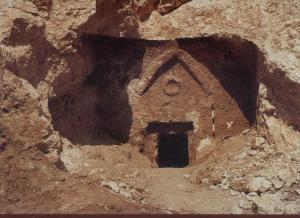
In particular, why would they build an ornate one? See the picture at the top of this post? Notice the geometric designs above the door of the tomb? That’s ornamentation, and it takes money to have rock carving like that done. Again, this isn’t the kind of tomb poor people would have.

The ornamentation also calls attention to the tomb, causing dominos three through six to keel over. The early Christian community and its claims about a Resurrected Messiah were very annoying to the local non-Christian communities, both Jewish and Roman. To non-Christian Jews, the Christian message was a betrayal of the faith as they understood it. It was heresy. It was something to be stamped out.

To the Romans, and increasingly with time, the Christian community was also troublesome. Partly it was troublesome because it stirred up contention within the Jewish community (which itself was headache enough for the Romans at the time). Partly it was troublesome because it came to be perceived as a treasonous group that did not honor the state religion nor form part of the tolerated religion of Judaism. And if you buy the theories common in liberal critical circles that the authors of the New Testament tried to shift the blame for Jesus’ death from Roman leaders to Jewish leaders then there’s an extra reason for the Romans to be annoyed with the early Christian community. Even if you don’t (as I don’t) buy the idea of blame transferrence, put yourself in the position of a Roman governor and ask: "Do I really want a local cult worshipping as a god a man who we Romans put to death?" For the Romans too, there was motive to undermine Christian claims.

So when Christians are running around saying that Jesus’ tomb is empty and that he’s been raised from the dead and that this only proves that he’s the Son of God, if you’re a non-Christian Roman or Jew then you’re going to have a powerful incentive to say, "Wait a minute! Jesus’ tomb is RIGHT OVER THERE in what will become the Talpiyot neighborhood of Jerusalem! And look, his bones are right here in this ossuary conveniently labeled ‘Jesus son of Joseph’ in this conveniently-ornamented-and-thus-advertised tomb that the rest of his family is using!"

Matthew 28:11-15 is also noteworthy in this regard:

[S]ome of the guard [over Jesus’ tomb] went into the city and told the chief priests all that had taken place.And when they had assembled with the elders and taken counsel, they gave a sum of money to the soldiers and said, "Tell people, `His disciples came by night and stole him away while we were asleep.’ And if this comes to the governor’s ears, we will satisfy him and keep you out of trouble." So they took the money and did as they were directed; and this story has been spread among the Jews to this day.

To the ears of any sensitive reader, but especially to an apologist, the nature of this passage is immediately apparent: It’s counter-apologetics. Matthew is pre-emptively doing apologetics against a claim that was current among non-Christian Jews in his day. It doesn’t matter if you believe that Matthew was right, or even if you believe that Matthew was Matthew (rather than a "Matthean community"). What’s happening here is that the leading non-Christian explanation for the empty tomb is being debunked.

As an apologist for the Christian position–like Matthew–you don’t want to raise alternatives to the Christian explanation in the reader’s mind if you don’t have to. Thus you don’t raise the idea of Jesus’ disciples stealing his body unless you’ve got a real, live objection out there that you need to offer a counter-explanation for (i.e., the chief priests bribed the soldiers to say this). You don’t even want the reader’s mind moving in that direction if you can avoid it.

So the fact that Matthew (or the "Matthean community") takes the trouble to raise and then debunk the idea of the disciples stealing the body shows that this was the leading explanation  in the non-Christian Jewish community of why the tomb was empty. (And why Matthew–rather than Mark or Luke or John–deals with this, since Matthew’s gospel was most clearly written for a Jewish audience: This was the audience in which this explanation was common.)

But there would be no reason to concoct this explanation if Jesus’ bones were, in fact, lying in a clearly labelled ossuary in a publicly marked tomb that was in multigenerational use by members of his family in Jerusalem. If you’ve got the body then you don’t need to make up the story about his disciples stealing it.

Domino seven–the early Christian preaching of the Ascension–also tips over against James Cameron’s case. It provides the Christian explanation for where Jesus’ body is: It ain’t on earth! It’s up in heaven! He’s been exalted to the right hand of God in accord with his status as Messiah and Son of God. So if you’ve got that oh-so-conveniently-identifiable tomb right there in Jerusalem, why don’t you use this to dethrone the Ascension claim by pointing out (in excellent Latin if you’re a Roman) Habeas corpus!–"That you have the body!" Right there! In that ossuary!

And then there’s domino #8: The Church as the Bride of Christ. This image would never have arisen if there was a Mrs. Jesus living right there in Jerusalem. Look at what happened in other religions where the founder was married. Do we know about their wives? Well, let’s see . . . Moses was married to Tsipporah and then later to an Ethiopian woman. Muhammad was married to Khadijah and then later to Aisha and Sawda and Zaynab and . . . well, let’s just say that he was very enthusiastic about marrying women. Joseph Smith Jr. was married to Emma Hale and Lucinda Pendleton and Louisa Beaman and . . . uh . . . let’s just say he was enthusiastic about marrying women, too.

We know about these women because they were honored figures as wives of The Founder, and if Jesus had a wife then (a) we would know about it and (b) the whole Church-as-the-Bride-of-Christ metaphor would never have come into existence.

And then there’s the fruit of marriage: offspring.

Now, Dan Brown wants to sneak a forgotten daughter of Jesus by us, but we tend to know about even the daughters of religious founders. Muhammad’s daughter Fatima comes to mind.

It would be much harder to sneak a forgotten son by the eyes of history. For example, Moses had Gershom and Joseph Smith Jr. had Joseph Smith III.

It’s not just hard to sneak sons past because patriarchal cultures focus more on sons, it’s also because of this: In traditional societies, the son is looked on as the father’s natural successor.

The son may not end up as successor, but we still tend to know about sons because of their role as potential successors. If a son dies before he can assume office, it’s viewed as a great blow to the community because it destabilizes the leadership and triggers a struggle for succession. That struggle gets recorded. Or, if the son doesn’t die, a succession struggle may break out anyway, and it, too, gets recorded. Thus when Joseph Smith Jr. was killed after shooting at the people who had come to lynch him (no passive martyr he), there was a succession struggle in the early Mormon community after which Joseph Smith III ended up out of power (later forming the Reorganized Church of Jesus Christ of Latter Day Saints, now the Community of Christ) while Brigham Young ended up in charge of the main Mormon establishment.

And we know about this because succession struggles are the things history is made of and so they get recorded.

So if Jesus had a son named Judah (or anything else), we’d know about it. We know a lot about the politics of the early Church, and we’d certainly know about a succession fight involving the son of Jesus. We’d have all the arguments of the winning side about why their side was right and the son of Jesus was not his legitimate successor.

This is especially the case when you realize that Jesus’ surviving male family members were active in the leadership of the Church, like James the Just, who became bishop of Jerusalem. But it was his "brothers" who played these leadership roles, not his son.

Thus the ninth domino falls: The fact that nothing like Cameron’s version was recorded by anybody–including those hostile to the Church who would want to discredit it–underscores the utter implausibility of the whole idea.

Then there are the specific arguments brought forth by Cameron and his crew in favor of their hypothesis, but those have been ably rebutted by others.

SEE HERE.

AND HERE.

AND HERE.
(CHT to the reader who e-mailed the last!)
Sold-out Silence: Manhattan Monk Movie Mania!

This weekend I went back to see INTO GREAT SILENCE a second time at the one venue it is currently playing, NYC’s Film Forum Theater.

I went with my 12-year-old daughter Sarah, who watched Papa’s two-minute plug for the film on EWTN’s "Life on the Rock" this past Thursday, and wanted to see it.

The screening was sold out.

Luckily I had bought tickets online, or we wouldn’t have got in. After an hour getting to the theater, turning around and going home would have been no fun. There weren’t two seats to be had together; I had to ask another patron if he would change seats so that I could sit with Sarah. (She loved the film, BTW.)

Apparently, that sold-out screening was indicative of a strong opening weekend; a contact at Zeitgeist tells me the film did very well in NYC (I don’t have numbers yet). So, this is good news for all of you who are hoping that the film will come to a theater near you, since art-house theater owners look to the NY opening of a film like this when deciding whether to book the film.

A number of readers have asked what they can do if the movie isn’t currently scheduled to play near them. Answer: Contact your local art-house/alternative theater owner(s) and ask them to book the film! The more interested patrons theater owners hear from, the more likely they are to book the film. And if it does come anywhere near you, make sure people who would enjoy it know about it.

Of course if you truly live in the sticks where there isn’t an art-house theater for three hours, you’re probably out of luck, but then you already knew that anyway.

P.S. Chicago-area readers: Note that the Music Box Theatre has moved up the film’s week-long run by a week, from a start date of April 6 to a start date of March 30!

WHERE AND WHEN (slightly updated!)