Okay, What Is It With The Good Homilies All Of A Sudden?

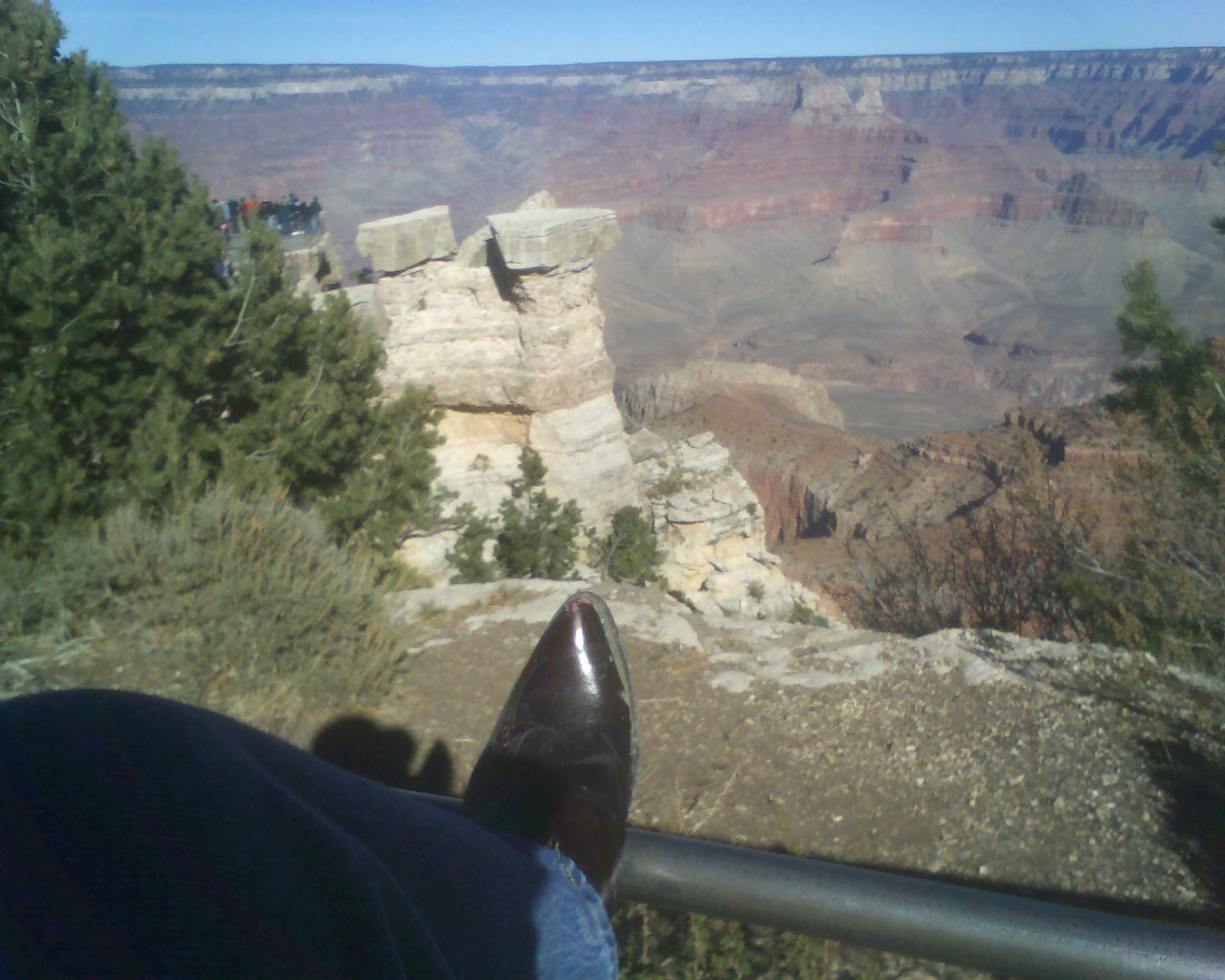
I got back from my trip to the Grand Canyon Sunday and I was DOG TIRED. I mean, I was PLUM TUCKERED OUT.

I’d driven 1200 miles in 48 hours (make that 1500 in 72 hours if you count the trip to the mud volcanoes), slept little and fitfully on hard hotel beds, and gone hiking in almost-freezing-cold weather at an altitude of 6000 feet (in a body acclimatized to 500 feet).

It was EXHAUSTING.

So when I got back, I was exhausted. But I had a problem: I still needed to go to Mass. With an hour to go before the last Mass of the day, I was falling asleep. So I set my alarm clock to give me 20 minutes to get up and get to Mass and then took a catnap.

I awoke debating with myself whether I was sufficiently tired to be excused from my Sunday obligation, but decided to go to Mass anyway.

If the priest celebrating Mass would have turned out to be the pastor, I seriously considered asking him if I could be excused from my Sunday obligation if I’d go to a daily Mass later in the week (pastors have the authority to excuse you), but it wasn’t the pastor. Instead, it was Fr. "Deep Voice," who was being assisted by a deacon.

I really dread going to the last Mass of the day on Sundays, because it’s the "youth Mass" at my parish, with its "youth choir" and "youth band" and "youth readers" and is designed to appeal to "youth." As a result, I find the music horrible, and so it was no surpise when they started Mass with a song whose opening melody line was (I am NOT kidding) "Twinkle, Twinkle, Little Star" played in a minor key. (The song is called "Sing Out Earth And Sky." Pray that this sanity-shattering liturgical horror is never inflicted on your parish.)

The homily was done by the deacon.

I ended up being glad that the pastor wasn’t the priest in attendance, because as a result of not being excused from my Sunday obligation, I got to hear one of the best homilies I’ve heard in a long time (not counting Fr. "You Decide!"’s recent memorable homily).

It started off as a standard "Let’s diss the commercialization of Christmas without offending anyone" homily–you know, the one in which the homilist talks about how much he enjoys Christmas celebrations and buying presents and such, thus providing himself heat shield for the deplorations of commercialization that he’s about to give. As formulaic as this type of homily tends to be, I appreciate them to a significant degree because at least people are being reminded that they need to resist the commercialization of Christmas and remember its spiritual significance.

But then the deacon’s homily really TOOK OFF!

After inoffensively dissing the commercialization of Christmas, he then asked (forcefully) "But who’s  birthday  is it, anyway!?"

He then asked (again, forcefully): "Is Jesus on your Christmas list?–And is he at THE TOP of that list?"

He then said that he wanted to give us some "shopping ideas–like the commercials do on television–for things that you might want to buy as presents for Christmas. I’m not talking about a CHEAP GIFT that is gone the next day. I’m talking about a GOOD GIFT."

He then went on to name things that we might give (to Jesus) as gifts for Christmas, such as:

  • Donating to or volunteering our time at homes for unwed mothers.
  • Resolving to go to Mass every Sunday next year if we aren’t already going to Mass regularly.
  • Resolving to go to Mass an ADDITIONAL day each week if we are going to Mass on Sundays. ("I didn’t say it would be easy," he added.)
  • Signing up to do an hour of Eucharistic adoration each week (possibly following his own example of signing up for a hard-to-fill hour; he mentioned that his is 1 a.m. Sunday  morning, and he added that, although he often wakes up for it thinking "Why did I ever volunteer for this?" that he NEVER regrets it once he is there and sitting in Jesus’ presence).

I mean, his homily totally ROCKED!

It wasn’t standard Christmas holiday sentiments and vague generalities about what to do in our lives. It was loaded with SPECIFICS and CHALLENGING BUT ACHIEVABLE SPECIFICS that can help DRIVE HOME to people the significance of Christmas if they make and follow-up on these resolutions.

YEE-HAW!!!

Now: I had been thinking early on of excusing myself for the concluding rites, in view of how tired I was, but after the deacon’s homily zoomed up into the stratosphere, I knew I had to hang around and thank him after Mass.

Credit where credit is due.

Lost In Translation

Ilovelucy_1

Michelle here.

Last week my brother-in-law found some time to install the DVD player he and my sister gave me last Christmas — which goes to show you that I’m no techno-geek, since it had to sit on my couch for nearly a year. Delighted to finally have DVD capability, I went out and bought three seasons worth of I Love Lucy (Seasons One, Four, and Five), my all-time favorite TV show.

When I put in Season One for my own personal I Love Lucy marathon, I was frustrated to find that most of the episodes were subtitled in Spanish. I was even more frustrated that Ricky Ricardo’s famous Spanish rages were not translated into English, but that’s another story. Since I couldn’t figure out how to turn off the subtitles, I assumed that they were standard to the set and decided to tolerate them.

Once I did, I started to notice something interesting.

I am not especially well-versed in Spanish, having only taken three years in high school and nothing since, but I can read a bit of it unassisted and recognize some more if put side-by-side with English. What I found fascinating during my viewing of I Love Lucy was seeing how English was translated into Spanish. Being fluent in English (I hope) and knowing enough Spanish to recognize translations, I found that a lot was lost in translation.

Some examples:

  • English colloquialisms apparently did not have exact translations. When the English-speaker would say "Easy!" while moving something, the translation into Spanish would be "Careful!" or "With caution." The meaning of the colloquialism was captured, but not a translation.
  • A whole range of English versions of "okay" would have one Spanish translation: "Bien."
  • The subtleties of language, which were sometimes used to humorous effect, were lost. Comical alliterations like "tubby trio" and "flabby foursome" could not be recaptured once they were translated.

All of this made up for the annoyance of subtitles that were not needed. Eventually, after fiddling around with the DVD remote, I finally figured out how to turn off the subtitles. But the translational game was so much fun I may turn them on again in the future to see if I can catch more translational glitches.

FOUND! The Sipapuni!

Sipapuni_1I’ve found the Sipapuni!

"What’s the Sipapuni?" you ask.

Well–that’s it! Right there! In the middle of the picture. The reddish round thing on the edge of the river. Has a little black dot in the center of it.

"Okay, but can I have a more informative answer?" you ask.

Sure. The Sipapuni is a natural formation on the Little Colorado River, about four miles upstream from where it intersects with the Colorado River. It’s in the Grand Canyon, though it’s just outside Grand Canyon National Park.

The Sipapuni is a travertine dome, which means that it’s a dome made of calcium carbonate (think: limestone)–usually layered–and formed from spring water, particularly the water of a hot spring. That black dot in the center of the Sipapuni is the spring, and the reason it’s a different color than the surrounding land is because of minerals in the spring water that leave orange and yellow deposits.

"Okay, but why is the Sipapuni important and why does it have a name–whereas so many travertine domes don’t?"

Because the Sipapuni is an enormously important location in the folklore of several American Indian tribes, particularly the Hopi and the Zuni.

According to both of these tribes, the Sipapuni is the location from which man emerged into this world. In other words, it’s their equivalent of the Garden of Eden.

According to both tribes (though the details vary), the beings that eventually emerged into the world went through a series of other worlds before climbing up out of the Sipapuni into ours.

In Hopi folklore, this is the fourth world. Things weren’t going so good in the third world, and so they found a way to climb up into a new, largely uninhabited world and became the human race.

In Zuni folklore, humans passed through a series of four caves before emerging through the Sipapuni, making this the fifth world.

Other tribes also believe that humans emerged from a site in the Grand Canyon but do not identify it with the Sipapuni, claiming that the site has been lost.

The idea that a body of people have an identifiable Eden that you can go see with your own eyes (though they don’t want you to do that since the site is considered sacred) is something I find fascinating.

If the early part of the book of Genesis were to be taken literally, you could get a rough fix on Eden’s location, but not with this kind of precision–and you certainly can’t find it today with Google’s satellite imagery.

HERE’S ANOTHER PICTURE OF THE SIPAPUNI WITH LATITUDE & LONGITUDE MEASUREMENTS.

HERE’S THE INTERSECTION OF THE COLORADO AND LITTLE COLORADO IF YOU WANT TO NAVIGATE EAST (RIGHT) TO THE SIPAPUNI FOR YOURSELF.

HERE’S A HOPI CREATION ACCOUNT FEATURING THE SIPAPUNI.

Having discussed where Hopi and Zuni Eden is, sometime soon I’ll have to tell you about where Zuni Heaven is.

The Grinch List

I’ve had a number of requests for lists of stores that are and aren’t honoring the holidayChristmas season by calling it "Christmas."

Now I’ve found one!

Concerned Women for America has developed a list of stores that are honoring the Christmas spirit by referring to Christmas–as well as stores that are hypocritically trying to get your Christmas money out of your Christmas pocket without ackowledging the Christmas that you are celebrating.

In other words: The Politically Correct Commercializers.

My own philosophy is that if any business wants my Christmas dollars then they can darn well ackowledge that they ARE Christmas dollars–either by sending me a CHRISMAS catalogue or by wishing me "Merry CHRISTMAS" or what have you.

But none of this "Holiday catalogue" or "Happy holidays" crud.

Any business going that route will get NONE of my Christmas dollars.

And, since boycotts are no good unless you tell the person THAT and WHY they’re being boycotted, I plan on telling such business that’s what I’m doing.

I, for one, refuse to sit by and allow Christmas to be banished from public consciousness and be added to the social "taboo" list the way that Christian concepts have in so many areas in our society.

As bad as the commercialization of Christmas is (something we must also all fight), having it vanish from our culture in a fit of political correctness is not acceptable.

GET THE LIST.

FLASH! Fr. “You Decide!” Breaks Form!

Since I knew I’d be visiting the mud volcanoes on Dec. 8, I went to the vigil Mass for the Immaculate Conception on Dec. 7th.

The priest was Fr. "You Decide!"–so named because his homilies ALWAYS follow a set formula of opening with a joke and then concluding with him posing a rhetorical question about whether you should do A (an obviously bad thing) or B (an obviously good thing), at which point he says "You decide!" and goes and sits down again.

Only that’s NOT what he did for the Immaculate Conception!!!

Instead he opened by explaining, in simple terms, what the Immaculate Conception is. (I.e., no opening joke–and actually EXPLAINING CHURCH TEACHING yet!)

Then he talked about the meaning of the doctrine and about history and how we should pray more. And he gave a specific recommendation of praying the Angelus as an example of a traditional prayer.

And then he finished and didn’t say "You decide!" It was an honest, straightforward homily without artificial encumbrances that explained Church teaching and sought to apply it to the congregation’s lives in a way that involved specific suggestions instead of vague generalities. In short: It was what a homily is SUPPOSED to be.

It was GREAT!

Now, Fr. "You Decide!" always makes a bee-line for the sacristy after Mass, so I followed him into the sacristy and said:

<great sincerity>Excuse me, Father, but I just wanted to say that I thought that was the best homily I’ve ever heard you preach. It was simple, direct, and explained Church teaching without any artificiality and with specific suggestions for what we could do, and I wanted to thank you for it.</great sincerity>

Just wanted to give credit where credit was due–and hopefully reinforce this kind of homily.

Who knows? Perhaps soon he’ll be known as "The Priest Formerly Known As ‘Fr. You Decide!’"

Equal Choice

Dragontail_1 Some indication from the L.A. Times that the absurdities of "choice" are beginning to be understood, even by some of those who support it.

What the writer of the article, Meghan Daum,  is trying to figure out is – in these days of absolute equality in everything, for everybody – why should killing your unborn children be the exclusive purvue of women? Shouldn’t men have "choice" too? What is sauce for the goose…

She does an admirable job of beginning to lay out objections to this proposal, and finds none that hold water. All objections to the idea of a man having the right to terminate his child in utero (or at least legally terminate his parental responsibilities) also apply to women.

From the article:

"The way the law is now, a man who gets a woman pregnant is not only powerless to force her to terminate the pregnancy, he also has a complete legal obligation to support that child for at least 18 years.

In other words, although women are able to take control of their futures by choosing from at least a small range of options — abortion, adoption or keeping the child — a man can be forced to be a father to a child he never wanted and cannot financially support. I even know of cases in which the woman absolves the man of responsibility, only to have the courts demand payment anyway. That takes the notion of "choice" very far from anything resembling equality."

So the liberal dragon has again turned on itself and bitten it’s own tail. What is being suggested would require, not just spousal notification for an abortion, but the legal permission of any male sex partner, be he spouse, boyfriend or the guy you hooked up with one weekend.

I only hope the new thinking being manifested on the far left will result in a continued disillusionment about abortion and it’s supposed benefits. If not, and this warped logic is followed to it’s conclusion, we can expect more abortions, rather than fewer.

Thanks to Eric Scheske (The Daily Eudemon) for the link.

GET THE STORY.

We Are Church?

A reader writes:

How would you respond to a deacon during a homily who said:  "If everyone were to leave this building, it would no longer be a Church–the people are the Church?

I’d say that he has a point but he’s expressing it in a rather boneheaded way.

It’s true that, THEOLOGICALLY SPEAKING, the Church of Christ is the body of people who are incorporated into Christ and that particular churches (e.g., the church of the Diocese of San Diego) are bodies of people who are incorporated into Christ and united to their bishop.

But it’s also true that Christian tradition across MULTIPLE LANGUAGES–INCLUDING LATIN–has received the usage of referring to specific buildings used by the Church as "churches" (Latin, ecclesiae).

Now, of these two uses the first is the original and more important, but human beings of normal intelligence normally have no trouble allowing words to have TWO OR MORE senses and being able to distinguish which sense is being used in what circumstance.

For an individual to pedantically insist on one usage to the exclusion of another usage that has DEEP roots in Christian tradition for his own pet theological concerns is to reject the customs and linguistic identity markers of the Christian community and MAY serve as a sign that he has a problem adhering to that community as it has traditionally understood itself.

It’s the verbal equivalent of a religious not wearing a habit, and it’s no surprise that many dissidents have highly stressed the idea of the Church as a community of people to the exclusion of other senses (e.g., church buildings, church hierarchy). Some–and I’m not accusing your deacon of being a dissident–have even banded together under the ungrammatical banner "We Are Church."

When one encounters such brazen defiance of established Christian linguistic custom, it’s enough to make one want to say, "TALK NORMAL, YA IDJIT!"

I don’t suggest that you should seriously say that to your deacon, though. If you are looking for something practical to say to him, you might try something like this:

Dear Deacon:

I was disturbed by your recent homily in which you said that "If everyone were to leave this building, it would no longer be a Church–the people are the Church."

While it is true that the original and more important meaning of the word "Church" refers to a body of people, Christian tradition has long received the usage of referring to buildings used by the Church as "churches." This is the case even in Latin. Most people have no trouble distinguishing the senses that different words have and are smart enough to handle both the idea of the Church as a people and the idea of churches as buildings.

You should be aware that when you criticize a deeply-embedded Christian usage of a term, it is quite disturbing to the faithful. Since you are rejecting the linguistic customs of the Christian community, it raises doubts in the faithful’s minds about how well you adhere to that community as it has historically understood itself.

If you don’t want to raise such doubts in the minds of the people to whom you are trying to minister, you may wish to find a way to express the fact that the Church is primarily the body of people incorporated into Christ without attacking long-held word usages of that community. After all, referring to church buildings as "churches" is part of "the Pope’s English."

Giant Mudpots

In my previous post I showed you the Salton Sea mud volcanoes, which are ULTRA cool. (YOU should go there. REALLY!)

I also knew there was another, similar mud-active field in the area, but it took me a while to find it (especially since I was approaching it from the wrong direction and didn’t have my copy of the directions with me).

I eventually got there and discovered that, unlike the previous field I visited, it didn’t have any mud volcanoes. (AWWW!)

It did, however, have GIANT mudpots. (WOO-HOO!)

In fact, the main mudpots were so large that they’d built a fence around them with a viewing platform.
100_1177_400x299

I took this photo from a distance, over the fence. But you’ll notice in the picture below that one slat in the fence is missing . . .
100_1205_400x299

I mean, that’s just an OPEN INVITATION, soooooo . . .

Continue reading “Giant Mudpots”

Mud Volcanoes! YEE-HAW!!!

100_1090_400x299The Salton Sea mud volcanoes were the thing that prompted this trip.

Once I found out about them, I knew I had to go.

I mean: Mud volcanoes? You gotta go see that!

Any volcanoes are cool, and ones made especially of mud are unique.

Not only because they’re made of mud but also because they are much SAFER than regular volcanoes when they’re errupting, so you can get much closer to them and even CLIMB UP ON THEM (like I did!) while they’re errupting.

WARNING! Impending cool pictures!

Continue reading “Mud Volcanoes! YEE-HAW!!!”