This Week’s Show (June 9, 2005)

LISTEN TO THE SHOW.

DOWNLOAD THE SHOW.

HIGHLIGHTS:

  • Is the current rite of Mass a "revised" order of Mass?
  • Why did folks make signs to Zechariah when John the Baptist was born if Zechariah wasn’t deaf?
  • Why was Moses told to take the sandals off his feet because he was standing on holy ground?
  • What does Jimmy think of von Balthasar’s work "Dare We Hope That All Men Be Saved"?
  • What are reasons to accept apparitions and miracles?
  • Can one register in two different parishes in two different dioceses?
  • What are some books proving the divinity of Christ and defending him against higher critics and skeptics?
  • Why do Protestants say "For thine is the kingdom and the power and the glory" as part of the Lord’s Prayer?
  • Will Jimmy be writing about Mary as "Co-Redemptrix," "Mediatrix," and "Advocate"? How to understand the title "Mediatrix of all graces"?
  • How does the Mass as a sacrifice compare to the Old Testament sacrifices?
  • How to know if someone is possessed?
  • What is the origin of the Pope Joan myth?
  • What does Jimmy think of a claim in the Ignatius Study Bible that Jesus celebrated Passover on Tuesday in keeping with an Essene solar calendar?
  • Can the Latin caller have his kids chrismated (confirmed) in an Eastern rite church?
  • How to refute Protestants who try to work the Catholic Church into the book of Revelation?

Infallibility

A reader writes:

How do you differentiate infallible declarations of a Pope from a fallible opinon? Is there a specific formula or phrase used? Also, are the decisions of councils considered infallible? (for example the Council of Trent) Thanks for all the information.

No prob!

While theoretically a pope or a council can engage the Church’s infallibility by using any form of words that adequately communicates the pope or council’s intent to make an infallible definition, in practice there have developed certain standard forms of expression that are understood to communicate this intent.

In the case of a pope, the standard form of expression uses the verb "define," as in "I declare and define that X."

In the case of a council, the standard form involves the word "anathema," which (contrary to a popular impression to the contrary) does not mean the automatic damnation of someone. (Instead it refers to an exclusion from communion with the Church; SEE HERE). The typical formula was "If anyone says X, let him be anathma."

Formulas of the latter nature, of course, have to be on a matter of faith or morals and not simply on disciplinary or similar matters.

Attention also has to be given as to whether these terms had come to signal the engagement of the Church’s infallibility in a particular age (there may be early examples in which the language is used before its intent to trigger infallibility had become fixed).

And in all cases the matter that is defined must be understood in its historical context (i.e., we have to read the language they use in the context of the time and not as if it had been uttered in earlier or later ages) and the matter being defined must be given a strict construction, in keeping with canon law’s provision that:

Can. 749 §3. No doctrine is understood as defined infallibly
unless this is manifestly evident.

This means that only the claim being specifically made is defined, not similar or related claims.

It also means that in cases of doubt, a matter is assumed not to be defined.

From the foregoing, it can be seen that the Church has a preference for not defining things and only engaging its infallibility when there is a pressing need (for the most part).

Celebrity Cell Block

Do you ever wonder what happens to the widely-publicized incarcerated criminals, the ones you figure would make a tempting target to fellow inmates? California has a special prison housing unit especially for them.

"If Michael Jackson is acquitted of child molestation and related charges, he’ll probably return home to his whimsical Neverland ranch in Santa Barbara County.

"But if he is convicted of any of the 10 felony counts against him, he will probably land in the most secure prison unit in California, designed to protect famous convicts from attack by other inmates, prison officials say.

"Corcoran State Prison is set in the middle of America’s richest cotton fields, about 50 miles south of Fresno.

"Its Protective Housing Unit is considered the safest place for an inmate in the California prison system, and therefore the home for mass murderers such as Charles Manson and Juan Corona — and any inmate whose notoriety would make him a trophy for other inmates, Corrections Department spokeswoman Terry Thornton said."

GET THE STORY.

For a true-crime buff like me, the article is an intriguing look at what happens to celebrity inmates after the cameras and public interest are gone.

Coming To A TVMovie Screen Near You

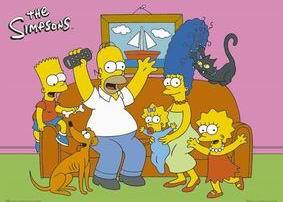
For some years they’ve been talking about doing a full-scale motion picture of The Simpsons.

Word has been, though, that they wouldn’t do it until the TV series wraps.

But the TV series has proven far more resilient than anybody imagined. Heading into its 17th season this fall, the series has become The Series That Wouldn’t Die.

Kinda helps a show stay fresh when the premise is as wide-open and unbound to conventions of realism as The Simpsons is, I guess. (I mean, the show may not be as fresh as the immortal Season 5, but can you even imagine how stale a typical sit-com would be in its 16th year? . . . Brrrrrr!)

So the movie-delayers finally threw in the towel and The Simpsons theatrical movie is now in production!

YEE-HAW!–I mean–WOO-HOO!

GET THE STORY.

Coming To A TVMovie Screen Near You

SimpsonsFor some years they’ve been talking about doing a full-scale motion picture of The Simpsons.

Word has been, though, that they wouldn’t do it until the TV series wraps.

But the TV series has proven far more resilient than anybody imagined. Heading into its 17th season this fall, the series has become The Series That Wouldn’t Die.

Kinda helps a show stay fresh when the premise is as wide-open and unbound to conventions of realism as The Simpsons is, I guess. (I mean, the show may not be as fresh as the immortal Season 5, but can you even imagine how stale a typical sit-com would be in its 16th year? . . . Brrrrrr!)

So the movie-delayers finally threw in the towel and The Simpsons theatrical movie is now in production!

YEE-HAW!–I mean–WOO-HOO!

GET THE STORY.

Money See, Money Do?

CapuchinmonkeyThe little feller you see to the left is a capuchin monkey. (So-named because of a visual similarity to Capuchin attire.)

They’re interesting critters:


The capuchin is a New World monkey, brown and cute, the size of a scrawny year-old human baby plus a long tail. ”The capuchin has a small brain, and it’s pretty much focused on food and sex,” says Keith Chen, a Yale economist. . . . ”You should really think of a capuchin as a bottomless stomach of want,” Chen says. ”You can feed them marshmallows all day, they’ll throw up and then come back for more.”

Now, you may be wondering: Why is a Yale economist telling us about capuchin monkeys?

‘Cause he’s studying their capacity for economics.

GET THE STORY.

He’s taught them to use money to buy grapes, apples, Jello-O cubes, cucumber slices, and . . . other things.

The currency Chen settled on was a silver disc, one inch in
diameter, with a hole in the middle — ”kind of like Chinese money,”
he says. It took several months of rudimentary repetition to teach the
monkeys that these tokens were valuable as a means of exchange for a
treat and would be similarly valuable the next day. Having gained that
understanding, a capuchin would then be presented with 12 tokens on a
tray and have to decide how many to surrender for, say, Jell-O cubes
versus grapes. This first step allowed each capuchin to reveal its
preferences and to grasp the concept of budgeting.

Then Chen introduced price shocks and wealth shocks. If, for
instance, the price of Jell-O fell (two cubes instead of one per
token), would the capuchin buy more Jell-O and fewer grapes? The
capuchins responded rationally to tests like this — that is, they
responded the way most readers of The Times would respond. In
economist-speak, the capuchins adhered to the rules of utility
maximization and price theory: when the price of something falls,
people tend to buy more of it.

Monkeys may not be able to come up with the idea of money, but this kind appears to be able to grasp the rudiments of the concept when they were taught it. They even behave surprisingly like humans in their use of money:

When taught to use money, a group of capuchin monkeys responded quite
rationally to simple incentives; responded irrationally to risky
gambles; failed to save; stole when they could; used money for food. . . . In other words, they behaved a good bit like the
creature that most of Chen’s more traditional colleagues study: Homo
sapiens.

The monkeys got quite creative with their manipulation of money. Before Chen took steps to prevent it they even developed the concept of . . . well, let’s just say that they invented a very old profession–the proceeds of which were then used to buy a grape.

Going To Pot

Once again Our Robed Masters are seeking to save you from the laws of your state, which cannot be trusted to pass laws that differ from the will of The All-Powerful Few:

"Federal authorities may prosecute sick people whose doctors prescribe marijuana to ease pain, the Supreme Court ruled Monday, concluding that state laws don’t protect users from a federal ban on the drug.

"The decision is a stinging defeat for marijuana advocates who had successfully pushed 10 states to allow the drug’s use to treat various illnesses.

"Justice John Paul Stevens, writing the 6-3 decision, said that Congress could change the law to allow medical use of marijuana.

"The closely watched case was an appeal by the Bush administration in a case involving two seriously ill California women who use marijuana. The court said the prosecution of pot users under the federal Controlled Substances Act was constitutional.

"’I’m going to have to be prepared to be arrested,’ said Diane Monson, one of the women involved in the case."

GET THE STORY.

Now, I am not a doctor, and so cannot comment on the possible legitimate medicinal usages for marijuana. What outrages me is that the United States Supreme Court can overturn any and all state laws with which it disagrees with virtual impunity, and has been able to do so for generations now. Ms. Monson, for example, should have been able, under our system of government, to be protected by her state. Now she stands alone and vulnerable, at a time when she is also seriously ill, before the unchecked might of the Men (and Women) In Black.

Our Founding Fathers would have been appalled.

Happy Birthday, Donald!

Donald_duckToday in 1934 Donald Fauntleroy Duck made his first appearance in the Silly Symphonies cartoon "The Wise Little Hen."

He became Disney’s second most popular character, next to Mickey Mouse (kind of their Daffy Duck to Disney’s Bugs Bunny).

He also went on to star in comic books (notably drawn by the great Carl Barks), TV shows, and other media.

You gotta admire a duck who could be that good natured and succeed despite that big a speech impediment (far worse than Daffy’s).

LEARN MORE ABOUT DONALD’S HISTORY.

ALSO LEARN ABOUT THE MAN BEHIND HIS VOICE–an Oklahoma boy who made it big talking like an incomprehensible duck.

Happy birthday, Donald!

I Am Telling a Lie…

CopI was flippin’ through the channels this morning and came across yet another live car chase on FOX News. I had other fish to fry, but just before I switched the TV off, the play-by-play guyreporter remarked that the police were likely telling the bad guy in the pursued vehicle anything they could think of that might make him give up. Police negotiators are allowed to say anything at all if it will save lives or cut short an unstable situation, even if it is 180 degrees opposite of the truth.

I have also watched numerous episodes of NYPD Blue, so I know that police interrogators are allowed to say things like "Your accomplice gave you up already. He says you made him do it. He’s singing like a canary… " even if it is not true. In other words, the police are allowed to lie. In certain situations I suppose it would even be considered a professional duty to lie, say to save the life of a hostage.

Now, obviously, this brought to mind Rahab, the lying prostitute back in the Old Testament (sorry, I’m not much for chapter and verse). She lied to save the good guys in the story (a couple of spies from Israel) and was rewarded by having her life spared later.

So, this all got me thinking, which is a dangerous thing. What sort of ethical, moral and spiritual problems might a devout Catholic police officer have about lying in the course of performing his/her job? Is it permissable from a moral standpoint? Is it even meritorious in certain circumstances? Would they have to go to confession after telling a whopper to a kidnapping suspect?

You might think that I ask these questions in a rhetorical fashion only in order to provide the answers later in the post. Nope.

I’m asking because I really don’t know. Now, I suspect that, yeah, in certain circumstances it might be considered not only morally permissable, but commendable to lie in certain life-or-death type siuations. BUT, I just don’t know. Much as I hate to punt on this, I will leave it to Jimmy and some of the better informed readers to handle this one. My head hurts…

Well, not really…