Third Of A Mill

Thirdofamill_1 

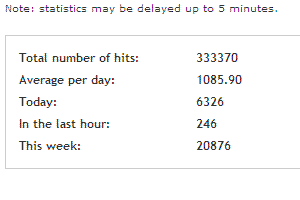
This morning we crossed the third of a million hits mark since moving to TypePad ten months ago.

These hits do include people going to the comments boxes, but they are page calls and do not include individual file calls (e.g., images on the page).

At this rate, we’re on track to hit the million mark in about 8 months. (If the blog keeps growing, though, we’ll hit it in less than that.)

THANKS, Y’ALL! THAT’S Y’ALL’S DOING!

(NOTE: The "Today" field really isn’t today. It’s everything-since-yesterday-midnight.)

Mmmm-Hmmm . . . ?

A reader writes:

I listen to you all the time on the radio Q&A. This is my own fabulous opinion, meaning you don’t have to pay it any attention:

I think you’ll sound better if instead of saying "mmm-hmm" while callers set up their question, you say "yes," or "continue," or some other words. Mmm-hmm is what I say when I don’t really want to be listening to what someone is saying (especially my kids)….I don’t know if listeners take it that way or not.

BTW, I have a question which I can’t phone in since I hear you taped, maybe you could answer it on the air:

In the pre V2 days the Mass was divided into the Mass of the Catechumens and the Mass of the Faithful; today it’s the Liturgy of the Word and Liturgy of the Eucharist.

Any ideas why this changed, and what is the point of the new terminology?

First, in regard to the question: I don’t have a firm answer from an official document explaining why the change was done. A check of the cumulative index of the BCL Newsletter and some leafing around in the 1969 issues didn’t turn anything up (though further digging might); neither did a check of Documents on the Liturgy (a standard collection), but my sense is that the terminological change was due to two things:

First, the custom of the ancient church of dismissing the catechumens at the end of the liturgy of the word had fallen out of use (at least in the Latin rite). Consequently, retaining the terminology was more confusing than not. By calling the rite "the liturgy of the word," it mede it more clear what the true purpose of the rite was.

Second, there was a desire to more greatly stress the unity of the Mass and the relevance to of the word to the Eucharist.

That’s my sense, anyway. If someone else has more specific information (and can quote a source), I hope they’ll add it in the comments box.

Now, regarding the mmmm-hmmm issue: After you’ve worked in radio for a while, you get an inbuilt instinct that dead air must be avoided at all costs, and so I use "mmmm-hmmmm" to fill dead air sometimes. I try to say it supportively, to indicate that I’m listening attentively to what the person says (and, in some cases, to hurry the caller up if he’s rambling), but I don’t know how it comes across to listeners, especially when it goes through the filtering process that causes some of my inflection to drop out.

"Yes" or "continue" would sound impatient to my ears, but I could be wrong.

Whadda y’all think?

Marriage Involvement 2

A reader writes:

I have a question about marriage involvement.  I know that I cannot attend my cousin’s upcoming "wedding" because she is Catholic and divorced, "marrying" a divorced man, in a non-Catholic ceremony.  But what about attending the reception and/or giving a gift?  My wife (a non-Catholic Christian) wants to do both, but I feel uncomfortable about them.  However, I suffer from OCD, often in the form of scrupulosity, so I can’t really be sure of my judgment in this matter.  (Prudential judgment is very difficult with OCD!)

I understand your situation, and it’s good that you check this out. Obsessive-Compulsive Disorder frequently does lead people to needless scrupulosity regarding matters. I have dealt with several individuals with OCD, and have some familiarity with it.

In this case, though, I don’t think that you are being scrupulous. If a wedding cannot be attended due to known or presumed invalidity, I could not recommend attending the reception or giving a wedding present. The last in particular, even more than attending, conveys an endorsement of the event. Gifts are given to celebrate things, and if a thing should not have happened, it should not be celebrated.

Even if you tell someone that you do not believe that they are really married and that you could not attend the wedding for that reason, if you turn around and give them a gift for their wedding, it undercuts the force of the message you are otherwise sending–a message that they very much need to hear and that is an act of charity toward them (as long as the message is communicated in a sincere and loving way).

A couple that received a gift from such a person would say to themselves, "Well, he may say that he doesn’t think we’re married, but the gift shows he isn’t really serious about that. The gift shows what he really thinks–where his heart is–and the other stuff is just talk."

Attending the reception isn’t as bad but also serves to undercut the basic message of honesty. It also would send mixed signals to a couple that need to understand the reality of their situation, and so I could not recommend it either.

As a non-Catholic Christian, your wife may not understand all this, but she should understand and respect that your religious conscience (now verified by a professional of your own faith) and recognize that you need to act in accord with that conscience.

Hope this helps!

20

Burial In Veterans' Cemetery

A reader writes:

I was born Catholic many years ago and remain faithfully practicing. I am a WW2 veteran – USCG. What is the correct thinking about burial in a county veterans cemetery? (unhallowed ground?)

I find my self reading your blog again and again. Thank you for it.

Thank you, sir! Always glad to have a member of the Greatest Generation reading! Y’all did a huge service for the world! One of my grandfathers was also in the Coast Guard in WWII, down in the Gulf of Mexico where Nazi subs were prowling.

I hope it’s a lot of years yet before you need to make use of this info, but it is permitted for you to be buried in a veterans’ cermetery. The Code of Canon Law provides that:

Canon  1240

§1. Where possible, the Church is to have its own cemeteries or at least areas in civil cemeteries that are designated for the deceased members of the faithful and properly blessed.

§2. If this cannot be achieved, however, then individual graves are to be properly blessed.

So: The veterans’ cemetery you’re thinking about may already have a section that has been set aside and blessed for Catholics, or your own grave could be blessed (before or after the interment, according to my understanding).

Like I said, though: Here’s hoping it a long time before that’s necessary. I’ll say a prayer to that end and encourage others to do so as well.

Hope you’ll keep visiting the blog!

20

Burial In Veterans’ Cemetery

A reader writes:

I was born Catholic many years ago and remain faithfully practicing. I am a WW2 veteran – USCG. What is the correct thinking about burial in a county veterans cemetery? (unhallowed ground?)

I find my self reading your blog again and again. Thank you for it.

Thank you, sir! Always glad to have a member of the Greatest Generation reading! Y’all did a huge service for the world! One of my grandfathers was also in the Coast Guard in WWII, down in the Gulf of Mexico where Nazi subs were prowling.

I hope it’s a lot of years yet before you need to make use of this info, but it is permitted for you to be buried in a veterans’ cermetery. The Code of Canon Law provides that:

Canon  1240

§1. Where possible, the Church is to have its own cemeteries or at least areas in civil cemeteries that are designated for the deceased members of the faithful and properly blessed.

§2. If this cannot be achieved, however, then individual graves are to be properly blessed.

So: The veterans’ cemetery you’re thinking about may already have a section that has been set aside and blessed for Catholics, or your own grave could be blessed (before or after the interment, according to my understanding).

Like I said, though: Here’s hoping it a long time before that’s necessary. I’ll say a prayer to that end and encourage others to do so as well.

Hope you’ll keep visiting the blog!

20

My Favorite Towns!

When I travel, I sometimes encounter towns with the most wonderful names.

Two of these are Yeehaw Junction, Florida and Cut’N Shoot, Texas.

I first encountered Yeehaw Junction when I was on my way to the first Catholic Answers cruise, which was leaving from South Florida. I was tooling down the highway when I happened to find myself in Yeehaw Junction, which is this little . . . junction . . . near Orlando where they have some stores where they sell various and sundries, including postcards with the town name (and pictures of rambunctious cartoon mules on them).

Hope I get to go back there sometime and pick up some postcards!

I encountered Cut’N Shoot when I was on a road trip all over the Southwest last summer. Though I’ve spent a lot of time in Houston (where my mom’s people lived for so long and where all my aunts and uncles still live), but I normally come into the city from a north easterly direction, driving down from the family ranch in Deep East Texas. This summer, though, happenstance took me on a detour to enter Houston from a more northerly direction, and in the process I found myself in Cut’N Shoot.

Gotta love a town with a name like that!

Despite it being in Texas, though, the town’s name doesn’t have anything (directly) to do with knives or guns.

According to the Handbook of Texas Online:

It was apparently named after a 1912 community confrontation that almost led to violence. According to the different versions of the story, the dispute was either over the design of a new steeple for the town’s only church, the issue of who should be allowed to preach there, or conflicting land claims among church members. A small boy at the scene reportedly declared, "I’m going to cut around the corner and shoot through the bushes in a minute!" The boy’s phrase apparently remained in residents’ minds and was eventually adopted as the town’s name.

So, in the best Hee-Haw tradition, let’s salute these two towns for their great countrified names!

ALL: Saaaaaaa-lute!!!

MORE ON YEEHAW JUNCTION.

MORE ON CUT N’ SHOOT.

What To Do About Grave Liturgical Abuses

A reader writes:

We went to a church where the priest has the entire congregation say the eucharistic prayer along with him.

We know that this is not right but not sure if we should do anything about it other than not attend that church.

One other thing is -Can a non-catholic receive Communion if they believe that it is the body and blood of Christ?  This happens often in the same church.

Let’s answer the second question first: As I indicated in the previous blog post, there are some situations in which non-Catholics can receive Communion in the Catholic Church. In that post, I addressed the situation of an Eastern Christian who does not have full communion with the Catholic Church. The conditions for such Christians receiving Communion are fairly broad. However, they are much stricter with Protestants. Here is what the Code of Canon Law says in their regard:
Canon 844

§4. If the danger of death is present or if, in the judgment of the diocesan bishop or conference of bishops, some other grave necessity urges it, Catholic ministers administer these same sacraments licitly also to other Christians not having full communion with the Catholic Church, who cannot approach a minister of their own community and who seek such on their own accord, provided that they manifest Catholic faith in respect to these sacraments and are properly disposed.

As you can see, the conditions are much more strict, requiring danger of death or other grave necessity just for openers. Therefore, if there is indiscriminate distribution of Communion to non-Catholics in that parish, a very grave liturgical abuse is being committed. In Redemptionis Sacramentum the Holy See was emphatic about this matter:

[85.] Catholic ministers licitly administer the Sacraments only to the Catholic faithful, who likewise receive them licitly only from Catholic ministers, except for those situations for which provision is made in can. 844 §§ 2,3, and 4, and can. 861 § 2. In addition, the conditions comprising can. 844 § 4, from which no dispensation can be given, cannot be separated; thus, it is necessary that all of these conditions be present together.

[83.] It is certainly best that all who are participating in the celebration of Holy Mass with the necessary dispositions should receive Communion. Nevertheless, it sometimes happens that Christ’s faithful approach the altar as a group indiscriminately. It pertains to the Pastors prudently and firmly to correct such an abuse.

The Holy See has also been most firm regarding the recitation of the Eucharistic Prayer. Redemptionis Sacramentum also states:
[52.] The proclamation of the Eucharistic Prayer, which by its very nature is the climax of the whole celebration, is proper to the Priest by virtue of his Ordination. It is therefore an abuse to proffer it in such a way that some parts of the Eucharistic Prayer are recited by a Deacon, a lay minister, or by an individual member of the faithful, or by all members of the faithful together. The Eucharistic Prayer, then, is to be recited by the Priest alone in full.

As to what to do regarding the abuses you witnessed, it is a judgment call. It depends on your relationship to the parish and your ability to bring about change in it. As a general rule, one would want to start with the individual responsible for these abuses (principally the pastor of the parish) and work one’s way up the chain of command from him to the bishop to the Congregation for Divine Worship and the Discipline of the Sacraments. The latter, should appeal to them be necessary, is inclined these days not only to take a very dim view of such actions but to actually take steps to correct them.

If you do take action, be sure to build a paper trail with dates and times and, to the extent possible, names: Who did what, where, and when. Specific reports get action taken on them more than vague allegations.

For detailed practical information on how to deal with liturgical abuses and to discern whether action should be taken, see chapter 12 of my book MASS CONFUSION.
Eastern Non-Catholics & Communion

A reader writes:

Hello!

I was baptized at an Armenian Apostolic Church in Michigan. Can I take Communion in the Catholic Church? Thanks!

Here is what the Code of Canon Law says about the matter:

Canon 844 §3.

Catholic ministers administer the sacraments of penance, Eucharist, and anointing of the sick licitly to members of Eastern Churches which do not have full communion with the Catholic Church if they seek such on their own accord and are properly disposed. This is also valid for members of other Churches which in the judgment of the Apostolic See are in the same condition in regard to the sacraments as these Eastern Churches.

So, as a baptized member of an Eastern Church (Armenian Apostolic), if you seek Communion on your own accord and are properly disposed (for example, you have been to confession since your last mortal sin, you have fasted for an hour before Communion time), canon law permits you to receive Communion in the Catholic Church.

I should note that the above quotation is from the Code of Canon Law, which governs churches belonging to the Latin rite of the Catholic Church. The Eastern Catholic churches (e.g., Maronites, Melkites, Chaldeans) are governed by a different work, called the Code of Canons of the Eastern Churches (CCEO). Its provisions on this matter are identical-down-to-the-word to the Code of Canon Law (the canon number is CCEO 671 §3). Therefore, the same rules would apply to your receiving Communion in an Eastern Catholic parish or a Latin rite Catholic parish.

Eastern Non-Catholics & Communion

A reader writes:

Hello!

I was baptized at an Armenian Apostolic Church in Michigan. Can I take Communion in the Catholic Church? Thanks!

Here is what the Code of Canon Law says about the matter:

Canon 844 §3.

Catholic ministers administer the sacraments of penance, Eucharist, and anointing of the sick licitly to members of Eastern Churches which do not have full communion with the Catholic Church if they seek such on their own accord and are properly disposed. This is also valid for members of other Churches which in the judgment of the Apostolic See are in the same condition in regard to the sacraments as these Eastern Churches.

So, as a baptized member of an Eastern Church (Armenian Apostolic), if you seek Communion on your own accord and are properly disposed (for example, you have been to confession since your last mortal sin, you have fasted for an hour before Communion time), canon law permits you to receive Communion in the Catholic Church.

I should note that the above quotation is from the Code of Canon Law, which governs churches belonging to the Latin rite of the Catholic Church. The Eastern Catholic churches (e.g., Maronites, Melkites, Chaldeans) are governed by a different work, called the Code of Canons of the Eastern Churches (CCEO). Its provisions on this matter are identical-down-to-the-word to the Code of Canon Law (the canon number is CCEO 671 §3). Therefore, the same rules would apply to your receiving Communion in an Eastern Catholic parish or a Latin rite Catholic parish.