About a blogger…

Jimmy asked me to give you a few details about myself before jumping into blogging, so here goes:

  • I’m a convert to the faith from Seventh-Day Adventism.  You can read my conversion story here and here (the second item is a sidebar to the original story).
  • I’ve worked for Catholic Answers since 2000; I started as a staff apologist in 2003.  When the Catholic Answers Forums went live in May 2004, the apologetics staff began answering questions-and-answers on the site.  You can check them out here.
  • I don’t yet know what I’ll blog about, but my interests are eclectic so my blog bits probably will be too.

You’ll probably learn more about me and my interests as we go along.  In the meantime, thanks to Jimmy for his invitation to participate.  Stay tuned….

Time On Protestants On Mary

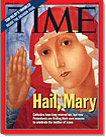
TimecoverTime Magazine is doing a cover story on the Virgin Mary and how she is coming to be regarded in Protestant circles.

For a long time many in Protestant churches (myself among them, back in the day) have downplayed and even dissed the Blessed Virgin, which is rather extraordinary since, y’know, she’s Jesus’ mom.

Well, the times, they are a-changin.’

Partly due to Mel Gibson’s treatment of Mary in The Passion of the Christ, partly due to cooling passions from the Reformation, partly due to Catholic apologetics, and partly due to thoughtful Protestant leaders who have been speaking out on the subject: Mary is now getting more of the respect and devotion she deserves in Protestant circles.

(Even if she does look like she’s doing the "wax on, wax off" move on the Time cover–but, hey, they ain’t Christian: They’s Church of the MSM.)

I’ve been quite surprised at the changes taking place. One Protestant apologist I know speaks very openly about Mary and sounds very Catholic in doing so, even defending titles like Mediatrix on her behalf.

You thus might want to check out this issue of Time at at your local news stand.

OR USE THIS LINK TO EXPLORE THE PARTIAL MATERIAL THEY MAKE AVAILABLE TO NON-SUBSCRIBERS.

(Cowboy hat tip to the reader who sent it!)

Derriere Garde

Hey, everyone! Tim Jones, here. Jimmy has taken a fever (not really! He’s OK! Do not send Get Well prayers) and invited me to guest blog on his excellent site, which I am only too happy to do, though I are not a righter. I’m actually working at being an artist.

I was raised a Baptist (in Alaska), but during my college years (in Arkansas) I found myself adrift in terms of faith. Apparently my Guardian Angel thought I was in need of some serious help, because I ended up becoming friends with this philosophy major who turns out to be a proto-apologist and theologian and who eventually is a major influence on me and my family coming into the Church. Neat! Jimmy is also, as you know, a fun and interesting guy with a fun and interesting blog, so in the interest of keeping your interest I’ll get to the point of this post…

Art, as you may know, had a hard slog through the twentieth century. It passed, literally, from the sublime to the ridiculous and beyond, becoming downright destructive and offensive. But, there has been a move afoot in the last decade or so (known informally as the "Derriere Garde") to revive the traditional techniques and sensibilities of the Great Masters and bring them once again into the living tradition of the present. In other words, great artwork is making a comeback. More and more artists and critics are becoming emboldened to air controversial ideas, such as to suggest that artists should be able to draw beyond a third grade level. The word "talent" has even popped up on occasion.

One of the bright spots in this new/old art movement is the Art Renewal Center (http://www.artrenewal.org). Though they are located, I believe, in New York, their main presence is on the Web, where they maintain a vast online museum of master artworks. Most of the images are available in a high-res format and can be purchased as prints as well. The ARC website also carries a wealth of educational material and articles of interest to artists. Good Stuff. Their site has definitely been an influence on my current artwork as well as on the small gallery/studio/art school that I operate in Rogers, Arkansas (I’ll post some pictures soon). I am working on my own website, as well as a blog, but I find I am more comfortable with a brush than with a keyboard. Give me time.

Two caveats about the ARC site: First, it is graphics-intense, so if you have a slower internet connection (like dial-up), you might find it equally slow to navigate around the site. Secondly, this site carries all kinds of images of classical (and present day) master paintings including some Nekkid People. Be Warned!!

New Guestbloggers!

To everything there is a season: A time to solo-blog and a time to group-blog.

The latter time is now here at JimmyAkin.Org.

In the last year I’ve really worked hard to try to build up the blog and make it an interesting, dynamic place. Of late I have been blogging at least six posts a day (except Saturday), which–since I write them at night–chews up a good bit of my evenings.

I haven’t burned out at that level, but I know that I need to devote time to additional things and that, eventually, I would burn out, at which point I might do what many bloggers do when life and blog begin to clash: go on hiatus. I don’t want to do that, though, nor do I want to cut back on the amount of activity on the blog, so I decided to deal with the matter before I got to the burnout point and ask some guest bloggers to join me.

Thus far, Steve Greydanus of DecentFilms.Com has done some guestblogging, particularly when I’ve been out of town, and he’s more than welcome to stop by and drop in a post any time he wants, but his own writing schedule of film reviews, etc., keeps him too busy to post regularly.

I thus decided to ask a couple of friends if they might be interested in contributing on a regular basis (at least for now), and they said yes! (I may also be adding some more guestbloggers later.)

The first guest blogger I’d like you to get to know is Tim Jones. He’s a long-time friend from Arkansas, who I’ve known since before I was Catholic. In fact, I’ve known him since before I was Christian.

The second is Michelle Arnold, a colleague from Catholic Answers. Michelle is a convert to the faith and an apologist with an uncommonly sharp eye for detail.

I’ll let both of them tell you more about themselves.

I hope y’all will join me in welcoming the two and making them feel at home here on the blog.

I know they got a lot to contribute!

Beware The Ides Of . . . DUCK, JULIUS!

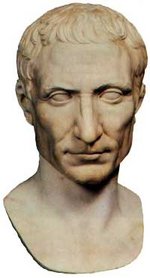
Julius_caesar March 15, 44 B.C.: Julius Caesar is assassinated by the super-hero teamgroup of senators called The Liberators.

Where why:

Romans used to have a king, just like everybody else.

Then they got rid of him and proclaimed themselves a Republic. In fact, that’s where we get the word "republic" from: res publica, which is Latin for "the public thing"–the body that governed Rome after they kicked out the last king, Lucius Tarquinius Superbus ("Tarquin the Proud," no relation to Grand Moff Tarkin).

Tarquin the Proud got kicked out both because he was a big jerk and because he had an immoral son who raped a noblewoman named Lucretia (hence the famous "rape of Lucretia"). Lucretia got revenge by summong the menfolk of her family, telling them what happened, and killing herself. They then took revenge on her behalf by driving the Tarquin house into exile and, subsequently, proclaiming a republic.

Or so the story goes.

The Roman Republic didn’t go swimmingly, though. Its first head was a guy named Lucius Junius Brutus who was, well, "the Lucius Junius Brutus of his race" (a quote from The Mikado) who executed two of his own sons! He didn’t execute all his offspring, though, because one of his descendants, almost five centuries later, was Marcus Junius Brutus.

Marcus Junius Brutus was particular dissatisfied with the events of his own day.

The Republic had proven itself ineffectual in governing (though, one must concede, it had a good run of a number of centuries) and some centralization of power was needed. Having thrown off the shackles of having a king, though, the Romans were not only proud of that fact, they were smug about it. So no king for them. It was a point of honor. (And they were justly afraid about what a king would do.) So they didn’t want to centralize power in the person of just one man.

Instead three guys began unofficially to assume supreme power, and these three guys were known as The Triumvirate (which is based on the Latin for "The Three Guys": trium viri–or, more literally, "the Men of the Three").

That honked a bunch of people off, but what honked even more off was that the Triumvirate proved unstable, with two of the triumviri trying to seize personal power and one kind of sitting out the fight.

The Triumvir who won was none other than Gaius Julius Caesar. He never became emperor (that title went to his successor), but he did get named "dictator for life." (Kewl, huh?)

Well, that was the straw that broke the camel’s back for ol’ Marcus Junius Brutus. He was descended from that guy who executed his own sons, ‘member? And that being the case, killing a cousin like Julius Caesar would be no sweat at all for such as him.

So that’s what he did: He and his Liberator buddies all thought Julius needed killin’, and so when Julius strides in, they stab him! And then they go and stab him twenty-two more times! Just to make sure he’s good an’ dead!

And they did all this on March 15, or the Ides of March (WHAT "IDES" ARE), which history (not just Shakespeare) records Julius as having been warned about by a fortuneteller.

And so they got the Republic back and avoided having a nasty ol’ king.

Well . . . not.

The Republic collapsed into Civil War and eventually there emerged a Second Triumvirate, which proved no more stable than the first and which had two of the triumviri trying to be king and one eventually got his wish, except that the Romans couldn’t bear to call him "king" so they called him "emperor" instead.

Romans, y’see, could have kings as long as they didn’t call them that.

Kinder the way America might one day (certainly not now) have an empire, only we would never be able to call it that.

Countries are funny like that.

Ain’t ancient history a hoot?

Oh, and Julius did apparently die saying something pretty close to "Et tu, Brute" or "Even you, Brutus?"

LEARN MORE THE LAST WORDS OF GAIUS JULIUS CAESAR.

ALSO LEARN ABOUT HOW GAIUS JULIUS CAESAR’S NAME WORKS.
I'm A Deputy!

No, really! I am!

I’ve been duly deputized! Put another way: I done been deputed!

I am not, however, a deputy sheriff or marshal.

I’m a deputy commissioner . . . of marriages.

Here’s the story on that:

Recently a relative and the relative’s fiancee (fiance?) asked me to marry them.

Neither the relative nor the fiance (fiancee?) is Catholic, so there is no requirement of Catholic form and it’s a first marriage for both, so it is presumptively valid in the eyes of the Church.

I was honored to be asked, of course, and you don’t say no to a relative lightly when they ask you something as personal as this, so I also checked and verified that there is no canonical barrier (and there’s not) to a Catholic layman performing such a service under these conditions. In fact, many Catholic lay people are commissioners of marriage working in county courthouses all across the country performing civil but–unless there’s an impediment–valid marriages.

Here’s how that gets applied to me: It turns out that California marriage law is crazy (no, really!) and basically anybody can perform marriage ceremonies.

F’rinstance: If you are an ordained minister of any denomination–even a shaman, a witchdoctor, or a minister of a phony Internet denomination made up purely so people can get tax breaks and marry people and call themselves ministers–then you can do marriages in California. You don’t have to be a resident of California. You don’t even have to tell California that you’re coming in to do a marriage. California maintains no central registry of persons authorized to perform marriages.

Since I’m not an ordained minister (not even of a phony Internet denomination), I’m not going that route, of course.

But wait, there’s more!

If you’re Joe Blow, you can go down to the county courthouse, fill out a form, pay a filing fee, and get appoitned a deputy commissioner of marriage so that you can perform one, specific marriage (whose particulars you describe on the form).

So that’s what I did.

And, as of next week, I’m going to go where (a few) Catholic lay people have gone before and perform a marriage.

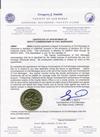
I do get a gold-star, though. It’s the seal on the form commissioning me:

Here’s the appointing document itself in case you’re curious. Figgered most folks have never seen such a thing (I certainly hadn’t). Click to enlarge it.

I’m particularly interested in the fact that it goes on at such length to say the county won’t cover injuries caused to you in the act of performing the marriage and that it also won’t cover injuries you cause others.

Guess there are still more shotgun weddings than I thought there were or something.

I’m A Deputy!

DeputyNo, really! I am!

I’ve been duly deputized! Put another way: I done been deputed!

I am not, however, a deputy sheriff or marshal.

I’m a deputy commissioner . . . of marriages.

Here’s the story on that:

Recently a relative and the relative’s fiancee (fiance?) asked me to marry them.

Neither the relative nor the fiance (fiancee?) is Catholic, so there is no requirement of Catholic form and it’s a first marriage for both, so it is presumptively valid in the eyes of the Church.

I was honored to be asked, of course, and you don’t say no to a relative lightly when they ask you something as personal as this, so I also checked and verified that there is no canonical barrier (and there’s not) to a Catholic layman performing such a service under these conditions. In fact, many Catholic lay people are commissioners of marriage working in county courthouses all across the country performing civil but–unless there’s an impediment–valid marriages.

Here’s how that gets applied to me: It turns out that California marriage law is crazy (no, really!) and basically anybody can perform marriage ceremonies.

F’rinstance: If you are an ordained minister of any denomination–even a shaman, a witchdoctor, or a minister of a phony Internet denomination made up purely so people can get tax breaks and marry people and call themselves ministers–then you can do marriages in California. You don’t have to be a resident of California. You don’t even have to tell California that you’re coming in to do a marriage. California maintains no central registry of persons authorized to perform marriages.

Since I’m not an ordained minister (not even of a phony Internet denomination), I’m not going that route, of course.

But wait, there’s more!

If you’re Joe Blow, you can go down to the county courthouse, fill out a form, pay a filing fee, and get appoitned a deputy commissioner of marriage so that you can perform one, specific marriage (whose particulars you describe on the form).

So that’s what I did.

And, as of next week, I’m going to go where (a few) Catholic lay people have gone before and perform a marriage.

I do get a gold-star, though. It’s the seal on the form commissioning me:

Commission2

Here’s the appointing document itself in case you’re curious. Figgered most folks have never seen such a thing (I certainly hadn’t). Click to enlarge it.

Commission1_1 I’m particularly interested in the fact that it goes on at such length to say the county won’t cover injuries caused to you in the act of performing the marriage and that it also won’t cover injuries you cause others.

Guess there are still more shotgun weddings than I thought there were or something.

Marcion & The Canon

A reader writes:

I have become reaquainted with a friend from highschool and we have had a couple of conversations of a religious nature. I have just recently come back to the Catholic faith and have been studying diligently but feel inadequate to answer some of his questions. He recently wrote to me regarding his criticisms of the creation of the Bible.

He states that the process of collecting and consolidating Scripture was launched when a rival sect produced it’s own quasi-biblical canon. Around 140 a Gnostic leader named Marcion began spreading a theory that the New and Old Testaments didn’t share the same God. Marcion argued that the Old Testament’s God represented law and wrath while the New Testament’s God, represented by Christ, exemplified love. As a result Marcion rejected the Old Testament and the most overtly Jewish New Testament writings, including Matthew, Mark, Acts and Hebrews. He manipulated other books to downplay their Jewish tendencies. Though in 144 the church in Rome declared his views heretical, Marcions’s teaching sparked a new cult.

Challenged by Marcion’s threat, church leaders began to consider earnestly their own views on a definitive list of Scriptural books including both the Old and New Testaments. He goes on to say that he thinks the process was flawed.

Would you please comment on this and possibly refer me to some writings on this subject? Your thoughts on this matter would be greatly appreciated.

This is a case of "right premises, wrong conclusions."

It’s true that Marcion rejected the Old Testament, holding that it had a different god, and that he produced an edited version of the New Testament (consisting of an edited version of the Gospel of Luke and edited versions of Paul’s epistles) that he had stripped the overtly Jewish passages out of.

LEARN MORE ABOUT MARCION HERE.

It’s also true (or thought to be true) that Marcion’s release of his mutilated canon helped spur the solidification of the real canon by the Church.

But . . . so what?

God often uses heretics to spur the Church to codify in explicit form what was handed down from Christ and the apostles. The Church tends to deal with things in a pastoral manner, meaning that if something hasn’t become a problem, it doesn’t come down on it with the full force of its teaching authority.

The fact is: Being challenged makes people get more explicit and precise about their beliefs. As long as they aren’t challenged on them, they aren’t forced to think through how to defend them and precisely what their boundaries are.

In the beginning, Jesus handed on certain Scriptures as divine to the apostles (i.e., the Scriptures of the Old Testament), and the apostles and their associates wrote new Scriptures (i.e., the New Testament0, which they handed on to the Church.

As long as nobody was challenging these Scriptures with a rival set, there was little need to write out a formal list of precisely what they included.

But when Marcion comes along and starts chucking out large portions of Scriptures known to have been handed on from Jesus and the apostles, the Church needed to start making explicit statements on the point in order to protect the faithful from absorbing his harmful ideas.

It thus reaffirmed in a more precise form what had always been believed.

That’s what typically happens when a new heresy crops up: The Church his forced to articulate what it has always believed in a more forceful and precise way.

Marcion wasn’t the only gent who furthered this process regarding the canon, either. In the second and third centuries lots of Gnostic individuals wrote phony gospels that they tried to pass off as the genuine article. Since these disagreed with the doctrine that had been handed down from Christ and the apostles by Tradition, and since they showed up all of a sudden, with no tradition of their having been used in the churches as handed down from the apostles, it was easy to spot them as fakes. But to prevent ordinary individuals from being taken in by them, the bishops felt it prudent to start issuing lists of the authentic Scriptures and contrasting them with the new-fangled forgeries.

Again: What had always been believed was being reaffirmed more forcefully and precisely.

None of this gives us any reason to doubt the canon or think that the process leading to it was flawed. The process was superintended by the Holy Spirit, who inspired the Scriptures, to make sure that the Church ended up identifying the right ones. Individual bishops, not possessing the charism of infallibility, might make mistakes, but the Magisterium of the Church as a whole (which does possess the charism of infallibility), could not err once it defined the matter.

That was some centuries later, but even before then the fact that Marcion’s scripture and the Gnostic scriptures were rejected as incompatible with what had been handed down from Christ and the apostles shows that the process of preserving and passing down the authentic Scriptures was working.

Marcion & The Canon

A reader writes:

I have become reaquainted with a friend from highschool and we have had a couple of conversations of a religious nature. I have just recently come back to the Catholic faith and have been studying diligently but feel inadequate to answer some of his questions. He recently wrote to me regarding his criticisms of the creation of the Bible.

He states that the process of collecting and consolidating Scripture was launched when a rival sect produced it’s own quasi-biblical canon. Around 140 a Gnostic leader named Marcion began spreading a theory that the New and Old Testaments didn’t share the same God. Marcion argued that the Old Testament’s God represented law and wrath while the New Testament’s God, represented by Christ, exemplified love. As a result Marcion rejected the Old Testament and the most overtly Jewish New Testament writings, including Matthew, Mark, Acts and Hebrews. He manipulated other books to downplay their Jewish tendencies. Though in 144 the church in Rome declared his views heretical, Marcions’s teaching sparked a new cult.

Challenged by Marcion’s threat, church leaders began to consider earnestly their own views on a definitive list of Scriptural books including both the Old and New Testaments. He goes on to say that he thinks the process was flawed.

Would you please comment on this and possibly refer me to some writings on this subject? Your thoughts on this matter would be greatly appreciated.

This is a case of "right premises, wrong conclusions."

It’s true that Marcion rejected the Old Testament, holding that it had a different god, and that he produced an edited version of the New Testament (consisting of an edited version of the Gospel of Luke and edited versions of Paul’s epistles) that he had stripped the overtly Jewish passages out of.

LEARN MORE ABOUT MARCION HERE.

It’s also true (or thought to be true) that Marcion’s release of his mutilated canon helped spur the solidification of the real canon by the Church.

But . . . so what?

God often uses heretics to spur the Church to codify in explicit form what was handed down from Christ and the apostles. The Church tends to deal with things in a pastoral manner, meaning that if something hasn’t become a problem, it doesn’t come down on it with the full force of its teaching authority.

The fact is: Being challenged makes people get more explicit and precise about their beliefs. As long as they aren’t challenged on them, they aren’t forced to think through how to defend them and precisely what their boundaries are.

In the beginning, Jesus handed on certain Scriptures as divine to the apostles (i.e., the Scriptures of the Old Testament), and the apostles and their associates wrote new Scriptures (i.e., the New Testament0, which they handed on to the Church.

As long as nobody was challenging these Scriptures with a rival set, there was little need to write out a formal list of precisely what they included.

But when Marcion comes along and starts chucking out large portions of Scriptures known to have been handed on from Jesus and the apostles, the Church needed to start making explicit statements on the point in order to protect the faithful from absorbing his harmful ideas.

It thus reaffirmed in a more precise form what had always been believed.

That’s what typically happens when a new heresy crops up: The Church his forced to articulate what it has always believed in a more forceful and precise way.

Marcion wasn’t the only gent who furthered this process regarding the canon, either. In the second and third centuries lots of Gnostic individuals wrote phony gospels that they tried to pass off as the genuine article. Since these disagreed with the doctrine that had been handed down from Christ and the apostles by Tradition, and since they showed up all of a sudden, with no tradition of their having been used in the churches as handed down from the apostles, it was easy to spot them as fakes. But to prevent ordinary individuals from being taken in by them, the bishops felt it prudent to start issuing lists of the authentic Scriptures and contrasting them with the new-fangled forgeries.

Again: What had always been believed was being reaffirmed more forcefully and precisely.

None of this gives us any reason to doubt the canon or think that the process leading to it was flawed. The process was superintended by the Holy Spirit, who inspired the Scriptures, to make sure that the Church ended up identifying the right ones. Individual bishops, not possessing the charism of infallibility, might make mistakes, but the Magisterium of the Church as a whole (which does possess the charism of infallibility), could not err once it defined the matter.

That was some centuries later, but even before then the fact that Marcion’s scripture and the Gnostic scriptures were rejected as incompatible with what had been handed down from Christ and the apostles shows that the process of preserving and passing down the authentic Scriptures was working.

ComBox Problem Query

Down yonder a kindly reader points out that there’s a problem with the comboxes: They aren’t remembering who folks are, so they have to re-type their name, e-mail addresses, etc.

This is a problem I’ve been having for a while, but . . . I thought it was just me.

I got a new computer recently and I haven’t downloaded Mozilla or Firefox yet, so I’ve been using Internet Explorer and I thought I’d just had a setting wrong or something.

Then the kindly reader mentioned he’s having the same problem and a buncha folks chimed in.

Sooooo . . . I contacted TypePad and asked what the deal was. They wanted to know what browser I and others are using since their techs have spotted the problem and are working to resolve it for IE. They hope to have it fixed soon.

Is anybody encountering the problem who is not using IE?