Oh, The Irony!

Today is also another significant anniversary, this one involving not the intersection between religion and contemporary (textual) scholarship but the intersection between (then) science-fiction and contemporary history.

  • The Nautilus is the name of the fictional submarine in Jules Verne’s 1870 science-fiction novel 20,000 Leagues Under The Sea.
  • The Nautilus is the name of a real-life, nuclear-powered American submarine (USS Nautilus, SSN-571).

A league is 3 miles, so 20,000 leagues is 60,000 miles.

Now for the irony:

On 4 February 1957, Nautilus logged her 60,000th nautical mile, matching the endurance of the fictional Nautilus described in Jules Verne’s novel 20,000 Leagues Under the Sea.

LEARN MORE.

READ THE NOVEL.

Aleph Found!

Alephfound146 year ago today, Aleph was found.

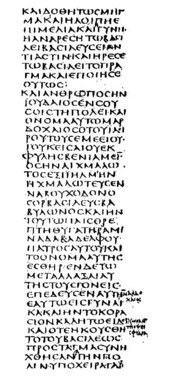
Aleph is the first letter of the Hebrew alphabet. It is also the symbol used to designate Codex Sinaiticus, which is the Aleph found in 1859.

Codes Sinaiticus is a fourth-century uncial manuscript of the entire Greek New Testament (as well as parts of the Old Testament and other works).

(An uncial manuscript is one written in all capital letters, which is basically what all manuscripts were before the invention of lower-case letters.)

Codex Sinaiticus is one of the two most important manuscripts in New Testament textual criticism (the study of which variants in New Testament manuscripts were most likely in the original–now lost–documents). The other most important manuscript is Codex Vaticanus.

Sinaiticus was found by Constantin von Tischendorf in a monastery (the Monastery of St. Catherine) at the ostensible site of Mt. Sinai (hence the name) in Egypt.

The text to the left is taken from Codex Sinaiticus.

(Incidentally, a codex is the modern form of a book that we use today, with pages attached to a spine, rather than the older form of book with pages dewn end-to-end, making a scroll. Christians popularized the codex or modern book.)

Codex Sinaiticus helped revolutionize the study of the textual history of the New Testament.

SSPX Confessions

Down yonder, a reader writes:

I was listening to the program, and I have a further question in
response to your answer to this question "Can priests in the Society of
St. Pius X validly celebrate the sacrament of penance? How about those
in the Charismatic Episcopal Church?"

Considering, as you said, the fact that the SSPX priests would not
have faculties to absolve sins from the Bishop, wouldn’t "Ecclisia
Supplet" (spelling?) kick in, so long as they were unaware of the
sacramental defect?

The limits of the principle of ecclesia supplet ("the Church supplies") are spelled out in the Code of Canon Law as follows:


Can. 144

§1. In factual or legal common error and in positive and probable doubt of law or of fact, the Church supplies executive power of governance for both the external and internal forum.

§2. The same norm is applied to the faculties mentioned in cann. 882, 883, 966, and 1111, §1.

The immediately relevant part of this canon to the situation of confessions is  §2, which applies the principles of §1 to the faculties for hearing confessions mentioned in Canon 966. In order for those faculties to be supplied, the conditions mentioned in §1 must be satisfied (mutatis mutandis for the fact we are talking about sacramental faculties rather than the power of governance).

Per §1 (via §2), one of two situations must exist for the Church to supply the missing faculties in a particular case. Either:

  1. There is a factual or legal common error regarding whether the faculties exist, or
  2. There is a positive and probable doubt of law or of fact regarding whether the faculties exist.

In the case of whether an SSPX priest has faculties, there is no question of law but only a question of fact: Does the priest have faculties from the competent authority to hear the confessions of the faithful in the local area?

The only authority comptent to grant the faculty of hearing the confessions of the faithful in the local area is a local ordinary:

Can. 969
§1. The local ordinary alone is competent to confer
upon any presbyters whatsoever the faculty to hear the confessions of
any of the faithful.

The diocesan bishop is one such ordinary, though a given diocese may have additional ordinaries capable of granting faculties.

This focuses the question as follows: Is there (a) a common error or (b) a positive and probable doubt as to whether a local ordinary of the diocese has granted an SSPX priest the faculty of hearing the confessions of the faithful?

A common error is a term of art referring to an error affecting a certain community whereby a reasonable and prudent person would give his assent to the error (see the green CLSA commentary on Can. 144 for further elaboration on this point). Even though the people attending an SSPX chapel form a community capable of having a common error, it does not appear that a common error exists on this point since it is implausible on its face that a local ordinary in communion with the pope would grant faculties to an SSPX priest. This means that a reasonable and prudent person would not give his assent to the idea that the local ordinary has done so, and thus there does not appear to be a common error.

Is there a positive and probably doubt as to this question? It does not appear so. A doubt is a situation in which a person cannot make a decision between contradictory conclusions. In this case the doubt would involve a person being unable to make a decision about whether the local ordinary has granted the priest faculties. For the faculties to be supplied via ecclesia supplet, the doubt would have to be positive and probable.

A positive doubt is one in which there are arguments both for and againt the idea in question. It does not appear, apart from very bizarre circumstances, that there would be any arguments supporting the idea that the local ordinary has supplied faculties to an SSPX priest, meaning that any such doubt on the part of the faithful would not be positive.

Given the massive improbability of the local ordinary doing so, it does not appear that it would be a probable doubt, either.

Thus in the absence of a doubt that is both positive and probable, and in the absence of a common error, the principle of ecclesia supplet would not be engaged and the Church would not supply the faculties to an SSPX priest.

There is also a further problem with the idea that the Church might supply faculties: namely, that the Church supplies missing faculties to its own ministers and not to priests in a state of schism. Thus it does not supply faculties to Eastern Orthodox priests. Those priests, never having been baptized or received into the Latin Church, are not subject to the Latin Church’s canon law (Can. 11) and thus not required to have faculties per Can. 966. SSPX priests, however, typically have been baptized or received into the Latin Church and thus are required to have faculties per Can. 966.

They ain’t got ’em.

Thus it is going to be hard to build a case for ecclesia supplet validating the confessions heard by SSPX priests.

The reader also asks:

Futher, if it did kick in, they would be absolved because the
"Church provides the grace", but it would not be considered a valid
sacrament anyway right? even though it had the sacramental effect?

If (contrary to what we have said above) ecclesia supplet did kick in, the people would be validly absolved–not because the Church supplies grace directly but because it supplies faculties for the celebration of a sacrament–and the sacrament would be valid. What it would not be is licit (lawful). In cases where ecclesia supplet allows a (non-schismatic) priest who does not have faculties from the local ordinary to hear confessions, it is a valid but illicit (unlawful) celebration of the sacrament.
January 29, 2004 Show

LISTEN TO THE SHOW.

DOWNLOAD THE SHOW.

HIGHLIGHTS:

  • Is it permissible for someone not
    ordained to give a short"commentary" after the priest delivers the homily?
  • After death, what happens to a person’s guardian angel?
  • Does the Church support illegal immigration? 
  • In the past few decades, is the Church’s language harsher toward the Society of St. Pius X than toward Protestants?  If so, why?
  • To whom should one address a parish’s questionable liturgical practices: the pastor or the bishop?
  • What is the proper posture for the congregation after Communion? Must that posture be uniform?
  • Does the embryological development of the human fetus prove Darwinism?
  • What was the intended nature of the marriage of Mary and Joseph? Did Joseph have children from a previous marriage?
  • Does mortal sin not repented of result in damnation?  Is
    Confession always required for one to return to a state of grace?
  • Is salvation possible for non-Christians?
  • Is Mel Gibson a member of a specific Catholic sect?  Would this affect how Jews react to The Passion of the Christ?
  • Was a dietary law imposed on Gentile Christians in Acts 15:29?  Is it still in effect?  If not, how is this reconcilable with it being a decision of Holy Spirit?

  • Commentary on the films The Passion of the Christ and The Gospel of
    John.
  • When did the tradition of godparents start?
  • How does one know if one’s contrition is perfect?  Is perfect contrition "difficult" to obtain?
  • Can the Anglican Communion claim apostolic succession?

Annyong Haceyo, North Korea!

With one member of the Axis of Evil (Iraq) recently taken out of the axis, with another member (Iran) hurtling toward a resolution of some kind, what’s up with the third member (North Korea)?

It seems that Kim Jong-il’s worker’s paradise is dissolving around him.

While tour guides continue to give tours explaining the virtues of North Korean Communism, the secret police have started stockpiling cash in advance of coming disasters, there are (literal!) shootouts among members of the ruling family, and the Christian underground is smuggling increased numbers of North Koreans to safety.

Change is in the (bitterly cold North Korean) wind.

GET THE STORY.

Aristotle On Youth

Speaking of Aristotle’s (blindingly obvious) observation that young people are reckless and like to have fun, here’s his description of young men and their character. Sound like anybody you know (or may have been)?

Young men have strong
passions, and tend to gratify them indiscriminately. Of the bodily
desires, it is the sexual by which they are most swayed and in which
they show absence of self-control.

They are changeable and fickle in
their desires, which are violent while they last, but quickly over:
their impulses are keen but not deep-rooted, and are like sick people’s
attacks of hunger and thirst.

They are hot-tempered, and quick-tempered,
and apt to give way to their anger; bad temper often gets the better of
them, for owing to their love of honour they cannot bear being slighted,
and are indignant if they imagine themselves unfairly treated.

While
they love honour, they love victory still more; for youth is eager for
superiority over others, and victory is one form of this.

They love both
more than they love money, which indeed they love very little, not
having yet learnt what it means to be without it — this is the point of
Pittacus’ remark about Amphiaraus.

They look at the good side rather
than the bad, not having yet witnessed many instances of wickedness.
They trust others readily, because they have not yet often been cheated.

They are sanguine; nature warms their blood as though with excess of
wine; and besides that, they have as yet met with few disappointments.

Their lives are mainly spent not in memory but in expectation; for
expectation refers to the future, memory to the past, and youth has a
long future before it and a short past behind it: on the first day of
one’s life one has nothing at all to remember, and can only look
forward.

They are easily cheated, owing to the sanguine disposition just
mentioned.

Their hot tempers and hopeful dispositions make them more
courageous than older men are; the hot temper prevents fear, and the
hopeful disposition creates confidence; we cannot feel fear so long as
we are feeling angry, and any expectation of good makes us confident.

They are shy, accepting the rules of society in which they have been
trained, and not yet believing in any other standard of honour.

They
have exalted notions, because they have not yet been humbled by life or
learnt its necessary limitations; moreover, their hopeful disposition
makes them think themselves equal to great things — and that means
having exalted notions.

They would always rather do noble deeds than
useful ones: their lives are regulated more by moral feeling than by
reasoning; and whereas reasoning leads us to choose what is useful,
moral goodness leads us to choose what is noble.

They are fonder of
their friends, intimates, and companions than older men are,  because they like spending their days in
the company of others, and have not yet come to value either their
friends or anything else by their usefulness to themselves.

All their
mistakes are in the direction of doing things excessively and
vehemently. They disobey Chilon’s precept by overdoing everything, they
love too much and hate too much, and the same thing with everything
else.

They think they know everything, and are always quite sure about
it; this, in fact, is why they overdo everything.

If they do wrong to
others, it is because they mean to insult them, not to do them actual
harm.

They are ready to pity others, because they think every one an
honest man, or anyhow better than he is: they judge their neighbour by
their own harmless natures, and so cannot think he deserves to be
treated in that way.

They are fond of fun and therefore witty, wit being
well-bred insolence [Rhetoric II:12:1389a-b].

Young People + Not-Fully-Formed-Brain = Recklessness!

Y’know how your auto insurance cost a lot more before you were 25 (even if your parents paid it at the time)?

And how you can’t rent a car until you’re 25?

Well, this is because folks under that age have way more car crashes than afterwards.

Teenagers are four times as likely as older
drivers to be involved in a crash and three times as likely to die in
one, according to the Insurance Institute for Highway Safety.

This likely has a biological basis–in the brain.

Contrary to the initial expectations of some (obviously clueless) NIH researchers, brain development does not peak by age 18.

"We’d thought the highest levels of physical and brain maturity were
reached by age 18, maybe earlier — so this threw us," said Jay Giedd,
a pediatric psychiatrist leading the study, which released its first
results in April. That makes adolescence "a dangerous time, when it
should be the best."

I don’t know what kind of pediatric psychiatry idealization-of-youth rhetoric this guy has been smoking, but he’s clearly out of touch.

People as far back as Aristotle (and before!) have pointed out that young people are reckless and like to have fun, and that’s a dangerous combination.

In any event, Dr. Giedd has to be given credit for being willing to recognize what their new neurological data showed them: A part of the brain that inhibits risk-taking behavior ain’t fully formed until age 25; hence, your auto insurance rates don’t got down until that age and you don’t get to rent a car until that age.

In a related study, young people of different ages were asked to play a simulated driving video game in which the goal was to get through a particular course as quickly as possible while not hitting anything. They also brought friends to the event and were tested both with and without their friends present.

The study showed that, with the presence of youthful companions, the young people were more responsible as they had others’ lives riding (virtually) of what they did as drivers, and so they took more precautions, right?

Ha!

Of course not! They were worse drivers with friends present.

An interesting aspect of all this is the gap between the onset of puberty and the maturing of the brain’s risk-inhibiting functions:

Temple’s Steinberg said the NIH/UCLA research supports his theory that
teen recklessness is partly the result of a critical gap in time —
starting with the thrill-seeking that comes in puberty and ending when
the brain learns to temper such behavior. Since children today reach
puberty earlier than previously, about age 13, and the brain’s
reasoning center doesn’t reach maturity until the mid-twenties,
Steinberg said, "This period of recklessness has never been as long as
it is now."

GET THE STORY.


A Not-So-Wild-Man Of Borneo?

A reader writes:

I got your email address from your website, jimmyakin.org. I
started listening to the Catholic Answers Life by downloading files
from the show archive recently (sorry, this may have nothing to do with
your website) . As a Catholic, I m very keen to learn more about the
faith. 

Since I m in Malaysia (State of Sabah, North Borneo),
Ah! Apa kabar? Saya bisa bicara bahasa Melayu–sedikit-sedikit saja–though I’m guessing you may be Chinese (in which case, Ni hao!).

I would like
to know if it is possible for me to ask questions through the internet.

Sure! You’re welcome to ask them here, though I can’t promise to answer them all. For additional help, I’d recommend going to the Catholic web boards at forums.catholic.com and forums.catholic-convert.com and (if you prefer bahasa Indonesia) ekaristi.org.
By the way, if you’re going to reply this email, I would like to
ask you just one question which is always on my mind. The question is
‘Why does God allow division among Christians (Catholic, Protestant,
Orthodox, etc.), or did He?’ Could you suggest any books/references on
this? (sorry, that’s more than 1 question)

I’m not sure that I can recommend any books on why God allows people to have disagreements in the Christian community, but I hope that the following thoughts may be helpful:

  1. The problem has been with us since the first century. Jesus prayed that his disciples would be one (John 17), knowing that divisions would arise among them. If you read 1 Corinthians, especially chapters 1-3, it’s very clear that there were divisions in the early Christian community, and St. Paul writes against these divisions.
  2. Since the existence of divisions in the Christian community is evil, this makes the existence of such divisions a part of the overall "problem of evil" (i.e., why God allows evil in general).
  3. We do not have a complete answer to why God allows evil, but since he always has adequate reasons for what he does, we can reason that there must be an adequate reason for God to allow this.
  4. Knowing that, we can speculate about what the reson or reasons he allows evil are.
  5. One of the most popular suggestions for why he allows evil in order to allow a certain kind of free will to exist in this life, the kind of free will whereby he allows people to make a free choice for good or evil. Letting them do this means letting them sometimes choose evil, which means allowing the existence of evil.
  6. While it is not certain that this is the reason God allows evil, it does fit with the facts that in this life people do sometimes choose evil and God does allow it.
  7. It also fits with the fact that the divisions in the Christian community have arisen because different people (the founders of different sects, in particular) have exercised their free will in such a way that they have left the unity of the Catholic Church and founded their own communities.

Hope this helps, and hope you’ll visit and participate in the blog regularly!

January 19, 2004 Show

LISTEN TO THE SHOW.

DOWNLOAD THE SHOW.

HIGHLIGHTS:

  • At the conclusion of an exorcism, is the
    expulsion of the demon apparent?  Are there exorcists present in every diocese?
  • Did Bishop Raymond Burke recently assert that all pro-abortion politicians should refrain of Communion?  Why single out abortion as a Communion disqualification?
  • Countering the Protestant notion of salvation by "faith
    alone."
  • Where in scripture would one find the distinction between mortal and venial sins?
  • Can one prove the truth of transubstantiation over consubstantiation?
  • Can priests in the Society of St. Pius X validly celebrate the sacrament of penance?  How about those in the Charismatic Episcopal Church?
  • How many precepts of the Church are there?  Can they change?
    Who determines them?
  • Is confession required before Communion if one misses Mass?  What are valid reasons for missing Mass?
  • Must there be "full" knowledge or consent for a sin to be
    mortal? What if an individual knows that an act constitutes grave matter in the eyes of the Church yet chooses to ignore that fact?
  • What Christian sects are custodians of the Church of the Holy Sepulchre?  Would the marriage of a Catholic in a Greek Orthodox church be valid?
  • What is the minimum age for an extraordinary minister of Holy
    Communion?
  • Is Catholic Family News a trustworthy publication?
  • What are the "Lost Gospels"?
  • To which scripture passages do proponents of the Rapture appeal? How should those same passages be properly interpreted?