Harriet Tubman (Underground Railroad) – Jimmy Akin’s Mysterious World

Harriet Tubman is famous as the escaped slave who became a conductor on the Underground Railroad to freedom. But Jimmy Akin and Dom Bettinelli also explore her reported visions and paranormal experiences and what could have caused them.

Help us continue to offer Jimmy Akin’s Mysterious World. Won’t you make a pledge at SQPN.com/give today?

Links for this episode:

Mysterious Headlines

This Episode is Brought to You By:
Jimmy Akin’s Mysterious World is brought to you in part through the generous support of Aaron Vurgason Electric and Automation at AaronV.com. Making Connections for Life for your automation and smart home needs in north and central Florida.

Catechism Class, a dynamic weekly podcast journey through the Catechism of the Catholic Church by Greg and Jennifer Willits. It’s the best book club, coffee talk, and faith study group, all rolled into one. Find it in any podcast directory.

Fiorvento Law, PLLC, specializing in adult guardianships and conservatorships, probate and estate planning matters. Accepting clients throughout Michigan. Taking into account your individual, healthcare, financial and religious needs. Visit FiorventoLaw.com

Deliver Contacts, offering honest pricing and reliable service for all your contact lens needs. See the difference at delivercontacts.com.

Want to Sponsor A Show?
Support StarQuest’s mission to explore the intersection of faith and pop culture by becoming a named sponsor of the show of your choice on the StarQuest network. Click to get started or find out more.

Direct Link to the Episode.

Subscribe on iTunes. | Other Ways to Subscribe.

What Is Manifesting, and Does It Work?

There’s a pop culture buzzword you may have encountered: manifesting.

It’s discussed on social media sites and by self-help, lifestyle, and New Age gurus.

This isn’t surprising. People are always looking for ways to better their condition, and there are cultural fads in which people latch on to specific words and phrases that become “the hot new thing” for a time.

To appraise a cultural phenomenon, we need to look past trendy terms and examine the underlying substance. So, what is “manifesting”?

The current use of the term is too new to appear in standard dictionaries, but Wikipedia says manifestation refers to “self-help strategies intended to bring about a personal goal, primarily by focusing one’s thoughts upon the desired outcome. . . . While the process involves positive thinking, or even directing requests to ‘the universe,’ it also involves action-steps on the part of the individual.”

An article on Vox.com cites the following as examples:

On TikTok, teenagers share stories about how “scripting,” or repeatedly writing down a wish, caused a crush to finally text them back. On YouTube, vloggers lead tutorials on how to properly manifest your dream future. On Instagram, someone will write that $20,000 will soon land in your hands, and all you have to do is comment “YES.” On Twitter, [extreme fans] will, ironically or not, attempt to manifest the release of a new Lorde album.

It’s easy to see these examples as superstitious. Superstition involves attributing too much efficacy to something.

Attributing too much efficacy to a remedy (“Eat this one superfood and you’ll lose your excess weight!”) is a form of scientific superstition. Attributing too much efficacy to a prayer (“Say this prayer three times; it never fails!”) is a form of religious superstition (CCC 2111).

“Just comment ‘YES’ and you’ll get $20,000” and “Write down your wish repeatedly and the boy you like will text you back” easily can be regarded as superstitious.

However, if it was obvious that attempts at manifesting a particular outcome never work, the practice would not be trendy. Even if most attempts to manifest fail, there needs to be enough plausibility and enough success for people to retain interest in the practice.

How might we explain that? We need to consider two kinds of causes that might produce success: normal and paranormal ones.

Random chance is an obvious possible natural cause. Maybe your boyfriend was going to text you back anyway, and he just happened to do so shortly after you tried to manifest this, lending plausibility to the idea that your manifesting efforts were the cause.

However, just because one thing happens after another doesn’t mean that was its cause. In logic, that idea is known as the post hoc ergo proper hoc fallacy (Latin, “After this, therefore because of this”). Or, as they say in scientific circles, “Correlation is not causation.”

Natural causes also can relate to manifesting in other ways. If you decide—with respect to a goal—that you’re going to think positive and act positive, that can help you achieve the goal.

Thinking and acting positively can make you more likable, and that can open doors and help remove obstacles. Similarly, self-confident action toward a goal can help you become “the little engine that could” in achieving it.

What about the paranormal aspects of manifesting? Here we need to differentiate more carefully than practitioners of manifestation may commonly do. What does it mean to ask “the universe” to manifest some desired goal?

It could mean that there are aspects of the universe and human nature that allow a human being to increase the likelihood of something happening by “positive thinking” or willing it to happen.

If humans have an ability to influence things in the world just by thinking about or willing them, then this would be a natural ability (i.e., one built into human nature), but it is not an ability recognized by mainstream science, making it some kind of psychic ability. In parapsychological terms, it would be classified either as a form of remote influencing or as a form of psychokinesis (mind over matter).

On the other hand, someone practicing manifestation may also be open to God or some other spirit taking a hand in helping them achieve their goal. In this case, the effect would be supernatural since it would be above (Latin, super) what human nature is capable of doing.

Could psychic functioning be involved in cases of manifestation? A knowledge of the history of Catholic thought on this subject would not rule out the possibility.

Doctors of the Church like St. Augustine and St. Thomas Aquinas held that God built weak abilities into human nature that today we would call psychic.

For example, both Augustine and Aquinas believed in precognition (Aquinas called it “natural prophecy,” to distinguish it from the supernatural prophecy God gives; see Disputed Questions on Truth 12:3).

More to the point, Aquinas believed that “when a soul is vehemently moved to wickedness,” it can physically harm another person. This was his explanation for the evil eye (ST I:117:3 ad 2; II-II:96:3 ad 1).

Aquinas didn’t discuss the reverse of this (i.e., could a soul vehemently moved by love physically help a person, such as healing them), but he’s talking about psychokinesis.

More recent Catholic authors—such as Fr. Alois Wiesinger (1885-1955)—have suggested that what today are considered psychic powers are the remnants of the “preternatural gifts” Adam and Eve enjoyed before the fall.

This is not to say that psychic functioning exists. It is simply to say that Catholic tradition has recognized its possible existence, and so the matter would need to be considered and the evidence for and against it evaluated.

When it comes to supernatural causation, this could play a role. Suppose a person is suffering in a terrible situation and uses manifestation to cry out for help, being open to God’s help. In this case, their efforts would be a kind of implicit, confused prayer.

Fortunately, God loves us even when we’re confused and aren’t thinking clearly about him. As a result, God might have mercy on such a person and intervene. God “sends rain on the just and the unjust” (Matt. 5:45).

However, there also is danger. Suppose a person is trying to manifest a sexual encounter outside of marriage with someone they’re attracted to. God isn’t going to help them with that, because the goal is evil. However, a demon might intervene to foster the parties’ temptations.

This leads us to the two fundamental problems with manifesting. First, there is a tremendous risk here of superstition—of attributing way more efficacy to it than is warranted—and second, it isn’t clearly thought out and doesn’t make the needed distinctions.

In other words, thinking positively, having goals, and taking concrete steps toward them are good. But don’t attribute too much efficacy to these things. And if you’re going to invoke superhuman powers, make sure you’re talking specifically to God (or his angels or saints), that you’re pursuing a morally licit goal, and that the result is dependent on God’s will rather than your efforts.

Once a Catholic, Always a Catholic?

There’s an old saying, “Once a Catholic; always a Catholic,” but what does this mean?

It could be taken to mean that a person raised in a devout Catholic family and culture will always carry aspects of this heritage, even if he stops practicing his faith.

For example, in Ireland there are accounts of people being asked whether they’re Catholic or Protestant, and when they reply, “I’m an atheist,” the response is, “Yes, but are you a Catholic atheist or a Protestant atheist?”

While the saying could be understood in terms of the culture one belongs to, it is often understood another way—that it’s literally impossible to stop being a Catholic even if you renounce the Faith and adopt another.

Is this true?

The matter is more complex than you might think.


Mystici Corporis

In 1943, Bl. Pius XII released the encyclical Mystici Corporis, in which he articulated membership in the Catholic Church this way:

Actually only those are to be included as members of the Church who have been baptized and profess the true faith, and who have not been so unfortunate as to separate themselves from the unity of the body, or been excluded by legitimate authority for grave faults committed (n. 22).

This created a bright line between “members” of the Church and others, and for membership it was required that one had not “separated themselves from the unity of the body” nor have been “excluded by legitimate authority for grave faults committed.”

This directly contradicts a literal interpretation of “Once a Catholic, always a Catholic.”

If you can separate yourself from unity or if legitimate authorities can exclude you for grave faults so that you no longer qualify as a “member” of the Church, then you can obviously cease to be Catholic.

You would still carry the indelible marks on your soul of baptism and confirmation (CCC 1280, 1317), but you would no longer be a member of the Church and thus not a Catholic.


Lumen Gentium

In its 1964 constitution Lumen Gentium, the Second Vatican Council took a different approach. Instead of speaking in terms of membership, it spoke of “full incorporation” and said:

They are fully incorporated in the society of the Church who, possessing the Spirit of Christ accept her entire system and all the means of salvation given to her, and are united with her as part of her visible bodily structure and through her with Christ, who rules her through the supreme pontiff and the bishops.

The bonds which bind men to the Church in a visible way are profession of faith, the sacraments, and ecclesiastical government and communion.

He is not saved, however, who, though part of the body of the Church, does not persevere in charity.

He remains indeed in the bosom of the Church, but, as it were, only in a “bodily” manner and not “in his heart” (n. 14).

The Council also stated that catechumens are already “joined” with the Church (n. 14), that baptized non-Catholics are “linked” with the Church (n. 15), and that the unevangelized are “related in various ways to the people of God” (n. 16).

Lumen Gentium thus articulates multiple ways in which one can be linked to the Church. If you have all the links (including the virtue of charity that corresponds to the state of grace), then you are said to be “fully incorporated.”

This is another way of covering the same basic ground that Pius XII did, for he also acknowledged a variety of things that linked one to the Church.

However, Lumen Gentium does not identify a particular set of conditions needed to be met for “membership” and prefers to put the accent on degrees of incorporation and linkage.

As a result, in the post-Conciliar era, magisterial documents have tended to speak in terms of degrees of communion with the Church rather than membership, with those who have committed offenses like heresy, apostasy, and schism not being in “full communion” with the Church.


Heresy, Apostasy, and Schism

According to the 1983 Code of Canon Law:

Heresy is the obstinate denial or obstinate doubt after the reception of baptism of some truth which is to be believed by divine and Catholic faith; apostasy is the total repudiation of the Christian faith; schism is the refusal of submission to the Supreme Pontiff or of communion with the members of the Church subject to him (can. 751).

Anyone committing these offenses would gravely injure their status with respect to the Church and certainly would no longer be in full communion.

But would they cease to be Catholic?

Certainly, the person himself might no longer identify as a Catholic. For example, if a person decided to reject the dogmas that the Church has defined and joined a Protestant church, he would no longer consider himself a Catholic but a Protestant.

Ceasing to identify as a Catholic would be even more obvious in the case of an apostate, for to commit that one must entirely renounce Christianity and be willing to say, “I am no longer a Christian.”

Some schismatics might no longer identify as Catholic (e.g., someone who joined an Orthodox church), but others might still claim to be Catholic (e.g., sedevacantists).

Would they still be Catholics from “the Church’s perspective”? The answer is not clear.

Under the membership definition articulated by Pius XII, the answer would be no, for they would have “separate[d] themselves from the unity of the body.”

On the analysis used following Vatican II, they would not be fully incorporated, but the Council did not provide a precise definition of who is and is not a Catholic.

On either analysis, it would not be possible to say, “The Church teaches you’re still a Catholic.”

At best, that would be an opinion, but it would not be Church teaching.


Baptism, Reception, and Ecclesiastical Law

Is there anything that would allow us to think of a former member of the Church as still “a Catholic”?

It would not be the indelible marks of baptism and confirmation, for people who have never been Catholic have those (e.g., Protestants are baptized and Orthodox are both baptized and confirmed/chrismated).

However, there is one thing that might allow us to think of an ex-Catholic as in some sense a Catholic. According to the 1983 Code of Canon Law:

Merely ecclesiastical laws bind those who have been baptized in the Catholic Church or received into it, possess the sufficient use of reason, and, unless the law expressly provides otherwise, have completed seven years of age (can. 11).

According to this canon, “merely ecclesiastical laws” (that is, laws created by Church authority) bind those who been baptized or received into the Church—provided they are 7 years old and have the use of reason.

There are no exceptions to this. There used to be a possible exception, but it has since been eliminated. So, even if a person leaves the Church, Catholic canon law still applies to him.

And if someone is subject to Catholic law, one might in some sense consider him still a Catholic.


Conclusion

However, this is a slim reed on which to base a literal interpretation of “Once a Catholic, always a Catholic.”

In the first place, canon 11 is itself a merely ecclesiastical law and could be altered (e.g., to include a new qualifier like “. . . unless they have committed heresy, apostasy, or schism”).

More fundamentally, as we’ve seen, the Church after Vatican II does not say an ex-Catholic is still a Catholic, and if we apply the analysis provided by Pius XII, an ex-Catholic (as opposed to a merely inactive Catholic) would not still be a member of the Church.

We thus should be on our guard against interpreting “Once a Catholic” in a literal way.

Pascal’s Wager: Eternal Gamble

Suppose that you have a friend who was raised Catholic (or at least Christian) but is now having doubts about whether God exists. You’ve given him a number of books about evidence for the Christian faith, but they haven’t really clicked for him. On the other hand, neither have arguments against Christianity. He feels torn between belief and unbelief, unable to resolve whether to be a Christian or an agnostic.

Your strategy of giving him more evidence doesn’t seem to be what he needs, so you wonder: Is there something else you can do, some way of helping him break out of his dilemma?

According to one of the most important apologists in the last 500 years, there is.

Short Life, Sharp Mind

Blaise Pascal (1623–1662) was a French mathematician who, in the most improbable manner, became the greatest apologist of his day. A child prodigy in mathematics, he wrote a number of brilliant papers solving mathematical problems. He became a follower of Jansenism, a seventeenth-century heresy that held, among other things, that Christ died not for all men but only for those who will be finally saved. When he was 23 years old, Pascal fell away from the rigors of the heresy and spent a number of years living a worldly life.

At 31, he experienced a profound mystical experience that convinced him to retire from the world. He ended up withdrawing to Port-Royal, a Benedictine abbey that was a hotbed of the Jansenist heresy. From there Pascal composed two major works, his Provincial Letters, which attacked and satirized the Jesuits, and his Pensées.

The Pensées (French, thoughts) were a collection of notes for Apologie de la Religion Chrétienne (Apology for the Christian Religion) that Pascal planned to write. He never got the chance. A malignant growth in his stomach spread to his brain, and he died August 19, 1662, at the age of 39. His notes for this unwritten work were published posthumously and, despite the fact that many are mere scraps that give little insight into what he was thinking, some are of such quality that they have made Pascal one of the most famous apologists in history.

Many of the Pensées are notes about traditional apologetic arguments, like fulfilled prophecy and miracles. But the most famous is a piece called Infinite—Nothing(no. 233), and it gave the world a distinctly non traditional argument now known as Pascal’s Wager.

This note represents Pascal at his most frustrating. He has a Major Insight, but he can’t figure out how to express it clearly or simply, so he makes several stabs at getting the idea down. The original piece of paper containing the note is a mess, with writing going in several directions, lots erasures, and corrections.

Because of the mess, it is notoriously difficult to summarize the Wager. Pascal gives at least three different versions of the same general argument, and philosophers have been driven nuts trying to give a precise account of what he was saying.

What They Did for Fun Before Television

To understand the Wager, one needs to understand a principle element in its development: gambling. Since seventeenth-century France didn’t have television, the Internet, or paintball, gambling was a major pastime. So major, in fact, that it helped push back the boundaries of mathematical knowledge. People wanted better ways of knowing which bets were safe and which weren’t. As a result, the foundations of game theory and probability calculus were laid. Pascal helped in this effort.

He realized was that game theory provides a means of practical decision making about important matters—i.e., money—when a person is uncertain of the outcome. The brilliant insight that lies behind the Wager is that some.aspects of this theory can be applied to other, similar matters about which one is uncertain. One such matter is religion.

Pascal realized that this reasoning might appeal to dissolute French gamblers in a way that traditional apologetics did not. In his day, an awful lot of Frenchmen had been raised Catholic but were tempted by agnosticism. Many, unreachable by traditional apologetics, seemed stuck between belief and unbelief. Pascal sought to reach them by taking one of their favorite pastimes and turning it in a spiritual direction.

You Bet Your Life!

Here’s one way of stating the Wager: Assume that you are torn between belief and non-belief in God based on the evidence. You have to pick one or the other, because belief and non-belief are opposites. Anything other than belief in God is, by definition, non-belief (typically agnosticism or atheism, if you were a seventeenth-century European).

If you are forced to choose between belief and non-belief and can’t decide based on the evidence, how can you resolve the situation? Pascal suggests that you look to your interests, just as you would in an uncertain situation where you had to take one bet or another.

So which is it? Belief or non-belief in God?

Since the options that Pascal is considering are (essentially) Catholicism and agnosticism, it is fairly easy to lay out how belief and non-belief affect your interests. Concerning happiness, he writes, “Let us weigh the gain and the loss in wagering that God is. . . . If you gain, you gain all; if you lose, you lose nothing. Wager, then, without hesitation that he is.”

In other words, if you embrace belief in God and you are right, you get an eternity of happiness in heaven; if you are wrong you lose nothing, since you go to the oblivion that awaits you anyway if there is no God and no afterlife. Since the first option maximizes your interests, you should choose to embrace belief.

You have probably heard the flipside of this argument: If you choose not to believe in God and you are wrong, you get an eternity of agony in hell; if you choose not to believe in him and you’re right, you get oblivion again. Since you can avoid hell if God does exist but can’t avoid oblivion if he doesn’t, then once again you should embrace belief.

The “hell” version is probably the most common way of putting the argument, though Pascal himself doesn’t explore that side of it. I suspect it is more popular because, for most of us (given our sense of sin), the thought of unending pain is more of a motivator than the thought of unending bliss.

Let the Objections Begin

People have made objections to every argument for why you should believe in God, and you can bet that an argument as nontraditional as Pascal’s Wager has been subjected to a large number of objections. Some of these Pascal himself anticipated and provided answers for in the Infinite—Nothing note. Others he could not easily have foreseen.

Part of the problem is that we are working from an unpublished note he wrote to remind himself of the general lines along which he wanted to flesh out his argument. It wasn’t intended to be a fully developed, publishable version of the Wager.

Thus one has to work with Pascal to tease out the insight he is trying to express. I must confess to some occupational sympathy for him. As an apologist, I would be uncomfortable with the idea of people rummaging through my hard drives after my death and publishing my raw, unedited notes for books I had been thinking about writing. Should they do so, I at least would want the notes to be read in the most charitable light possible, since I didn’t get the chance to fine-tune my half-articulated arguments.

Certainly Pascal was on to something. The Wager has become one of the most famous arguments—or, more precisely, argument styles —for why a person should believe in God. It has provided comfort to a lot of people doubting the existence of God. With that in mind, let’s look at some of the most popular objections to the Wager.

The Many Religions Objection

Probably the most popular objection today is one that Pascal could not have anticipated. Unlike French people in the 1600s, we live in a world in which we are acutely aware of the variety of religious options. It is no longer a choice simply between Catholicism and agnosticism or—put more broadly—a choice between Western theism and atheistic agnosticism. Consequently, many people object to the Wager on the grounds that it doesn’t address other religious positions.

True. But to demand this of the Wager is to press it beyond the bounds Pascal intended. It was never meant as a decision procedure for deciding between all religious options, only between two.

Kept in its intended role, it (or some version of it) is a useful tool. In the nineteenth century, the philosopher William James wrote an excellent piece on Pascal’s Wager titled “The Will to Believe” (you can find it on the Internet). He points out that at any given moment we are only drawn toward certain options. He calls them “live options.” If belief in the God of the Bible and atheist-leaning skepticism are your two live options at the moment, then the Wager can help.

The Evil God Objection

Sometimes people argue, “What if God exists, but he will send people to hell if they believe in him—or, at least, if they believe in him purely because of the Wager? In that case, it wouldn’t be in your interest to believe in him.”

True, but do we have any reason to think that this is the case? The world doesn’t seem to be pragmatically perverse, such that seeking our good normally results in the opposite. As long as I don’t have any evidence that such an evil, damn-my-believers God exists, believing in him isn’t a live option for me. I’m not tempted to believe in such a God, and the Wager is only meant to help me decide between things I am tempted to believe. Again, the argument is being pressed beyond its role by adding another religious option.

The Evidence Objection

Many people note that Pascal’s Wager is a pragmatic argument rather than an evidential one: It does not argue that God exists, it argues that you should believe that God exists. Those who voice this objection maintain one should not believe anything without sufficient evidence for it. Since Pascal’s Wager gives us no evidence that God exists, one shouldn’t believe on its basis.

In “The Will to Believe,” James points out that there is a problem with the evidence rule, at least as Pascal’s critics are advancing it. If you really are in a situation where based on the evidence you can’t decide between believing and not believing something, then you have to make the decision based on something else. You have to make it because there are no other alternatives besides believing or not believing something, and you can’t decide based on evidence because of the situation you’re in.

At such times, James argues, one must make the decision based on something else, and the typical thing we use is what he calls our “passional nature,” which includes the desire to promote our own good.

If I am on my deathbed and can’t wait for more evidence to tip the scales—or if I am at any other point where I need to move on and think about something else—it is appropriate for me to embrace belief on the grounds that I want to go to heaven.

I would take matters a step further and argue that our passional nature’s desire for good does constitute a form of evidence. Our passions—our desire to eat, to sleep, to move around, to flee danger—are oriented toward our good. Given the way of the world, if we never ate, slept, moved around, or fled danger, we’d die. Thus our passions tell us something about the way the world is. They are a kind of indirect evidence about it.

Given that, and in the absence of decisive evidence to the contrary (like reason to think that there is an evil God who damns his believers), there is no reason not to trust my desire to go to heaven when it tells me to seek God. In the same way, there is no reason not to trust my desire to eat when it tells me to seek food. The presumption is that both passions are oriented to my good unless proven otherwise. And they both provide indirect evidence about the world I live in: One where both God and food exist.

This covers the situation envisioned by Pascal’s first presentation of the Wager, where someone feels the evidence for God and against God is even. What about the other form we looked at, where someone feels the evidence is against God’s existence?

Here the evidence objection has more plausibility. There is a better case to be made that one should stick to the evidence and ignore game theory considerations when the evidence strongly points to one bet rather than another.

Let’s suppose that the objection succeeds to the point of showing that it is not rational to believe in God for any non-zero chance that he exists. It may be possible to revise the Wager in such a way that it is still serviceable.

Mr. Spock might go around calculating the mathematical probability that the God of the Bible exists, but ordinary people don’t. Instead, they develop a “gut feel” for the evidence. As a result, some people might feel that the evidence is sufficient to make belief in the Christian God reasonable even if they do not feel it is sufficient to require belief.

For such people, Pascal’s revised version of the Wager might be appropriate. In this case the argument could tell you: As long as you feel that the evidence makes it reasonable to believe in the Christian God, let your best interests tell you to go ahead and make the leap of faith to becoming a believer.

This corresponds to the way things are, anyway. While Catholic theology holds that it is possible (for at least some people) to prove with certainty the existence of a God by natural reason, it is different when showing that this God is the God of the Bible. Miracles and fulfilled prophecy provide motives of credibility to believe in the God of the Bible, but there remains a gap that must be bridged by a leap of faith.

The Hypocritical Believer Objection

Some have objected that God wouldn’t want people to believe in him just because they want to go to heaven. That would make them hypocrites. Several replies are in order:

    1. Then why did the apostles go about telling people to believe in order to gain salvation? Self-interest is clearly presented as a motive for belief in the apostolic message. It’s okay to believe in order to be saved.
    2. Pascal isn’t encouraging hypocrites who merely go through the motions of the Christian life. He’s urging people to really and sincerely become believers in God.
    3. Our greatest good is to be united with God by the beatific vision, which is the essence of heaven. Seeking our greatest good thus consists in seeking union with God. There is no separating the two.

The “I Can’t Control My Beliefs” Objection

The hypocritical believer objection seems to be motivated by the fact that often our beliefs don’t seem fully under our control. That is what prompts the image of someone merely going through the motions of the Christian life without really committing to belief in God. What may one make of the objection that for many it does not seem possible to control our beliefs?

Pascal anticipates this objection when he writes, “You would like to cure yourself of unbelief and ask the remedy for it. Learn of those who have been bound [in unbelief] like you and who now stake all their possessions [on God’s existence]. These are people who know the way which you would follow and who are cured of an ill of which you would be cured. Follow the way by which they began; by acting as if they believed, taking the holy water, having Masses said, etc. Even this will naturally make you believe, and deaden your acuteness.”

For those who find an emotional barrier to belief in God, Pascal recommends doing things that will overcome this barrier: Act on the assumption that God exists and strive to live the Christian life as sincerely as one can. Eventually the emotional barrier may melt, and you may realize that you really do believe in God.

The Cost of the Christian Life

Of course, many don’t want to live the Christian life because of the cost—like giving up the pleasures of being a dissolute French gambler.

Pascal anticipates this and has two responses. First, he points out that these costs are nothing compared to what you stand to gain. Even if there is a tiny, finite cost in this life (or even if it costs you this life as a whole), that is still nothing compared to the infinite life of bliss you stand to gain.

Second, Pascal argues that you aren’t really losing anything. Even in this life what you will gain by being a Christian outweighs the self-restraint you must show, leaving you better off even if there were no heaven.

He writes, “Now, what harm will befall you in taking this side? You will be faithful, humble, grateful, generous, a sincere friend, truthful. Certainly you will not have those poisonous pleasures, glory and luxury; but will you not have others? I will tell you that you will thereby gain in this life, and that, at each step you take on this road, you will see so great certainty of gain, so much nothingness in what you risk, that you will at last recognize that you have wagered for something certain and infinite, for which you have given nothing.”

Terminus – The Secrets of Doctor Who

The 5th Doctor’s farewell to Nyssa. Jimmy Akin, Dom Bettinelli, and Fr. Cory Sticha discuss the 2nd story of the Black Guardian trilogy, the connection to Norse mythology, and what really caused the Big Bang.

Direct Link to the Episode.

Subscribe on iTunes. | Other Ways to Subscribe.

The Weekly Francis – 14 June 2022

This version of The Weekly Francis covers material released in the last week from 4 June 2022 to 14 June 2022.

Angelus

General Audiences

Messages

Speeches

Papal Tweets

  • “Those who pass through the period of old age can discover a new mission in the light of the Gospel: to be signs and instruments of God’s love that indicate what the definitive goal is to which we are called, eternal life with God. #BlessingofTime” @Pontifex, 8 June 2022
  • “The Holy Spirit enables us to discern God’s presence and activity not in great things, not in outward appearances or shows of force, but in littleness and vulnerability.” @Pontifex, 9 June 2022
  • “May the #LongNightoftheChurches, taking place in many churches in several European countries, be a moment of encounter. And may it light many lights of hope in the darkness of the night.” @Pontifex, 10 June 2022
  • “I add my voice to that of the Pan-American and Pan-African Committees of Judges for Social Rights in calling on the @WTO to adopt measures to ensure access to Covid–19 vaccines for all, especially the peoples of Africa. #MC12” @Pontifex, 10 June 2022
  • “Equitable access to safe and effective vaccines is fundamental to saving lives and livelihoods. Africa must not be left behind. No one is safe until everyone is safe. @WTO #MC12” @Pontifex, 10 June 2022
  • “If we can truly invoke God, calling him “Abba — Dad”, it is because the Holy Spirit dwells in us; he is the One who transforms us deep within and makes us experience the soul-stirring joy of being loved by God as his true children.” @Pontifex, 11 June 2022
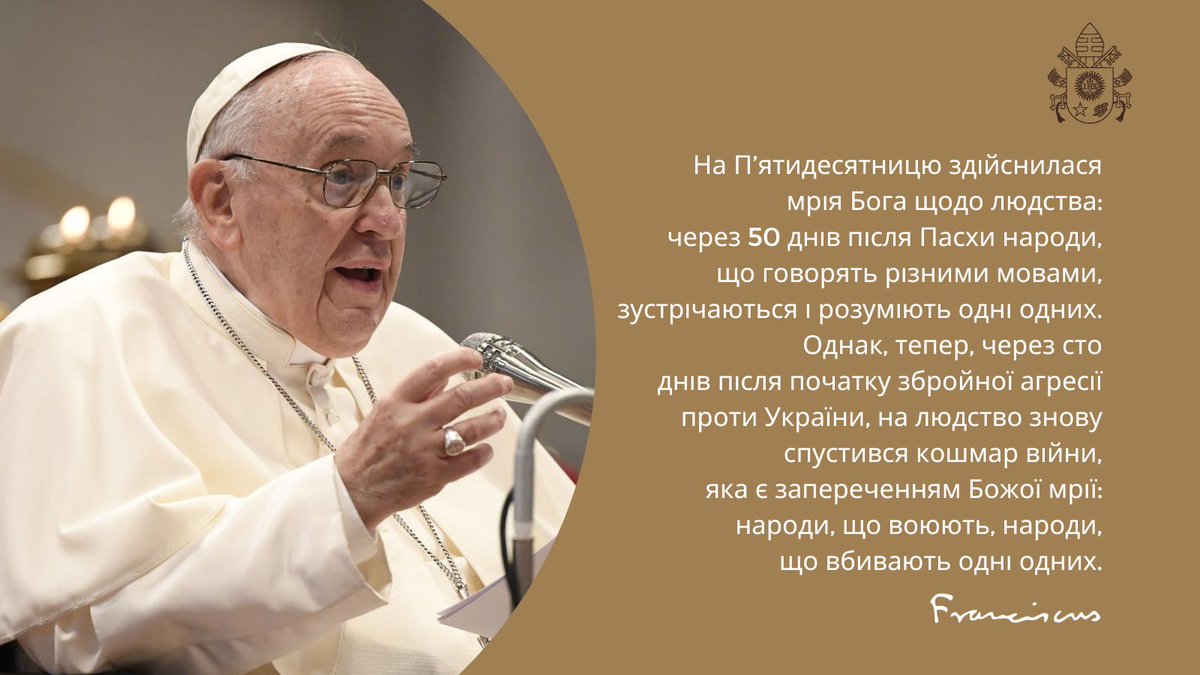
  • “У моєму серці не згасає думка про населення України, що страждає від війни. Нехай же час, який минає, не охолодить наш біль та наше занепокоєння цими багатостраждальними людьми. Будь ласка, не звикаймо до цієї трагічної дійсності! #МолімосяРазом” @Pontifex, 12 June 2022
  • “The thought of the people of Ukraine, afflicted by war, remains vivid in my heart. Let the passage of time not temper our grief and concern for that suffering population. Please, let us not grow accustomed to this tragic situation! Let us #PrayTogether” @Pontifex, 12 June 2022
  • “Today is the World Day against Child Labour. Let us all work to eliminate this scourge, so that no child is deprived of his or her fundamental rights and forced or coerced to work. #EndChildLabour” @Pontifex, 12 June 2022
  • “Love not only means that we wish others well or that we are good to others, but first and foremost, at the root, that we welcome others, make room for others, make space for others.” @Pontifex, 12 June 2022
  • “The #MostHolyTrinity teaches us that a person can never be without the other. We are not islands, we are in the world to live in God’s image: open, in need of others and in need of helping others.” @Pontifex, 12 June 2022
  • “Jesus summarized his commandments in a single one: “Love one another as I have loved you” (Jn. 15:12). To love like Christ loves means to put yourself at the service of your brothers and sisters, especially those in greatest need, as we are and with what we have.” @Pontifex, 13 June 2022
  • “What great poverty is produced by the senselessness of war! Wherever we look, we can see how violence strikes those who are defenseless and vulnerable. #WorldDayOfThePoor j Message@Pontifex, 14 June 2022

Papal Instagram

Lift Us Where Suffering Cannot Reach (SNW) – The Secrets of Star Trek

What if a civilization would thrive for as long as one person had to suffer on their behalf. Jimmy Akin, Dom Bettinelli, and Fr. Cory Sticha discuss this story that includes moral absolutes and a challenge to Pike’s conscience.

Direct Link to the Episode.

Subscribe on iTunes. | Other Ways to Subscribe.

Haunted House of Marin County (Ghosts, Hauntings, Apparitions) – Jimmy Akin’s Mysterious World

Is TV ghost hunting anything like the real thing? Jimmy Akin and Dom Bettinelli are joined by parapsychological investigator Loyd Auerbach to discuss his work and in particular about a haunted house in Marin County, California.

Help us continue to offer Jimmy Akin’s Mysterious World. Won’t you make a pledge at SQPN.com/give today?

Links for this episode:

Mysterious Headlines

This Episode is Brought to You By:
Jimmy Akin’s Mysterious World is brought to you in part through the generous support of Aaron Vurgason Electric and Automation at AaronV.com. Making Connections for Life for your automation and smart home needs in north and central Florida.

Catechism Class, a dynamic weekly podcast journey through the Catechism of the Catholic Church by Greg and Jennifer Willits. It’s the best book club, coffee talk, and faith study group, all rolled into one. Find it in any podcast directory.

Fiorvento Law, PLLC, specializing in adult guardianships and conservatorships, probate and estate planning matters. Accepting clients throughout Michigan. Taking into account your individual, healthcare, financial and religious needs. Visit FiorventoLaw.com

Deliver Contacts, offering honest pricing and reliable service for all your contact lens needs. See the difference at delivercontacts.com.

Want to Sponsor A Show?
Support StarQuest’s mission to explore the intersection of faith and pop culture by becoming a named sponsor of the show of your choice on the StarQuest network. Click to get started or find out more.

Direct Link to the Episode.

Subscribe on iTunes. | Other Ways to Subscribe.

Listen – The Secrets of Doctor Who

Sssshhhh! Jimmy Akin, Dom Bettinelli, and Fr. Cory Sticha discuss the 12th Doctor’s obsession with a theoretical creature capable of perfect hiding, how Danny Pink and Clara fail to listen, and the elephant-in-the-room loose thread of Orson Pink.

Direct Link to the Episode.

Subscribe on iTunes. | Other Ways to Subscribe.

The Weekly Francis – 7 June 2022

This version of The Weekly Francis covers material released in the last week from 30 May 2022 to 7 June 2022.

General Audiences

Homilies

Regina Caeli

Speeches

Papal Tweets

  • “Every educational process must be centred on persons and concentrate on what is essential; everything else is secondary. But never without roots and hope for the future. #GlobalCompactOnEducation” @Pontifex, 1 June 2022
  • “Блокада экспорта зерна из Украины угрожает жизни миллионов людей. Я настойчиво призываю гарантировать всеобщее право человека на питание. Пожалуйста, не используйте пшеницу, основной продукт питания, в качестве орудия войны!” @Pontifex, 1 June 2022
  • “Блокування експорту зерна з України ставить під загрозу життя мільйонів людей. Звертаюся із палким закликом гарантувати загальнолюдське право на харчування. Будь ласка, не використовуйте зерно, основний продовольчий продукт, як зброю на війні!” @Pontifex, 1 June 2022
  • “The elderly, in their weakness, can teach those in other ages of life that we all need to surrender ourselves to the Lord, to invoke his help. For God is always our hope and our support. #BlessingofTime” @Pontifex, 1 June 2022
  • “The blocking of grain exports from Ukraine endangers the lives of millions of people. I make a heartfelt appeal that every effort be made to guarantee the universal human right to food. Please do not use wheat, a staple food, as a weapon of war!” @Pontifex, 1 June 2022
  • “Let us #PrayTogether for Christian families around the world; may each and every family embody and experience unconditional love and advance in holiness in their daily lives. #PrayerIntention rPc Video@Pontifex, 2 June 2022
  • “We ask the Lord for many things, but how often do we forget to ask him for what is most important and what he desires most to give us: the Holy Spirit, the power to love. Indeed, without love, what can we offer to the world?” @Pontifex, 3 June 2022
  • “The culture of encounter is built in the search for harmony among diversity, a harmony that requires acceptance, openness and creativity. At the root of this style of life there is the Gospel. Never tire of invoking the Holy Spirit, Creator of harmony.” @Pontifex, 4 June 2022
  • “#LetsPrayTogether for the orphaned children fleeing from the war, who suffer throughout our world from hunger or lack of medical care, abuse and violence, and those denied the right to be born.” @Pontifex, 4 June 2022
  • “#МолімосяРазом за дітей, які осиротіли і які втікають від війни; за тих, що страждають в усьому світі через голод, брак лікування, від зловживань і насильства; за тих, яким заперечено право народитися. Захистімо всіх дітей!” @Pontifex, 4 June 2022
  • “#ПомолимсяВместе о детях, оставшихся сиротами и бегущих от войны, о детях во всем мире, страдающих от голода, от отсутствия ухода, от жестокого обращения и насилия; о тех, кому отказано в праве родиться. Давайте защитим всех детей!” @Pontifex, 4 June 2022
  • “Теперь, когда бушует ярость разрушения и смерти, когда разгораются конфликты, подпитывая эскалацию, всё более опасную для всех, я вновь призываю лидеров государств: пожалуйста, не ведите человечество к гибели!” @Pontifex, 5 June 2022
  • “Let the desperate cry of the people who suffer be heard! May human life be respected! Let the macabre destruction of cities and villages in Eastern Ukraine stop! Let us #PrayTogether and commit ourselves untiringly to peace.” @Pontifex, 5 June 2022
  • “Нехай буде почутим сповнене відчаю волання людей, що страждають, нехай зберігається пошана до людського життя, нехай зупиниться моторошне знищення міст і сіл на сході України. #МолімосяРазом і невтомно докладаймо зусилля на користь миру.” @Pontifex, 5 June 2022
  • “У той час, як шаленіє безумство руйнування і смерті та розпалюються протистояння, підживлюючи ескалацію, дедалі небезпечнішу для всіх, повторюю свій заклик до провідників народів: будь ласка, не доведіть людство до знищення!” @Pontifex, 5 June 2022
  • “The Holy Spirit, the Spirit of love, fills us with love, makes us feel loved, and teaches us how to love. He is the “motor” of our spiritual lives. #Pentecost
    f Homily@Pontifex, 5 June 2022
  • “A sound and sustainable ecology, one capable of bringing about change, will not develop unless people change, unless they are encouraged to opt for another style of life, one less greedy and more serene, more respectful and less anxious, more fraternal. #WorldEnvironmentDay” @Pontifex, 5 June 2022
  • “Да будет услышан отчаянный крик страдающих людей, да сохранится уважение к человеческой жизни, да прекратится чудовищное разрушение городов и деревень на востоке Украины. #ПомолимсяВместе, без устали трудясь ради мира.” @Pontifex, 5 June 2022
  • “While the madness of destruction and death rages, and clashes flare up, fueling an even more dangerous escalation for everyone, I renew my appeal to the leaders of nations: please do not bring humanity to destruction!” @Pontifex, 5 June 2022
  • “#Мир eOYp Image@Pontifex, 5 June 2022
  • “#Peace https://t.co/YWdjyavNux Image@Pontifex, 5 June 2022
  • “Let us invoke the Holy Spirit each day, so that He can remind us to make God’s gaze upon us our starting point, to make decisions by listening to His voice, and to journey together as Church, docile to Him and open to the world. #Pentecost” @Pontifex, 5 June 2022
  • “The Holy Spirit teaches the Church how to walk – the vital importance of going forth to proclaim the Gospel, not to remain closed in on herself, so that all can be nourished by God’s beauty. #Pentecost” @Pontifex, 5 June 2022
  • “The Spirit makes us see everything in a new way, with the eyes of Jesus. On the great journey of life, the Spirit teaches us where to begin, which paths to take, and how to walk. #Pentecost” @Pontifex, 5 June 2022
  • “#Мир lnAHBOO Image@Pontifex, 5 June 2022
  • “I was deeply saddened to learn of the horrific attack at Saint Francis church in Owo in #Nigeria. #PrayTogether for all those affected by this act of unspeakable violence and for the conversion of those blinded by hatred and violence.” @Pontifex, 6 June 2022
  • “Mary is the Mother who gives us her Son Jesus. Mary is the path that guides us to the Heart of Christ, who gave his life for love of us. This is why we love her and venerate her. #MotheroftheChurch” @Pontifex, 6 June 2022
  • “I encourage all of you to invoke the Holy Spirit often during the day. His good and creative strength allows us to go out of ourselves and to be a sign of comfort and hope for others.” @Pontifex, 7 June 2022

Papal Instagram