How Did “Liberal” Become A Bad Word?

HISTORIAN JOHN LUCAKS ANSWERS THIS QUESTION.

As to why it happened, the nut of his answer is this:

Beneath these political and ideological sentiments there was the sense,
more or less apparent, of a general disappointment with liberal ideals.
There was the inclination, sometimes fatal, of liberals to take the
ideas of the Enlightenment to extremes: to propagate a public morality
devoid of, if not altogether opposed to, religion; to insist more and
more on institutionalizing the promotion of justice, at times even at
the expense of truth; to emphasize freedom of speech, often at the
expense of thought; to make abortion legal; to approve same-sex
marriages and affirmative action.

To an increasing mass of Americans, "liberal" began to mean — rightly
or wrongly — a toleration, if not a promotion, of what many considered
to be immoralities.

That’s why it happened, but the context of when and how it happened is most interesting.

CHECK IT OUT.

Period Songs, Period Instruments

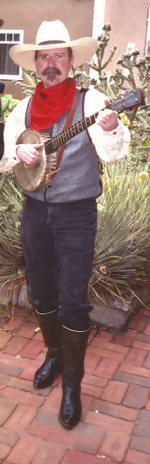
Mark_banjo_trinidad_1The banjo-playing historian I mentioned the other day who I met on a train was Mark Gardner (left, though he wasn’t in full regalia when I met him).

He told me about a recent CD he had made with his partner Rex Rideout using period instruments. It’s called Frontier Favorites: Old-Time Music of the Wild West. Afterwards, I bought a copy from CD Baby.

I was very pleased.

Mark plays banjo and Rex plays fiddle, and they are the only musicians on the CD, but despite this the songs never sounded weak or threadbare. I was, frankly, amazed at HOW MUCH MUSIC two men can make using only one banjo, one fiddle, and their voices.

LISTEN HERE FOR AN EXAMPLE.

The fact that they were using period instruments (i.e., not a modern,
steel banjo or modern fiddle) also had a major effect on the sound. (You can see Mark holding such an "organic" banjo in the picture.) Not being a music critic, I don’t know how to articulate the difference, but there is a more raw, natural sound to the instruments they are playing than what you would hear on a contemporary instruments CD.

The experience generated by the CD is the closest approximation of what it would be like to hear real 19th century musicians playing. It transports one back in time more effectively than any similar old-time CD I’ve heard, and I heartily recommend it.

One of the fascinating things about the songs of this period that can’t go without mention is their lyrics. Contrary to contemporary chronological snobbery, the folks who lived in the 19th century weren’t a bunch of dummies. In fact, they were more highly educated in some subjects than we are.

For example, how many times recently have you heard Latin used in a song? Well, you will in Mark & Rex’s "Old Dan Tucker" (a 19th century comedy song about a buffoon who behaves oddly and can’t do anything right). One of the verses goes:

Here’s my razor, in good order!
Magnum bonum, just have bought ‘er!
Sheep shell the oats; Tucker shell the corn.
I’ll shave you, son, when the water gets warm!

Magnum bonum is Latin for "great good," here meaning something like "very good" or "excellent quality." It says something about the people of the time that they could be expected to understand the phrase and recognize its relevance to a just-bought straight razor in a comedy song.

This isn’t the only time that the lyrics presuppose knowledge that moderns may not have. For example, the song Captain Jinks of the Horse Marines is filled with such references. This song, which was the wildly popular after it was first introduced (though it didn’t always have the patter that Mark and Rex include–and Mark is the vocalist on this one), is a treasure trove of cultural references. Also a comedy song, it concerns an incompetent military man (Capt. Jinks), who is the origin of the modern word "jinx" (meaning, a cursed or unlucky individual).

The refrain of the song goes:

I’m Captain Jinks of the horse marines.
I feed my horse on corn and beans.
And often live beyond my means.
Tho’ a captain in the army.

Here the jokes are densely-packed.

First, there was no such thing as the "horse marines." Marines are military men who travel by sea, and horses don’t usually do well on the sea. Classically, marines are either infantry or artillery. The idea of "horse marines" is a joke about a non-existent group (though completeness compels me to point out that some actual military groups have named themselves after this joke; there was a group of cowboys who patrolled the Texas coastline during the Texas Revolution who called themselves "horse marines" and also a group of U.S. Marines in the twentieth century in China who similarly styled themselves). The term "horse marine" thus came to refer to a member of a non-existent unit or, simply, to a misfit.

Second, nobody would feed their horse on corn and beans. In the 19th century those constituted "people food" and would be more expensive than what one would feed one’s horse on (hay, oats). Hence, Capt. Jinks often lives "beyond his means." A diet of pure corn and beans also wouldn’t be good for a horse nutritionally.

"Tho’ a captain in the Army," Captain Jinks is thus a very unfortunate and comical guy. The cards are stacked against him, and 21st century denizens may not fully appreciate the jokes at his expense.

Despite this, Mark & Rex’s CD is a terrific introduction to old-time music, as well as a fascinating re-creation of what it would have been like to transport back into the past and hear actual musicians of the period.

Highly recommended.

GET THE CD.

Ad Limina Doctrinarum Ecclesiae

Jamie at Ad Limina Apostolorum provides some commentary on my recent post about the Compendium of the Social Doctrine of the Church.

His central thesis–that the Compendium is viewed as an elaboration of a particular subject dealt with in the Catechism of the Catholic Church–is certainly correct. I think, however, that another thesis he advances must be understood with some nuance.

He writes (excerpts; and the "yeah!" is Jamie rather than me):

I share Akin’s concern that the social teaching of the Church not be so readily equated with its moral and dogmatic teaching, which admittedly admit [yeah!] of a greater degree of solemnity. But this concern is balanced with another (which Jimmy certainly shares as well) that the Church’s social teaching not be itself downgraded to the level of ‘optional’ or ‘throw-away,’ a hodgepodge of socioeconomic suggestions paperclipped to the Really Important Stuff ™ like the Pope and the Sacraments and all that.

[T]he fact that the Catechism already contains the Church’s social teaching, at least in summary form, brings up another point. It simply doesn’t make sense to think of the Catechism of the Catholic Church as a collection of the Really Important Stuff – like hard, dogmatic teaching – with the Church’s social thought playing the the ugly red-headed stepchild. If the Church’s social teaching is included in the Catechism, then it is the Really Important Stuff as well, or at least integral to it.

I would press the question of whether the Church’s social teachings can be so easily separated from the Church’s dogmatic and moral teachings. Is not the Church’s social teaching not moral in its very essence (even if it rarely advances to the level of solemn, dogmatic statements about morality)? Is it not also a ‘doctrine’ in the fullest sense of the word? In fact, the Holy Father has claimed the Church’s principles of social doctrine, as enunciated especially in Leo XIII’s Rerum Novarum, "belong to the Church’s doctrinal patrimony" (Centesimus Annus 3), constituting a "genuine doctrine" (5), and "an essential part of the Christian message" (5). John XXIII called it "an integral part of the Christian conception of life" (Statement on New Social Justice Compendium, Cardinal Martino (I know, I know, but at least give him the time of day) said, "When, in any way whatsoever, one loses the keen awareness that this Social Doctrine belongs to the Church’s mission, Social Doctrine itself is manipulated, falling prey to various forms of ambiguity and partisan application."

I’ve quoted Jamie at some length because he makes a number of points that need to be addressed for purposes of pointing out the nuance with which they need to be understood (and one point on which I disagree).

Here goes.

Continue reading “Ad Limina Doctrinarum Ecclesiae”

Americans Pretending To Be Canadians

Hmmm . . .

SOME AMERICANS ARE PRETENDING TO BE CANDADIANS WHEN THEY GO ABROAD.

Some are doing so to get out of awkward social situations where furriners say anti-American things.

If I were in such a situation, and if I were human, I believe my response would be "Go to hell." . . . If I were human.

But if an al-Qa’eda operative pointed a AK-47 in my face and wanted to know my nationality, I’d be sore tempted to do "the maple leaf masquerade."

Don’t know how plausible I’d be doing it. Could probably fake a Bob & Doug Mackenzie accent and speech pattern, but the cowboy hat, duster, and boots (all of which were worn on my most recent foreign trip–to Canada, ironically enough) would be dead giveaways.

Still, Canadians and Americans are similar in many ways.

Was reminded of a bit from the Canadian sketch comedy show The Kids In The Hall (which I didn’t watch but occasionally surfed through) in which a Canadian visiting the Philippines was repeatedly asked if he was an American.

He finally responded: "Noooooo . . . I’m a Canadian. . . . That’s like an American . . . but without the gun."

Take A Second Look

I’d like to recommend something to you that may sound implausible at first.

Take another look at the TV show Star Trek: Enterprise.

Things are not as they were.

When Enterprise first took to the air, I was very hopeful. There were all kinds of dramatic potential in a prequel to the original Star Trek series. E.g., getting to see all those "lost ships" the Original Series Enterprise went in search of and, in particular, seeing the founding of the Federation.

Unfortunately, danger signals started coming from the series almost at once. It seemed to be set too far in the past for the show to deal with the founding of the Federation, and most of the shows seemed misdirected towards a kind of "gee whiz" exploration of the galaxy.

My personal ability to bond with the series was also hampered by the fact that (at the time it went on air) I couldn’t even get the series due to living in an apartment complex with the dinkiest cable in the world, though I managed to see some episodes anyway.

Things didn’t seem to get better in the show’s second season, and its ratings declined. Taking this decline seriously, the show’s third season focused on a year-long story arc that posed a direct threat to the survival of everyone on Earth (the Xindi arc).

I thought this was a step in the right direction, like the lengthy arcs that drove the shows Babylon 5 and (in its latter seasons) Deep Space 9. The quality of the show definitely improved in season 3.

Despite this, the series almost was not renewed for a fourth season, but in the end it was.

I thought, and still think, that the series needs to move to the Roman War that leads to the founding of the Federation as quickly as possible to get things back on track.

They’re not moving to that as quickly as I would if I were the show-runner (though they are definitely moving toward it), but the quality of the show has improved even more in the fourth season, and I want to recommend that you take another look at the program (or a first look, if you haven’t seen it before).

The characteristic of the present (fourth) season is that for the most part it features stories that are longer than one episode but shorter than a whole season. Most stories are three or four episodes long.

More important than the format is that the show’s creators are focused on integrating the series more closely with the established Star Trek mythology, letting us look at corners of things that we have heard of but never seen or never seen explored in detail.

One three-part arc, for example, featured Brent Spiner (Next Gen‘s Commander Data and his "father" Noonien Soong) as Data’s "grandfather" Arik Soong. At the time of Enterprise, the line of family geniuses was not intersted in robotics but in genetic engineering. Arik Soong tried to bring to fruition a line of genetically "improved" humans dating from the late-20th-century Eugenics Wars (a la Kahn Noonien Singh). His disastrous failure in these episodes convinced him that trying to improve on the breed was a mistake, and by the end he turned to cybernetics, paving the way for the creation of Commander Data by his son.

Another trilogy of episodes focused on the planet Vulcan. We got to see things we’d heard about before, like the harsh desert known as Vulcan’s Forge (a reference to Roman mythology, incidentally) and we got an explanation for something Enterprise fans had long complained about: The Vulcans we saw in the series don’t seem the same as the Vulcans we know from the Original Series. They aren’t pacifists. They’re (somewhat) more emotional. They aren’t normally mind-melders. And they tend to be suspicious toward humans rather than respectful of them. In fact, they’re more like Romulans than the Vulcans we know from previous Star Trek shows.

Turns out that these differences are explained by a simple fact: Under the (hidden) influence of Romulans, the Vulcans of Enterprise‘s day have strayed from the teachings of their planetary peacemaker, Surak (who we kind-of met in the Original Series). But due to the intervention of the Enterprise crew, a social revolution starts that will lead to the dominance of the philosophy of the Vulcans that we know and love.

Upcoming episodes and min-arcs seem no less ambitious.

One such episode features the inventor of transporter technology.

A quadrology of episodes focuses on the Andorians and their homeworld.

An upcoming trilogy focuses on the Klingons and holds the prospect of finally offering an on-screen explanation of why the Klingons we saw in the Original Series are so different visually from the Klingons of the movies and subsequent series.

And Bill Shatner is likely to appear soon.

However things work out, a change has definitely been made in the Star Trek: Enterprise series. I’m already seeing messages on Internet boards like "What’s happening to me? I am actually loving Star Trek again."

There’s something to love here, again.

Tune in Friday nights to see what it is.

Start watching this Friday and be ready for the dramatic episodes that will start airing in January.

The Economics of Knowledge

Thomas Sowell follows British economist Lionel Robbins in defining economics as "the study of the use of scarce resources which have alternative uses" (Applied Economics, 1).

Knowledge is one such resource.

No surprise then that Nobel-prize winning economist Becker and federal judge and author Posner have the following insight:

Blogging is a major new social, political, and economic phenomenon.
It is a fresh and striking exemplification of Friedrich Hayek’s thesis
that knowledge is widely distributed among people and that the
challenge to society is to create mechanisms for pooling that
knowledge. The powerful mechanism that was the focus of Hayek’s work,
as as of economists generally, is the price system (the market). The
newest mechanism is the “blogosphere.” There are 4 million blogs. The
internet enables the instantaneous pooling (and hence correction,
refinement, and amplification) of the ideas and opinions, facts and
images, reportage and scholarship, generated by bloggers [SOURCE].

PRIEST: "My Diocese Of Mosul On Fire"

I just got the following e-mail from a Chaldean priest friend of mine:

Dear Friends:

These are some pictures of the 2 churches bombarded in Mosul

by Islamic Fanatics. The damaged palace is the Chaldean Catholic

Diocese center, where I lived for almost two years, and now is no more

useful for use. It was a new palace built from 1992-1996, close to an

old Shrine of the Virgin Mary from the 7th century! The Shrine was

untouched, thank God.

Mosul1_1

Mosul2_1

Mosul3_1

Mosul4_1

Click to enlarge.