Amy Welborn had a really nifty globalinfographicthingie on where the world’s Catholic population lives.
So I swiped it.
Here ’tis:
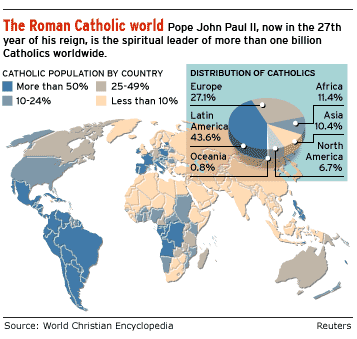
Click to enlarge. (Makes it clearer.)
[Cowboy hat tip: Amy Welborn.]
Amy Welborn had a really nifty globalinfographicthingie on where the world’s Catholic population lives.
So I swiped it.
Here ’tis:
Click to enlarge. (Makes it clearer.)
[Cowboy hat tip: Amy Welborn.]
National Abortion Rights Action League (NARAL) head Nancy Keenan has written a letter to pro-lifers asking for their help (WARNING! Evil file format! [.pdf]).
Wellllllll now. . . . Isn’t that "special."
Let’s see what she has to say:
Hm. Help NARAL prevent abortions? They’ve seen the light and are joining our side? They’re changing their name to NURAL (National Unborn Rights Action League)? Doesn’t sound plausible. The credibility quotient of professional babykillers is low. Must be on lookout for incompetent attempts at deception.
For years, your groups and ours have waged one of the country’s most divisive political wars over a woman’s right to choose to kill her own offspring.
True.
We believe passionately that women have the right to decide for themselves when to
bring children into the worldkill their own children [sorry, the kids are already "in the world" as soon as they’re conceived] – without government interference. You disagree – passionately and sincerely.
Darn tootin’!
We will never resolve our differences on this basic question.
If by "we" you mean most individuals who are alive in the pro-abort movement right now and most individual pro-lifers, you are correct. Though some individuals may convert from one side to the other, most of the most committed members of both sides will remain where they are. On the other hand, if you mean our movements will always be locked in this struggle, no. Pro-lifers reproduce themselves while pro-aborts do not. Eventually, your movement will wither for demographic reasons (a phenomenon dubbed "the Roe effect"), leaving the pro-life movement free to protect unborn children again. The only question is how long it will take to stop the abortion holocaust you have initiated and how many millions of children will be murdered in the meantime.
But we should agree on an equally fundamental point: America would be a better country if no woman ever faced the difficult choices posed by an unintended pregnancy.
Yeah, and it would be a better country if there was no such thing as cancer, heart disease, obesity, or AIDS and in which nobody had to work for a living and nobody ever disagreed with anybody or had to do anything they didn’t want to do and we all had superpowers.
 Furthermore, what’s all this dissing of "unintended pregnancies." Used to be a lot of folks would be excited when they got pregnant even though they weren’t intending to do so this month. Babies were looked forward to as positive things and as gifts from God. Some folks still take such attitudes, despite your propaganda campaign to equate "unintended pregnances" with unwanted babies.
What better way to end the debate (as if ending debate were an end in itself) over abortion rights than by eliminating the reasons women seek abortion?
You mean you want to change the facts that abortions are permitted by law and people have been propagandized to regard them as morally licit and to regard babies as an unwanted burden rather than as a positive contribution to humanity? Heck, yeah! I’m all up for changing those facts!
The time has come to join together in a new campaign to reduce the number of abortions.
DANGER, WILL ROBINSON, DANGER!!! IMPENDING INCOMPETENT DECEPTION ATTEMPT!!!
Senate Minority Leader Harry Reid – who slightly disagrees with us only so he can protect his Mormon base on the issue of abortion – has offered a
commonsensedeceptive bill deceptively called the Prevention First Act which would help reduceunintended pregnanciesunwanted babies through better access to often-abortifacientbirth controlcontraception. This landmark legislation represents aserious first step in addressing the problemlaughably transparent attempt to score political points with the public by appearing to claim the moral high ground while advancing our anti-baby agenda through other means that actually will increase the number of abortions occurring early in pregnancy, and I hope you–the pro-baby patsy of this evil scheme–wi’ll join pro-choiceabortion Americans and me, the Abortion Queen, in foolishly offering your support.Let’s work together to pass this bill, and <completely insincere offer>make it the first step in a dialogue</completely insincere offer> about preventing
unintended pregnanciesunwanted babies.I eagerly await your answer despite the fact I didn’t include my address, phone number, or e-mail on this letter.
Nancy Keenan
President
NARAL Pro-Choice America
GIVE NANCY KEENAN YOUR ANSWER.
TEXT OF THE "PREVENTION FIRST" ACT. (More fisking to follow)
[Cowboy hat tip: Pajama Hadin.]
Karl and I did the honors.
HIGHLIGHTS:
Karl and I did the honors.
HIGHLIGHTS:
Down yonder, a commenter (in dialogue with another commenter) writes:
The Church has traditionally distinguished between material apostasy and formal apostasy.
Jews who were never Christians are mateiral apostates. Jews who once were Christian are formal apostates.
"Based on that definition, any non-Christian of the Christian era could be considered a material apostate."
This is correct.
"Jews who sincerely believe that God requires them to follow the covenant established with Abraham and the Law given to Moses, and are therefore doing so to the best of their ability, can in no way be termed ‘apostates,’ materially or formally."
You obviously do not know the meaning of the phrase "material apostate" or "material sin" in general.
I’m sorry, but no.
The term "apostasy" is defined as follows:
[A]postasy is the total repudiation of the Christian faith (Latin, apostasia, fidei christianae ex toto repudiatio) [CIC, Can. 751].
Regarding the material/formal distinction in moral theology, those who commit a sin "materially" are those who perform it through no fault of their own (i.e., without culpability), while those who commit it "formally" are those who perform it through their own fault (i.e., with culpability).
In regard to the sin of apostasy, a material apostate would be one who totally repudiates the Christian faith without being culpable for doing so (due to a defect of knowledge or intent), while a formal apostate would be one who totally repudiates the Christian faith with adequate knowledge and intent.
The problem with maintaining this in the case of Jews or other non-Christians in the present age is the meaning of the word repudiatio.
As you might suppose, repudiatio means "repudiation"–the rejection of something one has previously held.
One thus cannot be an apostate from Christianity unless one has previously been a Christian and then totally repudiated the Christian faith. Jews who have never been Christian and other never-been-Christians of the present age (or any age) are thus not apostates.
The correct term for never-been-Christian Jews and never-been-Christian others is "the incredulous" (i.e., those who do not believe), per the Catechism of the Catholic Church:
Incredulity [Latin, incredulitas] is the neglect of revealed truth or the willful refusal to assent to it [CCC 2089].
Those never-been-Christians who are disbelieve through no fault of their own are the materially incredulous. Those never-been-Christians who disbelieve through their own fault are the formally incredulous.
Not proof, yet, but suggestive evidence.
A reader writes:
My following question stems from an article on CNN.com about a futurist who is trying keep healthy so that he can live long enough for science to be able to provide immortality:
Hah! As if! Sorry. Ain’t gonna happen.
I know you’re a sci-fi lover so I figured you may have though about how this might rest with the Faith. Would it be sinful to try to achieve immortality? I get the feeling that the answer is "yes" because God intends us to eventually join him in Heaven but I’m guessing there is a lot of grey area.
I would disagree, at least with the grounds stated. Dying is not a necessary precondition for joining God in heaven. St. Paul writes that at the last day, when Christ returns, those who are still alive will be transformed in the twinkling of an eye and be united with Jesus (at which point heaven and earth will become one, Revelation tells us). So if someone (in a state of grace) extended his own life indefinitely then he’d still be here when Jesus comes back and be untied with God.
One could argue that death is a punishment God means us to have and that it would be wrong to throw off the yoke of this punishment, but God doesn’t seem to mind us working to undo other effects of the Fall (e.g., striving against our fallen natures by his grace), so I don’t think that one could prove that it would be wrong to indefinitely extend one’s life by those means. We already know it’s kosher for physicians to help us extend our lives (Sirach is explicit on this point). At that point, it’s hard to see how any "you must not let your life go beyond this point or it’s a sin" command could be derived from the deposit of faith or natural law.
For instance, the nanites, stem cells (non-embryonic, of course), and other medical treatments could be used just to fight disease and not repair cell aging. In this way, you might live 2 or 3 times as long as you normally would. Would it be wrong if you used the technology to keep you alive for an extra 10, 50 or even 100 years and then stop using it? Would that be immoral? If not, how do you draw the line?
From what I can see, it would not be immoral. It also would not be immortal. "Immortal" means "exempt from death" (lit., "not mortal," with "mortal" meaning "subject to death"). If all you’re doing is upping the human lifespan, but not exempting a person from ultimate death, it ain’t immortality, just a longer mortality.
I don’t know if this makes a difference but this "immortality", would only protect against natural death.
Yeah, like Lorien on B5, who wouldn’t die on his own but could die from illness or accident.
No matter how many nanites you have pumping through your body, if you fall into an incinerator you’ll die.
Yes, though you might survive if you fall into a lava pit during a light saber battle. You might then need life-sustaining technology. In fact, you might end up more machine than man.
I hope this isn’t too frivolous a question; I’m sure you have a many more pragmatic questions thrown at you every day. I just find the topic of technology and morality interesting in this day and age.
Not too frivolous at all! As I often say, "There are no bad questions, only bad answers."
That being said, I’m quite dubious about this guy’s plan to live on indefinitely. There are a number of problems with it:
There is absolutely no harm in trying to stave that off for as long as possible, though. After all, God built a survival instinct into us. So I say: Let’s go with our instincts! Bring on the (morally-developed) high tech!
Personally, I’m waiting for the Cellular Regeneration and Entertainment Chamber.
Oh yeah, and scientific immortality is one of those projects that has "Danger: May Cause Confusion of Tongues!" written on the box it comes in.
A reader writes:
My following question stems from an article on CNN.com about a futurist who is trying keep healthy so that he can live long enough for science to be able to provide immortality:
Hah! As if! Sorry. Ain’t gonna happen.
I know you’re a sci-fi lover so I figured you may have though about how this might rest with the Faith. Would it be sinful to try to achieve immortality? I get the feeling that the answer is "yes" because God intends us to eventually join him in Heaven but I’m guessing there is a lot of grey area.
I would disagree, at least with the grounds stated. Dying is not a necessary precondition for joining God in heaven. St. Paul writes that at the last day, when Christ returns, those who are still alive will be transformed in the twinkling of an eye and be united with Jesus (at which point heaven and earth will become one, Revelation tells us). So if someone (in a state of grace) extended his own life indefinitely then he’d still be here when Jesus comes back and be untied with God.
One could argue that death is a punishment God means us to have and that it would be wrong to throw off the yoke of this punishment, but God doesn’t seem to mind us working to undo other effects of the Fall (e.g., striving against our fallen natures by his grace), so I don’t think that one could prove that it would be wrong to indefinitely extend one’s life by those means. We already know it’s kosher for physicians to help us extend our lives (Sirach is explicit on this point). At that point, it’s hard to see how any "you must not let your life go beyond this point or it’s a sin" command could be derived from the deposit of faith or natural law.
For instance, the nanites, stem cells (non-embryonic, of course), and other medical treatments could be used just to fight disease and not repair cell aging. In this way, you might live 2 or 3 times as long as you normally would. Would it be wrong if you used the technology to keep you alive for an extra 10, 50 or even 100 years and then stop using it? Would that be immoral? If not, how do you draw the line?
From what I can see, it would not be immoral. It also would not be immortal. "Immortal" means "exempt from death" (lit., "not mortal," with "mortal" meaning "subject to death"). If all you’re doing is upping the human lifespan, but not exempting a person from ultimate death, it ain’t immortality, just a longer mortality.
I don’t know if this makes a difference but this "immortality", would only protect against natural death.
Yeah, like Lorien on B5, who wouldn’t die on his own but could die from illness or accident.
No matter how many nanites you have pumping through your body, if you fall into an incinerator you’ll die.
Yes, though you might survive if you fall into a lava pit during a light saber battle. You might then need life-sustaining technology. In fact, you might end up more machine than man.
I hope this isn’t too frivolous a question; I’m sure you have a many more pragmatic questions thrown at you every day. I just find the topic of technology and morality interesting in this day and age.
Not too frivolous at all! As I often say, "There are no bad questions, only bad answers."
That being said, I’m quite dubious about this guy’s plan to live on indefinitely. There are a number of problems with it:
There is absolutely no harm in trying to stave that off for as long as possible, though. After all, God built a survival instinct into us. So I say: Let’s go with our instincts! Bring on the (morally-developed) high tech!
Personally, I’m waiting for the Cellular Regeneration and Entertainment Chamber.
Oh yeah, and scientific immortality is one of those projects that has "Danger: May Cause Confusion of Tongues!" written on the box it comes in.
A reader writes:
I am seriously considering pursuing a Ph.D. in Systematic Theology. I have a quick question. The programs I have looked at all have a language requirement. I have graduate degrees, in other fields; however, I have never taken any foreign languages. Now I am facing the task of becoming proficient enough to translate New Testament Greek, Latin and German (or French) with a dictionary. Do you have any recommendations of programs that I can begin preparing now? I am currently working on a MA in Theology and Christian Ministry (distance learning) from Franciscan University so I have some time to get ready. I would greatly appreciate any suggestions you might have.
For living langauges like French and German, definitely Pimsleur.
For the biblical ones, SEE HERE and ALSO HERE.
A reader writes:
I have a question for you (who doesn’t). As a facilitator in the RCIA program at my parish I’ve realized that my biggest scriptural and historical weakness is the history of the Jewish people. I can tell you all about the Jewish people of the 1st century and the history of the Catholic Church but I fall surprisingly short when it comes to Old Testament history. I definitely need to learn more about this to be an effective evangelizer (is that a word? [yes, it is–Jimmy]) and teacher.
I plan to re-read Genesis and Exodus. I think that will be a good start to learn about the beginnings of our Jewish ancestors. Beyond that, I was curious if you know of any books (or anything else for that matter) that would help me in learning the history of the Jewish people. I’m also looking for something with as many references to scripture as possible. I was hoping that there is an equivalent to "Triumph" by H. W. Crocker III (which I thought was excelent by the way) but for the Old Testament Jewish people.
Of course I’m looking for something Orthodox, not something the Jesus Seminar would be happy with.
Do you know of anything that would help me in learning more in this area?
I’d recommend three things:
Hope this helps, and God bless!