Divorce, Remarriage, & Confession

A reader writes:

Can my wife or myself go to confession?
Our story is this, both are cradle Catholics. I left the Church when I was seventeen-eighteen for Evangelical Protestantism and return to the Catholic church about one year ago, thanks be to God.  Married for the first time in my twenties, then divorced ten years later. I have two children from that marriage. I was married in a Protestant church. My wife was also married ten years then divorced but my wife was married in a Catholic church, no children from that marriage. This is our second marriage. We were married in a Lutheran church four years ago. We both have yet to start the paper work towards an annulment.

First, let me assure of you of God’s love for you and your wife. No matter what has led to your current situation, it remains true that God loves the both of you and sent his Son to die for all of us–y’all included–so that we could go to heaven.

Also, no matter what has led up to the present situation, it can be rectified. What needs to be done to rectify it is something that depends on the facts of the situation, but God always make possible a way for us to get right with him. This is as true of the two of you as it is everyone else.

With that in mind, let’s look at the situation at hand, and I’ll offer what help I can.

First, regarding your prior marriage, it is difficult to tell what the Church would judge its status to be. There is a signficant likelihood that the Church would presume (until the contrary is proven) that your first marriage is valid. Whether the Church would presume this depends on a number of factors that would be rather complex to go into here (e.g., whether in becoming an Evangelical you defected from the Catholic Church by a formal act, what year your first marriage occurred in). Assume for the moment, though, that the Church would presume your first marriage valid.

Before looking at your wife’s first marriage, I should also say a couple of things about the children that came from your first marriage:

First, the fact that children came from this marriage does not affect its validity. Marriages are either valid at the time they are contracted or they are not. If children arrive later this does not reach back in time and cause a marriage to become valid.

Second, even if your first marriage was invalid, this does not make your children illegitimate. Legitimacy is a category of human law used for determining things like inheritance rights, and under Church law the children of any putatively valid marriage are considered legitimate. For practical purposes, this means that if either your or your spouse entered the marriage in good faith–even if it was invalid–then the children are legitimate. You should not worry yourself on this point. (Also, even if they weren’t legitimate, that would only tell us something about their status under human law. It says nothing about how God views them. God loves them just as much as he does you or your wife or the pope.)

Regarding your current wife’s first marriage, it sounds as if the Church will regard it as valid until the contrary is proven.

It thus looks as if the Church may presume that your first marriage was valid and that it probably would presume that your current wife’s first marriage was valid. This means that the Church must assume that the two of you were not free to marry each other when you attempted to contract marriage four years ago.

If, however, the two of you were not free to marry each other because one or both of you were bound to previous spouses then your case falls into the situation Jesus warned about:

Whoever divorces his wife and marries another,  commits adultery against her; and if she divorces her  husband and marries another, she commits adultery [Mark 10:11-12].

The adultery in this case refers to the sexual relations that are assumed to be occurring between two persons living as husband and wife.

If two people are having adulterous relations then they are not able to go to confession for that reason until the situation is repaired.

This can occur a number of ways.

One way is to apply for annulments and, if necessary, having your current marriage convalidated ("blessed"). At that point you would be regarded as married to each other and thus the relations you have would not be adulterous, meaning that you could go to confession and participate in the normal sacramental life of the Church.

Another way to repair the situation is to cease having the relations that put one in danger of violating Jesus’ command. In other words, to live as brother and sister until such time as one’s marital situation has been properly addressed. In that case there would be no barrier to one going to confession and participating in the sacramental life of the Church.

The reader continues:

I understand the importance of marriage and family but would like an explanation why divorce is treated as almost an unforgivable sin. Seems that murderers who repent can ask for forgiveness but not the divorced.

I am sorry for a failed marriage and divorce. But what is the status of our soul if we cannot go to confession?

First, regarding divorce as an "unforgivable sin." I understand why it may seem this way at the moment, but this is not the best way to look at the situation. The problem really is not the divorces. The Church recognizes that there are legitimate reasons why one may need to seek a civil divorce. In those cases a person does not sin in divorce. Even apart from those circumstances–which is to say, even when a divorce was sinful–divorce is as forgivable as any other sin in confession.

The thing that prevents one from going to confession is thus not the divorce, it having ongoing sexual relations that fall afoul of Jesus’ prohibition on remarriage following divorce. Adulterous relations are themselves as forgivable as any other sin in confession, but one must repent of them as one must repent of any other mortal sin that one wishes to be forgiven of. As long as they are ongoing, one has not repented of them, and so one could not be absolved of them in confession.

It is not the divorces in the past that pose a problem for going to confession, it is the sexual relations being had in the present between parties who were not free to marry each other.

Regarding the state of your souls in the present situation, this is something that ultimately only God can say. He alone has knowledge needed. No human being does, and so the Church does not presume to pass judgment on the state of your souls.

What it can do, and must do, as part of its pastoral responsibility, though, is to be frank with you about how your situation appears to square–or fail to square–with God’s law and to warn you of the need to rectify matters if there appears to be one. This is what the Church is doing by pointing to Christ’s teachings on marriage and the seriousness of engaging in what, at least from the facts at hand, appear to be adulterous relations.

The Church wants to do everything possible to help the two of you address the situation, which is why it makes available the annulment process to examine your first marriages to see if they were valid or not. It is why, assuming the two of you are free to marry, it makes available the possibility of having your present union convalidated ("blessed"). And it is why, even before such eventualities, the Church offers sacramental absolution in confession if you choose to live as brother and sister until your marital situation can be rectified.

The Church is thus doing its best to both hold out the message of God’s grace while also holding fast to his teachings regarding marriage.

More can be said about all this, but let me add two points that I hope will help.

First, I strongly recommend that you get a copy of Ed Peters’ book

ANNULMENTS AND THE CATHOLIC CHURCH: STRAIGHT ANSWERS TO TOUGH QUESTIONS.

It’s the best book on the subject, bar none, and I’m sure it could help you get a better handle on the situation.

Second, because folks always wonder about what would happen if their lives were suddenly in jeopardy. In this situation there would be three things to do: (1) Resolve to do whatever is necessary to rectify your situation and live as God wants should you survive (i.e., repent), (2) implore God’s mercy and make an act of perfect contrition (i.e., turn from one’s sins based on love of God–a consideration of God’s infinite goodness being sufficient), and (3) go to confession if there is time for this before the end.

If one repents of one’s sins and makes an act of perfect contrition, one is reconciled with God even before one is able to go to confession. If there is time for a priest to be summoned and one can go to confession, the sacrament completes the work already done in one’s heart through repentance and perfect contrition.

Having said all that, let me once again reassure you of God’s love and the Church’s love. It is wonderful that you have already responded to God’s grace to the extent that you have and have resumed life as a Catholic. God will help bring you the rest of the way that needs to be gone.  I’ve tried to be straight with you about the situation, and I hope the answers help. Please do not hesitate to write back if I can be of service.

Saying The Old Divine Office

A reader writes:

Is it licit to use the pre-vatican ii divine office? I cannot see why the use of the old divine office as a private devotion would be contrary to church, though I am sure that it would not count as the official prayer of the church.

My preference would be to use the new Liturgia Horarum issued by the Vatican, but the cost is prohibitive–each of the 4 volumes is 85 dollars!–and it does not have an English translation. The English Liturgy of the Hours is quite expensive too but the principal reason I’d prefer to use the angelus press edition is that I’d like to pray the hours in Latin.

To sum up, my question is: Is it licit to use the angelus press officium divinum as a private devotion?

I am unaware of any law that would prohibit the saying of the old form of the divine office as a personal form of devotion. The content of the older form of the office was certainly in conformity with the Catholic faith, and the Church permits personal forms of devotion that are in conformity with the Catholic faith as long as they have not been specifically reprobated. I am unaware of anything that would reprobate this as a personal devotion, and so I see no reason why you cannot do so.

That being said, the older form of the divine office is not the same as the current form and, as a result–unless there is a provision out there allowing this–my understanding is that saying it according to the old form would not count as a participation in the Church’s liturgical prayer. If you want to do that, you need to say the prayer in the form that the Church presently prays.

Marriage To Anti-Catholic Redux

In regard to a previous post, a reader writes:

Ever since I got your response to my question, I was greatly troubled.  Can you clarify a point for me?  In the beginning of your answer, you said it would NOT be sinful to marry if the 4 conditions in canon law were met by the Catholic party.  However, later on in your post, you said it would besinful to marry if the non-Catholic party did not also meet those 4 conditions.  Could you clear this up for me?
(I’m determining if i have to break up with my one true love (my only chance of getting married, probably!), so please help me with this.)

Thanks for writing back. I know this is a difficult time for you as making the kind of decision you are facing is very hard emotionally.

The conditions affect your potential spouse in different ways. In particular, the three exclusionary reasons do.

1) The first exclusionary reason involves you making a firm commitment to removing all danger of your own defection from the faith *and* doing everything in your power to see that the children are raised Catholic.

The non-Catholic party is not required to make these commitments himself (he is not, as used to be the case, required to promise to raise the children Catholic, nor to become Catholic himself). But since the question was "Is it sinful to marry this gentleman?" it seems that his foreseen response to these commitments on your part is something that affects the moral character of your act.

If, for example, you reasonably foresee (or if you should reasonably foresee) that he will attempt to undermine your Catholic faith (either overtly or subtly) then are you really removing all dangers to your lapsing from the faith? It seems, instead, like you would be committing yourself to live in an environment in which your faith will be under attack (overtly or subtly) for decades and by the person with whom you are supposed to be most intimate. That sounds more like deliberately exposing oneself to the danger of defecting from the faith, which is sinful.

Similarly, there is the commitment on your part to do all that you can to see that all the children are raised Catholic. If you’re marrying an anti-Catholic, it is going to make this very hard to do. You’re asking for inter-spousal conflict by embarking on this course. If you really intend to do all in your power to raise all the kids Catholic and he has a reciprocal commitment to see that they’re raised in his faith, BLAMMO! Arguments galore.

The religious education of children is also, by natural law, a responsibility of their parents–including you–and for you to knowingly and voluntarily commit to raising your children in an anti-Catholic environment raises real questions about your handling of this responsibility. One can easily argue that sin is likely to be involved if one voluntarily commits to raising one’s children in an anti-Catholic environment.

2) The second condition is simply that the non-Catholic party has to be informed, before the marriage, of your commitments in such a way that he truly understands what you are committed to doing. This is customarily done by those involved in marriage preparation, though morally speaking you would be expected to play your part by impressing on your potential spouse the fact that you are firm in these commitments and will remain so.

3) Then there is the fact that the non-Catholic party is not to exclude the purposes or essential properties of marriage as the Church understands them.

This affects your proposed spouse directly. If he excludes the purposes or essential properties of marriage then it may be sinful to enter the union or the union itself may be invalid.

This question tends to impact Protestants on two fronts: the indissolubility of marriage and its openness to life.

Protestants typically do not hold that marriage is indissoluble. As a result, they typically believe that it is possible for one to divorce after a valid, consummated marriage between Christians and still be able to marry someone else while the first spouse lives. This is itself problematic, but does not automatically invalidate the marriage unless the property of indissolubility is excluded by an act which determines the will. (For example, if your proposed spouse were to say to himself, "I’m not getting married unless I have the right to divorce her and marry someone else if it doesn’t work out.")

When it comes to openness to life, Protestants (these days) typically do not recognize the immorality of using contraception, and the great majority use it. This is objectively sinful. While the Church acknowledges that it is possible for a Catholic spouse to have conjugal relations with a contracepting spouse under certain conditions, whether it is possible to without sin voluntarily enter a union in which one knows the other party will be contracepting is another question entirely.

Simiarly, the proposed spouse may pressure you to use contraception or may insist on using means of contraception that destroy the unitive aspect of the act (e.g., condoms). In the former case, it puts you in the proximate occasion of sin and in the latter case it causes the act itself to become sinful.

There are thus a host of different ways in which entering into marriage with an anti-Catholic Protestant could be sinful.

The reader also asks:

Would it still
be a sin to marry a Protestant, even though the Bishop allows it?

Bishops have to make the best decision they can based on the situation, and they often have less information about the situation than do the parties themselves. For this reason, and for other reasons, a bishop’s decision does not remove the responsibility of the parties themselves in determining whether they should get married.

It may well be that a bishop grants permission for a union in which one or both of the parties is sinning. Often this is done in hopes of avoiding a worse situation (e.g., the Catholic party leaving the faith immediately). A decision from the bishop thus does not mean that the parties are not sinning by marrying each other.

As hard as it is, you therefore have to make your own determination of whether it would be sinful to marry this gentleman, even if it were possible to obtain permission from the bishop. You have to look at what you know about the gentleman, what he would be likely to do or fail to do in marriage, compare it to the criteria that the Church has proposed, and make the best determination you can.

As you do this, it is certainly reasonable to consult those who may help you better discern your moral obligations. (Of course, you need to make sure that those whose counsel you seek are orthodox and not just telling you what you want to hear.)

For my part, I do not see how it would be possible to recommend that you marry an anti-Catholic. It would be one thing if he said, "I’m not Catholic, but I admire and respect the Catholic Church and think it does good in the world." It is another thing if he says (as you report he does), "I think that the Catholic Church is anti-Christ." As long as that is his view, I cannot recommend marriage to him.

I also think that you are likely underestimating your chances of finding a good Catholic man. I’ve already mentioned the possibility of using services like AveMariaSingles.Com to meet faithful Catholic men. As you mention in an e-mail I don’t quote, you’re in your twenties. You still have lots of time. And, as the saying goes, "There are lots of fish in the sea."

Often people underestimate their chances of finding someone. I’ve been guilty of this myself. Most people have at one time or another. I’d hate for you to make a life-affecting mistake just because you sold short your chances of finding a good Catholic guy.

20

Snoring The Tiber

The story sounds like a tall tale to me — how can a person over the age of reason, and one suffering from senile dementia to boot, be received into the Church without his knowledge or consent? — but this unique conversion story that is purported to be true did make me laugh:

"James died at an advanced age, and was given a full Roman Catholic funeral with the bells and smells. Joseph was deeply upset over the loss of his dear brother and senile dementia, which had already set in, got progressively worse. Joseph often got confused about things, and at some point, possibly after witnessing all the Catholic ceremonial, became convinced he was a Catholic too.

"’Of course I’m a Catholic … my brother was a Catholic and we’re twins … how could I not be a Catholic?’ was his response to anyone who said he was a Protestant. Now, Joseph’s grown-up children were, of course, pleased to hear their father now considered himself a Catholic. The problem was — he hadn’t yet been properly received into the Catholic Church, and wouldn’t even listen when his children suggested he be received — ‘I’ve always been a Catholic,’ he would protest. His health was going rapidly downhill too, and he insisted he must be given a Catholic funeral.

"What was one to do? They had a talk with the local RC priest and they had an idea."

GET THE TALE.

Tales such as this, especially those originating several generations ago and thus unverifiable, make the rounds of Catholic circles. You’d be surprised how many I hear from inquirers who want to know if I can explain the tales’ illogical points (e.g., the reception into the Church of a sleeping man). All one can do is to point out the principles (e.g., informed knowledge and consent is ordinarily necessary for adult reception) and advise the person to enjoy the story as a Catholic tall tale.

Nod to Dappled Things for the link. I especially liked Fr. Tucker’s own tale: "It reminded me of what one of our deacons tells non-Catholic best men at wedding rehearsals: ‘When I sprinkle the rings with holy water, make sure not to get any on you, otherwise you automatically become a Catholic.’ Then he makes sure to get the horrified Protestant wet during the wedding ceremony.")

Save the Rainbow!

Rainbowbook_1The rainbow used to be the very symbol of simple, innocent beauty. Noah’s Ark, the Wizard of Oz… heck, Kermit the Frog – these are the kinds of things that used to come to mind when we thought of rainbows. As an artist, the rainbow represents all the possibilities of the limited palette; from these few colors, you could paint anything.

Nowadays, though, the rainbow has been co-opted for more nefarious uses. From GLAAD (Gay and Lesbian Alliance Against Defamation) to Jesse Jackson’s Rainbow Coalition, the rainbow has been adopted as a symbol to give a veneer of happy innocence to the twisted causes of these groups.

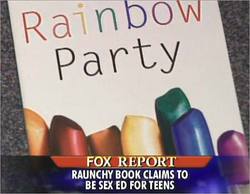
Now, the rainbow is being dragged even more deeply into the muck. A new book, Rainbow Party, tells the story of a group of teens who engage in a fairly new form of group sex involving girls wearing different colored lipstick (so, if your kid is ever invited to a rainbow party, just be informed that they will not be doing crafts for entertainment). The book itself would be less irksome if it were not written by an author of juvenile fiction and published by Simon Pulse, a division of Simon & Scuster that specializes in books for teens.

Michelle Malkin comments on the book in the Houston Chronicle, and points out why it is closer to sex-ploitation than to education. Under the guise of "educating the yutes" it will doubtless be showing up in school libraries before long. It reminds me of Reefer Madness, a classic exploitation flick which was designed to generate ticket sales and controversy, but was billed as being for educational purposes (it was re-released at one time under the frantic title Tell Your Children!).

GET THE "COLORFUL" STORY.

Poison!

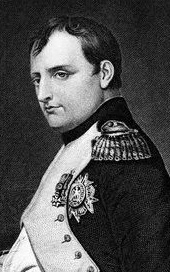
Napoleon1Stomach cancer may be what carried off H. P. Lovecraft. And it may be what Napoleon’s doctor put on his death certificate, but new findings strengthen the case that it wasn’t what carried off French emperor Napoleon.

Poison was.

Specifically, arsenic.

Some time ago, hair samples from Napoleon were found to contain abnormally high traces of arsenic, leading to speculation that he was poisoned.

SOME DISAGREED.

Some of the speculation centered on the idea that the abnormally high levels of arsenic might be due to environmental factors, such as the use of arsenic in certain kinds of wall paper at the time.

But new findings suggest that the arsenic in his hair was absorbed from his bloodstream, indicating frighteningly high serum concentrations of arsenic and thus a deliberate poisoning.

EXCERPTS:

The toxic form of arsenic, used for centuries as rat poison, was found in Napoleon’s hair samples at 37 to 42 times above the normal level in the new study.

"I can’t imagine Napoleon fed himself rat poison, even if he wasn’t a gourmet," joked Damamme of Montreal-based INS.

"The arsenic was in the ‘spinal cord’ of the hair, which implies that it came from the blood and food ingested," he said.

"Somebody in his circle gave him arsenic in small doses to poison him little by little to avoid another violent uprising by those who still supported the emperor in France," Damamme said.

GET THE STORY.

Now if they just had biological samples from the emperors Augustus and Claudius to verify the poisonings that reportedly did them in.

The Papers That Didn't Burn

So on Friday B16 named JP2’s personal secretary, Archbishop Stanislaw Dziwisz, to be the new archbishop of Krakow–the post Karol Wojtyla held before he became JP2.

Cool. A reward for a career of faithful service, no?

But on Saturday something emerged calling into question the precise degree of faithfulness that was involved: Archbishop Dziwisz announced that he had failed to burn all of JP2’s private papers, as called for in his will!

EXCERPTS:

Archbishop Stanislaw Dziwisz, who worked with the pope from 1966 until his death earlier this year, told Polish state radio there are "quite a lot of manuscripts on various issues," but he offered no details.

"Nothing has been burned," Dziwisz said. "Nothing is fit for burning, everything should be preserved and kept for history, for the future generations – every single sentence."

"These are great riches that should gradually be made available to the public."

Dziwisz did not say when or how that might happen.

In Saturday’s radio interview, Dziwisz suggested that some of the notes could prove useful in the late pontiff’s beatification process.

Now, I don’t know if Archbishop Dziwisz was himself charged with burning the papers, nor do I know if he was ordered not to do so by someone with the authority to give this order (e.g., B16), so I don’t know how to appraise his role in this.

Still, my feelings about this revelation are profoundly . . . mixed.

As they were when it was announced that JP2’s will called for all his private papers to be burned. I recognized that this represented a huge loss to historians, but on the other hand it was JP2’s will–and in his will–and you don’t disobey what someone says in his will.

I also have some sympathy for JP2’s desire. There have been people who’ve been badly burned historically by folks rumaging through their papers and the misrepresenting them.

It happened to Friedrich Nietzsche, for example. After he was institutionalized, his anti-Semitic, German-nationalistic sister went through his papers and "edited" them for publication. She also promoted what she proclaimed as "his" philosophy, which was really her own and which served to make Nietzsche an inspirational figure for Hitler and the Nazi party (contrary to what Nietzsche himself would have wanted).

While one hopes that the proper scholarly controls will be employed in any evaluation of JP2’s private papers, the potential for mischief is significant.

For one, we have no idea what state those papers are in. It may be that it will be hard or impossible to determine what was authored by the late pontiff and what wasn’t. People may have sent him drafts of things that found their way into his private papers, and some of these might be assumed to have been authored by the pope himself. Others’ (potentially lame-brained) ideas thus might end up being ascribed to JP2.

Also there is a fact that someone’s private papers are things that–by definition–the person did not intend for publication. Private papers frequently represent efforts individuals make at "trying out" ideas or ways of approaching a subject, only to have the individual himself conclude that this was a bad start that was unworthy of publication.

There may even be things in a person’s private papers where he tries to write out the strongest case he can make for a position he disagrees with–so that he can use this brief as a foil for later knocking down the position.

And then there is the danger of sensationalism–of an individual gaining (or claiming to have gained) access to the "secret" JP2 private papers and publishing books erroneously purporting to give his "true, private views" on matters.

Try to imagine what "historians" have done to Pius XII being done to JP2 to get an idea of what this could involve.

So while I am, on the one hand, pleased that JP2’s private papers are not lost to historians, I am simultaneously apprehensive about the use and misuse that might be made of them and concerned about the apparent violation of a clause of his will.

GET THE STORY.

(CHT to the reader who e-mailed.)

The Papers That Didn’t Burn

So on Friday B16 named JP2’s personal secretary, Archbishop Stanislaw Dziwisz, to be the new archbishop of Krakow–the post Karol Wojtyla held before he became JP2.

Cool. A reward for a career of faithful service, no?

But on Saturday something emerged calling into question the precise degree of faithfulness that was involved: Archbishop Dziwisz announced that he had failed to burn all of JP2’s private papers, as called for in his will!

EXCERPTS:

Archbishop Stanislaw Dziwisz, who worked with the pope from 1966 until his death earlier this year, told Polish state radio there are "quite a lot of manuscripts on various issues," but he offered no details.

"Nothing has been burned," Dziwisz said. "Nothing is fit for burning, everything should be preserved and kept for history, for the future generations – every single sentence."

"These are great riches that should gradually be made available to the public."

Dziwisz did not say when or how that might happen.

In Saturday’s radio interview, Dziwisz suggested that some of the notes could prove useful in the late pontiff’s beatification process.

Now, I don’t know if Archbishop Dziwisz was himself charged with burning the papers, nor do I know if he was ordered not to do so by someone with the authority to give this order (e.g., B16), so I don’t know how to appraise his role in this.

Still, my feelings about this revelation are profoundly . . . mixed.

As they were when it was announced that JP2’s will called for all his private papers to be burned. I recognized that this represented a huge loss to historians, but on the other hand it was JP2’s will–and in his will–and you don’t disobey what someone says in his will.

I also have some sympathy for JP2’s desire. There have been people who’ve been badly burned historically by folks rumaging through their papers and the misrepresenting them.

It happened to Friedrich Nietzsche, for example. After he was institutionalized, his anti-Semitic, German-nationalistic sister went through his papers and "edited" them for publication. She also promoted what she proclaimed as "his" philosophy, which was really her own and which served to make Nietzsche an inspirational figure for Hitler and the Nazi party (contrary to what Nietzsche himself would have wanted).

While one hopes that the proper scholarly controls will be employed in any evaluation of JP2’s private papers, the potential for mischief is significant.

For one, we have no idea what state those papers are in. It may be that it will be hard or impossible to determine what was authored by the late pontiff and what wasn’t. People may have sent him drafts of things that found their way into his private papers, and some of these might be assumed to have been authored by the pope himself. Others’ (potentially lame-brained) ideas thus might end up being ascribed to JP2.

Also there is a fact that someone’s private papers are things that–by definition–the person did not intend for publication. Private papers frequently represent efforts individuals make at "trying out" ideas or ways of approaching a subject, only to have the individual himself conclude that this was a bad start that was unworthy of publication.

There may even be things in a person’s private papers where he tries to write out the strongest case he can make for a position he disagrees with–so that he can use this brief as a foil for later knocking down the position.

And then there is the danger of sensationalism–of an individual gaining (or claiming to have gained) access to the "secret" JP2 private papers and publishing books erroneously purporting to give his "true, private views" on matters.

Try to imagine what "historians" have done to Pius XII being done to JP2 to get an idea of what this could involve.

So while I am, on the one hand, pleased that JP2’s private papers are not lost to historians, I am simultaneously apprehensive about the use and misuse that might be made of them and concerned about the apparent violation of a clause of his will.

GET THE STORY.

(CHT to the reader who e-mailed.)

Tag, I'm It!

Michelle did the blog book meme a piece back, and now Revolution of Love has tagged me for the book meme that’s going around the blogosphere, so here goes:

1) Total number of books I own –

A quick estimate of that based on shelf counting, etc., puts the number at about 4,000.

2) The last book I bought –

According to "My Account" at Amazon.Com, that would be

INTO THE TWILIGHT, ENDLESSLY GROUSING by humorist Patrick McManus

3) The last book I read was –

Read all the way through? Well, I just finished (listening to) one today so I s’ppose that would be

THE MAKING OF MODERN ECONOMICS: THE LIVES AND IDEAS OF THE GREAT THINKERS by Mark Skousen

4) Five books that mean a lot to me –

The five books (or sets) that mean the most to me would be the Bible, the Catechism, the Summa Theologiae, the collected decrees of the ecumenical councils, and the collected encyclicals of the popes, but those wouldn’t be very interesting for me to use to answer this question since they are all standard works directly related to my profession.

Therefore, let me offer five that are special to me for other reasons. Each one of the following affected my life in an important way:

  1. THE NEW TESTAMENT DOCUMENTS: ARE THEY RELIABLE? by F. F. Bruce. I read this book when I was a new follower of Christ who had imbibed an awful lot of secularism in high school and college. This book, by an important New Testament scholar, helped me start taking the historical value of the Gospels and the other New Testament documents seriously.
  2. MIRACLES by C. S. Lewis. This one further helped me get over the secular worldview by offering a powerful exploration of the concept of miracles and how they can fit with natural law and science.
  3. SCALING THE SECULAR CITY by J. P. Moreland. This one was a morale boost to me as a developing apologist because it provided an exemplar of Christian apologetics done with the kind of rigorously-argued approach that I craved. As an analytic philosophy student, I thrived on rigorous argumentation, but so few works out there tried to bring this level of work to the defense of the faith. This one did. It’s a modern classic and represents a kind of apologeics that still does not exist in Catholic circles. (Though I don’t like all of Moreland’s treatment of the kalaam argument for creation.)
  4. EARLY CHRISTIAN DOCTRINES by J. N. D. Kelly. Though Kelly is not a Catholic, reading his survey of doctrine in the early Church helped show me just how Catholic the early Church Fathers were.
  5. DR. ATKINS NEW DIET REVOLUTION by Dr. Robert Akins. This is the book that saved me from getting diabetes. I was insulin resistant with rising blood sugar levels when my doctor recommended this book to me. After going on the this diet, I dropped a hundred pounds without hunger. Even before the weight came off, I felt better and had more energy than I had in years. This book opened my eyes to how completely BACKWARDS normal dieting advice is (and thus why all previous diets I had tried had failed so dismally).

5) I tag – (5 bloggers)

Okay, here is a design flaw in this meme. There is no way, given how far it’s spread, that I’m going to go to who knows how many other blogs and search through their archives to see if they’ve already done the meme. Neither am I going to fire off tags to other bloggers irrespective of whether they may have done this meme.

Therefore, I hereby tag all the bloggers reading this who haven’t already been infected by the meme.