Coming To A TVMovie Screen Near You

SimpsonsFor some years they’ve been talking about doing a full-scale motion picture of The Simpsons.

Word has been, though, that they wouldn’t do it until the TV series wraps.

But the TV series has proven far more resilient than anybody imagined. Heading into its 17th season this fall, the series has become The Series That Wouldn’t Die.

Kinda helps a show stay fresh when the premise is as wide-open and unbound to conventions of realism as The Simpsons is, I guess. (I mean, the show may not be as fresh as the immortal Season 5, but can you even imagine how stale a typical sit-com would be in its 16th year? . . . Brrrrrr!)

So the movie-delayers finally threw in the towel and The Simpsons theatrical movie is now in production!

YEE-HAW!–I mean–WOO-HOO!

GET THE STORY.

Money See, Money Do?

CapuchinmonkeyThe little feller you see to the left is a capuchin monkey. (So-named because of a visual similarity to Capuchin attire.)

They’re interesting critters:


The capuchin is a New World monkey, brown and cute, the size of a scrawny year-old human baby plus a long tail. ”The capuchin has a small brain, and it’s pretty much focused on food and sex,” says Keith Chen, a Yale economist. . . . ”You should really think of a capuchin as a bottomless stomach of want,” Chen says. ”You can feed them marshmallows all day, they’ll throw up and then come back for more.”

Now, you may be wondering: Why is a Yale economist telling us about capuchin monkeys?

‘Cause he’s studying their capacity for economics.

GET THE STORY.

He’s taught them to use money to buy grapes, apples, Jello-O cubes, cucumber slices, and . . . other things.

The currency Chen settled on was a silver disc, one inch in
diameter, with a hole in the middle — ”kind of like Chinese money,”
he says. It took several months of rudimentary repetition to teach the
monkeys that these tokens were valuable as a means of exchange for a
treat and would be similarly valuable the next day. Having gained that
understanding, a capuchin would then be presented with 12 tokens on a
tray and have to decide how many to surrender for, say, Jell-O cubes
versus grapes. This first step allowed each capuchin to reveal its
preferences and to grasp the concept of budgeting.

Then Chen introduced price shocks and wealth shocks. If, for
instance, the price of Jell-O fell (two cubes instead of one per
token), would the capuchin buy more Jell-O and fewer grapes? The
capuchins responded rationally to tests like this — that is, they
responded the way most readers of The Times would respond. In
economist-speak, the capuchins adhered to the rules of utility
maximization and price theory: when the price of something falls,
people tend to buy more of it.

Monkeys may not be able to come up with the idea of money, but this kind appears to be able to grasp the rudiments of the concept when they were taught it. They even behave surprisingly like humans in their use of money:

When taught to use money, a group of capuchin monkeys responded quite
rationally to simple incentives; responded irrationally to risky
gambles; failed to save; stole when they could; used money for food. . . . In other words, they behaved a good bit like the
creature that most of Chen’s more traditional colleagues study: Homo
sapiens.

The monkeys got quite creative with their manipulation of money. Before Chen took steps to prevent it they even developed the concept of . . . well, let’s just say that they invented a very old profession–the proceeds of which were then used to buy a grape.

Going To Pot

Once again Our Robed Masters are seeking to save you from the laws of your state, which cannot be trusted to pass laws that differ from the will of The All-Powerful Few:

"Federal authorities may prosecute sick people whose doctors prescribe marijuana to ease pain, the Supreme Court ruled Monday, concluding that state laws don’t protect users from a federal ban on the drug.

"The decision is a stinging defeat for marijuana advocates who had successfully pushed 10 states to allow the drug’s use to treat various illnesses.

"Justice John Paul Stevens, writing the 6-3 decision, said that Congress could change the law to allow medical use of marijuana.

"The closely watched case was an appeal by the Bush administration in a case involving two seriously ill California women who use marijuana. The court said the prosecution of pot users under the federal Controlled Substances Act was constitutional.

"’I’m going to have to be prepared to be arrested,’ said Diane Monson, one of the women involved in the case."

GET THE STORY.

Now, I am not a doctor, and so cannot comment on the possible legitimate medicinal usages for marijuana. What outrages me is that the United States Supreme Court can overturn any and all state laws with which it disagrees with virtual impunity, and has been able to do so for generations now. Ms. Monson, for example, should have been able, under our system of government, to be protected by her state. Now she stands alone and vulnerable, at a time when she is also seriously ill, before the unchecked might of the Men (and Women) In Black.

Our Founding Fathers would have been appalled.

Happy Birthday, Donald!

Donald_duckToday in 1934 Donald Fauntleroy Duck made his first appearance in the Silly Symphonies cartoon "The Wise Little Hen."

He became Disney’s second most popular character, next to Mickey Mouse (kind of their Daffy Duck to Disney’s Bugs Bunny).

He also went on to star in comic books (notably drawn by the great Carl Barks), TV shows, and other media.

You gotta admire a duck who could be that good natured and succeed despite that big a speech impediment (far worse than Daffy’s).

LEARN MORE ABOUT DONALD’S HISTORY.

ALSO LEARN ABOUT THE MAN BEHIND HIS VOICE–an Oklahoma boy who made it big talking like an incomprehensible duck.

Happy birthday, Donald!

I Am Telling a Lie…

CopI was flippin’ through the channels this morning and came across yet another live car chase on FOX News. I had other fish to fry, but just before I switched the TV off, the play-by-play guyreporter remarked that the police were likely telling the bad guy in the pursued vehicle anything they could think of that might make him give up. Police negotiators are allowed to say anything at all if it will save lives or cut short an unstable situation, even if it is 180 degrees opposite of the truth.

I have also watched numerous episodes of NYPD Blue, so I know that police interrogators are allowed to say things like "Your accomplice gave you up already. He says you made him do it. He’s singing like a canary… " even if it is not true. In other words, the police are allowed to lie. In certain situations I suppose it would even be considered a professional duty to lie, say to save the life of a hostage.

Now, obviously, this brought to mind Rahab, the lying prostitute back in the Old Testament (sorry, I’m not much for chapter and verse). She lied to save the good guys in the story (a couple of spies from Israel) and was rewarded by having her life spared later.

So, this all got me thinking, which is a dangerous thing. What sort of ethical, moral and spiritual problems might a devout Catholic police officer have about lying in the course of performing his/her job? Is it permissable from a moral standpoint? Is it even meritorious in certain circumstances? Would they have to go to confession after telling a whopper to a kidnapping suspect?

You might think that I ask these questions in a rhetorical fashion only in order to provide the answers later in the post. Nope.

I’m asking because I really don’t know. Now, I suspect that, yeah, in certain circumstances it might be considered not only morally permissable, but commendable to lie in certain life-or-death type siuations. BUT, I just don’t know. Much as I hate to punt on this, I will leave it to Jimmy and some of the better informed readers to handle this one. My head hurts…

Well, not really…

Masses Per Day

A reader writes:

I am currently involved in a group studying ECCLESIA DE EUCHARISTIA.  Two questions came up last night.

            1) Can you go to two masses on the same day and receive communion at both?

            I realize that you can receive two times as long as the second one is a mass, (the first could be a communion service..etc).  But one of the participants really insisted that it couldn’t be two masses for the same day (like a 9:00 and an 11:00) service on Sunday.

Your friend is incorrect on this point. First, here is what the Code says as a general matter about receiving Communion:

Can.  912 Any baptized person not prohibited by law
can and must be admitted to holy communion.

This means that unless there is a specific prohibition in the law that would prevent a person from receiving at two Masses then the person is allowed to receive at two Masses.

Now, there are only two canons that deal with how often a layperson can receive Communion in a single day. One of them deals with Viaticum in case of death. Here’s the other:

Can.  917 A person who has already received the
Most Holy Eucharist can receive it a second time on the same day only within
the eucharistic celebration in which the person participates, without prejudice
to the prescript of can. 921, §2.

Canon 921, §2 deals with Viaticum, so it doesn’t apply to the situation you are asking about.

As you can see, this canon says that a person can receive Communion "a second time on the same day only within
the eucharistic celebration in which the person participates." This specifies the circumstances that must apply to the second time a person receives Communion but says nothing about the circumstances of the first time. Since there are no requirements in the law dealing with the first time one receives Communion, canon 912 applies, and so one can receive Communion at Mass both the first time one receives it in a day and the second time. In fact, it is required that one receive it at Mass the second time (per canon 917). Whether it is at a Mass or a Communion service the first time is a matter the law allows liberty on.

One thus could go to a 9 a.m. Mass and receive Communion and then go to an 11 a.m. Mass and receive again. What the law prohibits is going to more Masses than this per day and receiving Communion at each of them.

The reader continues:

            2) How many masses can a priest say a day?  I believe that He is encouraged to say at least one mass a day but what is the upper limit.

Here’s the regs on that:

Can.  905 §1. A priest is not permitted to
celebrate the Eucharist more than once a day except in cases where the law
permits him to celebrate or concelebrate more than once on the same day.

§2. If there is a shortage of priests, the local
ordinary can allow priests to celebrate twice a day for a just cause, or if
pastoral necessity requires it, even three times on Sundays and holy days of
obligation.

The typical cap is thus once per day unless the bishop allows him to say two or three Masses for pastoral reasons (three being allowed on Sundays and holy days). These latter practices are known as "binating" and "trinating," respectively.

(NOTE: The green CLSA commentary on the Code notes that there are particular circumstances in which additional Masses could be said, but that’s the general rule. There are also certain liturgical days in which multiple Masses are allowed by the law itself and so per §1 the permission of the bishop would not be needed to cover those days.)

Diagnosis: Calvary

An Israeli researcher believes that Jesus died not of blood loss, but of a blood clot:

"Professor Benjamin Brenner wrote in The Journal of Thrombosis and Haemostasis that Jesus’ death, traditionally believed to have occurred 3 to 6 hours after crucifixion began, was probably caused by a blood clot that reached his lungs.

"Such pulmonary embolisms, leading to sudden death, can stem from immobilization, multiple trauma and dehydration, said Brenner, a researcher at Rambam Medical Center in Haifa.

"’This fits well with Jesus’ condition and actually was in all likelihood the major cause of death by crucifixion,’ he wrote in the article, based on religious and medical texts."

GET THE STORY.

Given that the Shroud of Turin is not mentioned in the article as the source of study, how can scientists make such a determination that the cause of death was more likely to be blood clot than blood loss when they do not have a body to examine? Unless the researcher was studying blood patterns on the Shroud, believed to be Jesus’ burial clothes, making such a statement as anything more than mere speculation seems rash.

Forward Into The Past

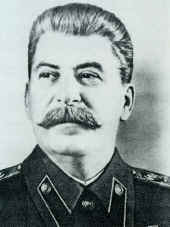
StalinToday in 1949 George Orwell’s classic dystopian novel 1984 was published.

Man! Was it that long ago?

1984, I mean, not 1949.

I remember growing up in the years before 1984, when Orwell’s novel was still a dark prophecy of the future. There was no way that the world would really resemble the novel come that year, but the number "1984" was still an ominous and emblematic number, filled with cultural resonance.

Guess the passage of time took the edge of it.

The novel’s still a classic, though.

LEARN MORE.

Now, you may be wondering why I’ve got a picture of Joseph Stalin in this post. The reason is that 1984 was written in significant measure to illustrate Orwell’s disappointment with Soviet Communism and, if you read the novel, it’s hard not to see Joseph Stalin (who was in power in Russia at the time) and all the Soviet propaganda posters of him as the prototype for Big Brother and all the IngSoc ("English Socialism") propaganda posters of him in turn. Realizing the political context of 1984, it’s hard not to imagine Joseph Stalin’s face on all those "Big Brother Is Watching You" posters.

Sola Fide, Heresy, & Damnation

A non-Catholic reader writes:

I was discussing several issues with a Romanist Apologist on the Planet Envoy forum. He indicated that the Magisterium declares that anyone who believes in Sola Fide is a heretic, and that as a result, their damnation is certain. What say you on the matter?

I’ll tell you. But before I do, let me say something else: Didn’t your momma teach you any manners at all?

Unless you are uncommonly unfamiliar with the standard use of the terms you are using, you must realize that the term "Romanist" is a religious slur that is highly offensive and used to express contempt for Catholics.

Would you really walk up to an African American and say something like, "So I was talking with a <INSERT RACIAL SLUR> activist, and he said . . . "?

Or would you e-mail a Jewish scholar and say, "I was in a chat room with a <INSERT ETHNO-RELIGIOUS SLUR> guy and was wondering if you, as one of his fellow <SLURS>, could comment on what he said?"

If you wouldn’t do these things, what the HECK are you doing writing to me, asking for my opinion on something, and throwing a religious term of contempt in my face?

Whatever bigoted language you may choose to use when among your own co-religionists, common sense should tell you how rude it is to go throwing such language in the faces of those from whom you are asking favors.

You should be ashamed of yourself.

Having made this point, let us now go the extra mile to address the subject of your query.

Since I have not read the exchange in question, I cannot comment on what the Catholic apologist said. I can only comment on what you report him as saying. There may be important nuances that have been lost in transmission.

That being said, there are two difficulties with the position as you present it.

The first concerns the use of the phrase "sola fide." While certain interpretations of the proposition that we are justified "by faith alone" (sola fide) have been infallibly rejected by the Magisterium, and while it would be materially heretical to endorse these interpretations, it is not the case that every possible use of the phrase has been infallibly rejected as heretical.

The use of the phrase is intrinsically misleading and contrary to the language of Scripture (since the only time the phrase is ever used in Scripture, in James 2:24, it is rejected under the inspiration of the Holy Ghost), but it is nevertheless possible to ascribe a meaning to the phrase that is non-heretical. For example, if (a) one understands the faith in question to be faith that results in hope and charity and if (b) one understands this phrase (as Luther did) non-exclusively of baptism, then the result is non-heretical. (See the Joint Declaration on the Doctrine of Justification.)

It is thus not the case that every possible interpretation (however forced or improbable) of the phrase "sola fide" has been infallibly rejected as heretical.

The second problem with the position you articulated concerns the damnation of heretics. While it is true that one who is formally guilty of heresy loses the state of grace and will be lost unless he responds to God’s grace and repents, it is not the case that all who embrace heretical positions lack the state of grace.

Those who, though excusing causes such as ignorance, hold in good conscience positions that are materially heretical are not formally guilty of heresy and so do not commit mortal sin by holding these positions and do not lose the state of grace.

The Church thus does not hold that all who use the formula "sola fide" (whether in non-heretical or even heretical senses) are damned.