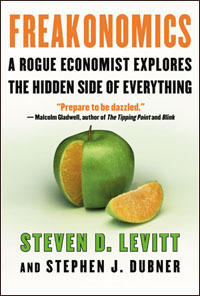
Welcome to Freakonomics week here on the blog. This last weekend I read the book pictured to the left and decided that I had enough to say about it to do a theme week (one post per day) on the subject.
First, let’s start with a general book review.
In case you may not be aware of it, Freakonomics is one of the breakout books this year. It has done extraordinarily well (especially for a book about economics). People are talking about it, arguing about it, citing it in editorials, etc., etc.
Having read it, it’s easy to see why. First, unlike the vast majority of economics books, it’s very easy to read. Even easier than some of Thomas Sowell’s economics books, and his are among the easiest there are.
You don’t have to get braced up for lots of technical gunk with this book. It’s written in clear, easy-to-understand English.
What’s more, it’s interesting. The authors aren’t trying to get across a lot of stuff about how the American economy or the global economy works. They aren’t predicing bear markets or bull markets, recessions or booms.
Instead, they are doing something an increasing number of economists are doing: Taking the principles and ideas normally used in economics and applying them to areas of life not traditionally considered economic in nature. Hence the "freak" part of the title. With chapter titles like "What Do School Teachers and Sumo Wrestlers Have in Common?" and "How Is the Ku Klux Klan Like a Group of Real-Estate Agents?" and "Why Do Drug Dealers Still Live with Their Moms?", you know that you’re not in for a typical, dry economics tome.
(Answers: School teachers and sumo wrestlers both fake results for reasons of self-interest; the KKK and real-estate agents both conceal certain kinds of information and lose their power when that knowledge is publicly exposed; most drug dealers pull in so little money that they are making less than minimum wage.)
The book is also iconoclastic. In applying economics principles to unusual areas, by asking unusual questions and then seeing what the available data has to say about them, the authors (or more specifically, the lead author) comes to conclusions that frequently (though not always) fly in the face of conventional wisdom. That helps make the book interesting, too. If it was just a work documenting all the cases in which the conventional wisdom is right, it’d be a lot less interesting.
For example: Did you know that it’s one hundred time more dangerous for small children to be in a typical house where there is a swimming pool than in a typical house where there are firearms?
Just one of the many cool tidbits that you’ll pick up by reading this book.
Now: There are things about the book that I don’t like. F’rinstance: I don’t like the way the lead author is treated. Steven D. Levitt is a noted young economist who has been the subject of various press articles by individuals such as co-author Stephen J. Dubner. Levitt was initially approached by a publisher about writing a book but wasn’t interested in doing it himself, so he teamed up with Dubner. As far as I can tell, all the economic ideas in the book are Levitt’s, while all the writing on the book was done by Dubner (no doubt with Levitt editing).
Here’s the problem: The book regularly quotes from a New York Times Magazine profile of Levitt that is basically a puff piece. It portrays Levitt as the coolest thing since sliced bread and as some kind of freaky economic supergenius who gets it right where all the other economists get it wrong. In fact, in one excerpt the piece compares Levitt to the guy who comes across numerous highly intelligent people futzing with a complex machine that they can’t get to work, only to notice that they haven’t plugged it in.
While it may be within the purview of the NYTM to publish such heroic puff pieces, it’s another thing entirely to quote such embarrassingly excessive passages in one of your own books. I expect to find deleriously positive ravings about an author placed by a publisher’s marketing department on the back of a book, but I don’t expect to find such statements placed in the text of the book by the author himself–or (more likely in this case) allowed by the author to be placed in there by his co-author.
It offends my sense of modesty and decorum.
It also seems to me to be massively imprudent. Writing a best-selling book that trounces what your colleagues in the field are doing is offense enough. To add to that offense such ego-displaying passages is bound to attract the attention and annoyance of one’s colleagues and generate a reputation for one as being a prima donna.
In fact, the authors cite in the book the example of one economist who went online and, pretending to be one of his own students, wrote glowingly about how great he was as a professor. When the ruse was found out, the professor became the object of professional and non-professional scorn.
Something similar is likely to happen in this case. Levitt may not be putting words in the mouth of an imaginary student about how great he is, but he’s immodestly allowing his co-author to reprint them inside a book that carries his name, and that’s just vanity in the extreme. Colleagues will not approve.
It’s also just the kind of thing that would lead colleagues to go over the reasoning in the book with a fine-toothed comb and find fault with it.
A lot of the stuff in Freakonomics is highly new and experimental and at least some of it is (here’s the important part) Not Likely To Hold Up After Further Study. Going back to the data, getting better data, and doing finer-grained analyses are likely to overturn at least some of the ideas advanced in the book, and when that happens, Levitt will look like a young whipper-snapper who self-importantly thought that he could tell everyone in the profession what to do and who crypto-(i.e., through his co-author) boasted in his own book about what a genius he was.
If I had no other impression to go on besides what comes through in such passages of the book (as, indeed, I do not), I’d have to conclude that Steven Levitt is an arrogant young would-be know-it-all and a Big Jerk who’s going to get his comeuppance one of these days.
In real life, Levitt may not be like that at all, but he’s likely to have a significant price to pay from the impression created among his colleagues once the backlash starts. Such passages are even annoying to non-economist readers who, after all, picked up the book to read about interesting economic ideas, not what an economic "superstar" Levitt wants to be portrayed as.
Now, I wouldn’t want the existence of such passages to put you off reading Freakonomics. They’re a relatively minor thing in the book. Most of it is devoted to the "freakonomic" ideas and not to portraying Levitt as a superstar. It’s easy enough to skip a paragraph or flip a page when the latter happens.
The economic ideas in the book are interesting–interesting enough that I’d devote a theme week to them–and involve very well-told tales.
So I’d encourage you to
GET THE BOOK.
Postscript: There’s a bit of offensive language in the
book when Klansmen and drug dealers are being quoted, so fair warning.
One other postscript: You may have noticed that I got all the way through the above review without even mentioning the most controversial claim of the book–that abortion is a major factor reducing the crime rate in recent years.
We’ll talk about that tomorrow.