In fact, they want to SCARE CHILDREN AWAY FROM HALLOWEEN.
Jack Chick, for example.
Joe over at Evangelical Outpost has
THIS DECONSTRUCTION OF ONE OF CHICK’S ANTI-HALLOWEEN TRACTS.

In fact, they want to SCARE CHILDREN AWAY FROM HALLOWEEN.
Jack Chick, for example.
Joe over at Evangelical Outpost has
THIS DECONSTRUCTION OF ONE OF CHICK’S ANTI-HALLOWEEN TRACTS.

Is Halloween too spooky for children? One Penn State psychologist thinks so.
"It is the adults who should be afraid this Halloween. Not of ghouls and goblins, but of permanently scarring their children.
"In a recent study of six- and seven-year-olds in the Philadelphia area, Penn State psychologist Cindy Dell Clark found that most parents underestimate just how terrifying the holiday can be for young kids.
[…]
"According to Clark, who interviewed parents and children after three Halloweens, younger children may be unwilling participants in the whole ritual.
"The key ingredient in the recipe of Halloween fright is, of course, death.
"’Intriguingly, Halloween is a holiday when adults assist children in behaviors taboo and out of bounds,’ Clark writes in the anthropological journal Ethos. ‘It is striking that on Halloween, death-related themes are intended as entertainment for the very children whom adults routinely protect.’"
After reading through this story, I wondered why the results of so many scientific studies seem to point to the solution of simply using common sense. Basically, it boils down to parents making sure their children learn the difference between reality and make-believe, and that they be on guard against well-intentioned people who expose children to more Halloween fright than the kids can handle. Then again, these days common sense is all too often an uncommon commodity.
REINVENTING THE HALLOWEEN LIGHT.
Happy Halloween! (Or, have a happy All Hallows Even, if you prefer.)
JIMMY ADDS: My own theory on the spookiness of Halloween celebrations is that it’s part of the same psychological process that leads humans to watch drama (which always involves dramatic tension–if the drama is any good) and to "play fight" as children. It’s a way of exposing oneself to dangers in a simulated, safe manner and thus learning to cope wiht the emotion of fear that accompanies them so that you’ll be able to handle it when you face REAL dangers. Such simulated danger situations are part of life–and of growing up. That’s not to say that some kids may not find the whole experience too scary. I know that when I was a small boy I was quite scared of some Halloween stuff, though that didn’t stop me from wanting to stay up late every Friday night to watch monster movies on Boo Theater.
The problems with my computer were sufficiently grave that I determined it was time to buy a new one, so I did.
Will try to suck the data off the old one and (if possible) get it repaired to use as a back-up, but I am now back up to speed blogging. (I even have a good chunk of this week’s entries written in advance.)
Am still getting my old programs installed on the new one and figuring out what it’s individual quirks are since it’s a different model than my previous one.
Spent more than an hour Saturday morning trying to figure out what the speakers that had been working the night before were no longer emitting sound.
Did all kinds of troubleshooting. Could see that the unit was trying to produce sound (sound programs were displaying graphical wave formations or otherwise behaving as if they were producing sound), the speakers just weren’t emitting any. All the software seemed to be working. It seemed like a mechanical device problem.
It was.
Turned out that the new computer has a rotating volume control on the front of the unit near the touchpad and my thumb had apparently set it to zero without me realizing it was there.
D’OH!
That’s an hour of my life I won’t get back.
Having a physical volume control on the front of the unit is a handy thing–IF YOU KNOW IT’S THERE.
Steve Dillard of Southern Appeal and Confirm Them has gone out on a limb and made a prediction as to who George Bush will nominate to the Supreme Court.
THE L.A. TIMES THINKS HE’S WRONG.
But in Feddie’s favor, he was right when–just prior to the beginning of the Miers debacle–he predicted that Bush would choose badly.
Now he thinks the replacement choice for Miers may be stellar.
I hope he’s right.
We’ll probably know Monday.
I’m sorry, folks, but my computer was very, very sick last night and I spent all evening babying it, trying to get it well, and so I was unable to do any blogging.
I may be able to do a bit this morning, but can’t promise anything given how ill my computer has been.
I think it caught the flu from someone at Mass.
Y’know those "From the pastor’s desk" items that they run in Sunday bulletins? Whether in Protestant churches or Catholic churches, I’ve always found those to be largely . . . what’s the right term? "A waste of space"? No, that’s probably too strong. "Useless"? No, sounds too negative. How about: "Of rather limited value." Yeah, that’ll do.
We’ll, here’s one that’s actually GOOD!
It appeared in this last Sunday’s bulletin at the parish I live in:
FROM THE PASTOR’S DESK The word is out–this is supposed to be a really nasty FLU SEASON. I prefer to have healthy parishioners, and as such, support any of you who prefer to shy away from the handshake/hug as a sign of peace, as well as holding hands during the Our Father. As a courtes to your fellow parishioners, I do encorage you to offer a gentle nod, a friendly smile and the words "Peace be with you" at the appropriate time. Laurie has suggested also that we catch sneezes or coughs in the crooks of our elbows rather than in our hands, helping to contain any germs on our own clothing–the less airborne, shared actvity the better!
YES!
A voice of sanity!
Only thing I’d tweak is that people who are contagious SHOULD NOT BE AT MASS AT ALL.
In a story that has been making waves throughout St. Blog’s Parish, one Catholic high school has decided that enough’s enough and it is going to crack down on its students … by banning students from blogging, not just on school computers on school time but even from the comfort and privacy of the kids’ own homes.
"When students post their faces, personal diaries and gossip on Web sites like Myspace.com and Xanga.com, it is not simply harmless teen fun, according to one area Catholic school principal.
"It’s an open invitation to predators and an activity Pope John XXIII Regional High School in Sparta will no longer tolerate, Rev. Kieran McHugh told a packed assembly of 900 high school students two weeks ago.
"Effective immediately, and over student complaints, the teens were told to dismantle their Myspace.com accounts or similar sites with personal profiles and blogs. Defy the order and face suspension, students were told.
"In the arena of unregulated online communities, which has largely escaped the reach of schools, Pope John appears to be breaking new ground. While public and private schools routinely block access to non-educational Web sites on school computers, Pope John’s order seeks to reach into students’homes.
"’I don’t see this as censorship,’ McHugh said this week. ‘I believe we are teaching common civility, courtesy and respect.’"
(Nod to the Curt Jester for the link.)
Dawn Eden of the Dawn Patrol has a post requesting opinion. Although I am not (yet) a parent or a Catholic school educator, here’s mine:
The policy stinks.
As others have pointed out, it is unenforceable, usurps parental authority within the parents’ own home, and does nothing to teach teens responsible use of the Internet. A letter to parents outlining the dangers; a rule forbidding blogging on school computers on school time; a policy disallowing students to name the school, school employees, or fellow students in an identifiable fashion on their privately-maintained blogs; and a student assembly to teach the students safe Internet habits may well have been far more effective.
That said.
If I were a parent of a student, I would require my child to obey the policy.
Catholics are not supposed to be rugged individualists with a me-the-Pope-and-Jesus worldview (although some American Catholics unfortunately appear to be formed by such a quasi-Protestant worldview). They are members of a larger community that inculcates the virtue of obedience to legitimate authority, religious and civil, in all things but those that are inherently sinful. Children should learn that while growing up may free them from that obedience to parents that is proper to childhood, it does not free them from the requirement of obedience to lawful authority. Practicing the virtue by obeying their parochial school’s authority can prepare them for the obedience they may one day have to give to a bishop or religious superior.
Legitimate authority may make prudentially unwise decisions. Granted. But parents who place the value of their child’s freedom to express himself on the Internet while under parental supervision over and above the value of teaching their child the virtue of Christian obedience — even when it’s difficult to be obedient to a prudentially unwise rule — do their child no favors. Far better, IMHO, to express to the school one’s displeasure with the policy while refraining from bad-mouthing the school to the child and requiring the child to follow the policy while it’s in effect.
JIMMY ADDS: Much of what I am about to say would be moot because I am a strong advocate of homeschooling and would not plan to put my children in an outside-of-the-home school, but here goes. . . .
I concur with everything Michelle said about the badness of the policy, and I respect her opinion regarding how she would handle the issue in her family. That’s a matter of parental choice. In my case, I would do things differently. Since the school has no legitimate authority over what the child does at home (that’s the parents’ domain), I would use the situation as an opportunity to teach the child the difference between obedience to legitimate authority (mine) and resistance to illegitimate authority (the school’s telling him what he can and can’t do on the Internet at home). I would therefore require my child to ignore the policy. (I would also explore taking action against the school, such as having recourse to the diocese.)
If the child wants to blog that would be fine with me–AND we’d have to face the issue of blogging anonymously to avoid the school policy–BUT no posts would go up without prior parental authorization of them (which would be a household rule irrespective of the school’s policy). If left unsupervised, kids say things that they shouldn’t, and in the electronic age they need to learn what is acceptable to say on the Net and what is not. In the process of parental reviewing and approving of posts, the child would learn the difference (gossip about classmates and teachers being things that fall into the unacceptable category).
It’s already been noted in the combox below, but I thought it deserved its own post:
Follow-up memo to Jeb: This does not mean that you don’t still need to pick up the phone and call your brother. He needs to understand, in no uncertain terms, that his next nomination has to be in the Scalia-Thomas mold.
Even another Roberts — as vast an improvement as that would be over another Miers — isn’t remotely going to cut it at this point.
More to follow…
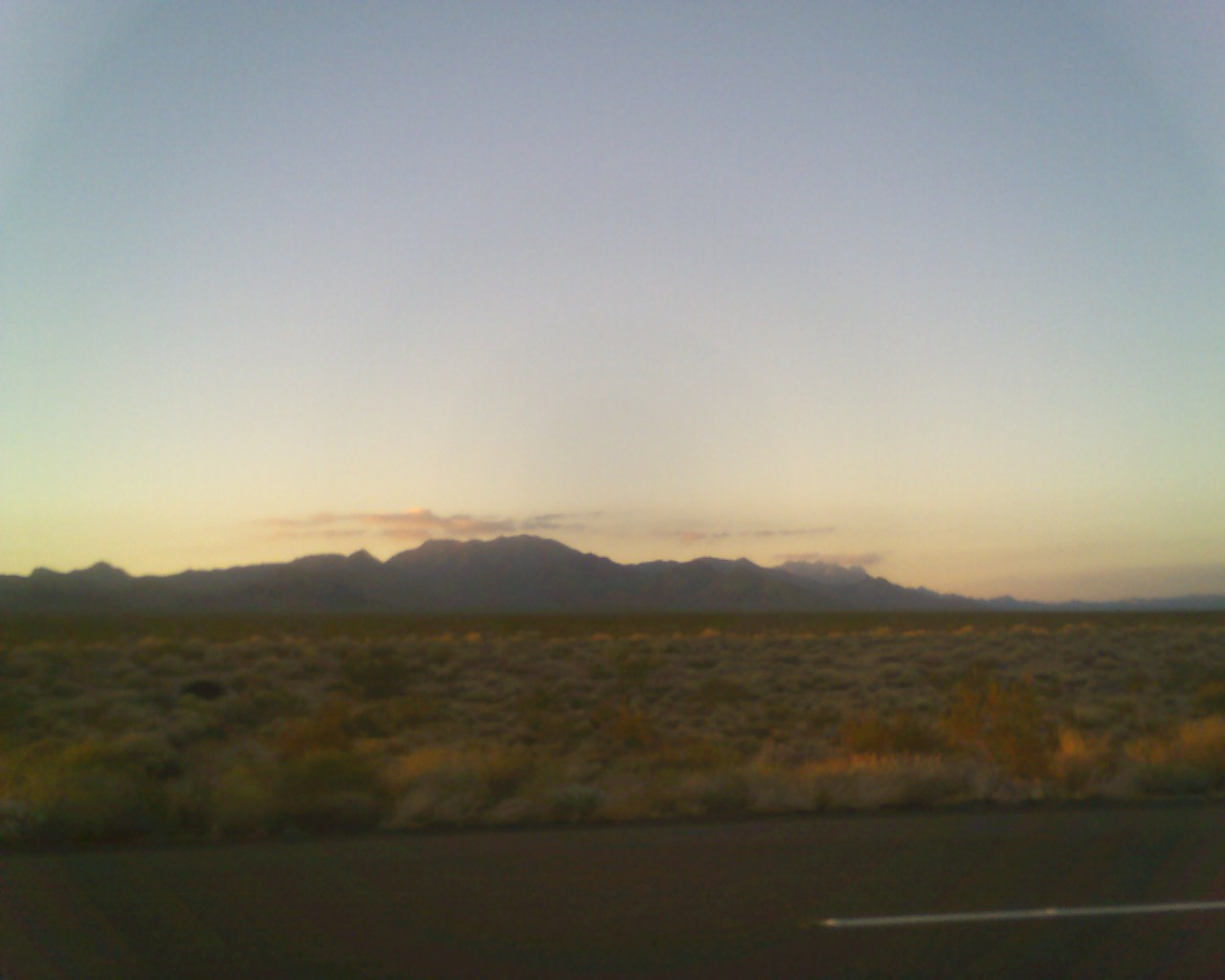
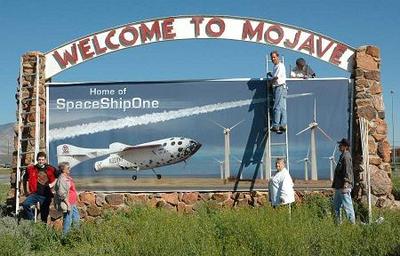
 While I’m linking places I’ve seen in my travels to sci-fi, lemme mention a connection to the Mojave Desert, whose southern edge I skirted on my recent road trip.
To the left is a frame from the original pilot for Star Trek. The pilot was called "The Cage" and did not feature Jim Kirk as captain of the Enteriprise. Instead, the ship was captained by Christopher Pike (played by Jeffrey Hunter).
NBC liked the pilot, but not enough to pick up the show. So they took the unusual step of ordering a second pilot, for which they gave Gene Roddenberry a lot of "notes" (directives for what to do differently).
Among the notes were that Roddenberry needed to LOSE the Number One character (an emotionless female HUMAN first officer played by Majel Berrett, later Nurse Chapel, later Majel Berrett-Roddenberry, later Lwaxana Troi and the Federation Computer Voice) AND he needed to lose the pointy-eared character Spock.
Roddenberry sacrificed the first in order to save the second.
Whether he also needed to lose Jeffrey Hunter as Christopher Pike or whether left for other reasons, I dunno.
But in the original pilot we were treated to an interesting story that was significantly similar to . . . and significantly different from . . . later incarnations of Trek.
(The footage from "The Cage" was also later almost all used in the Star Trek two-parter "The Menagerie"–the one featuring a horribly disfigured Captain Pike [now played by Sean Kenney] in a wheelchair)
In "The Cage," Captain Pike is captured by aliens who can read his mind and give him any fantasy he wants. They’re doing this to try to get him to hook up with a human female they also have so that the two can become the progenitors of a new race on their dying planet.
In one scene (pictured above), they give Pike a fantasy of going back to Earth, where he is married to the captive human cutie and lives in his home town of Mojave (mo-HAH-vee), California.
Upon seeing the ultra-futuristic sci-fi city, Pike declares:
I used to ride through here when I was a kid. Not as pretty as some of the parks around the big cities, but. . . . That’s Mojave. That’s where I was born.
Later, his imaginary wifey remarks:
They say that in the olden days all this was a desert–just blowing sand and cactus.
That’s a pretty good clue that we’re talking about a not-yet-built city in the Mojave Desert, which has been terraformed into being like a more garden-like part of Terra.
But there are a couple of problems:
1) The Mojave Desert ain’t just a bunch of dunes. Like many deserts, it doesn’t fit the typical sand dune model that we have in mind from TV and the movies. Instead, much of it is filled with scrub and there isn’t a sand dune in sight, as my recent post showed.
But this is somewhat soluble since there IS a section of the Mojave Desert that is filled with sand dunes. It’s called the Kelso Dunes (below), and is presumably where Captain Pike’s hometown was built. (Obviously a serious blow was done to LEAVE-IT-ALONE-AT-ALL-COSTS!-environmentalism between now and then. Maybe World War III did that.)
But there’s also a second problem:
2) THERE ALREADY IS A MOJAVE, CALIFORNIA!
It’s near Tehachapi.

I mean, it’s not a BIG town–in 2000 the town only has 3,800 inhabitants–but then Captian Pike indicated that his Mojave was a smaller place.
It also seems to be in at least a semi-desert area, though I have no indication that there are sand dunes there.
So either this Mojave doesn’t exist in the Star Trek universe or it ceased to exist between now and Captian Pike’s time (maybe World War III did that) or it’s been renamed–or something!–and a new Mojave has been built in the Mojave Desert, as the pilot implies.
In any event, the real world Mojave is about three and a half hours north of San Diego.
Maybe someday, I’ll go there, too.
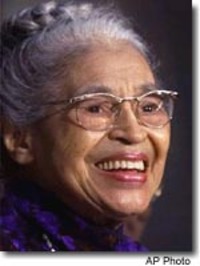
Rosa Parks, the quiet seamstress who sparked the civil rights movement by refusing to relinquish her bus seat to a white man, died Monday at the age of 92. (As an aside, beyond the issues of racial bigotry, which are heinous in and of themselves and which I do not intend to trivialize, I’ve wondered if that white man’s mama dressed him down for expecting a lady to give him her seat.)
"[Congressman John] Conyers [D-MI], who first met Parks during the early days of the civil rights struggle, recalled Monday that she worked on his original congressional staff when he first was elected to the House of Representatives in 1964.
"’I think that she, as the mother of the new civil rights movement, has left an impact not just on the nation, but on the world,’ he told CNN in a telephone interview. ‘She was a real apostle of the nonviolence movement.’
"He remembered her as someone who never raised her voice — an eloquent voice of the civil rights movement."
"’You treated her with deference because she was so quiet, so serene — just a very special person,’ he said, adding that ‘there was only one’ Rosa Parks."
While reading through this section of Parks’ obituary, I was struck by the Marian tone of the piece. Parks was a motherly figure to the movement and offered a presence that gave the cause a mantle of quiet dignity and courage. Interesting, isn’t it, how great paradigm shifts in history are often ushered in by women? Men may take the lead in fighting the battle, but the "incarnation" of the moment often enough enters history through a woman.
May Rosa Parks rest in peace and may perpetual light shine upon her through Christ our Lord, as mediated by Mary his most holy Mother.