B16 On Islam’s Capacity To Change

You may be aware of a story that has been floating around the blogosphere/MSM regarding comments allegedly made by B16 to the effect that Islam is incapable of changing and its to the modern world.

The story is based on comments made by Fr. Joseph Fessio to Hugh Hewitt on his radio show.

In some places folks have been making a lot out of this,

SUCH AS HERE.

But before people go off half-cocked on this one, they need to read a very important clarification of his remarks issued by Fr. Fessio in response to the article I just linked.

READ IT HERE.

(CHT: Insight scoop.)

UPDATE: MORE HERE FROM SANDRO MAGISTER. (Thanks to the reader who e-mailed!)

Fulfilling One’s Sunday Obligation

A reader writes:

My wife went to confession this
past Sunday.  Our church provides confession before mass and it runs up
to communion.  While in line for confession, she said she wasn’t able
to concentrate on the readings, then by the time she came out of the
confessional, she had missed the end of the gospel.  She then
considered not receiving communion because she felt she did not
complete her Sunday obligation of mass.  She finally decided to receive
communion, but on the drive home she thought that she may have
committed a sin by receiving communion.  She ended up going to another
mass later that evening, but that didn’t calm her fears.  Is
there anything I can tell her or do to help her?

Yes. Let’s split this question in two.

First: Did your wife sin by receiving Communion when she hadn’t been able to participate in part of the liturgy of the word?

NO!

Y’know why? Because YOU DON’T HAVE TO PARTICIPATE IN MASS IN ORDER
TO RECEIVE COMMUNION. That’s why there are Communion services. That’s
why the Church’s documents EXPLICITLY note that it’s licit to receive
Communion even if you just happen to be walking through a church when
Communion is being distributed.

How much or how little of the Mass you attend when you receive
Communion the first time during a day has NOTHING to do with whether
you can receive Communion. You don’t even have to be at Mass at all!
You may be receiving in a Communion service (as is the case, for
example, with the sick who are receiving Communion in the hospital).

(NOTE: This applies to the FIRST time you receive Communion on a
given day. If you want to receive twice then canon law provides that
the SECOND time you receive that you need to do so in the context of a
Mass that you are attending.)

Since this was the first time (I assume) that your wife had received Communion that day, there was NO SIN AT ALL committed.

Receiving Communion and fulfilling one’s Sunday obligation are TWO SEPARATE ISSUES.

Now let’s deal with the second question: Did your wife fulfill her Sunday obligation?

Yes.

Not only because she went to Mass later in the day but ALSO because
her participation in the first Mass was sufficient to satisfy the
requirements of canon law.

Here’s why:

The Church HASN’T specified precisely how much or what parts of the
Mass one needs to attend in order to fulfill one’s Sunday obligation.
Obviously, it needs to be a significant part of the Mass, but the
Church has not offered us an explicit formula for figuring this out.

That means that it is reasonable to look to the historic practice of
the Church for help in figuring out this question. When we do that, we
find that the situation your wife was in is VERY COMMON in Church
history. Before the liturgy was revised, it was VERY COMMON to have
confessions being heard during the liturgy of the word (which was then
called the "Mass of the catechumens," separate from the liturgy of the
Eucharist or "Mass of the faithfu") and–y’know what?–they DIDN’T stop
confessions during the gospel so people could hear it. Nor did the
Church tell people they had to go to another Mass if they didn’t hear
the gospel.

A common stream of opinion prior to the reform of the liturgy was
that you satisfied your Sunday obligation AS LONG AS YOU HEARD THE MASS
FROM THE OFFERTORY NEAR THE BEGINNING OF THE LITURGY OF THE EUCHARIST
OR "MASS OF THE FAITHFUL." In other words, YOU COULD MISS THE ENTIRE
LITURGY OF THE WORD OR "MASS OF THE CATECHUMENS" AND STILL FULFILL YOUR
SUNDAY OBLIGATION.

I can quote this point from MULTIPLE pre-Concililiar moral theologies if necessary.

That being the case, we then ask: Do the Church’s documents indicate that MORE than this is required today?

No.

They don’t.

In fact, as I’ve mentioned, canon law does not indicate anything at
all regarding how much of the Mass we need to attend in order to
satisfy our Sunday obligation, which also tells us something else: THEY
DON’T WANT US SCRUPULING ABOUT THIS POINT. If they wanted us to scruple
about it, they would have told us more precisely what is required.

As long as we’re making a basic effort to do our part and attending
Mass–and ESPECIALLY if we attend Mass from the Offertory onwards,
which was commonly considered sufficient in the past–then we have done
that.

Now maybe she might have doubts about this.

Okay, then in comes our old friend, Canon 14 of the Code of Canon Law, which provides that in cases of a doubt of law then the law does not bind.

Given the lack of guidance on this question and the presence of the
pre-Conciliar history of regarding hearing Mass from the Offertory
onward as sufficient we AT LEAST have a doubt of whether the law
requires us to attend any particular part of the liturgy of the Word in
order to fulfill our Sunday obligation.

We therefore have a doubt of law, and the law does not bind unless and until Rome clarifies it.

Until then the faithful are not obligated to hear any part of the
liturgy of the word in order to fulfill their Sunday obligation.

That may surprise some folks, but that’s what canon law indicates
given the doubt of law situation that unambiguously exists in this case.

If your wife couldn’t concentrate on certain readings (which
wouldn’t have counted prior to the reform of the liturgy, anyway) or
didn’t hear the gospel then she CLEARLY fulfilled her obligation under
the old law and, since the new law doesn’t specify and has the
provision regarding a doubt of law not binding then she CLEARLY
fulfilled her Sunday obligation by attending the part of Mass that she
did.

So: It was praiseworthy for your wife to go to the lengths she did
to attend another Mass, but it was not required by the law and she did
not sin. Her Sunday obligation was fulfilled (TWICE!) and she should
not scruple on this point.

20

Encyclical MP3

HERE’S THE NEW ENCYCLICAL–DEUS CARITAS EST–IN MP3 FORMAT.

It’s about 17 meg in size and takes just over and hour and a half to listen to.

This is just a rough-n-ready adaptation of the encyclical to audio format. I didn’t have time to do a lot of tweaking to smooth things out, so there may be infelicities here and there. I did tweak a few things, though.

(Y’know, we’re really living in the future now. B16 issues an encyclical and in an incredibly short space of time it’s flashed all over the globe electronically and then in a couple of minutes–much less time that it takes to read it aloud–it’s read by an artificial voice and flashed back across the globe for anyone who wants to listen to it. B16’s predecessor B15 would have been stunned at this unimaginability. "These are the days of miracle and wonder.")

For this version of the file, I tried to remove listening distractions by stripping out the section numbers, footnotes, and scripture citations in parentheses (e.g., "1 Jn 1:4").

I also tried to tweak the artificial voice’s pronunciation of certain key Greek and Latin words in the encyclical (agape, caritas), but when the text uses a longer phrase in Latin, the results may not always be felicitous.

As a tip to how to use this mp3, you may want to have the encyclical on the screen in front of you–or a print copy–as you listen to the mp3. I often find that this dual audio/visual reinforcement makes it easier for me to assimilate texts. The voice pulls me along so I don’t get bogged down and distracted, and the visual reading experience helps me focus on what the voice is saying.

DOWNLOAD THE TEXT OF THE ENCYCLICAL HERE.

It’s also available HERE (.doc) and HERE [WARNING! Evil file format! (.pdf)]

Special thanks to the folks at ReapTeam.Org for hosting the mp3.

PLEASE CHECK OUT THEIR SITE.

Fear Of Going To Hell

A reader writes:

My wife has been having some problems lately with her fear of going to hell.  She has explained to me that she thinks she is going to hell because she doesn’t do any good deeds, and when she remembers some good deeds, she makes her self believe that it wasn’t with the proper intent.  She has been driving herself crazy with this lately.  Is there anything that I can say to her or anything I can do to calm her fears?

The first thing to recognize is that your wife is going through a period of scrupulosity, which is a disordered fear that one is sinning or in danger of going to hell. This is not uncommon. Many people go through periods of this at least once in their lives. Sometimes it is due to a need for a bit of extra theological education. When that is the case then once the person gets the additional education the problem begins to abate. In other cases the problem is related to additional causes (one common contributing cause being Obsessive-Compulsive Disorder, though this is not simply the same thing as scrupulosity). In these cases the problem may be longer lasting but is still treatable.

Let’s assume that your wife’s case is one of the short-term ones that is produced by a need for a bit of extra theological info. If so, it should be easily to address. If it is longer lasting, I suggest that you get in touch with an organization like Scrupulous Anonymous, though I wouldn’t recommend that right now. (It could make the situation more difficult by raising additional BASELESS fears that OTHER PEOPLE worry about that would need to be addressed. Go to them if the problem persists for a significant time after addressing her immediate concerns.)

To address the issue that your wife has raised regarding good works, there are certain things she needs to understand. Feel free to have her read this (assuming she won’t get mad).

The first thing that she needs to understand is that the thing that gets us to heaven is our receiving and remaining in God’s grace. We receive God’s grace when we turn to him and accept his offer of grace, particularly through the sacraments. When your wife makes a good confession, she thus receives God’s grace and is put in a state of grace.

That’s the first half of the equation.

The second half is remaining in a state of grace. The only way to not do this is to commit a mortal sin. Unless you commit a mortal sin, you remain in God’s grace.

Good works, therefore, are not of themselves necessary to remain in a state of grace. They may help you stay in a state of grace by building good habits that steer you away from sin, but a lack of good works IS  NOT A MORTAL SIN. If you are a baptized baby and you die before you are capable of doing good works, you don’t have any, but that doesn’t keep you out of heaven. Similarly, if you’re an adult convert and you get baptized and then run over by a bus so that you don’t have a chance to do good works, you don’t get kept out of heaven.

The key to going to heaven is our reception of and remaining in God’s grace. It’s his grace that gets us to heaven.

Good works are a natural outgrowth of his grace working in our hearts, and he rewards us for cooperating with his grace in doing good works, but the thing that would keep us out of heaven is mortal sin, not having an insufficient number of good works.

She should therefore put this worry out of her mind.

That, OF ITSELF, takes care of her parallel worry about doing good works with the right intention.

She ALSO does not need to worry about that because of a simple fact: Humans have mixed intentions. This is something Pope Benedict has written about in the past, before his election, and it’s an obvious fact of human experience. The fact that we have mixed motives does not prevent us from pleasing God by the good works we do.

It doesn’t matter if you’re doing a good work for multiple reasons. As long as ONE REASON is that you want to please God then–to the extent that that was a motive–your act is supernaturally good and will receive a supernatural reward.

In other words: As long as a desire to please God is in there somewhere–amid all your many mixed motives–then the act still has something in it that does please God.

Now here’s a new twist: Humans also have virtual intentions. A virtual intention is an intention that you aren’t thinking about at the moment.

Let’s take an example: Suppose that you and your wife have a son and that one day your son’s life is engandered by a raging river. Your wife is there and can save him by snatching him out of the river. She plunges into the river and grabs him out, saving his life.

Why did she do this?

Certainly, at least in part, because she loves him and didn’t want him to die. That undoubtedly a prominent motive of hers, which probably dwarfs other motives that she might have.

But now ask this: Was she even thinking about her love for your son at the moment she rescues him?

Probably not.

I’d wager that the word "love" didn’t even cross her mind. She didn’t take time to think "I love my son; therefore I want to rescue him." She was too busy actually rescuing him!

This shows that her love for her son–which is probably the DOMINANT motive in the rescue–was something that wasn’t articulated in her mind at the moment of her act. In other words, it was a virtual motive rather than an explicit motive.

We have virtual intentions like this all the time. In fact, one of the most common in the lives of Christians is the intent to do things to please God.

Almost all Christians–and all who take their faith seriously and strive to live as God wants–have at least a virtual intent to do good things to please God. We may not be thinking about God at the moment we do a particular good act, just like your wife didn’t think about love when she was rescuing her son in the example, but it’s still in there, motivating us to do good.

Your wife undoubtedly already has this motive, but just to reassure herself, she should sit down and say to herself: "Y’know. I want to please God. I want to direct all the good acts I do in the future to please him."

If she does that then–unless she explicitly changes her mind and decides (firmly) that she doesn’t want to please God–then she still has it as a virtual intention. (And even if she did have such a thought flit across her mind, all she’d need to do is re-initialize her intent to please God by a new act of the will.)

And that’s enough.

Our works are pleasing to God–at least in some manner–as long as we have at least a VIRTUAL intention of pleasing him when we do them–an intention that every serious Christian has.

So that’s one more reason your wife doesn’t need to worry about this.

Hope this helps!

20

The Ordo Salutis

A reader writes:

I’m Catholic and have regularly been invited to join a dozen or so Reformed Calvinists for theological discussions while enjoying cigars. The next time we meet the guys want to talk about the Ordo Salutus (the order of salvation). In Calvinism it’s the call, regeneration, justification, adoption, and sanctification – all occur in that specific order. I don’t see anything so neat and tidy in the catechism about such, and I’m not certain if Augustine or Acquinas ever addressed this. I hate to attend the next meeting without a cogent way of explaining the Catholic view. Any ideas?

The Ordo Salutis is a big deal in Calvinist theology. It’s kind of one of their theological calling cards, and they devote a lot of energy to it. That’s the reason that you don’t find something equivalent in the Catechism. Other groups of Christians also don’t focus specifically on tihs concept the way Calvinists do.

For those who may not be aware, the Ordo Salutis (Latin, "the order of salvaion") is a set of stages through which each individual is held to pass on the way to heaven. The order of these stages is fixed and the same for everyone in the Calvinist view, beginning with God’s eternal election of an individual (before he even exists) and ending with his glorifcation in heaven.

Different Calvinists include different steps in the Ordo Salutis, and they debate the details of which steps precede which. They also construct what they perceive to be alternative understandings of the Ordo Salutis based on the theologies of other groups of Chrisitans. They then set about critiquing these alternative orderings. (At your next discussion you may be presented with a "Catholic Ordo Salutis" that they have constructed and want to critique.)

Here is a typical listing of the Ordo Salutis from a Calvinist perspective:

  1. election
  2. predestination
  3. outward call through hearing the gospel
  4. inward call to respond to the gospel through God’s grace
  5. regeneration
  6. conversion (faith & repentance)
  7. justification
  8. sanctification
  9. glorification

Calvinists stress that these stages are not all separated in time. They represent the logical order of what happens in salvation but not always the chronological order. For exmaple, justification and sanctification are held to happen at the same moment in time, but–according to Calvinists–justification is logically distinct from and prior to sanctification.

To back up their understandings of the Ordo Salutis, Calvinists appeal to various biblical texts–usually in Paul.

SEE HERE FOR MORE INFO.

ALSO HERE, ESP. FOR BIBLICAL PASSAGES.

From a Catholic perspective there are several difficulties with the typical Calvinist articulation of the Ordo Salutis.

One that I would point out–though I don’t know that all Catholics would point this out–is that Calvinists frequently press biblical language beyond its limits in trying to come up with a precise Ordo Salutis. Specifically: They assume that the biblical authors are using the relevant terms in univocal senses. That means: They assume that the biblical authors use the same words in the same way all the time, so whenever Paul talks about "justification" in a discussion of salvation he always has to mean the same thing by it, and it is necessarily distinct from–for example–sanctification.

This is a problem because Paul’s language is a lot more complex than that. See the early chapters of my book The Salvation Controversy for a bunch of illustrations. (One to have in your hip pocket for the discussion is the fact that in Romans 6:7 Paul clearly uses the word "justify" in a way that overlaps with "sanctify." What he literally says in Greek in this passage is "He who has died has been justified from sin" but the context is so obviously sanctificational that most translations–even Protestant ones–will render this something like "He who has died has been freed from sin.")

This problem goes to the theological-exegetical method of Calvinists.

The next problem goes to a particular feature of Calvinist theology: Their understanding of regeneration. Calvinists conceive of regeneration as a work of God whereby God makes the person capable of responding to him in faith. Regeneration thus precedes faith, which precedes justification.

Unfortunately, they are just wrong on this one. Regeneration is an impartation of divine life that normatively happens in baptism and baptism (in the case of adults) follows faith. The paradigm for adult believers would thus be: God’s iniative of grace enabling one to respond in faith > faith > baptism > regeneration.

Expect John 3:3-5 to be a central text in debates with Calvinists concerning regeneration. See the stuff from the Fathers Know Best section of the library at Catholic.com to show patristic disagreement (which is unanimous) with the Calvinist understanding of regeneration.

It would be possible to construct a Catholic understanding of the Ordo Salutis. Unfortunately, I don’t have the leisure at the moment to do the heavy lifting needed to do a detailed Catholic articulation, but the core elements of one (for adults) might look like this:

  1. God’s initiative of grace enabling an individual to respond to his call.
  2. Conversion (faith and repentance)
  3. Baptism
  4. Regeneration/Justification/Sanctification
  5. Glorification in heaven.

When you start wanting to get into more detail than that, though, problems arise.

First, you’ll notice that I have listed regeneration, justification, and sanctification on the same line. That is because God normally does all of these at once in time (which Calvinists will admit in the case of justification and sanctification). I don’t know that one can establish any of them as being logically prior to the others.

Second, between steps four and five there are things that happen, and they do not all happen in the same order. These include things like falling from grace and being restored to it. They also include growth in justification (a concept wholly absent from Calvinist though), and purification in purgatory for some but not necessarily all people.

Third, you’ll note that I don’t have anything prior to step one like election or predestination. This is because the Catholic Church has not mandated a single view of these matters and permits considerably more flexibility than Calvinism does. Thomas Aquinas put election prior to predestination (and love prior to election), but that’s a matter of theological opinion, not something that the Magisterium mandates.

Then you’d have to build in ways of handling the situation of infants who are baptized and baptism of desire situations and baptism of implicit desire, and you see how complex this is all gettting.

We’re now hitting the reason why Catholics (and other non-Calvinist Christians) don’t generally go in for detailed articulations of the Ordo Salutis.

God just doesn’t have a fixed order of how he applies salvation to people. Even if you assign fixed meanings to terms like "election" (and it’s not AT ALL clear that Scripture uses this term the same way in every case), God just gives some people graces at different stages than he gives others.

What you can do is describe, within limits, how God normally does it in the archtypal case, but there just isn’t a "one size fits all" paradim for this in Scripture. Calvinists are wrong to think that there is, and they fail to do justice to the complexity of biblical language and the biblical text when they assume there is.

This is why many non-Calvinist Protestants accuse Calvinists of logic chopping the biblical text on these points.

Now: If you try to explain all this, you’re likely to meet with some stock responses, such as how complex the Catholic Church makes things. There are a number of responses to this, including:

  1. Excuse me, but your proposed Ordo Salutis is looking rather complex to me already.
  2. Indeed, it’s more complex than it appears, since you have to have an alternate Ordo Salutis to cover the case of elect infants who die before reaching the age of reason.
  3. And the existence of debate even in Calvinist circles about the precise sequencing of some steps shows that not every question is settled in your own movement and that different Scriptures can be brought forward to argue different positions.
  4. Trying to work out a detailed schema of salvation inevitably is going to result in complexity because of the mysteriousness of searching out God’s ways, which is another way of saying
  5. I didn’t make it complex. God did. You’re just not wanting to recognize the true scope of the mystery of God’s action as Scripture presents it to us, and
  6. Despite the complexity of a detailed account, the core message of salvation can be boiled down into a very simple form: "Repent, believe, and be baptized." (And, if you need to add: "If you fall into mortal sin then repent, believe, and go to confession.")
  7. The Catholic articulation of these matters can thus be presented in very simple, practical form that even a child can understand or it can be presented in all the enormous theological depth needed to satisfy a theologian.
  8. If you’re having trouble keeping up with the latter, Friend Calvinist, I’ll talk slower to make it easier for you.

Hope this helps!
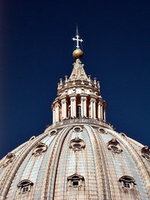
Dante, B16, And B15

In a speech yesterday B16 revealed that one of the influences on his first encyclical was the vision of love expressed in Dante’s Divine Commedy.

In the speech he also comments on what he was trying to express in the encyclical, and he warns people away from certain false interpretations of it.

GET THE SPEECH.

As interesting as it is that Dante would be an influence on this encyclical, it isn’t the first time that’s happened. Nor will it even be the most pronounced influence Dante has had on an encyclical. In fact,

B16’S PREDECESSOR B15 DEVOTED A WHOLE ENYCLICAL JUST TO DANTE!

I’ll be keen to see whether he actually quotes Dante in the encyclial, as he did in the speech.

We’ll know the answer to that question when the encyclical is released . . . just a few hours from now!

YEE-HAW!

Eternal Berlin

Stpetersbasilica

Adolf Hitler, who according to popular myth had Pope Pius XII on his payroll, [heavy sarcasm]loved the Catholic Church and "his pope" so much[/heavy sarcasm] that he wanted to build a new St. Peter’s Basilica in Berlin and had chief architect Albert Speer working up plans for the project:

"Speer built a scale model of how he planned to recreate the columns of St Peter’s Square, which encircle the piazza in front of the Basilica.

"The Moscow museum’s director, David Sarkisian, told the Sunday Telegraph: ‘The plan was for the new Berlin to be ready in 1950 after Nazi Germany had defeated the Allies.

"’Hitler would declare Germany the ruler of a world empire and at the centre of its capital Berlin was to be a recreation of St Peter’s Square in the Vatican.

"’Speer’s plans included the columns from the square and at the centre instead of a fountain as in Rome there would be a huge statue of Benito Mussolini.

"’Hitler considered the Eternal City [Rome] to be the only city in the world to rival Berlin so he wanted to better it in every way possible.’ Speer’s documents show that Hitler took a great interest in the plans and was delighted with the architect’s model."

GET THE STORY.

As a side note, for those interested in a thorough refutation of the Catholic urban legend that Pius XII was "Hitler’s Pope," I highly recommend Rabbi David G. Dalin’s The Myth of Hitler’s Pope.

GET THE BOOK.

Meeting Jesus For The First Time

A reader writes:

Hi Jimmy,
You’re the only one I know who can answer this question:
In last week’s Gospel from John we read:

35 The next day John was there again with two of his disciples,
36 and as he watched Jesus walk by, he said, "Behold, the Lamb of God."
37 The two disciples  heard what he said and followed Jesus.
38 Jesus turned and saw them following him and said to them, "What are you looking for?" They said to him, "Rabbi" (which translated means Teacher), "where are you staying?"
39 He said to them,"Come, and you will see." So they went and saw where he was staying, and they stayed with him that day. It was about four in the afternoon.
40 Andrew, the brother of Simon Peter, was one of the two who heard John and followed Jesus.

But this week, we read from Mark:

14 After John had been arrested, Jesus came to Galilee proclaiming the gospel of God:
15 "This is the time of fulfillment. The kingdom of God is at hand. Repent, and believe in the gospel."
16 As he passed by the Sea of Galilee, he saw Simon and his brother Andrew casting their nets into the sea; they were fishermen.
17 Jesus said to them, "Come after me, and I will make you fishers of men."
18 Then they abandoned their nets and followed him.
19 He walked along a little farther and saw James, the son of Zebedee, and his brother John. They too were in a boat mending their nets.
20 Then he called them.

So: were the first disciples called before, or after, John’s arrest?  Were the disciples with John at the time, or were they fishing?  (Could it be that John the Evangelist is compressing time in verses 36-38?)

There are a couple of things to keep in mind here. First, the Gospels are not complete accounts of what Jesus said and did. This is something that (a) obvious from how short they are and (b) John is explicit about the point (John 21:24-25).

Second, the Gospels–like ancient books of history in general–are MUCH more flexible about chronology than modern ones are. Often ancient writers would arrange events topically rather than chronologically. SEE HERE FOR MORE INFO.

What we seem to have in this case is a statement by John about how certain apostles first met Jesus and a statement by Mark about how he formally called them to his service full-time.

I know that I wouldn’t be inclined to drop everything and follow someone full-time if I’d only just met him, even if he was held by friends of mine to be a prophet. That kind of commitment is only likely to develop over time, after you’ve known someone and gotten to trust him. It’s a significant decision that one doesn’t make on the spur of the moment.

Since this is how human relationships normally work, it’s most naturally assumed by the Gospels.

You’ll note that John doesn’t say (and neither does Mark, for that matter) that the disciples in question started following Jesus full-time. John only says that they followed him to see where he was staying that day. John even mentions that it was toward evening (about four in the afternoon). Andrew then introduces Peter to Jesus the next day (immediately after the part of John 1 that you quoted).

So the likely chronology is:

  1. Andrew and another disciple of John the Baptist meet Jesus for the first time and follows him to where he is staying.
  2. Andrew introduces Peter to Jesus for the first time. Andrew and Peter may or may not have been working as fishermen at this time, though Andrew was clearly a disciple of John the Baptist.
  3. John gets arrested.
  4. Jesus calls Andrew and Peter (together with James and John) to be disciples on a more stable and possibly a full-time basis. Andrew and Peter were both clearly working as fishermen at this time and left their profession here or soon afterwards to follow Jesus as full-time disciples.