
Revised Ignatius Bible
A reader writes:
Are you familiar with this 2nd Edition of the Ignatius Catholic Leather Bible that has just been released? It is leather and I would like to get one, but I am never sure on what will be considered a "good" translation. I have read your tracts on Bible translations already and know that you recommend the RSV, so is the 2nd Edition RSV going to be pretty much the same thing and trustworthy?
I had not previously been familiar with the 2nd edition of the Ignatius Bible, though my confidence in the publishing house is such that I would have been able to recommend it anyway.
By a strange coincidence, however, I happened to have the chance to examine a copy of it today. (Our purchaser at Catholic Answers wanted me to look over a copy to see if it was something we want to carry.)
As a result, I now have more familiarity with it and can give a more specific response.
It appears that they have done three basic things:
- They re-typeset it so that it looks better than it did before on the page.
- They took the notes that used to appear in appendices at the end of the Old and New Testaments and put them on the pages that the notes apply to, so you no longer have to flip to the back of the book.
- They made minor changes to confusing and archaic language at a very small number of points in the translation.
Here’s how the Ignatius web site (www.ignatius.com) describes this edition:
A completely new typeset and designed edition of the popular Ignatius Revised Standard Version Bible, with minor revisions to some of the archaic language used in the first edition. This revised version is a contemporary English translation without dumbing-down the text. This second edition of the RSV doesn’t put the biblical text through a filter to make it acceptable to current tastes and prejudices, and it retains the beauty of the RSV language that has made it such a joy to read and reflect on the Word of God. Now the only Catholic Bible in standard English is even more beautiful in word and design!
Note the clause that I’ve highlighted in blue. This is code for "this Bible does not make feminist revisions to the genders that are found in the biblical text."
That’s a good thing.
And I’d have no problem recommending this edition.
Passover & Transubstantiation
A reader writes:
During the last supper Jesus offered bread and wine to the apostles and said this is my body and blood, do this in rememberance of Me . At the jewish seder meal, food and elements are presented for rememberance, to bring forth the struggles of the Hebrew peoples. My question is at the supper Jesus could of created a new seder memory for future Passovers. Mr. Akins this is a troubleing topic for me, I’m catholic and believe in the real presents.
The seder passover meal is a recreation of the jewish struggle by presenting elements at the table to eat and remember the past. Could Jesus have introduced a new element to the seder on his last night with the Jewish apostles for them to add his memory to the Jewish table. Not actual real presents which would have been difficult for a jew, but for the seder meal this would have been very easy to accept.
If I understand correctly, there are two questions here. The first is whether by instituting the Eucharist Jesus simply meant to add an additional new rite to the Passover meal. The second is whether the Eucharist is to be understood symbolically or realistically.
Let’s deal with the first question first.
Jesus certainly could have simply added a new rite to the Passover meal if that is what he had wanted to do. He’s God, so he can do anything he wants. But the question for us is: What evidence do we have that he simply wanted to add a new rite to the Passover meal? Not much.
Since none of us has a time travelling De Lorean, we can’t go back to the Last Supper and see everything that Jesus said. (NOTE: If anyone does have a time-travelling De Lorean, or other workable time travel device, please contact me via e-mail. There are several events in world history that I need to go back and change.) As a result, we have to rely on what the apostles said and understood Jesus to say.
It seems clear that they did not understand Jesus to simply be instituting a new element in the ritual of the Passover meal. We know this because the evidence that we have points to the early Church celebrating the Lord’s Supper on a frequent basis–not just once a year, like Passover.
The evidence strongly suggests that the early Christians celebrated the Eucharist at least weekly, in which case it could not simply have been an addition to the Passover rite. It was something based on Passover (with Jesus taking the place of the lamb as the true Lamb of God), but it was independent from Passover and could be celebrated much more frequently.
So the evidence we have indicates that Jesus wasn’t just making an addition to the Passover rite. He was making a much more radical change. The question is: How radical? How much was he changing?
That leads to question #2: Could he have meant the Eucharist to simply be symbolic of his body and blood rather than really being his body and blood?
Again, he could have. He’s God, and he can do what he wants. But once more the question is: How did the people who heard him–who heard all of what he said (not just the parts recorded in Scripture)–understand him?
They understood him in terms that went way beyond symbolism. If you read John 6, for example, you’ll see that some people did resist Jesus’ declaration that we must eat his flesh and drink his blood. What was Jesus’ response? Did he say, "Hey, guys, it’s only a metaphor. Don’t sweat it?" No. Instead, he repeated his assertion, causing some people who had been following him up to that point to quit following him.
Did he explain the metaphor privately to his core disciples, as he had various metaphors that he used on other occasions? No. Instead, he asked them if they too wanted to quit following him. This means that Jesus was willing to lose his core disciples rather than water down the assertion he made about eating his flesh and blood.
This would be inexplicable if he was just using a metaphor. On occasions when he used metaphors that the apostles didn’t understand, he explained them to the apostles privately. He didn’t draw a line in the sand and ask them if they wanted to leave if they didn’t accept it.
It may well have been his forcefulness on this point that prepared the disciples for what he would do at the Last Supper. He had already prepped them for the idea of literally eating his flesh and blood, so they understood the intent of his action when he actually called upon them to do it at the Last Supper.
Also remember that the apostles weren’t ordinary Jews. They had already come to recognize Jesus as the Son of God and had seen him work many miracles. They themselves had handed out the bread that he had miraculously multiplied, so they knew that he was capable of transubstantiating bread and wine if he wanted to.
And, remember, they weren’t people growing up in the anti-supernatural 21st century. They were firm believers in the miraculous and were much more prepared than people today to interpret things as miraculous rather than symbolic.
We also have the witness of the other early Christians–to whom the apostles passed on the faith and who also understood the Eucharist in realistic terms.
For more on all this.
I’d also like to call attention to the fact that Jesus made some pretty specific promises to the apostles and to the Church as a whole, telling them that he would send the Holy Spirit to reinforce their understanding of what he had taught them and telling us that he would be with the Church until the end of time.
This means that Jesus guided the apostles, and has guided the Church, into a correct understanding of matters that are fundmental to the Christian faith–like the nature of the Eucharist. His providential care guarantees that the Church has not misunderstood the Eucharist, either in regard to whether it is just an addition to the Passover meal or in regard to whether it is realistic or symbolic.
We have Jesus’ word on it.
(One other note: I’ve written the above on the assumption that first century Jews understood the Passover meal in a symbolic sense. That’s not altogether clear. There are strands in Jewish thought that understand the Passover meal as a real participation in the events of the Exodus in a manner not unlike a form of transubstantiation.)
Pregnancy Is Good For You! Maybe!
A big CHT to the reader who e-mailed the following story.
It turns out that, after giving birth, mothers continue to have cells from their children in their bodies.
This was a shock to scientists, who figgered that the mother’s immune system would quickly (within hours) pick off any of the baby’s cells since they have a different genetic profile than the mother’s.
But it turns out that’s not the case. The cells appear to stay in her for decades (40-50 years).
And with each new baby that a mother has, she gets new cells from it that stay in her system and float around her bloodstream.
What are they doing in there?
There are three hypotheses, any of which (or some combination of which) could be true.
The "Bystander Hypothesis" holds that they aren’t really doing anything. They’re just bystanders.
The "Bad Hypothesis" holds that they may do damage to the mother, causing autoimmune diseases in some cases.
And the "Good Hypothesis" holds that they actually help the mother out, acting as a second (or third or forth or twelfth) repair system in the mother’s body.
It isn’t certain yet which hypothesis is true, but evidence for the Bad Hypothesis appears small and evidence for the Good Hypothesis is rapidly mounting.
For example: In the case of a woman who had contracted hepatitis it was found that cells from her prior children clustered around her liver in vast quantities and seemed to be functioning like normal liver cells, helping her out.
It may be that this is a form of natural embryonic stem cell therapy, with the baby’s cells morphing into whatever kind of cells mom needs.
Sweet!
Also, for mothers who have lost children to miscarriage (or abortion) there is also the fact that these babies’ cells stay in you as well and may be helping you out, decades after the fact.
Research is still being done, but one scientist (quoted in the audio story linked below) thinks that we’ll have the answer within five years.
NOTE: Be sure to listen to the audio story and don’t just read the text one. The audio one contains a bunch more info.
‘NUTHER NOTE: The title of this post is not to be construed as dissing other research showing that pregnancy is good for you.
In The News
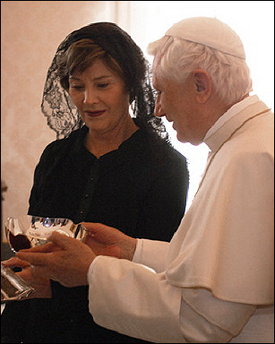 And here Pope Benedict is shown receiving a bowl of first lady Laura Bush’s five-alarm barn burner home made Texas chili, topped with shredded Monterrey Jack cheese.
Oh, wait. That’s not what’s going on here.
(Sorry, couldn’t resist.)
Actually, Mrs. Bush was in Italy for the opening of the Olympics, and she stopped by to see the pope.
They talked about terrorism and the cartoon riots.
And she brought him a silver bowl. (No chili. I’m sure the pope was disappointed.)
Compendium At End Of March
The USCCB has been released that the Compendium of the Catechism of the Catholic Church will be released in English on March 31st–just over seven weeks from now.
Sweet!
This is gonna be good!
According to Catholic News Agency,
The new Compendium of the Catechism of the Catholic Church, a 200-page synthesis of the 1992 catechism, will be available starting March 31 from the publishing office of the U.S. Conference of Catholic Bishops.
The compendium consists of 598 questions and answers, a format similar to the very popular Baltimore Catechism, which was a standard text in many Catholic parishes and schools, from 1885 to the 1960s.
The compendium is structured in four parts, like the Catechism of the Catholic Church. The text has some direct quotes from the catechism used as sidebars, but the questions and answers are original text.
In addition to the questions and answers, the compendium also includes two appendices. The first is a list of Catholic prayers. The second appendix contains “Formulas of Catholic Doctrine,” including the Ten Commandments, Beatitudes, theological and cardinal virtues, and spiritual and corporal works of mercy. Fourteen masterpieces of Christian art are also reproduced in the text.
For those who can’t wait till then, I’d note that the Compendium is already online . . . but in Italian.
The IslamoKlan Meme Spreads
Blogger Christopher B. Wright has picked up on what I wrote the other day in The Muslim BrotherhoodKlan–and drawn a cartoon about it!
He also adds commentary at the end of the cartoon, starting with some text that may clear away an important misunderstanding:
I suspect that someone, somewhere, is going to look at this cartoon
and decide that I am equating Islam with the Ku Klux Klan. Which is a
wholly irrational reaction to have, unless you also believe that KKK
and Christianity are exactly the same thing. That
would be a very peculiar position to take given Dr. Martin Luther
King’s profession (he was a Baptist minister), but I suppose it could
be done.It would perhaps be more accurate to say that I am equating a
specific group within Islam with the KKK. A group that uses violence
and terror in order to advance a political agenda, a political agenda
that hides behind the justification of faith.
So it seems the IslamoKlan meme is starting to spread.
As Montgomery Burns would say: "Exxxxxx-celent."
Maybe other bloggers will consider adopting this meme.
Let the shaming continue!
Oklahoma! Choreography
Down yonder a reader (Emily S of O Beauty Unattempted) writes:
Thanks so much for the link! When first you mentioned it, being of a dancerly nature myself, I thought "Oh, how hard can it really be?" Phew! But now I can hardly wait to have an opportunity to try out those moves (Oklahoma choreography, here I come!). Just one question – do they generally require any sort of hand/arm hold or no? (The ones you mentioned. Esp. when circling a partner.)
Glad to hear you’re interested! Yes, there are specific hand and arm holds that are required in these moves. Sometimes more than one hold is used in each move.
In Spin Chain And Exchange The Gears, for example, the dancers who are about to trade places put their hands palm-forward (NOT grabbing) at approximately shoulder height and then use this as the pivot point around which they trade. At a certain point in the move, though, you have groups of four dancers putting their hands together (again at approximately shoulder height, NOT grabbing) to create what is known as a star formation, which then rotates around the four hands as a pivot point.
There are other hand holds in these moves, too, so it gets rather complicated.
If you’re wanting to use square dancing as part of a production of Oklahoma! (if I understood your meaning correctly) then the simplest thing to do is bring in an actual square dance group (including the caller) as a bunch of extras.
If that isn’t feasible (e.g., because you’re wanting to do a high school production of the musical with only students as actors) then the thing to do would be to bring in a caller to teach the students just enough square dance moves to do the choreography you want. (You won’t have time to train them in all square dance moves.)
I’d probably recommend having most of it be simple, ordinary stuff that won’t be hard for the students, with maybe one or two really complex moves as a show-stopper for the audience.
I’d also recommend checking out some actual square dance groups in your area first to get a sense of what is possible and how it looks from a horizontal (audience) perspective.
Incidentally, there’s one nice advantage to square dancing compared to almost other forms of dance: It really doesn’t matter that much what you’re doing with your feet. Square dancing is about your position on the floor and what you’re doing with your arms, not specifically what you’re doing with your feet as you navigate the floor. (It helps to step to the beat, but this is not required. As long as you get where you’re supposed to be, that’s enough.)
With square dancing there’s no careful, elegant stepping of the kind that ballroom or round
dancing (or tap, for that matter) requires, so this is one thing that students or actors won’t have to worry about.
Square dancing, especially when done fast, is about having fun rather than being elegant–a fact that has become obvious to me now that I’m also taking round dancing classes. As I’m in the round dance class trying to do all kind of elegantly timed steps, I can hear the square dance class in the next room tearing up the floor and having fun without worrying about being graceful and elegant.
The Shaming Has Begun
The last couple of days I’ve been pointing out the disgraceful and violent behavior of many Muslims in the protests over the Danish cartoons.
In fact, people have been dying in the protests. As many as 10 have been killed in Afghanistan–shot by crowd control officers.
Now the largest paper in the Islamofascist state Iran–with whom we’re going to have to go to war in the next year or so if their crazy president doesn’t get reigned in by the mullahs (who at the moment seem to be egging him on to a Shi’a apocalyptic policy)–has ANNOUNCED A CONTEST TO MAKE FUN OF THE JEWISH HOLOCAUST.
AND THE EDITOR OF THE DANISH PAPER THAT STARTED THIS SAYS HE’LL PRINT THE HOLOCAUST CARTOONS.
BUT THERE ARE MUSLIM GROUPS CALLING FOR AN END TO THE PROTESTS AND DEATH THREATS.
There’s even a group of Arabs who have set up a web site apologizing to Norway and Denmark for the shameful actions of their co-religionists.
CHECK OUT SORRYNORWAYDENMARK.COM.
The shaming has begun.
Schism & Confirmation
As a way of building up to questions about the validity of the administration of confirmation in SSPX chapels, a reader writes:
1) Does a schismatic bishop administer Confirmation validly, even if illicitly, when there is no danger of death?
Yes. Bishops can always confirm validly, regardless of whether they are in the Catholic Church or not. Bishops are the ordinary ministers of this sacrament and so they do not need to have faculties delegated to them in order to perform it validly. The ability to do this sacrament is one of the powers that is conferred on a bishop in his ordination.
2) Does a schismatic priest administer Confirmation validly, even if illicitly, when there is no danger of death?
The law is not entirely clear on this point. There are clearly at least some circumstances in which a priest who is not a member of the Catholic Church can confirm validly. Specifically: If he is part of a non-Catholic church (in the proper sense of the term "church" with a valid episcopacy) and that church authorizes him to perform confirmations then he can do so validly. Thus Eastern Orthodox priests confirm validly.
It is not clear, however, whether a priest can confirm validly on his own, without doing so under the auspices of a church, properly so-called.
3) Does a schismatic priest administer Confirmation validly, even if illicitly, when there is no danger of death and he has no faculties from his bishop?
This is not clear. The law does not presently address this point.
4) How would the anser to #3 apply to Lefebvrist priests, who technically do not have Ordinaries?
Let’s leave aside the question of whether the Lefebvrist bishops count as "ordinaries." They are not ordinaries in the sense of persons in authority approved by Rome, but in terms of their function within the society that term may be applicable to them (even if they would disavow it).
The real question is whether the SSPX is a church or not. If they are a church and if they empower their priests to perform confirmations apart from the danger of death then these confirmations would be valid. If they are not a church then it is unclear whether the confirmations would be valid.
The SSPX, presumably, would deny that it is a church and argue that it is a priestly society. Perhaps. But schismatics typically deny that they are in schism and that they are starting a new church. Refusing to own the title "church" does not mean that you aren’t one. If the Patriarch of Constantinople decided to stop referring to the church he heads as a church then that would not make it less a church, not would it makes its confirmations invalid.
It’s that whole "a rose by any other name" thing, y’know?
So what is required for there to be a church? Some light is shed on this by the CDF’s Note On The Expression "Sister Churches" and by the Catechism.
The Note notes that "in the proper sense sister churches are exclusively particular churches (or groupings of particular churches; for example, the patriarchates or metropolitan provinces) among themselves" (10). This points toward regarding as a church outside the Catholic Church any particular church or group of particular churches.
The importance of this for the present discussion is that EITHER a single, independent particular church OR a group of particular churches is sufficient for validity of the sacraments in it. The only grouping of particular churches that is of divine origin is the Catholic Church, which these groups are outside.
As a result of the non-divine origin of groupings of particular churches outside the Catholic Church, the power of valid confirmations cannot rest in them. Thus the power of validly confirming must rest in particular churches. You don’t need a whole group of them before this power is present. Thus, for example, if somehow all the Eastern Orthodox churches EXCEPT the particular church of the Russian Orthodox of Moscow suddenly vanished then it would not cause confirmations administered in the Moscow church to be invalid just because there were no other Orthodox for them to be in communion with.
This means that if the Lefebvrists meet the qualifications for being a single particular church are met then they would have the ability to authorize their priests to do confirmations validly.
(Sorry if that seemed like a digression, but I wanted to close off a potential objection that the SSPX isn’t part of a big communion of churches like the Eastern Orthodox.)
So what do you need to be a particular church? The Catechism says:
833 The phrase "particular church," which is the diocese (or eparchy), refers to a community of the Christian faithful in communion of faith and sacraments with their bishop ordained in apostolic succession. These particular Churches "are constituted after the model of the universal Church; it is in these and formed out of them that the one and unique Catholic Church exists."
Now, the Lefebvrist bishops are ordained in apostolic succession, and if they are "in communion of faith and sacraments" with "a community of the Christian faithful" then they would seem to count as a particular church even if they don’t use this title for themselves–at least according to the definition offered by the Catechism.
If we turn to other documents, like Pius XII’s encyclical Mystici Corporis and look at what he says about the Catholic Church, we might come up with an extra criterion. In that encyclical he identifies there are being three bonds that fully unite one to the Catholic Church: faith, sacraments, and governance. If that is what is needed to be united to the Catholic Church then presumably any other body that had a common faith, valid sacraments (including the episcopacy), and a common governance would also be a church.
These the Lefebvrists seem to have. They have the Catholic faith, they have a valid episcopacy allowing for the valid exercise of all the other sacraments in at least some cases (e.g., when an SSPX bishop himself confirms), and they have their own internal governance.
So they’re looking pretty church-like, even though (I assume) they would deny this title to themselves.
Thus if they are a church and they empower their priests to confirm outside of danger of death then these confirmations will be valid.
If they’re not a church then it is unclear whether their priestly confirmations would be valid.
5) Do Confirmed Lefebvrists have to be re-Confirmed?
Pending further clarification from Rome, it is unclear whether confirmations done by SSPX priests are valid and, in the presence of the doubtful administration of a sacrament that can be administered only once, the pastorally prudent thing to do would be to administer conditional confirmations to such people.
If Rome clarifies (perhaps as part of regularization of the SSPX) and says, "No, the first confirmations were valid" then we go with that.
6) If Levebvrist Confirmations are not valid, then why are those done by Eastern Orthodox and other schismatic Christians? (Ditto with Marriages and Confessions?)
If Lefebvrist priestly confirmations are not valid then it is because SSPX priests do not have faculties because they have not been granted them by a particular church. Eastern Orthodox and other, similar groups do have particular churches that have empowered their priets to confirm (and perform marriages and hear confessions) and so their validity would not be in doubt.