Weight Loss Good News

A reader writes:

You made some blog posts in July of last year in regards to fiber and wieght loss.  The scientific approach that you used for losing weight was very appealing to me (I’m a software engineer).

Basically I set a goal of losing 2 lbs a week  (with some weeks being exceptions like Thanksgiving and Christmas).  I then weighed myself twice a day to determine how I was tracking to that goal each week and adjusting my food intake accordingly. 

I get most of my exercise playing indoor soccer 3 times a week and chasing my 4 kids (I will really be in for it once my twin 11 month old boys figure out walking). 

I did supplement fiber via powder mixed in water for the first few months of dieting pretty consistently, but less so after that.  Long story short, I was 210 last July and am 155 now (at 5 ft. 7in) and I credit you with inspiring me to strategize losing weight. 

It will be nice when I get back into backpacking this year to have a lighter load to carry.  So thanks Jimmy for sharing your knowledge and perspectives through your website,

Congratulations! I’m honored to have played a role in your achieving your goals. I hope your remarks come as an encouragement to others.

I’m also glad that the fiber recommendation was useful. It really can play a significant role in helping folks achieve their weight goals.

READ MORE.

Vatican Has Red Hat Sale!

Well, "Red Hat Giveaway" might be more accurate. (Slightly.)

What I’m saying is this: The pope named a buncha new cardinals yesterday–twelve of them under voting age for the next pope, and three more over it.

It came as no surprise that Archbishop William Levada (formerly of San Francisco, now head of the CDF) got a red hat. His new job is a red hat job.

Archbishop Sean O’Malley of Boston also got one.

John Paul II’s former personal secretary–now Archbishop Stanislaw Dziwitsz of Krakow–also did.

In making his selections, B16 continued the global diversification of the college of cardinals. Only 2 of the 12 new voting age cardinals were Italian.

B16 has also called ALL of the cardinals to Rome next month for a meeting of prayer and reflection the day before the consistory in which he installs the new cardinals.

This is a new thing. It certainly makes sense, though, and it will be interesting to see if it sticks with future popes (and future such events by this pope).

GET THE STORY.

MORE.

GET PICTURES OF THE NEW GUYS.

GET THE TEA LEAVES ON THE NEW GUYS.

FULL LIST OF CARDINALS.

Marriage After Hysterectomy

A reader writes:

I have been having a civil discussion about two married people and whether or not they should continue with the marital act after the women has had a hysterectomy for medical reasons.  The disagreement is based on the fact that two people should be married, only if they plan, or at least try to have children.

Okay, there is the first problematic premise. It is NOT true that people should only marry if they plan or hope to have children. The Church has NEVER taught this. It has always recognized that it is morally legitimate for infertile people to get married–whether they are infertile due to advanced age or something else. As long as they can perform the marital act, they can marry. Whether the marital act will be fertile or infertile in their case is another issue.

Although nothing is impossible with God, it seems inconceivable (sorry for that pun) that the women would get pregnant after a hysterectomy. 

True.

My point is, that even if this is true (getting married to only have children), when the couple was first married this was possible without Divine intervention.  What are your thoughts / understanding on this?

Whether you become infertile before or after you get married has nothing to do with whether you and your spouse can engage in the marital act. Sex is not just about procreation. You cannot intentionally thwart the procreative aspect of sex, but if it is infertile for other reasons then you can continue to have it.

In fact, it continues to be a debt that the two spouses owe to each other, whether they are fertile or not. If either of them reasonably requests it, the other party is morally obliged to pay the marriage debt in a reasonable manner and time.

If a woman has had to have a hysterectomy for medical reasons then that is not a contraceptive act because it is not done in order to bring about a contraceptive effect. The fact that she is now infertile is a side-effect of the procedure, not the reason it was done.

Even if she did have the procedure to prevent herself from having more children, that would be a sin that would require repentence and confession on her part, but it would not prevent her from having intercourse while in an infertile condition.

Bottom line: Being infertile–for whatever reason and whether it is culpable or inculpable infertility–does not prevent one from engaging in the marital act. Period.

Every sound Catholic moral theologian will tell you the same.

20

And Now A Word For Gmail Users

Gmail is an online email service run by Google. While it’s still (seemingly perpetually) in Beta release, those who use it know that it is head and shoulders above other email interfaces.

Unfortunately, Google has just schmutzed up Gmail by integrating a bunch of chat features into it. The intro to these new features by the Gmail team was positively giddy. Apparently the folks who work on Gmail behind the scenes are really, really into chatting, and these new features may be really cool and exciting for folks who are that into chatting.

But not all of us are.

I’ve used chat clients in the past, but these days I just don’t have the time available for it, my writing schedule is so full.

I suspect that the majority of Gmail users, even those who do some chatting online, found the new features confusing and annoying. Particularly annoying were pop-up boxes that appeared whenever you moused over a person’s name in your inbox. Simply trying to open an email to read it caused a chat-contact box to appear over the sender’s name, which was a huge distraction.

The badness of that Bad Idea seems to have sunk in on Google, and from what I can tell, that feature has  now been shut off.

But there’s also the Quick Contacts box in the left margin that populates itself automatically with the names of all kinds of people who have emailed you (even if you don’t know them) and that has no explanation of what the green, orange, and grey dots are that appear next to some (and not other) folks names (though they seem to have to do with who is online).

This Quick Contacts box has a default position (which is changeable in Settings) that puts it above the special email filters (called Labels) that the user has set up. For me this meant I had to scroll down through the incredibly long Quick Contacts link in order to see if my friends had sent me any email, which would appear under the Friends Label I created.

So I think that Gmail has committed a serious error here, and I went to their suggestions page and suggested that they give users a way to completely shut off the new chat features.

I’m curious to know what other Gmail users’ experiences have been with
all this, and would be interested to hear their impressions–positive
or negative. Also,

IF YOU’RE A GMAIL USER, SUBMIT YOUR OWN SUGGESTION.

Continue reading “And Now A Word For Gmail Users”

A Beef-Eating Surrender Monkey

Certain elements in the French population have been derisively termed "cheese-eating surrender monkeys," but the surrender monkey disease can also be found across the channel.

HERE’S A PIECE BY A BRITISH AUTHOR WHO SEEMS PREFECTLY WILLING TO STAND BY AND WITNESS THE DEATH OF WESTERN CIVILIZATION.

The author is Martin Jacques, who–despite is French-sounding name–is actually British. He’s also the former editor of Marxism Today and has been described as an  "embittered British Stalinist."

I was intrigued into reading the article by its headline: "Europe’s contempt for other cultures can’t be sustained." As a member of a culture that has been regularly the object of European contempt, the article was natively interesting to me.

The author makes a number of valid points, but I was shocked to realize just how much of a surrender monkey the author is.

Jacques writes (excerpts):

Is the argument over the Danish cartoons really reducible to a matter
of free speech? Even if we believe that free speech is a fundamental
value, that does not give us carte blanche to say what we like in any
context, regardless of consequence or effect. Respect for others,
especially in an increasingly interdependent world, is a value of at
least equal importance.

If European societies want to live in some kind of domestic peace and harmony – rather than in a state of Balkanisation and repression – then they must find ways of integrating these minorities on rather more equal terms than, for the most part, they have so far achieved. That must mean, among other things, respect for their values. Second, it is patently clear that, globally speaking, Europe matters far less than it used to – and in the future will count for less and less. We must not only learn to share our homelands with people from very different roots, we must also learn to share the world with diverse peoples in a very different kind of way from what has been the European practice.

By the end of this century Europe is likely to pale into insignificance
alongside China and India. In such a world, Europe will be forced to
observe and respect the sensibilities of others.

Regardless of what good points he makes, the fundamental message that comes through from Jacques is that Europeans should simply acquiesce to their demise, they should allow their free speech rights to be abridged in deference to the sensibilities of others, they should offer more and more accomodations to foreigners who they should continue to allow into their lands, and they should simply be prepared to go quietly into the night as a civilization.

I’m sorry, but while I’m all for self-restraint in the exercise of free expression and not giving offense to others needlessly, this kind of civilizational surrender is simply unacceptable.

No matter what its flaws have been historically or what they are presently, the world is better off with a non-Islamicized Europe than with one living under sharia.

Let’s hope that most Europeans are made of sterner stuff than this gentleman is.

Godcasting

You’ve heard of podcasting. Well, now there’s Godcasting — more specifically, The GodCast Network, a global Christian podcasting network.

"This is a podcast site, home of free MP3 audio shows that you can listen to now on your computer by clicking on the MP3 icons below. Or, using podcasting client software such as Apple’s iTunes, you can subscribe to our shows and have them downloaded automatically to your computer and optionally to your portable MP3 player whenever new shows become available."

VISIT THE SITE.

(Nod to the reader who sent the link.)

Oh, and JA.org’s sci-fi fans will want to be sure to check out Klingon Word, a show that promises to have listeners "thinking about the Scriptures through the lens of the Klingon Language Version of the World English Bible."

SEARCH THE KLINGON SCRIPTURES.

(And, no, I’m not making that up. It’s amazing what people put on the Internet and that Google finds.)

"vaD joH’a’ vaj loved the qo’, vetlh ghaH nobta’ Daj wa’ je neH puqloD, vetlh ‘Iv HartaH Daq ghaH should ghobe’ chIlqu’, ‘ach ghaj eternal yIn."

Translation: "For God so loved the world, that he gave his one and only Son, that whoever believes in him should not perish, but have eternal life" (John 3:16).

Abortion & Battlestar Galactica

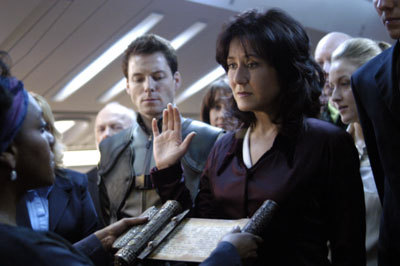
BoomerBattlestar Galactica has recently addressed the issue of abortion–twice–and they’ve done it well both times.

The first time it happened was when the question of aborting Boomer’s human-cylon baby came up.

For those who don’t know, the cylons are artificial entities (who seem more biological than not) that wiped out human civilization in a distant star system. (The survivors are now fleeing the cylons and trying to find the lost colony called Earth.)

Boomer (left) is a cylon who was able to mate successfully with a human, and now she’s pregnant. In view of what her people did to ours, though, there are a lot of folks who want her and her hybrid baby dead, and the question of forcing an abortion upon her was floated on the show.

Ultimately, there was no abortion. This was good not only from a moral perspective (violence was done neither to the baby nor the mother) but also from a dramatic perspective. (Killing Boomer’s child would deprive the show of a huge amount of dramatic possibilities as well as completely turn off the audience.)

They also had the saving of the child result (via a kind of stem cell-like thing) in curing the terminal cancer of President Laura Roslin (below), who was the chief one wanting the baby dead. So even before the child was born, it saved a life.

Abortion then came up a few weeks later, when a girl from a pro-life colony tried get an abortion from the doctor aboard the Galactica.

RoslinThis episode established that abortion had been legal before the cylon attack, and so it was still legal. Further, President Roslin was very much a pro-abort. Yet she was also regarded as a religious figure by the pro-life colony, and she needs their political support to stay in office and keep the ragtag fleet of survivors safe.

As we know from the opening credits of the show every week, there are only 40-something thousand humans who survived the cylon attack, and more are getting picked off each week.

As Roslin herself said in the immediate wake of the attack, human civilization is doomed if they don’t get away from their home solar system " . . . And. Start. Having. Babies."

So the episode pits her pro-abortion ideology against the fact that humanity is facing extinction, and in this episode she’s told that unless demographic trends change (the trends including new cylon attacks on a regular basis) that the human race will be dead in less than 18 years.

Dramatically, this is very good. We’ve got internal conflict in the character. Laura Roslin is in the process of being mugged by reality.

And so in the end she issues an executive order that criminalizes abortion and makes anyone who would interfere with the birth of a child–whether mother or doctor (fathers don’t get mentioned explicitly for some reason)–subject to criminal penalties.

Two points for BSG!

But only two, because the writers throw a bone to the pro-aborts in the audience by letting the girl from the pro-life colony have the abortion before the executive order is issued–possibly costing President Roslin the support of the pro-life colonials in the upcoming election.

This also may not be the last time the subject comes up, because Roslin–who is now a "personally-in-favor-of-abortion-BUT" candidate (how’s that for a switch!) is pitted against a true pro-abort.

Interesting stuff.

Part of what I find interesting is that the writers of the show seem to be quite liberal (as you learn if you listen to the podcast commentary), but they’re telling a story that regularly forces them into having to take conservative positions on the show, because the conservative positions are the ones that are required for the survival of mankind.

"Liberalism is a luxury we can’t afford" is the message that keeps coming out.

Watching the characters from a pampered civilization get mugged by reality and have to shed their former illusions may not be one of the reasons that TV Guide called this "The best show on television," but it could have been.

Is There NOT ENOUGH Sci-Fi On JimmyAkin.Org?

A reader writes:

I find your website a joy in the
midst of boring stupidity.  However, I have a complaint:  As a lover of
sci-fi, you haven’t posted anything in-depth about sci-fi lately.  As a
fellow "nerd" (I imply no disrespect), I enjoy the compatibility you
bring towards both Catholicism and Science Fiction.  The only problem
(which is two-fold) is that you have neither posted anything lately on
Science Fiction nor about Battlestar Galactica.  Why is this?

It’s
because I blog at night after work and frequently grab whatever is
handy to blog about. Lately, I’ve been trying to deal with some of the
questions (particularly pastoral ones) that have come in. Without many
sci-fi questions, the topic mix altered for a bit, which is normal. The
topic mix tends to go through cycles.

I did run a reply to a query on what happend to Jonah Quinn on
Stargate, though, and I’ve been planning to comment on something from
last week’s Battlestar Galactica, so that post will go up next.

If folks want more sci-fi on JimmyAkin.Org, they’re welcome to send in sci-fi related questions–particularly if they involve the theological and moral dimensions of science fiction. The same thing goes for fantasy, horror, weird fiction, and whatever else.

Catholic Blog Awards Reflections

By now the voting on the 2006 Catholic Blog Awards is over (or is scheduled to be over). I don’t yet know whether I won anything, because I am writing this in advance and am going to be out of town on the day that the voting closes.

I want to thank all who supported the blog in the various categories it was nominated for. I really appreciate your support. This blog is a labor of love for me, and to have people express the value they see in it by voting for it is an incentive to keep going.

I also want to thank CyberCatholics for hosting the awards. I know that they did a LOT of behind the scenes work to get the awards done, and they did it amid very difficult conditions, including major Internet connectivity, bandwidth problems, and data loss in one category. So a big thank you to them as well.

That being said, I think that there were some problems with the way the awards were conducted this year, and these should be addressed in the future.

In particular, there was the vote once per day thing.

The Catholic Blog Awards page explaind that this was "to keep voting fair." How this could serve to keep voting fair is something that I did not understand. So I asked, and I was told that the reason that this was implemented was to allow people who share a single IP address to both vote (e.g., a husband and wife who have a single computer with a cable modem, or the people in an office or school who share the same IP).

Unfortunately, this was not explained on the voting page. It also doesn’t really put married couples, schools, and offices on the same footing as single people, since in the course of the week of voting a single person would have seven theoretical votes to cast, while a married couple, school, or office would have seven votes to split between them.

Since the voting page simply explained thing in terms of one vote per day, the potential positive effect of this was blunted in that it encouraged single people to exercise their extra votes just as much as those sharing an IP.

It also put the nominated bloggers in a really delicate position.

As soon as I learned about this aspect of the voting, I hated it. I realized that some bloggers would take the "Vote early and often" line, which would (a) come across as unseemly to the readers and (b) would give those bloggers an advantage over those who wanted to stick to the "one person, one vote" principle and this (c) could lead to bad blood between the two groups of bloggers, which is the antithesis of what should happen in the Catholic blogging community.

Since I was one of the "one person, one vote" bloggers, I sat back for several days and didn’t mention the possibility of multiple votes.

Until I started losing in the one category I was most interested in (Best Apologetics) because my principal competition in that category started using the "Vote early, vote often" line.

Now, I know some folks have taken the attitude that this is all in fun and these awards don’t mean anything, and that’s a very easy position to take if you aren’t one of the nominees. But if you’ve invested a lot of personal time and effort in building something that people see enough value in to nominate then it does mean something to you. Receiving recognition for all your hard work is important.

That’s not vanity. That’s an expression of an aspect of basic human nature. People need recognition for their efforts. That’s true in marriages and in friendships and in job situations and in blogging. Recognition is incentive to keep going.

This year one of the ways the Catholic blogging community could give recognition to bloggers who have worked hard was through these awards, and there was one category in particular that I have a special interest in because of my profession.

So when I saw the "vote early, vote often" meme looking like it would unbalance the results in that category, I reluctantly decided to point out this aspect of the rules. That way the blogs were put back on an equal footing.

Which is required if the results are to mean anything at all.

Unfortunately, the multiple votes thing of itself diminishes the meaningfulness of the results. It doesn’t deprive them of all meaning because if a blog’s readers are enthusiastic enough to cast multiple votes then that says something about the blog.

But it doesn’t say as much as if the awards had been conducted under the "one person, one vote" principle.

It was thus with great reluctance that I eventually said to myself, "Well, this is the way the rules are this year. I didn’t choose that. I would have opposed it if I had been asked about it. But that’s the way it is, and if these results are to mean anything then the rules need to be pointed out."

I also left my comboxes open in the two posts where I pointed it out, and I took my lumps, as people accused me to my face (virtually speaking) of "vanity" and "egregious self-promotion," and said deliberately cruel things like I "do not deserve" particular awards or that my pointing out the multiple-vote rule and saying mild things like "Please support JimmyAkin.Org" caused them to vote against me.

I noticed other bloggers turning off the comboxes in posts where they pointed to the multiple-vote aspect of the rules, and I can understand why. The kind of reaction I got when I left them on underscores the problem with the multiple-vote rule.

In all this I was trying to do the best I could in a bad situation. I didn’t want to criticize the rule while the voting was still underway since that would serve no purpose (the rule couldn’t be changed once it was announced), but I wanted to thank those who voted for the blog, and I felt y’all deserved a public explanation of where I stand on the multiple-vote rule.

I appreciate the Catholic Blog Awards, but the multiple-vote rule needs to be altered in some way to avoid the problems that were encountered with it this year.

At the same time, I want to reiterate my thanks to those who put on and ran the awards this year. I know that they had a tremendously difficult job, and I want to give them full credit for the efforts they put in.