Darth Ginsburg: Petty Judicial Charlatan

Darth Ginsburgh recently gave a speech in South Africa that has received a great deal of comment. In it, she showed herself to be a very petty, spiteful woman who is willing to take cheap and manifestly unjust shots at those who disagree with her judicial philosophy. It really knocked her down several rungs in my book, which I was kind of surprised by considering how low she already was in my book. It turns out that my ladder of respect has more rungs on its lower end than I was previously aware of. (It gets kinda dim down there, and my eyes aren’t so good, y’know.)

As part of the speech, she defended the indefensible way in which recent SCOTUS cases have relied on foreign law, which I think constitute grounds for impeachment for her and the other justices who drew on foreign law sources to overrule the will of the American people as expressed through the laws that had been democratically established in this country.

Jeremy Rabkin has an interesting look at Ginsburgh’s defense of the indefensible, which is quite insightful.

In part he point out:

In her South Africa speech, Justice Ginsburg tried to frame such practices as looking to foreign law to "add to the store of knowledge relevant to the solution of trying questions." It is much closer to the truth to say that what the Court is doing is shifting its perspective from America to the world at large, so that positions with less support in the United States can still be viewed–in a global context–as majority or dominant positions. Rather than looking to thoughtful analysis of "trying questions," the Court, in effect, takes a poll–on an international basis.

In all three recent cases where foreign opinion was cited, the Court faced the difficulty of explaining why it was abandoning contrary constitutional rulings from as recently as the 1980s. The Court tried to say that opinion had since changed, as some states had changed their laws on such questions as whether tests of mental deficiency would be relevant to imposition of the death penalty. Not enough states had actually changed their laws, so the Court, in effect, enlarged the count to include foreign jurisdictions. Red states and blue states might be evenly balanced at home but 25 nation-states of the European Union could tip the balance, if counted.

In one of its capital punishment cases, as Justice Ginsburg noted, the Court had received amicus briefs from Nobel Prize winners such as Jimmy Carter. What has this to do with legal analysis? It is simply a way of appealing from the views of American voters to those of electors for the Nobel Prize–the sort of people who regard President Bush as a reckless cowboy and Jimmy Carter as a distinguished statesman.

He also illustrates the problem in a way that may be of special interest to JA.O readers, considering how often the topic of canon law comes up here:

To see the partisan character of appeals to foreign authorities in this setting, one need only think of a close analogy. If foreign law, why not religious law? Why not the canon law of the Catholic Church? As it happens, the U.S. Supreme Court has cited "canon law" in more than two dozen cases over the past 200 years. Most of the references are entirely incidental, but a few cases in the early 20th century actually engaged with Church sources, among others, in wrestling with the meaning of "due process." More recent cases have insisted that secular courts cannot enter into disputed questions of church law when asked to determine claims about ownership of church property or tenure in religious office.

Suppose that Catholic or conservative justices began to regularly cite canon law on the most controversial constitutional disputes–on such matters as family law or medical ethics. These justices could insist, as Justice Ginsburg does, that such "foreign opinions are not authoritative" and "set no binding precedent for the U.S. judge" but simply "add to the store of knowledge." In today’s world, the protests from liberals would be deafening, because such soothing abstractions would be seen as disingenuous. To treat canon law as any sort of "persuasive authority" would be intensely divisive. The "foreign opinion" that liberals prefer has no more inherent relevance or authority, however. We could save a lot of needless dispute by agreeing in advance that all sides will play by American rules.

One can imagine the howl that would go up from liberals if the Court took this path, and it does indeed illustrate the circumvention of the will of the American people by drawing substance from law sources that the American people have not voted for.

But this is just one of the problems that Rabkin brings out in his essay, so
GET THE STORY.

Benedict: Year One

John Allen has a thoughtful (and lengthy!) analysis of the first year of B16’s reign. It’s worth reading as a whole, but I wanted to call attention to this one point, in which Allen is describing the reaction many had to Benedict’s election:

[I]n the immediate aftermath of his election, most commentators fell back upon tried-and-true labels: "archconservative," "authoritarian," "hard-line."

Probably the best expression of all this came in an editorial cartoon in L’Unità, the newspaper of the old Communist Party in Italy. Understanding the cartoon requires a bit of background. In Italy, perhaps the most revered pope of modern times is John XXIII, know as il papa buono, "The Good Pope." One treasured memory of John XXIII is an evening in October 1962, the opening of the Second Vatican Council, when the Catholic Action movement organized a torchlight parade that finished in St. Peter’s Square. The pope was not scheduled to address the crowd, but when it arrived, John XXIII wanted to speak. He said something burned into the consciousness of most Italians, repeated endlessly on television and radio. Smiling down on the crowd, he said: Tornando a casa, troverete i bambini. Date una carezza ai vostri bambini e dite: questa è la carezza del Papa. It means, "When you go home, you’ll find your children. Give them a kiss, and tell them that this kiss comes from the pope." It summed up the legendary love of the man.

Thus the L’Unità cartoon showed Benedict XVI at the same window, saying, "Tonight, when you go home, I want you to give your children a spanking, and tell them that this spanking comes from the pope."

ROFL!

GET THE STORY.

Strange Evangelization Stories #1

Tim Powers (who says it’s okay to blog this) writes:

Did I tell you about the time a crowd of Jehovah’s Witnesses came to our house to tell us the truth about Jesus? I had read their pamphlet on why the Trinity is a bogus idea, and it quoted a whole bunch of the Fathers, as well as the Will & Ariel Durant History of Civilization, and I assembled all the full quotes that their pamphlet had given out-of-context phrases from, and I was well into my devastating rebuttal, when I —

Well, my eyes are no good, and I’ve got to read with a magnifying glass. And we were outside, and I said, "Let me see your Bible, and I’ll show youright in it  why you’re wrong. I won’t use a Catholic Bible, since you’d believe theyr’e unreliable, so let me see yours." And they handed their New World Translation Bible to me, and I started to read something from it, but it was a real sunny day, and I accidentally set their Bible on fire. I’m sure they went home and told their friends, "Those Catholics just have to touch a Bible and it bursts into flames!"

ROFL!

Tim and his wife, Serena, say that the JWs refused to take back the Bible after this incident and so they still have it!

Incidentally, Tim and Serena visited Catholic Answers yesterday and sat in on the show. They even said howdy to the audience, so if you’d like to hear what they sound like,

LISTEN HERE.

Shakespeare Sale

Shakespearefolio_1

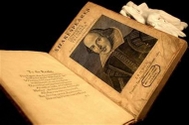
If you have a spare 3.5 million lying around (pounds, that is; in U.S. dollars you’ll need $6.1 million), you may want to consider investing it in an original Shakespeare First Folio that will be auctioned off by Sotheby’s in July:

"Hailed by auctioneer Sotheby’s as the most important book in English literature, the First Folio is credited with saving for posterity many of the bard’s plays including ‘Macbeth,’ ‘Twelfth Night’ and ‘Julius Caesar’ which had never before been printed.

"’The First Folio preserves 18 of his plays, including some of the most major, which otherwise would have been lost for all time,’ English literature specialist Peter Selley said as the volume was put on show on Thursday.

"’Relatively complete copies of the Folio in contemporary or near contemporary bindings very rarely come to market. There is only one copy recorded as remaining in private hands,’ he added."

GET THE STORY.

Baptizing TomKat’s Baby

Tom Cruise and Katie Holmes (a.k.a. TomKat, apparently) are having a baby.

Tom Cruise and Katie Holmes are also both baptized Catholic.

But now Tom is a Scientologist, and Katie seems to be leaning that way.

Katie’s parents are pushing for the baby to be baptized.

Will Church law and pastoral practice permit this?

CANONIST ED PETERS TAKES ON THE ISSUE.

In reading what he says, be careful to note the distinction Ed uses between delaying baptism and denying baptism.

There is a difference there.

Catholics With Murderous Tendencies?

Arthur of the Ancient and Illuminated Seers of Bavaria (who says it’s okay to blog this) writes:

Amongst other things, I enjoy reading murder mysteries, especially those from the golden age of the English whodunnit in the 20s and 30. Recently I’ve been reading up on the lives of some of those authors and I came across something rather surprising.

Of the five great authors of the English golden age, Agatha Christie, Margery Allingham, Dorothy L. Sayers, G.K. Chesterton and Ronald Knox, all but one (Christie) were Catholic!  Indeed of those three (Sayers, Chesterton and Knox) were also serious authors on philosophical matters and theology.  Okay Knox was primarily a theologian who dabbled in mystery writing, but you get my drift.  🙂

I’m not sure exactly what that means, but I found it interesting.

I’m not sure what it means, either. It could be random chance, but . . .

. . . Jack Chick might take it as evidence that Catholics just have murderous tendencies.

. . . Some psychologists might take it as evidence that British Catholics have murderous thoughts, given how much they suffered persecution from the British Crown and how much alienation they suffered in British society.

. . . I might take it to mean that there’s an intellectual streak in Catholicism that results in its authors liking intellectual puzzles and this tendency then manifesting in literary form (the murder mystery being a familiar form of intellectual puzzle in fiction).

What’s your explanation for the phenomenon?

Name Changes & Marriage

A reader writes:

My sister is getting married this summer. She is thinking about keeping our last name instead of taking her husbands name or hyphenation of the two names. I am not sure how I feel about this except that if it is ok with her future husband and her it’s probably ok.

My wife and I talked about it before marrying – my wife changed her maiden name into a second middle name (my family has a two middle name tradition). I might be old fashioned; I would have had a problem with my wife completely rejecting my name and hanging on to hers.

Where does the name change tradition come from? Is there a reason besides tradition to take the grooms last name?

Different cultures handle this issue differently. Not all cultures even have last names, much less do they all have women taking them at marriage.

As a result, there is no in principle reason why your sister could not keep her last name.

That being said, there is a reason why the custom exists in our culture. The basic reason is that our culture (a) does have family names and (b) it is a patrilineal culture.

What the second thing means is that we trace our ancestry, at least dominantly, by the male line (hence: patri- lineal = "by the father’s line"). Not all cultures do this. Some are matrilineal, meaning that they trace descent primarily by the female line (hence: matri- lineal = "by the mother’s line").

The cultures from which ours descended, including not only the major western cultures but also biblical Judaism, were patrilineal. That’s why, even though they didn’t have last names in biblical times, you have Peter being named Simon bar-Jonah (bar- is Aramaic for "son of").

In patrilineal cultures when a marriage occurs the wife becomes part of her husband’s family, and if you have family names in such a culture, it becomes natural for the wife to take her husband’s family name.

There may be a sense in such cultures that both the husband and wife are really part of each other’s families now, but since descent is reckoned by the male line, there is a greater sense that the wife is part of the husband’s family rather than visa versa.

These are the reasons that the custom exists anthropologically, but the origins of the custom tended to be obscured in the minds of many.

When radical feminism came along, it wanted to radically tinker with the sexual status quo, to smash traditional gender roles, and even to call into question the institution of the nuclear family. (I’m talking about radical feminism, mind you, not moderate feminism that merely wanted better treatment for women.)

Doing away with the historical naming conventions would serve those goals (as well as making it harder to keep track of who is related to whom, thus undermining the family), and so not taking the husband’s name became a symbol of defiance against traditional values.

That reason is enough for a traditional minded person to be suspicious of the practice.

It’s not that there’s anything wrong with a woman keeping her own name in principle. It’s done that way in many cultures. But to reject the practice of taking the husband’s name in our culture signifies a rejection of how our culture handles marriage, and that is rightly regarded by many as a danger signal.

Personally, my instincts on such matters are traditional, and I think that we are biblically required to maintain certain elements of the husband-wife relationship as it has been historically understood in Christian culture.

As St. Paul says in Ephesians 5:

21: Be subject to one another out of reverence for Christ.
22: Wives, be subject to your husbands, as to the Lord.
23: For the husband is the head of the wife as Christ is the head of the Church, his body, and is himself its Savior.
24: As the Church is subject to Christ, so let wives also be subject in everything to their husbands.
25: Husbands, love your wives, as Christ loved the Church and gave himself up for her,
26: that he might sanctify her, having cleansed her by the washing of water with the word,
27: that he might present the Church to himself in splendor, without spot or wrinkle or any such thing, that she might be holy and without blemish.
28: Even so husbands should love their wives as their own bodies. He who loves his wife loves himself.
29: For no man ever hates his own flesh, but nourishes and cherishes it, as Christ does the Church,
30: because we are members of his body.
31: "For this reason a man shall leave his father and mother and be joined to his wife, and the two shall become one flesh."
32: This mystery is a profound one, and I am saying that it refers to Christ and the Church;
33: however, let each one of you love his wife as himself, and let the wife see that she respects her husband.

This passage reflects a unity-in-diversity between husbands and wives. Their roles in marriage are not simply interchangeable, but neither may one side take advantage of the other. Both must be treated with equal dignity, even if their roles and obligations are not identical (note: a husband is required to sacrifice himself for his wife in a way that is not true in reverse).

My late wife–Renee–was also traditional in this matter. She wanted to
be called Mrs. Akin. In fact, she loved being called Mrs. James Akin (James being my legal name at the time),
and I felt proud to have her want to share not just one but both of my
names.

I understand the suspicion that many men would have upon learning that a prospective marriage partner wanted to keep her own last name. The question that would immediately come to mind is: "If she rejects this aspect of marriage as it is traditionally handled in our culture, what else about traditional marriage does she reject?"

Should I marry again (as I hope to), I would definitely start asking myself that question if a prospective marriage partner told me that she wanted to keep her own name.

Hope this helps!

Of Course It’s Civil War. So What?

That’s the attitude taken by commentator Charles Krauthammer on the situation in Iraq.

He writes:

This whole debate about civil war is surreal. What is the insurgency if not a war supported by one (minority) part of Iraqi society fighting to prevent the birth of the new Iraqi state supported by another (majority) part of Iraqi society?

By definition that is civil war, and there’s nothing new about it. As I noted here in November 2004: “People keep warning about the danger of civil war. This is absurd. There already is a civil war. It is raging before our eyes. Problem is, only one side” — the Sunni insurgency — “is fighting it.”

Indeed, until very recently that has been the case: ex-Baathist insurgents (aided by the foreign jihadists) fighting on one side, with the United States fighting back in defense of a new Iraq dominated by Shiites and Kurds.

Now all of a sudden everyone is shocked, shocked to find Iraqis going after Iraqis. But is it not our entire counterinsurgency strategy to get Iraqis who believe in the new Iraq to fight Iraqis who want to restore Baathism or impose Taliban-like rule? Does not everyone who wishes us well support the strategy of standing up the Iraqis so we can stand down? And does that not mean getting the Iraqis to fight the civil war themselves?

Hence the gradual transfer of war-making responsibility. Hence the decline of American casualties. Hence the rise of Iraqi casualties.

So for Krauthammer the question is not whether there’s a civil war in Iraq but how do we make sure the right guys win it:

Civil wars are not eternal. This war will end not with an Appomattox instrument of surrender. It will end when a critical mass of Sunnis stops supporting the insurgency and throws in its lot with the new Iraq.

How does this happen? The stick is military — the increased cost in the Sunni blood of continuing the fight. But the carrot is political — a place at the table for those Sunnis, some of whom are represented in parliament, who are prepared to abandon the insurgency for a share of power, a share of oil income and a sense of security and dignity in the new Iraq.

This is doable. That is not to say it will be done. It is to say that those who have decided that because of “civil war” it cannot be done have been unreasonably panicked by something that has been with us all along.

GET THE STORY.

Growing Up

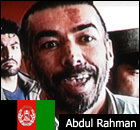
Abdul_rahmanI’ve been meaning to blog about Abdul Rahman, the Afghani convert to Christianity who was imprisoned for his faith and threatened with the death penalty.

(First, please indulge the language nitpicker in me for a moment as I point out that the /h/ in his second name is not silent. His name is pronounced /RAH-man/ with an audible expulsion of air at the end of the first syllable. Rahman is an Arabic word that means "merciful." I don’t know if Mr. Rahman is a speaker of Dari or Pashto or another language, but his second name seems to be a loanword from Arabic.)

Now for actually serious matters:

I’m pleased to report–as you likely already know–that the charges against him have been dropped, albeit on a technicality. The wave of Western pressure on the Afghani government has worked–so far.

But the struggle is not over, since Mr. Rahman’s safety must be secured, and if they just let him loose on the streets then he’ll be killed in short order by fanatical Muslims.

He has now applied for foreign asylum, and Italy has offered it. Other countries are expected to offer it as well.

GET THE STORY.

The larger issue here is that we have a victory in the process of getting Muslims to behave like civilized human beings. Sure, there are plenty of zealots who are willing to off Mr. Rahman in a heartbeat, but the Afghani government has realized that it needed to cave on this one if it didn’t want to alienate the West, upon which it is significantly dependent.

Good.

Muslim countries need to learn that they can’t have it all their own way.

When children learn this fact, we call it "socialization." Right now what the Muslim world needs is a massive series of lessons in socialization.

I’ve already pointed to the need to shame Muslims for unacceptable behavior in their culture, just as children need to be made to feel shame when they have done something unacceptable so that they internalize the drive not to do it again.

The cartoon riots and the vandalism and violence and killings that they resulted in were an example of this. They are something that the Muslim community should feel ashamed of.

So is the treatment of Mr. Rahman.

It’s high time that the West get off its cultural relativist hobby horse and say to the Muslim world: "Some behaviors are simply unacceptable, and you should feel ashamed if you commit or tolerate them. Grow up and clean up your act."

The kind of cultural relativism that has infected many in the West is itself a sign of immaturity. It’s a kind of culturally adolescent phase.

You ever notice how teen agers latch on to cultural relativism as a way of undermining the idea that anything is really wrong–so that they can justify the things that they want to do that are wrong?

It’s when you grow up and really have to take responsibility for yourself that you set aside both the self-centered tantrums of childhood and the kind of self-centered rationalizations that characterize adolescence.

The present confrontations with Muslim tantrumhood may help many in the West grow out of their cultural adolescence.

So we may both get a lesson in growing up.