WWYDIJP

Down yonder, a reader writes:

I asked it once and no one responded, so I will ask again, would you give Christ a copy of Lovecraft’s books if He were standing next to you, and would you tell Him what you have told each other about these books in here? When you stand before Him on judgment day and He asks you why you read books that glorified murder and mayhem, what will you say to Him?

Let’s take this a piece at a time:

would you give Christ a copy of Lovecraft’s books if He were standing next to you

No, because I’d have much more pressing issues to deal with, like falling on my face and worshipping him and begging his forgiveness for everything I have ever done wrong and imploring his assistance for all my future and asking him certain critical pastoral and theological questions that I need the answers to–not to mention asking him what he wants me to do with my very limited time with him, if I’m not imposing on him too much with my worshipping and begging and imploring and asking. I mean, I know that he sometimes went off on his own to pray and so maybe what he really wants from me at the moment is to leave him alone so he can go do that without me being a distraction and I really don’t want to impose on him and so if he wants me to leave him alone all he has to do is say the word and I will be more than happy to do so and I hope he’s not mad at me for rambling on like this in the first place and actually my adrenalin level and heart rate and blood pressure would probably go down if he did just want to go off and pray and I didn’t have to deal with the anxiety of a sudden encounter with God Incarnate and man, oh, man I hope I’m not blowing it already and if I am then I really, really hope he’ll forgive me, because I want to do the right thing and I just haven’t ever had to cope with a situation like this before, but– HAVE MERCY ON ME, O LORD!

This is the natural human reaction to have. In fact, we see people having it even with angels in Scripture (as well as the Risen Christ in Revelation), which is why one of the first things that the visitor has to do when he shows up is to tell the person he’s appearing to to stand up and calm down ("Be not afraid") so he can deliver his message.

This illustration also shows the problem with the test that the reader is proposing.

Essentially, the test is WWYDIJP or "What Would You Do In Jesus’ Presence?"

I don’t think much of this test, or its counterpart WWJD. Neither one of them is a very useful guide for figuring out what one should do.

The problem with WWJD is twofold:

1) What was appropriate for Christ to do and what is appropriate for me to do are not always the same thing. As Lord of the Temple, for example, it may have been okay for him to whip sinners out of it, but that doesn’t mean it would be okay for me to do that.

2) More fundamentally, the test relies on our speculative imagination regarding what Jesus was like and whe he would do, and our imaginations are spectacularly bad in this area. The Gospels just don’t contain enough data for us to picture him fully. Unlike the apostles, we don’t have the benefit of having lived with him for three years and seen how he reacted to countless different situations, including ordinary ones.

We have to rely on our imagination of what Jesus was like, and these invariably lead us astray, either by viewing Jesus as a kind of etherial 2-dimensional icon that isn’t a full 3-dimensional man or–if we do imagine him as a 3-D man, we fill in that third dimension with bits of our own personality and those of our parents and such.

Both of these result in a falsification of who Jesus is.

It is better, when we don’t know what Jesus would do (which is the great majority of the time) to just say, "I don’t know what he would do" than to try to imagine and thus make up what he would do.

The real question that we should be focused on is not what Jesus would do but what he would have us do, and often that means not over-thinking the answer to a question and just going with your instincts.

In fact, "Go with your instincts unless reason tells you otherwise" is the basic paradigm that God built into human nature to guide our actions. He gave us instincts to motivate us to do things, and he gave us reason (including our conscience and the teaching of the Church) as a check on our instincts.

Trying to imagine what Jesus would do is a tool of very limited value (I’m not saying no value) that will lead us in the direction of scrupulosity and over-analysis if we try to employ it on a frequent basis.

The same is true of WWYDIJP.

Our real reactions to what we would do if suddenly confronted with Jesus in physical form are nothing like a reliable guide to what we should do when he is not present in physical form.

The closest guide we have to what that is like is being in Church, where he is present in the sacrament, and there is a certain decorum that is to be maintained in Church–a decorum that would be put on steroids if Jesus stepped out of the sacrament and stood before us in physical form.

There are whole classes of behavior that inappropriate in Church but which are necessary to human life (eating, sleeping, bathing, reproducing, doing your day job, etc., etc., etc.), making it clear that the "What Would You Do In Jesus’ Presence?" (in the Eucharist or in physical form) is just not a good test for whether something is okay for us to do.

In fact, the WWYDIJP test seems to me to be positively pernicious in a way that WWJD may not be, because if we try to use it as a test for what is okay then one of two things will happen: Either (1) we will refuse to do all kinds of things that are okay but inconsistent with the proper reaction to a Theophany or (2) we will degrade our view of what the proper response to a Theophany is by intruding all kinds of things from ordinary life into Theophany-acceptable behavior that really don’t belong in that category.

So as with WWJD, WWYDIJP is usually the WRONG QUESTION to ask.

A much better question is "What would Jesus have me do?" and the answer to that question is always "Go with your instincts unless reason tells you otherwise."

If someone has an instinct that leads them to enjoy suspenseful fiction when the read fiction then this is legitimate unless there is a specific reason why they shouldn’t.

Sometimes there will be a reason not to read a particular kind of ficiton. If it tempts you to sin then you shouldn’t read it. But if it doesn’t tempt you to sin (directly or indirectly by degrading your ethical sensibilities) then I have a hard time imagining another reason it should be avoided in principle (as opposed to being avoided right now because I don’t have the time to devote to it, for example).

Elsewhere in the combox, the same reader argued that Lovecraft’s story Dagon romanticizes suicide and this makes it an occasion of sin. It would be for a person who is already suicidal, but for a person who is not suicidal, Dagon ain’t gonna get ’em into that state.

READ IT FOR YOURSELF.

In fact, as was pointed out by another astute reader in the combox, Dagon does not romanticize suicide–it uses the character’s suicide to underscore how horrible the thing he encountered was–but Romeo & Juliet does romanticize suicide. The suicides of the two main characters in that are depicted as expressions of their love for each other and their unwillingness to live without each other because of how strong their romantic feelings are for each other, and if that ain’t romanticizing suicide then I don’t know what is.

Yet if you aren’t suicidally romantic at the moment or likely to become so then watching Romeo & Juliet does not constitute an occasion of sin for you and there’s no reason not to go to the Shakespeare festival the night that it’s playing.

would you tell Him what you have told each other about these books in here?

I can only speak for myself here, but yes. I weigh what I say on the blog very carefully, because I know that I am responsible to him for what I write–particularly when analyzing moral and pastoral problems for others–and I think very carefully about these.

Of course, I’m fallible, and I’m quite sure that if I went through the archives I’d find things that I would want to change–and I’m sure that Judgment Day will bring more of these to light–but I try (in my imperfect, fallen way) to live and write with integrity so that I have no reason to be ashamed before Jesus of what I have said.

When you stand before Him on judgment day and He asks you why you read books that glorified murder and mayhem, what will you say to Him?

I’m sorry, but I don’t think I’ve done this–certainly not to a significant degree. Lovecraft’s books do not glorify murder and mayhem; certainly not in a general way (though if I did a thorough review I might conclude that in individual passages he crossed the line).

Lovecraft’s books do refer on occasion to murder and mayhem but the are not simply glorifications of it. The reader’s facts here are simply out of order.

How Deaf Is Deaf?

Jkfernandes

How deaf is deaf? What kind of a question is that? you ask. Shouldn’t such a question matter only to the medical community when designating degrees of hearing loss? Why should it matter to anyone else the degree to which a particular person suffers hearing loss? Ah, but when you seek to be the president of a university for deaf students, a question like that matters, you see.

"The newly chosen president for the nation’s only liberal arts college for the deaf is drawing protests from faculty and students, some of whom question whether she is ‘deaf enough’ to lead their school.

"Last week, Jane K. Fernandes [pictured at right] was named to succeed I. King Jordan as president of Gallaudet University. She isn’t scheduled to take over until January, but already the school’s faculty has called a meeting for Monday afternoon to consider for a no-confidence vote against her and students have carried out a weeklong protest.

[…]

"She was born deaf but grew up speaking, and she didn’t learn American Sign Language until she was 23. She now characterizes herself as a ‘fluent signer’ who can understand and be understood by everyone on campus.

"’There’s a kind of perfect deaf person,’ said Fernandes, who described that as someone who is born deaf to deaf parents, who learns ASL at home, attends deaf schools, marries a deaf person and has deaf children. ‘People like that will remain the core of the university.’"

GET THE STORY.

Apparently, according to the story, the "need" for a deaf university president at Gallaudet was "created" by student activists in the late 1980s, leading to the appointment of Fernandes’s predecessor as Gallaudet’s first deaf president. Now this created need is to become a litmus test against which all future presidents of the university will be judged.

Never mind the qualifications the candidate has in the education of the hearing-disabled. Never mind whether the candidate can be understood by students because he or she is fluent in ASL. Never mind whether the candidate might have deaf relatives of his or her own, which may have sparked the candidate’s interest in the education of the hearing-disabled. Either the candidate is One Of Us, or Need Not Apply.

Following In Newman’s Footsteps

A reader from the U.K. writes:

I’ve just turned eighteen and over the last year I’ve been looking into the Catholic Church. I was baptised in the Church of England as a baby but I’m completely ‘unchurched’.

I never really had any sort of Christian instruction and a few years ago I stopped believing even in God for a while before eventually returning to a form of Christian belief. Things didn’t really start to make sense to me though until I started investigating Catholicism. Over the last year, I’ve devoured books (and websites) about Catholicism – on doctrine, Church history, writings of Fathers and Saints… Protestantism was all I knew of Christianity so I’ve still had to struggle with all the usual Catholic doctrines that Protestants struggle with, etc. But it’s not just been about struggling with Catholic distinctives – I decided fairly quickly that if any form of Christianity was true, Catholicism was it – I’ve been steadily growing in my faith in Christ in general, praying, and studying the Bible.)

I’ve been certain for a couple of months now that I have to become Catholic but I haven’t been totally sure what to do about it. I’ve just returned from an amazing trip to Rome and being there underscored that I have to do something ASAP to take steps to enter the Church. I guess I need to contact a priest, but I don’t really know what the procedure is. Does this mean waiting a year and being confirmed next Easter? When would I be able to go to Confession – would that mean waiting a year? And I worry that there’s going to be disruption in the middle of all this – I’m going away to university on the other side of England in October.

I’ll try to be as much help as I can.

I’m afraid that I don’t know the process for the reception of converts in England as well as I’d like. Here in the States, the process is (theoretically) governed by a document known as the National Statutes for the Catechumenate, but this applies only to the U.S. and the bishops of England and Wales are likely to have their own particular law regarding the reception of converts. If they do, though, it isn’t discussed in the commentaries I have available to me at the moment.

I have reason to think, though, that you would not be required to endure a whole year before being able to be received at Easter. Since you are already baptized, Easter shouldn’t be the liturgically desirable point for your reception into the Church, anyway, and that research I’ve done online suggests that a period of a number of months might be involved, but not a whole year.

You’re right that you should contact a priest, and he could get you started on the process, but hopefully it won’t involve all the nonsense that converting to Catholicism in America typically does.

Perhaps some of the British readers of the blog could use the combox to shed light on the British conversion process.

HERE’S SOME FOLKS WHO CAN ALSO HELP YOU OUT.

CHECK OUT THIS PAGE IN PARTICULAR.

Hope this helps, and welcome home!

Returning To The Church & Annulment

A reader writes:

I was raised as a Catholic, but when I was in my twenties I started slowly drifting away from the Church. I was married in a Protestant Church and regularly attend its or other Protestant services with my wife. On occasion I also attend Catholic Mass (but do not receive Communion.)

Recently I have been contemplating the possibility of re-joining (probably not the correct word) the Catholic Church and am wondering what would be involved in this process. I am not sure if they are relevant, but here are a few other facts:

I have been married only once
My wife has been married previously and divorced.
My wife has always been a Protestant and is probably not interested in converting.
I was baptized and confirmed in the Catholic Church

I assume that the fact that my marriage is not valid in the eyes of Rome is an issue with my getting back into the Catholic Church. I assume that my wife and I would have to be remarried in a Catholic Church. Would my wife have to have her previous marriage annulled? On one level that would not make sense to me as her first marriage would not have been valid under Catholic rules, but at the same time I somehow have the idea in my head that her prior marriage would have to be annulled.

I would be most appreciative if you could give me some direction in this area.

Thank you very much for writing and for being willing to confront these issues in a straightforward way. It is a sign that God is working in your heart and that you are cooperating with his grace–something that he will definitely bless.

It does not appear from what you said that you ever formally defected from the Church, and so you’re right that re-joining might not be the right word.

What you do want to do is to be reconciled with the Church, and for a person in your position the fundamental way to do that is the same as for most people whose full communion with the Church has been impaired in some way: to go to confession.

Upon being able to make a good confession, you would be restored to normal status in the Church and able to lead a full sacramental life.

They key is being able to make a good confession, and that is where your wife’s marriage is relevant.

Since your wife was not a Catholic at the time of her first marriage, she was not bound to observe the Catholic form of marriage, and so the Church would presume that her first marriage was valid.

If it was valid then she was not free to marry you (assuming her former husband was still alive at the time your marriage to her took place) and the two of you would not be validly married. This means that you would not be entitled to conjugal relations with each other, and if you are having them then you would not be able to make a good confession.

The typical solution to your situation (which is very common) would be for your wife to pursue an annulment for her first marriage. If it is found null then you and she would be free to have your marriage convalidated, at which point you would be able to continue leading a conjugal life and be able to make a good confession and return to normal sacramental life as a Catholic.

Since your wife is not Catholic, it may be difficult for her to understand and accept the need to pursue a solution like this, but–even if she does not think this is needed or desirable–hopefully she can understand how important it is for you as a Catholic to be reconciled to your Church and to pursue a solution like this as a matter of conscience. Her conscience may not require her to pursue such steps, but yours does, and hopefully she can come to understand and appreciate that.

She may even find a form of healing by working through the annulment process and coming to have a better understanding of why her first marriage failed and to "close the books on it" in a sense. Many people, even non-Catholics, have reported that the annulment process helped them come to terms with what happened to their prior marriages and provided a kind of clarity and healing that they appreciated.

Pursuing a solution such as the one above may be difficult at times, but God will make sure that you and your wife have the grace you need to deal with whatever happens. Trust him to guide and strengthen you, moment by moment, and he will make sure that you have the grace that you both need.

He loves you both, and more than you know. After all, he sent his Son to die so that you might have the graces he wants to give you.

I hope this helps, and I encourage my readers to keep you and all in similar situations in their prayers.

BTW, I also authored a short booklet on annulments to help people understand them better. You can get a copy of it here.

20

Contraception & Extra-Marital Sex

Catholics are often confused by reports of high churchmen, or even representatives of a Vatican dicastery, who say things that seem contrary to an absolute opposition to the use of contraception.

We’ve recently been hearing statements from some churchmen that sound "soft" on the use of condoms to prevent the spread of AIDS, but these are only the most recent such statements. They’ve been going on for years.

One of the most well-known cases occurred several decades ago, when nuns in the Congo (which was undergoing civil strife) were permitted to use contraception to prevent pregnancy in case they were raped.

"How can things like this be squared with the Church’s teaching in Humanae Vitae?" many wonder. "Don’t these churchmen recognize that they’re in obvious dissent?"

I think I can shed some light on what they’re thinking, but first I need to issue

THE BIG RED DISCLAIMER: What follows IS NOT TO BE CONSTRUED AS MY PERSONAL OPINION. I am trying to provide a window into the minds of those who make the kinds of disturbing statements described above. I am trying to explain a phenomenon that perplexes orthodox Catholics, NOT expressing my own view. Thankyew.

Let’s look at the Congo nuns story. In that one, the argument was made that it was legitimate for the nuns to use contraception because they did not will the sexual act. It was being imposed on them by force, and so their lack of consent to the sexual act means that they were not consenting EITHER to its unitive OR its procreative aspect.

Thus it is argued that it was just for them to do what they could to avoid the procreative aspects of the act just as much as it was just for them to do what they could to avoid the unitive aspect of the act. The use of contraception, in their case, would constitute a form of legitimate defense against the consequences of an act that were imposed on them, not the frustration of the consequences of an act in which they freely engaged.

At least that was the argument that was made. (SEE HERE AND SCROLL DOWN.)

Now, how could anybody think that this squares with Humanae Vitae? If you look at the translation of Humanae Vitae on the Vatican web site, it clearly says:

Similarly excluded is any action which either before, at the moment of, or after sexual intercourse, is specifically intended to prevent procreation—whether as an end or as a means (HV 14).

This is very blunt. It precludes doing anything before, during, or after sexual intercourse that would thwart procreation. No exceptions are made for whether the act of sexual intercourse is willed by both parties or whether it is an act of rape.

Unfortunately, this passage contains a mistranslation.

Here’s the Latin original:

Item quivis respuendus est actus, qui, cum coniugale commercium vel praevidetur vel efficitur vel ad suos naturales exitus ducit, id tamquam finem obtinendum aut viam adhibendam intendat, ut procreatio impediatur.

I’ve highlighted the words that the English translation gives as "sexual intercourse." Even if you don’t have a background in Latin, the meaning of these words is pretty clear via their cognates in English. They literally mean "conjugal commerce" or–to make them slightly more idiomatic–"marital exchange."

In any event, they don’t mean simply "sexual intercourse." They mean a specific kind of sexual intercourse: Sexual intercourse which is conjugal or between married persons.

This understanding of the Latin is reflected in the English translation of the Catechism of the Catholic Church (also on the Vatican’s web site), which quotes this same passage from Humanae Vitae and renders the (highlighted) Latin phrase more accurately:

CCC 2370 Periodic continence, that is, the methods of birth regulation based on self-observation and the use of infertile periods, is in conformity with the objective criteria of morality. These methods respect the bodies of the spouses, encourage tenderness between them, and favor the education of an authentic freedom. In contrast, "every action which, whether in anticipation of the conjugal act, or in its accomplishment, or in the development of its natural consequences, proposes, whether as an end or as a means, to render procreation impossible" is intrinsically evil.

Now, it’s easy to gloss over the word "conjugal" and interpret it as simply meaning "sexual," but that is not its meaning. It really does mean "marital."

And that sheds light on some of the mystifying statements that get made by churchmen and theologians that seem soft on the use of contraception.

In the case of the Congo nuns, for example, they weren’t married to the people who were likely to rape them and so for them using contraception would not be an "action which . . . in anticipation of the conjugal act . . . proposes . . .  to render procreation impossible." There could be no conjugal act for these nuns because they were not married.

It’s kind of eye-opening when you realize that, as Humanae Vitae 14 is worded, it is condemning the use of contraception within marriage and not really going into its use outside of marriage, but the entire framework to which Paul VI is addressing himself is to "the first principles of a human and Christian doctrine of marriage," and he does not address the question of whether the principles he is articulating also apply to sexual relations outside of marriage.

The same tends to be true of other Church documents. The framework in which contraception is addressed tends to be marital: If you look in the Catechism of the Catholic Church, for example, the discussion of contraception occurs under the major subhead "The Love of Husband and Wife" and under the minor subhead "The fecundity of marriage."

Contraception is not mentioned at all in the sections on adultery and fornication and other forms of extra-marital sexuality.

This is the pattern in Church documents: They tend to condemn contraception in connection with marital sex, but they don’t mention it when it comes to extra-marital sex.

The reason for this, I assume, is that the folks at the Vatican are waiting for doctrinal development to occur on this point, and so they’re staying closed-mouth about how contraception relates to extra-marital sex. Either that or they (some of them) don’t want to appear to be saying, "If you’re going to fornicate, at least take precautions," which would have the effect of encouraging fornication.

Now, as I said THE ABOVE DOES NOT REPRESENT MY PERSONAL OPINION. I would be happy if B16 or a future pope issued an encyclical that said "All of the principles contained in Humanae Vitae 14 apply to extra-marital sex as well as marital sex."

But this does shed light on some statements that otherwise mystify orthodox Catholics who want to fully accept the Church’s teaching on human sexuality.

Dulles On Ratzinger On Vatican II

Avery Cardinal Dulles has  a recent article on the subject of Joseph Ratzinger and Vatican II. The article covers Ratzinger’s involvement in the Council, his early thoughts on it afterwards, and his more mature thought.

EXCERPTS:

In his many publications Ratzinger continued to debate questions that arose during the council and in some cases expressed dissatisfaction with the council’s documents. In this respect he differs from Pope John Paul, who consistently praised the council and never (to my knowledge) criticized it. The material conveniently divides into three stages: his participation at the council, his early commentaries on the council’s documents, and his later reflections on the reception of the council. And then there are his changing reactions to the four great constitutions: on the liturgy (Sacrosanctum Concilium), on revelation (Dei Verbum), on the Church (Lumen Gentium), and on the Church in the modern world (Gaudium et Spes).

As a personalist in philosophy and as a theologian in the Augustinian tradition, he expects the Church to maintain a posture of prayer and worship. He is suspicious of technology, of social activism, and of human claims to be building the Kingdom of God. For this reason he most appreciates the council documents on the liturgy and revelation, and has reservations about the constitution on the Church in the modern world, while giving it credit for some solid achievements.

The contrast between Pope Benedict and his predecessor is striking. John Paul II was a social ethicist, anxious to involve the Church in shaping a world order of peace, justice, and fraternal love. Among the documents of Vatican II, John Paul’s favorite was surely the pastoral constitution Gaudium et Spes. Benedict XVI, who looks upon Gaudium et Spes as the weakest of the four constitutions, shows a clear preference for the other three.

I really enjoy reading Dulles’ articles for their characteristic clarity, frankness, and informative value. His willingness to take on the subject of Ratzinger’s awareness of the shortcomings of Vatican II and the criticisms that Cardinal Ratzinger made of certain passages in the Council is refreshing.

I’ve had access to some of Ratzinger’s early commentaries on the Council, but after reading Dulles’ summary of these, I’m going to have to try to look up the passage in which Ratzinger referred to one statement in Gaudium et Spes as "downright Pelagian."

That’s a statement that is eye-opening enough to make almost any theologically sensitive person to want to

GET THE STORY.

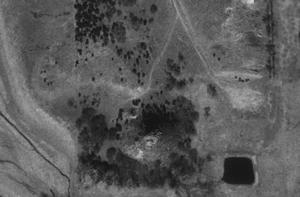
The Mound. . . . Visited!

The mystery photo from earlier today was a site that I’ve written about before. In fact, I’ve even published a picture of it before–but it was a picture taken from orbit.

Here’s that photo:

Mound2_3_1In case that doesn’t jog your memory, what you’re looking at here is a geological feature outside Binger, Oklahoma known as the "Ghost Mound."

Ghost Mound is one of a number of mounds that have names in Caddo County, Oklahoma–though there seem to be an even larger number of mounds that don’t have names.

It also appears to be the basis of the mound that is featured in H. P. Lovecraft’s story The Mound, which he (appropriately enough) ghostwrote for a woman named Zealia Bishop.

The Mound is considered the most impressive of all of the stories that Lovecraft is known to have ghostwritten for others–so impressive, in fact, that it’s often grouped with the stories that he published under his own name.

Lovecraft was given a minimal plot kernel to work with on this story. Here is all Bishop gave him to work with:

There is an Indian mound near here, which is haunted by a headless ghost. Sometimes it is a woman (S. T Joshi, H. P. Lovecraft: A Life, 467).

Lovecraft hated having to solve plot problems, and it particularly irked him that he had to write this story basically from scratch. (The fact he had trouble getting Bishop to pay him for the stories he ghosted for her also irked him.)

But the fact that she gave him so little to work with probably made the story what it is: one of Lovecraft’s best. The more he was given to work with by his literary clients, the worse the stories usually turned out. It was when he was left alone to wrestle through the story on his own that he did his best work, and The Mound is definitely one of his better stories.

It doesn’t actually feature ghosts, though. By this point in his career, Lovecraft was doing more science-oriented weird fiction and less supernatural-oriented weird fiction, so he doesn’t have conventional ghosts in the story. Instead, he provides an entire ancient, technologically-advanced civilization underneath the mound in his story.

To find out what the ghost-like entities actually are, you’ll have to

GET THE STORY.

If you do, you’ll note that Lovecraft’s description of the mound varies considreably from what it looks like in real life (because Lovecraft hadn’t visited the site and certainly wasn’t going to for the piddling wages he stood to make from the writing project–if he could even collect them).

In the story, he describes the mound as

a huge, lone mound or small hill that rose above the plain about a third of a mile west of the village—a mound which some thought a product of Nature, but which others believed to be a burial-place or ceremonial dais constructed by prehistoric tribes. This mound, the villagers said, was constantly haunted by, two Indian figures which appeared in alternation; an old man who paced back and forth along the top from dawn till dusk, regardless of the weather and with only brief intervals of disappearance, and a squaw who took his place at night with a blue-flamed torch that glimmered quite continuously till morning. When the moon was bright the squaw’s peculiar figure could be seen fairly plainly, and over half the villagers agreed that the apparition was headless.

He then has his protagonist climb up on top of the mound and start digging:

As I turned up the soil with my trench-knife I could not help wondering at the relative thinness of the reddish regional layer. The country as a whole was all red sandstone earth, but here I found a strange black loam less than a foot down.

Most of this doesn’t correspond to the actual mound the story is based on. First, it ain’t a third of a mile west of the town (not village) of Binger. It’s miles away and is actually closer to Hydro, Oklahoma. It also is clearly natural rather than artificial, and there is no soil–red or otherwise–up on top of it to be dug, if one could even get to the top of the thing.

I was disappointed when I got there and saw that I wouldn’t be able to climb the thing (not without way more time than I had, special climbing gear, and the permission of the landowner on whose property it is located). I’d hoped to go to the top of it, like the character in the story, and retrieve a soil sample.

Still, the mound is still the basis of a ripping weird fiction story!

Nice To See The Catholic Press Getting It Right . . .

. . . where the MSM has been getting it wrong.

Despite numerous secular press reports yesterday, the new Chinese bishops have not been declared excommuicate by the Holy See (EXCERPTS):

The threat of excommunication hangs over two Chinese bishops ordained without papal approval, but only if they acted knowingly and freely, said a canon lawyer.

And even if they incurred excommunication automatically by acting of their own free will, the penalty is limited until Pope Benedict XVI publicly declares their excommunication to the bishops and their faithful, said Jesuit Father James Conn, a professor of canon law at Rome’s Pontifical Gregorian University.

Excommunication "may have been incurred, but we do not know that because we do not know their consciences or the external factors involved," Father Conn said.

If they were automatically excommunicated, they immediately are forbidden to celebrate the sacraments, receive the sacraments or perform the functions of a bishop unless the good of souls requires them to do so, he said.

Father Conn said the penalty is formal and more extensive once it is publicly declared by the pope, the only person in the church with the authority to impose penal sanctions on a bishop.

Public notification is not simply a formality, he said, but it is "for the good of the people of God," who have a right to know when a minister is celebrating the sacraments illicitly.

"There cannot be just a vague declaration because the good of souls is at stake," Father Conn said.

GET THE STORY.

Mystery Map

Gas_pricesTake a look at this map.

Lots of reds and greens with some yellows in there.

Now mentally sub in some other colors.

Change the reds and yellows to blue, and change the greens to red.

If you do that, what does the map start to look like? Rather a lot like the election map from 2004. Not perfect, but close.

But this map isn’t a map of voting results. It’s a map of gas prices.

The redder the color of a county, the higher the gas prices. The greener the county, the less gas costs there.

Some of the factors affecting gas prices may be geographic (it’s harder to get gas to some places than others), but the political aspect is not to be ignored.

Big government folks like their governments . . . well . . big, and to fund those big governments they need big taxes. That’s one of the reasons California consistently charges so much more for gas than Arizona. California has a HUGE gas tax compared to other states, and there are gas stations right over the border in Arizona that advertise the fact that you can fill up there without paying the California gas tax.

It works! If I’m heading east, I wait till I get to Arizona to fill up my tank for long road trips. It’s only two hours away, and I’ve usually got enough in the tank to get there before filling up.

It was interesting on my recent trip to see what the gas prices were elsewhere. At one truck stop, a trucker I ran into was positively livid about them and used vulgarity to express himself. At numerous stops people commented to me about how high the prices were.

To me, they weren’t nothin.’

I live in California.

We always have the worst gas prices in the  nation.

Thanks to our lovely blue-state legislature.

HERE’S THE SITE THE MAP IS FROM.

AND HERE ARE THEIR TIPS ON HOW TO SAVE MONEY ON GAS.

The Duty Of Office

In the comments section of a post by Mark Shea that took note of a blogger’s letter in response to a priest who waxed conflicted about homosexual identity and same-sex marriage in a parish bulletin, Chris Durnell offered some words of wisdom worth reprinting here so they are not eaten by Haloscan at some point down the line:

"The very real distinction between one’s public responsibilities and private feelings has been very overriden [sic] these days. Few seem to notice or care that the office one holds is not for one’s private use, but to fulfill the obligations of that office."

Amen.