The Woman Caught In Adultery

A reader writes:

I read online recently (sorry, lost track of the link) that there was significant evidence that the story of the women caught in adultery in the Gospel of John was a late addition rather than part of John’s original Gospel.

I’d never heard this before, so I don’t know if this is some weird biblical scholarship theory or something moderately mainstream.  And if it is correct what, if anything, is the Church’s reaction to the question?  The article mentioned the story not appearing in a number of early manuscripts of the New Testament, and also said that although Augustine and later Fathers mentioned it, that earlier writers like Tertullian and Origin seemed not to be aware of its existence.

The claim that this passage in John’s Gospel–known as the pericope adulterae ("the passage of the adulterous woman"; John 7:53-8:11)–was not originally in this gospel is not at all fringe biblical scholarship. It is quite mainstream, and you’ll see it noted in the footnotes of some Bibles that the passage may not be in the original.

A good, brief summary of the reasons why it is so regarded is offered by Wikipedia:

The pericope is now viewed by critical scholars of the New Testament as an interpolation: it is argued that it disrupts the story told at the end of chapter 7 and in the remainder of chapter 8; it uses Greek more characteristic of the synoptic Gospels than of John; it appears in only one early Greek manuscript and sometimes appears in different places in later manuscripts, even interpolated in one case into the Gospel of Luke. B. M. Metzger writes that the evidence for the non-Johannine origin of the pericope of the adulteress is overwhelming.

So it’s not oddball scholarship that suggests this, which leaves the reader’s question of what–if anything–the Church’s reaction has been.

The Magisterium of the Church has not, to my knowledge, taken specific action regarding this passage, leaving us to apply the general principles that would be applied to any such manuscript discrepancy.

First, the passage is found in the Vulgate (including the Neo-Vulgate). Now, the Council of Trent issued a definition in which it said:

if any one receive not, as sacred and canonical, the said
books entire with all their parts, as they have been used to be read in the
Catholic Church, and as they are contained in the old Latin vulgate
edition; and knowingly and deliberately contemn the traditions aforesaid;
let him be anathema [SOURCE].

This has led some to suppose that if a passage is found in the Vulgate that it must, ipso facto, be sacred and canonical and thus in the original manuscripts, but this is not what Trent was saying. The Council was not attempting to address the question of what passages were in the originals. What it was doing was repudiating the Protestant claim that the deuterocanonicals were non-canonical. Among the deuterocanonicals are certain passages of Daniel and Esther that are not found in Protestant Bibles (e.g., Bel and the Dragon, the song of the three children). Trent’s reference to accepting "said books entire with all their parts" is meant to emphasize that not only the seven books that are wholly deuterocanonical are to be accepted as sacred and canonical but that the books that have deuterocanonical parts (i.e., Daniel and Esther) are to be accepted as wholly sacred and canonical as well.

The Council was not attempting to determine–beyond this–the authenticity of particular passages. Indeed, there were minor variations in what passages were included in different editions of the Vulgate itself, and there was no edition of the Vulgate that could be appealed to to unambiguously settle such questions. What specific passages were in the originals thus has to be determined by textual criticism, using the best manuscripts and manuscript-evaluation techniques that we have available.

This point was made by Pope Pius XII in his encyclical Divino Afflante Spiritu:

Nor should anyone think that this use of the original texts, in accordance with the methods of criticism, in any way derogates from those decrees so wisely enacted by the Council of Trent concerning the Latin Vulgate. It is historically certain that the Presidents of the Council received a commission, which they duly carried out, to beg, that is, the Sovereign Pontiff in the name of the Council that he should have corrected, as far as possible, first a Latin, and then a Greek, and Hebrew edition, which eventually would be published for the benefit of the Holy Church of God. If this desire could not then be fully realized owing to the difficulties of the times and other obstacles, at present it can, We earnestly hope, be more perfectly and entirely fulfilled by the united efforts of Catholic scholars [Divino Afflante Spiritu 20].

He went on to write:

And if the Tridentine Synod wished "that all should use as authentic" the Vulgate Latin version, this, as all know, applies only to the Latin Church and to the public use of the same Scriptures; nor does it, doubtless, in any way diminish the authority and value of the original texts. For there was no question then of these texts, but of the Latin versions, which were in circulation at that time, and of these the same Council rightly declared to be preferable that which "had been approved by its long-continued use for so many centuries in the Church." Hence this special authority or as they say, authenticity of the Vulgate was not affirmed by the Council particularly for critical reasons, but rather because of its legitimate use in the Churches throughout so many centuries; by which use indeed the same is shown, in the sense in which the Church has understood and understands it, to be free from any error whatsoever in matters of faith and morals; so that, as the Church herself testifies and affirms, it may be quoted safely and without fear of error in disputations, in lectures and in preaching; and so its authenticity is not specified primarily as critical, but rather as juridical [Divino Afflante Spiritu 21].

Here Pius XII articulates two points that are of use in assessing the pericope adulterae:

(1) the authenticity of the Vulgate is not critical but juridical, which means that Trent legally bound Catholics of the Latin Church of its day to use the Vulgate publicly but it did not attempt to set up the Vulgate as the official critical edition of the Bible so that we would no longer have to look at the original language manuscripts to determine what was supposed to be in a particular passage.

This means that whether the pericope adulterae was in the original manuscripts or not has to be settled by recourse to the original language manuscripts, not simply the Vulgate.

(2) The reason for the special juridical authenticity of the Vulgate is because its use through so many centuries had shown that "in the sense in which the Church has understood and understands it, [it is] free from any error whatsoever in matters of faith and morals."

This means that the pericope adulterae–by being included in the Vulgate–does not contain errors of faith or morals when properly understood.

And so those would be the two points that–in the absence of a current, binding statement from the Magisterium on the authenticity of the passage–one would naturally conclude regarding it: Critical scholarship must determine whether the passage was in the originals but, even if it was not, the passage does not contain errors of faith or morals when understood in a Catholic sense and so it may safely be appealed to as a passage from which Christians may learn.
MORE ON THE PERICOPE ADULTERAE.

George Washington Vs. Guy Fawkes Day

Arthur of the Ancient and Illuminated Seers of Bavaria writes:

Being the incredible history geek that I am, I have recently started
reading George Washington’s headquarters correspondence (there are
advantages to working at a university).

And I ws struck by something from his General Orders for November 5,
1775 (and Nov. 5 being Guy Fawkes Day in England):

"As the Commander in Chief has been apprized of a design form’d for
the observance of the ridiculous and chidish custom of burning the
Efficgy of the pope – He cannot help expressing his surprise that
there should be Officers and Soldiers in this army so void of common
sense, as not to see the impropriety of such a step at the Huncture;
at a Time when we are solliciting, and have really obtain’d, the
friendship and alliance of the people of Canada, whom we ought to
consider as Brethren embarked in the same Cause.  The defence of the
general Liberty of America: At such a juncture, and in such
Cirumstances, to be insulting their Religion, is so monstrous, as not
to be suffered or excused; indeed instead of offereng the most remote
insult, it is our duty to address public thanks to these our Brethren,
as to them we are so much indebted for every late happy Success over
the common Enemy in Canada."

(Writings of Washington, Vol 4 Oct. 1775-Apr, 1776,  page 65, US
Government Printing Office, Washington DC, 1931)

Now a cynic might point out this order is just a political ploy to
insure the support of the French Canadian Catholic population of
Quebec and there may be some justice to that.  But given the vehemence
with which this order is worded, I for one, get the impression that
Washington really had no truck with anti-Catholic sentiment despite
the fact ath he was personally a high church Anglican as well as a
Freemason.

Thought you might find it interesting.

Indeed. Thanks for passing it along!

I’m not one to underestimate the role that the necessities of wartime could play in such a declaration, but it is phrased with a vehemence suggesting that there is more here than cynical calculation in play. A general does not lightly refer to his own embattled troops’ behavior as "ridiculous," "childish," and "monstrous."

Washington also extended good will toward persons of other religions, writing affectiveto the Hebrew Congregation in Newport, Rhode Island that in America

All possess alike liberty of conscience and immunities of citizenship It is now no more that toleration is spoken of, as if it was by the indulgence of one class of people, that another enjoyed the exercise of their inherent natural rights. For happily the Government of the United States, which gives to bigotry no sanction, to persecution no assistance requires only that they who live under its protection should demean themselves as good citizens, in giving it on all occasions their effectual support.

It would be inconsistent with the frankness of my character not to avow that I am pleased with your favorable opinion of my Administration, and fervent wishes for my felicity. May the Children of the Stock of Abraham, who dwell in this land, continue to merit and enjoy the good will of the other Inhabitants; while every one shall sit in safety under his own vine and figtree, and there shall be none to make him afraid. May the father of all mercies scatter light and not darkness in our paths, and make us all in our several vocations useful here, and in his own due time and way everlastingly happy [SOURCE].

In The Mail

Threedaystonever2I’m reading Tim Powers’ new novel, Three Days to Never.

This is his first new novel in five years, the previous one being Declare (2001), so its release is an occasion among Tim Powers fans.

Whereas Declare was heavily Catholic themed, this one is more Jewish-themed and involves a secret history spy story involving time travel and ghosts and dybbuks.

So far, I’m enjoying it very much. Powersis his usual, hyperinventive self, and I’ll offer my comments after I’ve had a chance to finish it.

In the meantime, you can

READ A REVIEW OF IT BY JOHN SHIRLEY.

Here’s a taste:

Tim Powers is his own genre. There are a few other novelists who write urban fantasy — de Lint and Gaiman, perhaps one or two others who attempt to bind physics and metaphysics, the spy novel with the novel of the fantastic, but none who move us with such proficiency, such deceptive ease from the gritty to the transcendent; who so excel at making us feel we too, if we follow directions, can travel effortlessly from three dimensions, to four, to five.

Currently there are two editions of the book in print. One, an ordinary hardback

IS AVAILABLE AT AMAZON.

There is also a special edition (pictured above) that has cool illustrations and that comes with a chapbook of sonnets written by one of the characters in the novel.

IT’S AVAILABLE HERE.

Enjoy!

Little Greenhouse Of Horrors

Corpse_flowerA piece back I introduced y’all to the Vampire Squid From Hell.

Well, it turns out that the animal kingdom ain’t the only place that has morbidly-named, fascinating creatures in it. The plant kingdom does, too!

What you’re looking at here (left) is the blossom of a parasitic plant known as the "corpse flower."

It’s native to Indonesia and surrounding region, and it is so-named because . . .  well . . . because it smells like decaying meat.

The reason–apparently–is that the corpse flower wants to attract flies and other insects that like the smell of decaying meat and who then help with things like pollination.

The genus to which the corpse flower belongs contains a number of related species and include the largest known flowers in the world, with a bloom a meter wide and weighing up to 24 lbs (11 kg).

Recently a corpse flower bloomed (they only do that every few years) at a greenhouse in Virginia, causing not only a lot of hungry flies to be attracted but a lot of curious humans as well.

The Virginia Tech folks hosing the corpse flower even set up a web cam so curious humans could catch a glimpse (if not a whiff) of it at a distance.

Corpse_flower2They also posted a lot of other pictures of the corpse flower and its development, one of which I’ve included here (right).

All I can say is . . . I don’t want anyone laying one of these things by my bed at night, and not just because of the smell.

GET THE STORY.

LEARN MORE.

ABOUT THE WORLD’S BIGGEST FLOWER.

SEE THE PICTURES ON THE VIRGINIA TECH SITE.

The Guns Of August?

Okay, two scary stories from the terrorism front.

First (EXCERPTS),

Eleven Egyptian students who were supposed to travel to a Montana university after flying to JFK airport late last month disappeared in New York, spurring federal authorities to issue a nationwide alert, officials said yesterday.

Montana State University Provost David Dooley said 17 Mansoura University students signed up for a 32-day cultural-exchange program to intensively study English, learn about Montana history and go on several field trips.

They arrived at JFK on a flight from Egypt on July 29, but only one managed to clear immigration in time to make a connecting flight, Dooley said.

By July 31, five others had arrived in Bozeman, but the rest were unaccounted for.

Dooley said the ones who showed up "were not certain about the status of their fellow students and why they haven’t made it."

MSU alerted federal Homeland Security and Mansoura officials and notified the students via e-mail they had 24 hours to show up in Bozeman. None of them did, Dooley said.

And for the least credible line in the story:

[FBI Special Agent] Kolko said there is no reason to believe the missing students, all men around 20 years old, represent a threat.

I’m sorry, but I agree with the congressman from Long Island:

Rep. Peter King (R-L.I.), who chairs the House Homeland Security Committee, said the situation "has to be taken very seriously."

"Having a number of students from an Arab country arriving on student visas and disappearing is cause for concern," he said.

GET THE STORY.

Now for scary story #2:

Islam expert Bernard Lewis has an op ed in the Wall Street Jounral that forcefully makes the case why Iran must not be allowed to get The Bomb–if it doesn’t have it already. EXCERPTS:

There is a radical difference between the Islamic Republic of Iran and other governments with nuclear weapons. This difference is expressed in what can only be described as the apocalyptic worldview of Iran’s present rulers. This worldview and expectation, vividly expressed in speeches, articles and even schoolbooks, clearly shape the perception and therefore the policies of Ahmadinejad and his disciples.

Even in the past it was clear that terrorists claiming to act in the name of Islam had no compunction in slaughtering large numbers of fellow Muslims. A notable example was the blowing up of the American embassies in East Africa in 1998, killing a few American diplomats and a much larger number of uninvolved local passersby, many of them Muslims. There were numerous other Muslim victims in the various terrorist attacks of the last 15 years.

The phrase "Allah will know his own" is usually used to explain such apparently callous unconcern; it means that while infidel, i.e., non-Muslim, victims will go to a well-deserved punishment in hell, Muslims will be sent straight to heaven. According to this view, the bombers are in fact doing their Muslim victims a favor by giving them a quick pass to heaven and its delights–the rewards without the struggles of martyrdom. School textbooks tell young Iranians to be ready for a final global struggle against an evil enemy, named as the U.S., and to prepare themselves for the privileges of martyrdom.

A passage from the Ayatollah Khomeini, quoted in an 11th-grade Iranian schoolbook, is revealing. "I am decisively announcing to the whole world that if the world-devourers [i.e., the infidel powers] wish to stand against our religion, we will stand against their whole world and will not cease until the annihilation of all them. Either we all become free, or we will go to the greater freedom which is martyrdom. Either we shake one another’s hands in joy at the victory of Islam in the world, or all of us will turn to eternal life and martyrdom. In both cases, victory and success are ours."

In this context, mutual assured destruction, the deterrent that worked so well during the Cold War, would have no meaning. At the end of time, there will be general destruction anyway. What will matter will be the final destination of the dead–hell for the infidels, and heaven for the believers. For people with this mindset, MAD is not a constraint; it is an inducement.

Now for the kicker:

Mr. Ahmadinejad and his followers clearly believe that this time [the end times] is now, and that the terminal struggle has already begun and is indeed well advanced. It may even have a date, indicated by several references by the Iranian president to giving his final answer to the U.S. about nuclear development by Aug. 22. This was at first reported as "by the end of August," but Mr. Ahmadinejad’s statement was more precise.

What is the significance of Aug. 22? This year, Aug. 22 corresponds, in the Islamic calendar, to the 27th day of the month of Rajab of the year 1427. This, by tradition, is the night when many Muslims commemorate the night flight of the prophet Muhammad on the winged horse Buraq, first to "the farthest mosque," usually identified with Jerusalem, and then to heaven and back (c.f., Koran XVII.1). This might well be deemed an appropriate date for the apocalyptic ending of Israel and if necessary of the world.

GET THE STORY.

Operations Note

TypePad is currently having a problem with some combox totals not updating, which is why today’s posts are currently listed as having zero comments even though there ARE discussions going on in their comboxes.

TypePad is aware of the problem and trying to fix it.

In the meantime, to participate in the discussions, just click on the Comments link even though it says (0).

Tritiocanonicals?

A reader writes:

I know that the word deuterocanonical means "included in the second canon". I also know that the word is something of a misnomer since there has really only been one canon that is universally definitive, and there have been a lot more than two canons that have not been universally definitive. I have been told once by someone whom I can not now remember that the canon of the Council of Trent is closed, that there can never be such a thing as "tritocanonical books". So I remember being a little surprised some months ago when I read the decree from the Council which listed the canon that it contained no exclusive language, i.e., that it said, in effect, "these books are holy and to be received", rather than "these books and only these books are holy and to be received".

Just the other day, I was reminded of my surprise when I read this discussion of the deuterocanonical books from the Proemial Annotations of Volume I of the Old Testament of Douay, the 1635 edition from before Challoner’s revision:

"True it is that some of these books … were sometimes doubted of by some Catholics, and called Apocrypha, in that sense as the word properly signifieth hidden, or not apparent. So St. Jerome (in his prologue before the Latin Bible) calleth divers books Apocryphal, being not so evident, whether they were Divine Scripture, because they were not in the Jews’ Canon, nor at first in the Church’s Canon,  but were never rejected as false or erroneous. In which sense the Prayers of Manasses, the third book of Esdras, and the third of Machabees are yet called Apocryphal. As for the fourth of Esdras, and the fourth of Machabees there is more doubt."

Is it just me, or is Cardinal Allen here saying that these books may someday be "tritocanonical"? If this was true in 1592, could this still be true today? If not, then why not?

Please note that this issue seems different to me from the one you discussed HERE, which was primarily about a hypothetical newly discovered text. This issue is about texts which, before the 17th century, were part of or appended to almost every Christian version of the bible ever published.

As I mentioned in the post you linked, it appears that the places where the Magisterium has infallibly dealt with the canon are not phrased in such a way that they definitively close the canon. While they do infallibly include the deterocanonicals in the canon, they do not appear to infallibly repudiate the possibility in principle of ever declaring other books to be canonical.

Also as I mentioned before, I don’t think that there is any practical chance of a newly-discovered book being added to the canon, due to the lack of a tradition supporting its authentity and inspiration.

But you have named the one circumstance that could, conceivably–even as a long-shot–result in a book being added to the canon.

I don’t know what Cardinal Allen may have had in mind. It does sound like he was open to the idea of books such as the Prayer of Manasseh being declared canonical, though perhaps he was only clarifying the word used for such books ("apocryphal") without seriously entertaining the idea that they might one day be declared canonical.

But I can see a (hypothetical, long-shot) path by which such books might be declared canonical.

The fact is that some of the books that are referred to by Catholics as apocryphal (the Prayer of Manasseh, 1-2 [3-4] Esdras, 3-4 Maccabees, etc.) are accepted as canonical by other groups of Christians, notably in the East. That being the case, suppose the Catholic Church were to achieve visible union with one of these groups. How would the canonicity of these books be handled?

My guess is that they would be handled the way that other sensitive theological issues get handled in such unifications: The existing churches in the Catholic Church would not be bound to accept them but the newly unified church would be allowed to retain them.

This would be analogous to the way that there is a theological difference between the Latin church and some of the Eastern Catholic churches regarding when the consecration of the elements takes place during Mass. According to the standard theology of the Latin church (which I personally am strongly convinced is correct), the Real Presence appears at the point where the wods of institution are said ("This is my Body. . . . This is my Blood"). However, according to the theology common in some Eastern Catholic churches, the Real Presence appears earlier, when the Holy Spirit is invoked upon the elements to transform them, a point known as the Epiklesis.

Similarly, there is a theological difference concerning who performs the sacrament of marriage. According to standard Latin church theology, it is the parties themselves, but according to some in Eastern Catholic churches, it is the priest.

These theological differences are permitted within the scope of Catholic orthodoxy and, should the need arise, the question of which theological opinion is correct could be addressed definitively by the Magisterium. As long as that need is not pressing, however, the Magisterium is content to allow the differences to exist as trying to settle the question could produce graver harms, including potentially inaugurating a schism. While it would b enice to have every point of theology infallibly settled, the Church has deemed it appropriate to allow us to live with a certain amount of theological uncertainty regarding matters that occupy subordinate positions in the hierarchy of truths.

The same could be true–hypothetically–regarding the canonicity of certain books of Scripture. In fact, there was a long period of time when the Church did live with a degree of uncertainty regarding some of the books not infallibly recognized as canonical. This was because the books were of a subordinate position in the cnaon and issue of their canonicity was not pressing.

If the Catholic Church were to reunite with, say, the Russian Orthodox Church, and if the Russian Orthodox Church accepts 2 Esdras as canonical, it could be judged a matter that should not prevent the full visible union of the churches. Members of the Russian Orthodox Church-now-in-union-with-Rome would be free to continue honoring 2 Esdras as canonical, but members of the Latin church would not be required to do so.

This kind of solution I consider to be likely–IF–and that’s a significant IF–such reunions take place (which I pray they do; I’d love to see at least one such union in my lifetime).

Now let’s push it a step further: Following such a union, could the current (early 21st century) churches of the Catholic Church come to recognize such books as canonical?

Yes.

Upon the development of the kind of situation described above, it would be clear that Catholics previously in union with Rome would be free to hold the canonicity of such works, just as a member of the Latin church could–if he were so convinced–licity hold Eastern Catholic theological positions today.

It seems to me, then, that there would be a path for recognition of the canonicity of such books in the Latin and other current Catholic churches, but two things would have to happen first: (1) a long period of time would have to go by in which the canonicity of these books slowly became generally recognized in these churches and (2) there would have to be a canonical crisis at some point forcing a decision on the matter.

So I’d see a three step process to the infallible recognition of the canonicity of these books:

1) Reunion with a church that holds them to be canonical
2) A widespread acceptance of their canonicity in the previous churches in union with Rome
3) A canonical crisis to force the issue

There is also a fourth condition that would have to be met:

4) These books have to be inspired, for otherwise the Holy Spirit will not allow the Magisterium to infallibly recognize their canonicity

Independent of whether condition (4) is the case, I don’t expect to see (1)-(3) fulfilled in my lifetime for any book, unless we get an immortality pill soon.

But it is at least possible that this could happen one day (assuming condition 4 is met).

I’d note that this process finds a mirror in the early Church. While we don’t speak of the New Testament as having "deuterocanonical" books, we certainly could do so, because there were books of the New Testament whose canonicity was disputed in some churches in the early centuries. What happened was, as canonical consciousness grew, those New Testament books which were regarded as canonical in some regions eventually came to be recognized as canonical in all regions. If a sizable enough group of people regarded a book as canonical then it tended to become more favorably regarded as canonical elsewhere, until consent was universal. What we’re talking about above is essentially the same process, played out over a much larger timescale.

And such a process could also alleviate a particular nagging issue: the book of Jude quotes from the book of Enoch in a way that sure makes it sound like the book of Enoch (1st Enoch, that is) is inspired. Since the Ethiopian Orthodox Church regards Enoch as canonical, the above route could bring wider recognition of the canonicity of this book, solving the tension created by Jude’s use of it.

That’s not something to be automatically wished for, though. The edition of 1st Enoch that is used by the Ethiopian Orthodox Church has lots of stuff in it that would generate new tensions, and they accept other books that would generate even further tensions if their canonicity were received.

I’m just sayin’.


How Do He Know?

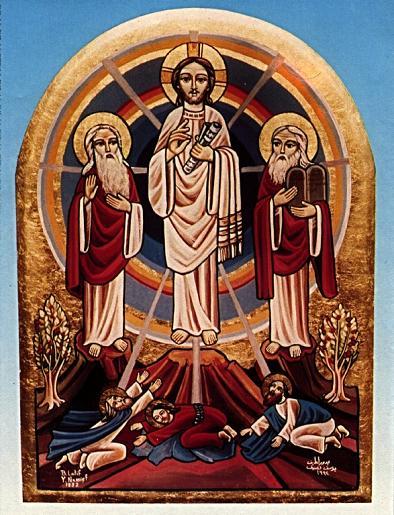
TransfigurationA reader writes:

At the transfiguration it says that Jesus was talking with Moses and Elijah.  Moses and Elijah have been deceased for a considerable amount of time.  There are no portraits of either man anywhere.  Jesus is still alive, so the Holy Spirit has not descended on the Apostles yet.  So, How was Peter able to recognize that Jesus was talking to Moses and Elijah?

We really can’t do more than speculate on this one since Scripture doesn’t give us the answer, but I can envision a number of possibilities:

1) They heard the figures identified by a heavenly voice; it just doesn’t record this fact in Scripture.

2) The just knew–like in a dream–who the figures were. The fact that the Holy Spirit had not been generally given as he was on Pentecost is not really an issue for this since God can make exceptions if he wants and the Holy Spirit is said to have been active even in the Old Testament prophets; he simply had not bee poured out in the way that he was on Pentecost.

3) They may have had symbols associated with them that identified them. For example, in the icon above Moses is shown holding the Ten Commandments. I know if I saw a vision and there was an old guy with a beard talking to Jesus and he (the old guy) was holding the Ten Commandments, I’d think of him as Moses. Maybe Elijah’s mantle gave him away or (hypothetically) maybe he seemed to descend in a whirlwind or something like that.

4) It says that they conversed with Jesus, so maybe it was made clear from what they said. Perhaps Jesus referred to them by name or perhaps Moses and Elijah made references to things they had done during their earthly lives (e.g., "Back in my day the people were really ornery, too! Why I hadn’t even gotten off the holy mountain before they’d gone and made a golden calf for theyselves!").

Or maybe it was a combinatoin of these. We really can’t say, though personally I’m partial to the just knowing it like in a dream theory, followed by the conversation and symbol theories.

Condoms During Pregnancy

A reader writes:

When pregnant, I have am prone to receiving a type of bacterial
infection that can cause pre-term labor, and my first child was born
several weeks early because of it. 

During my second pregnancy, I read
that many doctors recommend the use of condoms during pregnancy to try
and reduce the transition of the bacteria, because the male germ cells can aggravate
the condition (this is not related to a sexually transmitted disease.)
My midwife recommended this practice as well, although there have not
yet been studies to see if it is effective. 

I solicited opinions on a
Catholic e-mail list as to whether or not the use of condoms during
pregnancy under these conditions would be licit.  I assumed that it
would be.  If I’m already pregnant, I am obviously not trying to
contracept, right? 

I was surprised that the opinion fell the other way,
feeling that the "unitive end" of the marital act would be frustrated if
a barrier were between us.

Could you give me your opinion on the subject?

I can, but let me do so in the below-the-fold section of this post so that people don’t have to look at the discussion who do not want to read it. (I’ll also keep as clinical as I can).

Continue reading “Condoms During Pregnancy”