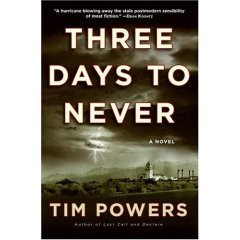
Tim Powers’ new novel,
Three Days To Never (3DTN), is a supernatural thriller about spies,
magic, science, religion, and the secret history of the 20th
century. Set in 1987 during that year’s famed three-day New Age “Harmonic
Convergence,” the story involves Albert Einstein, Charlie Chaplin,
Israeli intelligence, remote viewers, the Qabbalah, the nature of time,
identity, and free will–and an unsuspecting English teacher from San
Bernardino and his young daughter.
The author has graciously consented
to give JimmyAkin.Org an exclusive interview about his new book.
* * *
JA.O: Authors usually dread the
question “Where do you get your ideas?” so I won’t ask that, but
I’d like to ask about the starting point for 3DTN. Where did the germ
of this novel come from? What was the first thing that you decided about
it? Did you want to write about a specific theme, a specific moment,
a specific character, a specific concept?
Tim Powers: Actually
it all started simply by me being curious about why Einstein’s hair
is white in all photographs after 1928. Biographies note that he had
something like a heart attack at that time, in the Swiss Alps, but I
was in my writer-paranoid mode, so I wasn’t buying the heart-attack
story.
I
suppose anybody’s biography would yield the sort of clues I look for
to base a story on — I bet I could find them in a biography of Louisa
May Alcott, or Beatrix Potter! — but I was pleased to find that Einstein’s
life was particularly full of odd bits. He really did devote years to
working on some kind of "maschinchen," little machine, which
apparently in real life came to nothing, and he did go to a séance
with Charlie Chaplin, and he did leave California forever on the day
of the big Long Beach earthquake, for instance.
I
always simply note lots of interesting bits and then try to figure out
what sort of story they appear to be part of — as opposed to having
a story in mind in advance and then looking for substantiation for it.
And so when I found that Einstein was devoted to the state of Israel,
for instance, and donated lots of his papers to a university there,
I just noted that Israel would probably figure in the story. That led
me to the Qabbalah and the Mossad, and then they led me on to lots of
other colorful stuff.
* * *
I know that your stories
are heavily researched. How did you go about researching this one?
Well,
I read a good dozen biographies of Einstein! Underlining and cross-referencing
and making customized indexes on the flyleaves! (I always wind up wrecking
my research books.) And I read heaps too on Qabbalah, and the history
of Israel, and Charlie Chaplin, and old Hollywood, as the Einstein biographies
pointed toward these things.
And
since the story’s action was mostly taking place within an hour’s drive
of where I live, my wife and I were able (as usually we’re not) to go
to the places I was writing about, and take pictures and wander around
and make notes. Since I usually can’t go to the places I set my stories
in, I insist that it’s not necessary — but just between you and me,
it is a help!
* * *
3DTN involves
the Israeli intelligence service, the Mossad. How did you go about researching
them, and how close are the intelligence methods shown in the story
to the ones the Mossad used in the 1980s? Are you at liberty to tell
us or would you have to kill me and my blog readers if you said?
The
actual Mossad is more efficient than the fictional agents I put in the
book — but moderately inefficient characters are more useful in fiction
and more interesting, I think, to read about. But the background and
methods I give them are accurate for the 1980s, assuming my research
books were accurate. I read Victor Ostrovsky’s By Way of Deception
, and Gordon Thomas’s Gideon’s Spies, and Israel’s Secret
Wars by Black and Morris, and several more. Taken altogether they
probably gave me a plausible picture of the Mossad in the ’80s, and
plausibility is more crucial than strict accuracy. (And as you note,
precise accuracy in espionage matters might be dangerous!)
* * *
When I read your stories,
I’m often surprised to find out that things I thought you made up
actually came from real history. For example, in 3DTN there is an occult
group with ties to the Nazi Regime that I thought you likely made up
(though we know the Nazis were interested in the occult). There is also
a long-lost Charlie Chaplin film that I suspected was an invention of
yours. Yet when I checked online, I found both of these were real. Are
there other things buried in the novel that the reader might be surprised
to find came from history?
Actually
a whole lot of it is real stuff — Einstein’s maschinchen for measuring
faint voltages, his pal who assassinated the Austrian premier in 1916,
the mid-movie interruption of the first screening of Chaplin’s City
Lights, the "kidnap" and ransom of Chaplin’s dead body,
for instances. This is a result of me getting my story almost ready-made
by reading a whole lot of research stuff and noting the intriguing bits,
which I then only have to fit together into a plot. It’s much easier
to just find all this than to make it up!
* * *
One of the things that I
find fascinating about your work is the way that you mix real life with
fantasy. Like many of your novels, 3DTN is set in modern times. This
is different than many fantasy novels, which are set in either the Middle
Ages or an imaginary period that is meant to be like the Middle Ages.
Personally, except in the case of someone like Tolkien, I often find
those stories coming across as flat or artificial. Is there a specific
reason why you weave magic around modern settings instead of going with
the traditional "sword and sorcery" type of fantasy? Is it
just a personal preference or do you think there are advantages to writing
magical tales set in the present day?
Well,
I want to trick my readers into believing, while they’re reading the
book at least, that all this stuff is really happening, to real
people. If I set it in that default-medieval world, with wizards and
Dark Lords, readers would probably think, "Oh, an imaginary story!"
and I don’t want them noticing that it is, in fact, imaginary.
So I put the magical stuff in alongside TVs and freeways and Marlboros,
and hope that when the magical business starts up, it will seem to be
as genuine as … you know, the internet and streetlights and
Big Macs.
Ideally
my readers will develop a bit of reflexive mistrust of apparent, mundane
reality! You really don’t have to nudge readers very hard to elicit
this. People say things like, "I’m not scared of ghosts, I’m scared
of urban gangs and nuclear war," but if they’re all alone in a
house at night, and they hear a scraping sound down the hall, they don’t
think it’s an urban gang member; for at least a moment or two they
know it’s a ghost.
* * *
Elements of your own life
are often mixed into your stories. Your characters often live in the
same town that you do, and incidents in the stories are often modeled
on things that happened to you. For example, in your story
“The Bible Repairman,” you have a character who accidentally set
afire a Jehovah’s Witness Bible, just as you once did. Can you tell
us some elements of your own life that found their way into 3DTN?
I
think most writers use their own lives as the basic kit for their protagonists,
to be altered as plot might require. It’s easier! You know the (ideally
mildly interesting) details of your own life pretty thoroughly, and
so a protagonist based on yourself is going to have a history, and tastes,
and even such flaws as you might be aware of having.
I
don’t have a daughter, and my wife fortunately is still alive! But Marrity’s
house is our house, and his furniture and books and cats and pickup
truck are all ours. (Our pickup truck was a lot newer when he had it
in ’87 than it is now.) And I quit drinking some years ago, which I
think might be a wise course for Marrity.
* * *
Last year you visited Israel
for a science fiction convention. Visiting Israel was a very powerful
experience for me, and I wonder how it affected you. What did you think
about your trip and did getting to go there influence 3DTN in any way?
Unfortunately
my wife and I went to Israel after I had finished the book! I
did manage to shove a few first-hand details about Tel Aviv into the
book, at least. And the real-life Israel didn’t contradict the Israel
I had imagined — I expected it to be a wonderful place, with admirable
people, and it was certainly that.
And
we did get to Jerusalem, several times! As Catholics, we found that
was kind of comprehension overload — the realization that God walked
right here, and according to tradition touched this particular stone,
and died right here, is just disorienting. You only begin to appreciate
it later, in pieces.
We
definitely want to go back. Ideally we’d go every year, with the tax
excuse of attending the convention!
* * *
Your previous novel,
Declare, had significant Catholic themes in it, while 3DTN has significant
Jewish themes. Specifically, it has a magical system related to the
Qabbalah of Jewish mysticism. Why did you decide to go that way this
time? It’s not just that you’re a huge Madonna fan or something is
it?
Well, no. What I generally do in my books, once I’ve got a situation
figured out, is look for the supernatural tradition most closely associated
with it — so that with pirates in the Caribbean I used voodoo [in the novel On Stranger Tides–ja], and
with Arabs I used genies [in the novel Declare–ja]. Declare was fun, in that one of the
historical characters’ uneasy fascination with Catholicism gave me an
excuse to present Catholicism as true. In this new book, I guess I present
Judaism as true! That Mossad character is a fairly orthodox Jew, and
isn’t comfortable using Qabbalah.
And
Judaism isn’t alien to Catholics, of course — I always figure that
if Catholicism were somehow, per impossibile, proved wrong, I’d
jump straight into Judaism.
* * *
One of the ways that you
ground your stories in real life is by weaving science and magic closely
together. It’s not uncommon in your stories to have quantum mechanical
explanations for magic, or ghosts explained as a partly electrical phenomena,
or devices that are part technology and part enchantment. Depending
on how it’s handled, I could see this either helping or hurting a
story. What have you found to be the benefits and
risks of closely juxtaposing science and magic?
One
way it helps — I hope! — in soliciting reader credulity is that it
shows magic impinging on, participating in, reality as we know it. After
all, if you can see a thing, then it’s reflecting light, and so it must
have some physical properties! And I like to give magical phenomena
a quantum or Newtonian or relativistic structure, just because those
have internal consistency and I hope my magical stuff will therefore
have a plausible consistency. I don’t want readers to think that I’m
free to make up any old magical effects at all.
The
risk of this, of course, is that you’ll make magic into just another
technology — pentagrams are effective up to such-and-such amount of
stress, the effectiveness of magic spells diminishes as the square of
the distance — you risk losing the numinous, vertiginous qaulity which
is really the whole point of magic. Real magic should be as scary as
an earthquake, even if it’s "good" magic.
* * *
H. P. Lovecraft felt strongly
that a weird fiction story should be thoroughly grounded in reality
and contain only a single supernatural element—the
“wonder” at the heart of the story. Your approach is different:
You strongly ground your stories in the real world but you weave in
multiple supernatural elements. It’s like there is a whole magical
subtext bubbling just under the surface of daily life. Do you think
Lovecraft was too conservative about how much of the supernatural readers
can accept or are there special challenges to pulling off
the kind of thing that you do?
Well
I suppose I’d claim that I’m only introducing one magical element, but
that it’s got lots of apparently-unconnected side effects! — but that
would probably be more glib than true.
Yes,
I think Lovecraft was too conservative. The thing we want to show the
reader is that there’s a whole world of unsuspected stuff going on —
when Leeuwenhoek first looked into his microscope, he didn’t see just
one weird new creature, but dozens of them! The unsuspected world will
have its internal consistencies, its own possibilities and impossibilities,
but it’s gonna be intricate.
* * *
Albert Einstein figures
prominently in 3DTN and you go beyond the known facts of his life in
working him into the story’s background. Einstein is such an iconic
figure that many authors have felt the liberty to fictionalize his life
in books and movies, but just recently we’ve had a great deal of criticism
directed toward Dan Brown for his rewriting the facts of Jesus’ life
in The Da Vinci Code, and Jesus is
an even more iconic figure. A lot of people took offense at what Brown
did, but a lot don’t take offense at a fictional version of Einstein’s
life. How do you explain this and, in your view, how much liberty should
authors have when fictionalizing the lives of historical figures?
I
think the main thing is to base your characterization on what’s known
of the real historical figure — don’t have him do things he never would
have done. You can invent lots of unrecorded motivations for him, but
he should react to those in character.
I
like to think I presented Einstein as an admirable character, which
he appears mostly to have been. I’ve portrayed some historical bad guys
somewhat sympathetically — Bugsy Siegel, for example [in the novel Last Call–ja] — but I don’t
think readers mind that as much as going the other way, and portraying
revered figures as villains. Brown portrayed Jesus as a fairly vague
nonentity, but at least he didn’t make Him a bad guy!
* * *
Despite the emphasis on
reality, your stories often have striking elements of whimsy. For example,
some of your characters have joke names—and joke names based on ecclesiastical
Latin at that! In a couple of your novels there was a character named
“Neal Obstadt” (nihil obstat;
“nothing obstructs”) and in 3DTN there’s a woman going by the
name “Libra Nosamalo” (libera nos a malo;
“deliver us from evil”). Is there a risk of harming suspension of
disbelief here or do you think that the payoff in humor is enough for
those who’ll get the joke?
Well,
I think there is a risk of harming suspension of disbelief, yes. I shouldn’t
do it! Anything that reminds the reader that he’s just sitting in a chair
holding a stack of papers all glued together at one edge, and not in
the presence of the book’s characters, is a mistake, even if it gets
a laugh.
It
could be worse! After all, Neal Obstadt may have picked that name because
of its associations, and Libra Nosamalo explains that her parents had
an odd sense of humor.
But
the best sort of humor in a book is things that arise naturally from
the action, things a reader can laugh at without stepping outside the
story!
* * *
Compared to many contemporary
novels, yours are fairly clean. While they’re meant for adults, they
aren’t loaded up with sex scenes and they don’t celebrate sin. There
are cuss words and your characters definitely have things they’d need
to talk about in confession, but on a deeper level your books presuppose
a moral structure to the universe. As a Catholic, how do you find the
balance between showing the reality of man’s fallen condition and
glorifying evil the way we commonly see in the media?
Well,
while I show people doing bad things — even show the atractiveness
of doing bad things! — I like to think I show too that they work out
badly, and that the characters would have been way better off not having
done those things. Often a character wants to do the difficult right
thing but keep a couple of pet sins too — just little ones, they don’t
eat a lot or make much noise! And I hope I show that there’s bad consequences
of that. I always remember Lewis’s statement in The Great Divorce,
something like, "If we choose Heaven we will not be able to keep
even the smallest and most intimate souvenirs of Hell."
This
is really more craft than morality — given, I suppose, my own beliefs.
Sex-scenes, for example, I think are generally just bad craft. They
usually feel to me like clumsy gear-changes, jolting the reader abruptly
from one sort of fiction into another. Not smooth carpentry!
* * *
J. R. R. Tolkien’s works
envision a world that differs from ours in a number of respects. Some
things are “okay” in his world that would not be okay in ours (e.g.,
Gandalf’s use of magic). C. S. Lewis’s
Chronicles of Narnia are similar. When reading or watching science
fiction and fantasy, I often imagine that I’m peeking in on a universe
where God established different rules (which is certainly his right),
but many people feel that there are limits to what authors should portray
in this regard. A considerable number of Christians feel that J. K.
Rowling crossed the line in her
Harry Potter series and created a world that could tempt real-world
children toward the occult. In your novels I’ve noticed that the more
people chase after magic, the more they get burned by it. Where do you
come down on this topic? Are there limits to how different an author
should make the world he envisions? Does it depend on the audience?
What are the boundaries?
I
make magic a damaging thing for characters to mess with just because
that feels logical and convincing to me. I’d be writing about a fake
magic — fake to me, anyway — if I made it benevolent or even neutral.
But
I wouldn’t advise a writer who sees magic as a nice thing to
try to change the way he deals with it! I don’t think you can fake these
things. I’ve known writers who try in their stories to endorse moral
correctnesses they don’t actually care about, or which they even feel
to be invalid, just to make their work more palatable to perceived readers’
tastes, and it never works. Your fiction is going to reflect what you
actually believe and don’t believe, and it’d be a mistake for Rowling,
for example, to vilify magic just because people think it ought to be
vilified. They may be right and she may be wrong, but it’s her eyes
we’re looking through when we experience the story.
Joan
Didion said that "art is hostile to ideology." Fiction
can be educational and beneficial and improving, but that’s not
one of its jobs!
* * *
Your stories often begin
after the death of an important character—frequently a female character whose
death sets the plot in motion. Is this a consequence of writing stories
that often involve ghosts, is it just a good place to begin stories,
or is it a personal trademark?
I
guess it’s just a personal quirk! I really wasn’t aware of it till you
pointed it out. I guess it’s a natural way to get into a dramatic situation
— the reader learns about this deleted person from seeing how the other
characters react to her (generally her) sudden absence, and when a mystery
becomes evident she’s not there to explain it, and they’ve got to try
to reconstruct what she secretly knew or what she was actually up to.
And
yes, in stories of mine her ghost is likely to show up and have some
comments!
* * *
Your stories often end with
the creation of new families by characters who aren’t initially part
of the same family. Is this a crypto pro-family statement that you’re
trying to get across, does it play a specific
dramatic function, or is it something that you just find interesting?
I
suppose it plays a dramatic function, in that it’s putting together
a new orderliness, with optimistic promise, out of the ruins of what
had been there before the story’s catastrophes started. Like, "Things
won’t be the same, but they’ll be nice in a different way." And
I generally get fond of my characters, and I want them to have nice
lives after the book’s spotlight isn’t on them anymore!
* * *
Your previous novel,
Declare, came out in 2001 and 3DTN has come out in 2006. You’re
not going to make us wait until 2011 for another Tim Powers novel are
you?
I
hope not! No, no, definitely not. This one was slowed down by me teaching
two high school classes and one or two college classes every semester,
and I’m going to cut back on that, I swear.
* * *
ORDER THREE DAYS TO NEVER–OR OTHER WORKS BY TIM POWERS–FROM JIMMY AKIN’S STORE.