GodBlogCon Update

I just got the final schedule for GodBlogCon 2006, and it turns out that I’ll be speaking on two panels instead of one.

The first panel will be "Bridging the Christian Divide" and will focus on  how Christian bloggers of different stripes (Protestants, Catholics, Orthodox) can work together to promote the common good and how they can handle their theological differences.

This panel will take place at 9 a.m. on Friday, October 27th. I’ll be serving as the Catholic representative and will be joined by Joe Carter of Evangelical Outpost, James Kushiner of Mere Comments, and moderator Joe Shroeder of Blogotional.

The folks involved in this panel have already been having an e-mail discussion amongst ourselves, and it has become clear that we do not take ourselves with supreme seriousness. Jokes at each others’ espenses are planned, so it should be a lively and entertaining discussion.

The second panel I’m on is a Roundtable Discussion that will take place at 10:30 a.m. on Saturday, October 28th. This panel will focus on how Christians can make sure that their voices are heard in the blogosphere so that they aren’t shut out of the broader social discussion the way they generally have been on Television and in the news media.

Big names who will be attending the conference include Hugh Hewitt and La Shawn Barber. Info on the speakers can be found HERE, along with snazzy pictures of them.

I was particularly interested to see that, right next to my picture, there is a picture of another speaker who is perhaps best known for being the seventh president of the United States. All I can say is . . . wow, he looks a lot younger than I expected.

If you’ll be within spitting distance of Los Angeles during October 26-28, I hope that you’ll join us for GodConBlog 2006. It’d be great if a sizeable Catholic turnout appears. Many of the organizers of the conference are Evangelical, but they’re Catholic friendly, and any time our friends across the confessional aisle reach out to include Catholics in an event, it’s good for us to reciprocate.

MORE INFO HERE.

On Not Praying For Sinners

A reader writes:

My roommate and I (both devout Catholics) enjoy having theological conversations.  In one of these discussions, a question arose.

We were looking at 1 John 5, and we questioned the meaning of 1 John 5:16:

"If anyone sees his brother sinning, if the sin is not deadly, he should pray to God and he will give him life. This is only for those whose sin is not deadly. There is such a thing as deadly sin, about which I do not say that you should pray" (NAB). 

It seems as though John is telling us not to pray for those in mortal sin, but this command does not seem to make sense.  Obviously repentance, even for one in mortal sin, is only possible through the grace of God given to that person.  So why would we not pray that God would continue to offer grace to a person whose sin is deadly, so that the person would come to repentance? 

Furthermore, given that we cannot judge the state of someone’s soul, we can even pray for people who died in states of objectively serious sin (for example, those who commit suicide) in the hopes that they lacked either full knowledge or full consent, or that they repented in their last moments.  Are we misunderstanding John’s meaning here, or is there a particular reason he would discourage his readers from praying for people whose sin is deadly?

This verse is notoriously difficult for people of all theological stripes to interpret, and one of the reasons for this–at least in the English-speaking world–seems to be that it does not come over into English that smoothly, leading translators to fudge a bit of what the Greek says in order to better fit the idiom of our speech John does not literally refer to someone whose sin is "not deadly." That’s an attempt (a guess, really) at what John meant by the Greek phrase he used (mE pros thanaton).

My own thought is that the verse is easier to understand if you stick with a more literal translation, and to that end let me quote the verse from a translation that I don’t often use–Young’s Literal Translation:

If any one may see his brother sinning a sin not unto death, he shall ask, and He shall give to him life to those sinning not unto death; there is sin to death, not concerning it do I speak that he may beseech.

I also should note that the "a" in "sinning a sin" is not there in the Greek (Greek does not have an equivalent of the word "a," so the translator has to decide whether or not to add it based on the context). You could thus translate the first part of this, "If anyone sees his brother sinning sin not unto death." (You could also use "to" instead of the archaic "unto.")

That’s clunky English, but it enables one to see what I think is the most natural interpretation of the text: John is talking about people who sin and keep on sinning until they die, with no repentance. To paraphrase the passage, what I think John is saying is this:

If somebody sees his fellow Christian sinning, but not up to the point of death, then he should pray and God will give the brother life–that is, to those who don’t keep sinning until death; there is such a thing as sinning until death, and I’m not talking about praying about that.

In all of this it is understood that the sin in question is mortal sin, and the point John is making is that as long as a person hasn’t died in mortal sin you can still pray for them and God can give them life (spiritual and/or physical).

If someone has died in mortal sin then, of course, there is no point praying for them, which is why John says what he does.

You’ll note, though, that he doesn’t say not to pray for them. He just says, "I am not saying that he should pray about that." It strikes me that John may avoid saying "Don’t pray for such people" precisely because we can’t ultimately know if someone was in mortal sin when they died. He’s just not advocating prayer for people who appeared to remain in mortal sin until they died.

This is still different than what we tend to do today–we tend to pray for everybody, even those who really STRONGLY appeared to be in mortal sin when they died (e.g., the 9/11 hijackers) because we know that there is some small chance that they weren’t–but in the New Testament era the emphasis tended to be placed on what a person’s outward behavior would indicate about their spiritual status rather than what their hypothetically possible inward state might be.

People in the New Testament recognized that the inward state of a person might not match their outward state (i.e., people who appeared to be righteous outwardly could really be sinners inwardly, and people who sinned outwardly might have diminished culpability for their actions), but there was a tendency in practice to read the outward state as a usually-reliable guide to their inward state.

Incidentally, other folks do other things with this passage, and other interpretations of it are certainly legitimate, but this is the interpretation that strikes me as the most natural.

MST3K Revividus!

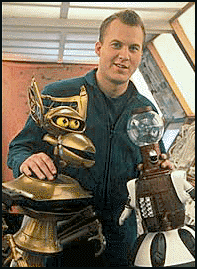
MikebotsIt was a sad day, seven years ago now, when Sci-Fi cancelled Mystery Science Theater 3000.

I was watching when Mike and the bots signed off for the last time, the credits rolled, and the haunting Love Theme From MST3K played.

Sniff.

What a great show that was. I and my college buddies had been doing the same thing in our living rooms for years (in fact, I can still annoy people riffing movies we’re watching on DVD), but this show did all the comedy work for you–so you don’t have to!

The show is too cool an idea to remain forever dormant, and it may someday make a return to the airwaves (or at least the coaxial cables).

And now the digital millennium has brought the show back! . . . almost.

In an age when TV show producers are producing podcast commentaries that you can download and listen to as you watch their shows, Mike Nelson and his pals got the idea of cutting out that expensive middleman–the TV network–and bringing their mstings straight to you!

The result is RiffTrax, a service where Mike–together with Kevin Murphy (Tom Servo) and Bill Corbett (Sci-Fi’s Crow "I’m Different!" T. Robot)–produce mp3 riff-laden commentaries that you can download and watch along with the corresponding DVD (sold separately).

They even have a few DVDs that contain the riff-track ON the DVD, including a version of one of the most-requested movies that they never got around to doing on the show: Plan 9 From Outer Space! I know I’m going to get that one.

I’m pleased as punch to see these guys (a) bringing back their hilarious movie commentaries and (b) finding a way to make some money again after all these years, so

CHECK IT OUT.
(CHT: Catholic Whiteboy)

Don’t know what we’re talking about? Missed out on all the fun?

GET EDJUMACATED.

Incidentally, Mike Nelson is an Evangelical who has a special interest in apologetics. I’ve exchanged e-mail with him before, and he seems like a real nice guy. Some of the other regulars from the show, such as Kevin Murphy and Mary Jo Pehl (Pearl Forrester) were Catholic, and Christian and Catholic themes often showed up in the commentaries (along with other, less mentionable material on occasion, but you know what Ludwig Wittgenstein said about things we can’t talk about).

Music Scruples: The Opus Continues

A reader writes:

I majoring in music and I oftentimes get sheet music in my
classes and private lessons.  Many of these are of a full song and sometimes
copied straight out of a book.  Some are modern songs that aren’t in public
domain.  I fear the teachers may not have gotten permission to use these but
I don’t know the law well enough to say whether it is fair use.  I know you
probably aren’t an expert on copyright, but being somewhat scrupulous, I’m
not sure how to go about doing my work while fearing that I could be
violating copyright.  I certainly don’t want to commit mortal sin just to do
my homework.  Should I bring it up whenever I feel it is a problem, or
should I just let the teachers worry about it?  May I just ignore it and
give extra to charity?  Any advice would be helpful.

I don’t have the background in civil law needed to answer the question of what civil law would say about this situation, so I’ll answer it primarily in terms of moral law, with the caveat that the moral law answer may clash with the civil law answer. If it does then it would be a matter of prudence as to whether you should follow the moral law answer in violation of civil law. As long as you’re doing what’s moral then, by definition, you’re morally safe, and it’s a question of whether you’re willing to take the risks associated with not following the civil law answer. (In this case–that of a student being given fishy sheet music by his teacher–I would say that the risks are small.)

Let’s start with whose responsibility it is to secure rights to the sheet music in question: It’s your teachers’. If they are violating copyright in their production of this material then that is fundamentally their responsibility, not yours. You are only involved to the extent that you are cooperating with the situation, and your cooperation looks to be remote and material only. Remote material cooperation can be morally legitimate when there is a proportionate reason, and your need to get an education is certainly a proportionate reason to go head and play what’s on some shady sheet music that your teacher puts before you (or sends home with you).

The situation of teacher and student is analogous to the situation of employer and employee. If, once you’re out in the workplace, your employer (let’s say it’s a symphony orchestra) puts fishy sheet music in front of you then your need to make a living is a proportionate reason to play what’s on it.

The same goes for people in other fields of employment whose bosses require them–as part of their work–to use things that they haven’t secured the rights to. For example, if you work in an office and your employer hasn’t gotten a software license for the copy of Microsoft Word that is on your computer then you go ahead and use the word processor. It’s your boss’s moral responsibility to get the license, not yours. Your need to earn a living is proportionate to the individual act of piracy that you are (at best) remotely cooperating with.

Of course, to the extent that prudence allows we should encourage our employers (or teachers) to obtain the needed rights or permissions, but our ability to do this prudently is often very limited. People can be denied pay raises or promotions or good grades if they come off as scrupulous troublemakers to their superiors. In extreme cases, they can even end up fired or failed. As a result, significant caution should be exercised in making the decision whether and how to address such matters.

In the case of courses taken at an academic institution, the professor (as opposed to the student) is very much in charge of the classroom, and I generally advise students to keep their heads down, not make trouble, get good grades, and then deal with the situation (if it’s worth dealing with) once one is an alumnus and can no longer be hurt by the institution. There are exceptions to this rule, of course, but erring on the side of caution is my general advice.

In the case of the private lessons you are taking, though, you may have more leeway. The student in such a setting may be in a better position to say, "Hey, why don’t we study this (non-problematic) material?"

One last bit of info, which pertains specifically to educational situations: U.S. copyright law includes fair use provision that allow for academic/educational use of limited amounts of copyrighted material. This is one reason, for example, that professors of various disciplines may make photocopies of individual journal articles or individual chapters of books and distribute them to their students via professor publishing.

At least in some settings this is allowed.

Whether it is allowed in the case of the sheet music you are being given, I couldn’t say–I don’t know enough about the provisions of civil law on this point or your own situation. Whatever the case might be, however, I would seek to avoid scrupling over this issue, and you would not have a moral obligation to give extra to charity, as revealing as that thought is about the good intentions you clearly have.

Pay No Attention To That Man Behind The Camera: Part Two

BillmoyersBill Moyers (left–and leftist) has long been regarded as one of the worst journalistic shills for the Democratic Party, pretending neutrality but in reality viciously slanting his coverage in favor of liberal causes.

And with good reason. As his Wikipedia entry notes:

Moyers’ frequent criticism of conservative policy has led conservative commentators like Brent Bozell to label him a liberal commentator rather than an objective journalist.

Moyers has drawn further allegations of bias in his role as president of the Schumann Center for Media and Democracy. In 2003 the center gave money to a variety of establishments which have been described as "left leaning," such as Sojourners magazine ($500,000), Salon.com ($277,785) and The Nation magazine ($115,000). After reviewing these donations David Horowitz’s conservative Discover the Network website has asserted that "Bill Moyers has dropped any pretense of objectivity". He has also been involved with the group Take Back America, an organization that seeks to help elect liberal political candidates.

I was interested, therefore, when E. Calvin Beisner of the Interfaith Stewardship Alliance told me that he would be on a recent episode of Moyers’ program "Moyers on America" that was devoted to environmentalism and titled "Is God Green?"

I was not surprised that he tried to smear Cal by selectively disclosing facts and selectively editing the interview he did with him. That’s par for the course with the MSM. What did surprise me was just how open Moyers was about his use of his journalism as a political tool to benefit liberal causes. In a recent ISA newsletter (not yet online, unfortunately), Cal writes (EXCERPTS):

The bias of Moyers’s program is not
surprising.
He forthrightly told me before our interviews that he, as a
liberal Democrat, hoped to use this program to divide the evangelical
vote and return control of Congress to the Democrats in November’s
elections.
The timing of the program’s release, therefore, is not
surprising.

The PBS program aired Wednesday, October 11. The full program, which included excerpts from an interview Moyers did with yours truly, can be viewed on PBS’s web site; the transcript is also available, as is the full transcript of his interview with me. Comparing the full transcript of his interview with me with what actually got into the program is an education in how to misrepresent someone by editing his on-camera comments.


What kind of selective presentation of information did Moyers make?

While Moyers mentioned that some think tanks that oppose the popular view receive some funding from fossil fuel industry sources (and, by the way, he did not mention that I received no compensation for my association with the Acton Institute or any other think tank–he just let the association of ideas do its job of making viewers think my views are bought off), he did not mention that the Evangelical Climate Initiative’s initial funding was a $475,000 grant from the Hewlett Foundation, which is a major supporter of abortion as a method of population control around the world, or the reasons why Hewlett links those concerns with global warming concerns.

[H]e left the appearance that this lonely little professor of historical theology and social ethics [Beisner] holds this view, along with a handful of contrarian scientists, all bought off by industry money, when in fact, as we document in our “Call to Truth,” the scientific community is quite divided on the issue.

You will also have noticed that Moyers very carefully avoided all discussion of the actual scientific evidence, asserting instead simply that a 2004 study of 928 scientific articles found unanimous consensus in favor of the manmade catastrophic warming hypothesis. What he didn’t tell viewers was that an attempt to replicate that study discovered very significant methodological errors in it that improperly excluded over 90 percent of the relevant literature and that even within the articles the study did survey,

* only 1 percent explicitly endorsed what study author Naomi Oreskes called the “consensus view”;

* 29 percent implicitly accepted it “but mainly focus[ed] on impact assessments of envisaged global climate change”;

* 8 percent focused on “mitigation”;

* 6 percent focused on methodological questions;

* 8 percent dealt “exclusively with paleo-climatological research unrelated to recent climate change”;

* 3 percent “reject[ed] or doubt[ed] the view that human activities are the main drivers of the ‘the [sic] observed warming over the last 50 years’”;

* 4 percent focused “on natural factors of global climate change”; and

* 42 percent did “not include any direct or indirect link or reference to human activities, CO2 or greenhouse gas emissions, let alone anthropogenic forcing of recent climate change.” {Benny J. Peiser, Letter to Science, January 4, 2005, submission ID: 56001.Science Associate Letters Editor Etta Kavanagh eventually decided against publishing the letter, or the shortened version of it provided at her request by Peiser, not because it was flawed but because “the basic points of your letter have already been widely dispersed over the internet” (e-mail from Etta Kavanagh to Benny Peiser, April 13, 2005). Peiser, a scientist at Liverpool John Moores University, replied: “As far as I am aware, neither the details nor the results of my analysis have been cited anywhere. In any case, don’t you feel that SCIENCE has an obligation to your readers to correct manifest errors? After all, these errors continue to be employed by activists, journalists and science organizations . . . . Are you not aware that most observers know only too well that there is absolutely *no* consensus within the scientific community about global warming science?” He went on to cite a survey of “some 500 climatologists [that] found that ‘a quarter of respondents still question whether human activity is responsible for the most recent climatic changes,” and other evidence. Peiser, e-mail to Kavanagh, April 14, 2005. The whole correspondence, including much more evidence of the lack of scientific consensus on anthropogenic global warming, and refutation of some attempts to debunk Peiser’s critique of Oreskes’s study, is online at www.staff.livjm.ac.uk/spsbpeis/Scienceletter.htm.}

When you think the data are on your side, you argue the data. When you don’t, you attack the person. That is what Moyers did, and that is what the supporters of the Evangelical Climate Initiative have done, consistently.

UPDATE: Mr. Moyers disputes Dr. Beisner’s account; PLEASE SEE THIS LINK.

Mr. Moyers sent an e-mail to Dr. Beisner stating the following:

From: Moyers, Bill
Sent: Tuesday, October 17, 2006 12:47 PM
To: [Dr. E. Calvin Beisner]
Subject: What has come over you?

You are not telling the truth. In fact, what you wrote in the ISA
newsletter is an outright lie. You claim that "When Moyers interviewed
me for the documentary last spring, he very candidly told me that he is
a liberal Democrat and intended for the documentary to influence the
November elections to bring control of Congress back to the Democrats."
I said nothing of the sort — nothing. To the contrary, I told you that
I am an independent – members of the crew remember my saying that to
you specifically (there were, remember, three other people in the
room.) You yourself taped the entire session with your own recorder;
show me where in the transcript such a conversation occurred. I also
told you, as I told everyone interviewed, that we of course could not
usethe entire interview but that I would post it on our Website when
the broadcast aired, as was done. If I had said anything approaching
what you claim I said, if you perceived any bias on my part. you could
have — and should have refused to participate. But you did participate
freely, you were treated fairly and honestly, and for you now to bear
false witness is not only unChristian but astonishing. What am I to
make of the many friendly emails you have sent over these months,
signed: "In Christ, Cal"? Or our exchange on how much I have enjoyed
your daughter’s CD that you sent? Your conservative evangelical
brothers who were also interviewed in the documentary – from Richard
Cizik to Tri Robinson to Allan Johnson (not a liberal among them) have
written in praise of how they were treated. You and you alone have
chosen to bear false witness to our conversation and to defame – in
your own words –the ethics and journalistic balance of the documentary.
You owe me arid my team an apology and a public retraction.

Bill
A Note Of Thanks

I just wanted to put up a note of thanks to all those who sent in Bible-related questions after my recent invitation for them–as well as those sending in questions on other topics.

So many folks responded that it’s taking me some time to work through the questions that were sent in, but I wanted to let you know that I’m still working on them and will let you know before your question goes up on the site.

Muchas gracias, mis amigos!

Catholic University Invites Member Of Babykilling Criminal Underground To Address Students

John over at Generations for Life writes:

I thought you might be interested in an entry I recently posted on the
Generations for Life blog.

Last week, Judith Arcana, a member of the group "Jane," which claimed to
have performed over 11,000 illegal abortions in Chicago in the years prior
to Roe v. Wade, spoke at Loyola University Chicago at the invitation of the
school’s Women’s Studies Department.

In the post, John quotes a former speech in which the babykiller explained how her underground murder syndicate worked:

Women joined the Service through periodic orientation meetings, and learned the necessary tasks from those who had come before them. Once their counseling skills had been developed in new recruits, and the group had come to trust them, they could learn more – doing everything from basic record keeping to becoming a medic, one who performed abortions.

Ultimately, we learned to do abortions in all three trimesters. Although we did only a handful in the third, as you may imagine, there were many in the second, no doubt because illegality forced women and girls to take so much time searching for abortionists and saving up money. The methods that we learned, we primarily learned from one man. He was not a doctor, but he was the best. Once we understood that many of the people doing abortions at that time were not doctors, we realized that we could do it too. This would mean women would not have to be charged a lot of money, could even come through the Service free.

So we pressed this man to teach us, as he had been taught. He was an extraordinary man in many ways, had been doing this work, and maybe other illegal work, virtually all of his life.

He also quotes her as saying

I performed abortions, I have had an abortion and I am in favor of women having abortions when we choose to do so. But we should never disregard the fact that being pregnant means there is a baby growing inside of a woman, a baby whose life is ended. We ought not to pretend this is not happening.

following which, he trenchantly notes

It’s bad enough when a Catholic university gives a platform to a pro-abortion politician or other public figure — that in itself is prohibited by the U. S. Catholic Bishops. Loyola, like so many other Catholic universities, has done that before.

But the fact that a Catholic university has given a platform to someone who actually facilitated abortions, has no regrets about having done so, and who, by her own admission, understands that abortion is the taking of a baby’s life — takes the word “scandal” to a whole new level.

Indeed!

GET THE STORY.

GodBlogCon 2006

GbcJust a note to let folks know that I’ll be attending and participating in the 2006 Godblog Conference or "GodBlogCon" being held later this month in the Los Angeles area.

The conference is devoted to the subject of religious blogging or "GodBlogs," and bigname participants include Hugh Hewitt and La Shawn Barber, as well as many others.

The convention runs from Thursday, October 26th to Saturday, October 28th and will be held on the campus of Biola University in La Mirada. (For those who may not know, Biola is a coined word meaning "Bible Institute of Los Angeles"–one of the most famous Chirstian schools on the West Coast and important in the history of American Evangelicalism.)

I’ll be participating in the panel "Briding the Christian Divide" on Friday morning at 9 a.m. along with co-panelists coming from Protestant and Orthodox traditions. Specifically, there’ll be

* John Shroeder (moderator; Blog: Blogotional)
* Joe Carter (Family Research Council; Blog: Evangelical Outpost)
* James Kushiner (Touchstone Magazine; Blog: Mere Comments)
* and myself

The purpose of the panel is to discuss how Christians of different traditions can and should interact as they promote the Christian faith through new media venues such as the blogosphere.

I’d really encourage anyone within spitting distance of L.A. to come to the event.

I’d also like to give a shot out to other Catholic bloggers and ask if they could consider promoting the event as well. The different Christian traditions need to work together to promote and preserve Christian culture in America and the world, and the new media tools that are becoming available will be central to that effort. The greater the participation of Catholics there can be in the event, the better for all.

MORE INFO ON THE CON HERE!

So I hope to see you there if you can possibly attend! If you need any further incentive to attend, just remind yourself: It’s what B16 would want you do to.

In The Mail

God_or_the_girl_1I just received a review copy of the DVD release of the A & E reality series "God or the Girl," which aired a piece back.

I didn’t see it when it aired, but it got very good reviews and was widely perceived as a thoughtful, responsible look at the issue of vocations discernment (despite its rather sensationalistic title), as exemplified by the experiences of several young men trying to discern whether they might be called to the priesthood.

A lot of folks in the Catholic community praised it, and now A & E Home Video has it out on DVD, along with new bonus features that were not part of the original broadcast.

If you’re interested but haven’t seen it, or if you have seen it and would like to again, or if you’d like to give it as a present to a young man discerning his own vocation, be sure to

GET
THE SERIES.