OTC Fat-Blocking Diet Pill
The Chillling Stars?
Abortion/Excommunication Mess
There are press reports about an Austrian bishop saying that a business owner who rented shopping mall space to an abortion clinic has excommunicated himself.
HERE’S JOHN ALLEN’S VERSION OF THE STORY.
Allen goes a bit too far when he says:
It’s long been a subject of debate whether more remote forms of cooperation, such as the contractor who builds a clinic, also trigger automatic excommunication.
Not that I’m aware of. Not in serious canonical circles.
The canon that provides automatic (latae sententiae) excommunication for abortion is this:
Can. 1398 A
person who procures a completed abortion incurs a latae sententiae
excommunication.
As phrased, that would strike only the person who has actually procured the abortion. However, canon 1329 also provides that:
§2. Accomplices who are not named in a law or
precept incur a latae sententiae penalty attached to a delict if without their
assistance the delict would not have been committed, and the penalty is of such
a nature that it can affect them; otherwise, they can be punished by ferendae
sententiae penalties.
The clause in blue allows not only the procurer of the abortion to be struck with automatic excommunication but also those directly involved in the abortion itself, such as the abortionist, the person who paid the money for the abortion, and possibly a few others (nurses, the person who drove the patient to the clinic). It does not apply to people whose cooperation is more remote and thus whose role might have been substituted for by someone else. At least, in the absence of an authentic interpretation to the contrary, it is doubtful whether the law applies to remote cooperators, which means that the following canon kicks in:
Can. 18 Laws which
establish a penalty, restrict the free exercise of rights, or contain an
exception from the law are subject to strict interpretation.
That means that in cases of doubt you have to give the benefit of the doubt to the person who would be struck by a penalty.
Since the cooperation of a person who rents space to a "sexual health clinic" that performs abortions is only remotely involved (like the people who supply electric power and gas and who stamp the legal forms at city hall and to handle the clinic’s money at the bank, and who provide cleaners, and who provide medical supplies), you can’t–as the law presently stands–say that these people are automatically excommunicated.
The green CLSA commentary on the Code concurs:
A properly strict interpretation means that the canon applies primarily to those directly participating in the abortion, not those removed from such participation [p. 1603, n. 308].
If a bishop with the proper jurisdiction over the shopping mall owner concludes that the owner is gravely at fault for renting space to the clinic (an extremely resonable conclusion) then he could declare an excommunication (ferendae sententiae), but it would not be an automatic (latae sententiae) excommunication.
My sense on this is that the Austrian bishop (apparently an auxiliary of Cardinal Shonborn) simply misspoke, which is why Cardinal Schonborn hasn’t backed him up.
In any event, the press reports on this are a mess.
MORE FROM ED PETERS.
The Our Father In Aramaic
Yesterday there was a caller on the show who wanted to know about finding the Our Father in Aramaic. I mentioned that it’s found in the Pshitta, an Aramaic translation of Scripture, and it’s also available online. Unfortunately, the address of the site I had was too long, so I promised to put it up on the blog this morning.
Unfortunately, after the show, a closer inspection of the site showed it to be kooky to the extreme. The translation they gave of the Aramaic into English was completely wrong, so I decided just to print the text of the Lord’s Prayer in Aramaic.
First, though, here’s an audio file of it (.wav format):
After doing a little digging around, I found the following nice image, which contains the prayer in English and the Aramaic alphabet, with an Aramaic pronounciation also. Bear in mind that the English and the Aramaic pronunciation runs left-to-right, while the Aramaic script itself runs right-to-left.
Also bear in mind that the pronunciation the prayer is given in Aramaic will vary from one group of speakers to another, based on accent. For example, the first word of the Lord’s prayer in Aramaic is Abun, which will be pronounced by some groups as "Ah-boon," others as "Ah-woon," and still others (as in the transliteration below) as "Ah-voon."
Click to enlarge.
One word of warning about the above: What’s on the Aramaic transliteration line doesn’t always match up to exactly what’s on the English line. Because of word division and length, the lines don’t match up exactly. For example, on the third line from the bottom in the Aramaic column, you’ll see the word Malkutha ("Mal-koo-tha"), which means "Kingdom," but Kingdom is on the fourth line from the bottom in the English column.
I can’t go through the whole prayer line by line right now, but some folks might find it interesting to understand a little of how the language works.
The prayer is often called the Abun Dbashmaya in Aramaic, which are its first two words. This is similar to the way we call it the Our Father after it’s first two words. But in Aramaic "Abun Dbashmaya" means more than just "Our Father."
The "Our Father" part of it is just the first word: Abun. As you know, one of the Aramaic words for "father" (there are actually several variants) is Abba, which is just spelled ABA in Aramaic (it being understood that the B reduplicates in pronunciation).
In Aramaic, pronouns often take the form of suffixes on the ends of words, and the suffix -un is a pronoun suffix that means "our." When you stick -un on Abba, you get "Abun," meaning "Our Father."
The Aramaic word for "heaven" is shmaya, and you can see that in the second word of the prayer. The prefix b- (sometimes followed by a vowel, sometimes not) is the Aramaic equivalent of "in" (remember the in/on discussion we had recently?), so bashmaya means "in heaven." And the prefix d- is the Aramaic equivalent of "who," "which," or "that." Dbashmaya thus means "who (is) in heaven." (Aramaic sometimes omits the verb "to be," as it does here.)
Thus you can see how "Abun dbashmaya" translates as "Our Father, who art in heaven."
Cool, huh?


Podcast: Play in new window | Download
Undying Love
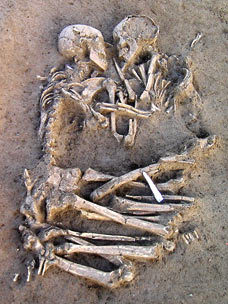 You’ve gotta admire ’em!
The picture to the left depicts the skeletons of a pair of lovers who died 5,000 years ago (3,000 B.C.) in Mantua, Italy.
Their tenderness is obvious.
This couple wasn’t buried in a volcanic explosion like that of Pompeii (which happend in the 1st century A.D.). It seems that the man (left) was killed or mortally wounded first and the woman (right) lay down beside him, knowing that she would be killed as well.
Sad!
But a tribute to human love.
I find archaeologists saying how "excited" they are by this find a little morbid.
I’d suggest, instead, praying for their souls.
Lovers like that deserve that much.
GET THE STORY.
Apple Vs. DRM?
If true, then
HERE’S STEVE JOBS’ ORIGINAL ESSAY.
EXCERPT:
Imagine a world where every online store sells DRM-free music encoded in open licensable formats. In such a world, any player can play music purchased from any store, and any store can sell music which is playable on all players. This is clearly the best alternative for consumers, and Apple would embrace it in a heartbeat. If the big four music companies would license Apple their music without the requirement that it be protected with a DRM, we would switch to selling only DRM-free music on our iTunes store. Every iPod ever made will play this DRM-free music.
Why would the big four music companies agree to let Apple and others distribute their music without using DRM systems to protect it? The simplest answer is because DRMs haven’t worked, and may never work, to halt music piracy. Though the big four music companies require that all their music sold online be protected with DRMs, these same music companies continue to sell billions of CDs a year which contain completely unprotected music. That’s right! No DRM system was ever developed for the CD, so all the music distributed on CDs can be easily uploaded to the Internet, then (illegally) downloaded and played on any computer or player.
In 2006, under 2 billion DRM-protected songs were sold worldwide by online stores, while over 20 billion songs were sold completely DRM-free and unprotected on CDs by the music companies themselves. The music companies sell the vast majority of their music DRM-free, and show no signs of changing this behavior, since the overwhelming majority of their revenues depend on selling CDs which must play in CD players that support no DRM system.
So if the music companies are selling over 90 percent of their music DRM-free, what benefits do they get from selling the remaining small percentage of their music encumbered with a DRM system? There appear to be none. If anything, the technical expertise and overhead required to create, operate and update a DRM system has limited the number of participants selling DRM protected music. If such requirements were removed, the music industry might experience an influx of new companies willing to invest in innovative new stores and players. This can only be seen as a positive by the music companies.
Canon Law Or Catechism?
A reader writes:
I wanted to comment on this section [i.e., Marriages in Church] but did not want to contradict what you have stated.
Don’t worry about contradicting me. That wasn’t a Rule 20 post, so there was no "e-mail me if you want to object to my answer" rule in effect.
I do have a question, why did you cite the Cannon Law and not the Catechism also?
CCC 1621 – 1624 give a good idea of where we are obliged to get married and why.
We, ordinary lay people, do not have access to the Cannon Law nor do we always understand it.
Why didn’t you include the CCC in your answer?
Well, the truth is that I was writing late at night and didn’t think to look in the Catechism, but there’s a deeper reason than that.
Part of my philosophy is going straight to the source documents
whenever possible. That’s why I quote from these documents regularly
when I’m writing and thus "show my work" (as my math teacher used to
insist), rather than simply giving the answer and expecting the reader
to just trust me. I’ve seen a lot of people–particularly clerics and professors–just say "This is the way it is" without giving the questioner a way to follow-up on the answer and verify that it’s correct.
I don’t have a clerical collar–or even a degree in the relevant fields–and so I have no institution endorsing my answers (particularly when I’m writing here on my blog). They have to stand or fall on their own merits, and it’s a lot easier on me–and builds confidence on the part of the reader–if I simply quote the relevant documents up front so that the reader can see for himself what they say. He is then in a position, or a better position, to evaluate whether the answer I am drawing from them is correct. It’s part of how I try to build and maintain a reputation for accuracy and reliability.
This approach means that I need to cite the most relevant, most authoritative documents I can, and in the case of the legal obligation of Catholics to celebrate sacramental marriages in Catholic churches, the most relevant and authoritative document is the Code of Canon Law. It is this document that creates the obligation in the first place.
It’s true that the Catechism is more familiar to most readers, but it is not a legal document and does not create legal obligations for the faithful. Instead, it is a teaching document that is meant to impart doctrine.
I thus cite the Catechism when I’m handling doctrinal questions, and I cite the Code when I’m handling legal questions.
Sometimes I provide links to the source documents on the Vatican’s website, though these two documents are so well-known and so often-quoted on my blog that I often assume that readers will know how to get to them if they want to look up the context of the parts I’ve quoted. That may be a bad assumption on my part–particularly in regard to new visitors to the blog–but I already spend more time than I should on the blog, and not adding a link to these two documents every time I quote them is an extra time-saving step for me.
This is probably a good place to link to them, though, so new readers will have a jumping-on point, so:
and
And as an added bonus,
So–in keeping with my time limits–once I’ve identified the most relevant and authoritative documents to quote, I just use them and don’t generally have the luxury of quoting other documents in addition (something that would only cause my blog posts to expand beyond their current lengthy lengthiness anyway).
Thus I didn’t bother looking in the Catechism.
Had I done so, I might not have quoted CCC 1621-1624 in my answer, anyway. Of these paragraphs, the most relevant one is 1621, but it has some limitations in addressing the question. First, it only addresses the custom in the Latin Rite. That’s not too much of a limitation, though, since the person asking why marriages are celebrated in churches likely had the Latin Rite’s practice in mind. Second, and more significantly, the paragraph doesn’t really talk about why Latin Rite marriages are celebrated in churches. It talks about why they are celebrated (normally) in Masses.
If I used this as the basis of my answer, I wouldn’t have dealt with the situations of marriages which aren’t celebrated during Mass but nevertheless are celebrated in Catholic churches, and I wouldn’t have been able to appeal to the fact that the relevant canon in the Code of Canon Law draws a distinction between sacramental and non-sacramental marriages (which is highly important to answering the original question) since the Catechism doesn’t go into that.
I also would have had to extend the discussion by sketching the chain between normally having weddings during Mass and normally having Masses in churches. It was just a lot simpler to go straight for the spot in the Code where it says you’ve normally got to have sacramental marriages celebrated in churches.
That being said, CCC 1621 can shed extra light on the reasoning behind the law, and it’s worth looking at in that regard–as additional insight on the law, but not as law itself or as an exhaustive answer on the reasoning behind the law.
Hope this helps!
“On/In Earth As It Is In Heaven”
A reader writes:
I’m on the RCIA team for my parish, and this past week, a gentleman asked me if I could find out something for him about the Our Father. His mother says the line above as "in earth as it is in heaven" and he said she told him that’s how it used to be or that was how her translation of the Bible had it. I asked him what denomination she was, and he said just a regular Protestant, non-denominational.
I’ve tried checking out a few sites with different Bible translations and have not found any that say "in" earth. Wondered if you had any historical information as to this question.
This man is very very interested and knowledgeable about the Faith and is very much looking forward to the Easter Vigil and coming into the Church. I suspect he may be getting a little grief from his family, and the poor man is aggravated by, as he puts it, "a one letter difference," so I told him I would try to find out for him.
Your friend may be right that his mother is getting this from her ordinary translation of the New Testament. Many groups of Protestants still use the King James Version of Scripture as their ordinary translation, and in this translation it does read "in earth as it is in heaven" (SOURCE). So that’s likely where this is coming from.
As to the reasonability of the "on"/"in" translation, this comes from the Greek of the text. In the Greek New Testament, there is a difference in the prepositions that are present in the two phrases. The "earth" phrase is introduced by the preposition epi, which would naturally be rendered by "on," "upon" or something like that, while the "heaven" phrase is introduced by the preposition en, which would naturally be rendered by "in." So there is a distinction in the Greek between the two phrases.
The image that is conveyed by the Greek prepositions seems to be one in which the person saying the prayer is located on earth, which is below the heaven where God’s will is performed perfectly. We’re thus asking that his will be done on earth (i.e., down here) the way it is up there (i.e., in heaven).
This seems to be what the Greek translator has in mind, informing the English language translation, though if we want to trace this all the way back to its rootes, we have to go into the Aramaic.
Here we find something different.
It’s always hard to translate prepositions from one language to another, because prepositions can mean a variety of things, and their meanings don’t perfectly overlap from one language to another. That’s a problem that happens with all words, but it particularly happens with prepositions.
If we look at common Aramaic versions of the Our Father (LIKE THIS ONE), we find that the preposition introducing both the "earth" phrase and the "heaven" phrase is b-, giving us bish-maya ("in/on heaven") and b’ar-ah ("in/on earth").
The distinction between the two thus likely wasn’t there in the original Aramaic of this prayer. Jesus probably said b-heaven and b-earth, which could be translated "in heaven" or "on heaven" and "in earth" or "on earth." It was up to the translator to decide what was best.
The Greek translator decided that–in Greek–it sounded more natural to say "in (en) heaven" and "on (epi) earth," and many English translators looking at the Greek have decided similarly, leading to the standard English translation of the Lord’s Prayer. The translators of the King James Version seem to have decided differently, rendering the preposition as "in" in both cases.
But this is not an essential point. It’s a matter of translation (specifically, a matter of English translation that does not apply to other languages), and I suspect that your friend’s difficulties with his family may involve weightier matters in the end.
Still, let’s keep him–and them–in prayer.
Marriages In Church
A reader writes:
I’ve been looking for a really solid explanation of why Catholic weddings are ordinarily required to be in a Church. I have many friends that often ask me this question, but sadly I think my answers are not as good as they could be. Obviously, having a wedding in a Church emphasizes the sacramentality thereof, and it is a testimony to the faith community’s part in the couple’s life.
Thank you for your assistance.
There are two ways to approach the answer to this question. The first is the canonical approach. Catholic weddings are ordinarily celebrated in a church because the Code of Canon Law provides the following:
Can. 1118 §1. A marriage between Catholics or between a Catholic party and a non-Catholic baptized party is to be celebrated in a parish church. It can be celebrated in another church or oratory with the permission of the local ordinary or pastor.
§2. The local ordinary can permit a marriage to be celebrated in another suitable place.
§3. A marriage between a Catholic party and a non-baptized party can be celebrated in a church or in another suitable place.
Since most Catholics are either marrying other Catholics or baptized non-Catholics, section 1 applies, which indicates that the marriage is to be celebrated in a parish church unless the local ordinary (typically the bishop) or the pastor gives permission for it to be celebrated in another church or oratory (meaning, due to another canon we won’t go into, another Catholic church or oratory).
At first glance, the canonical answer may not seem that enlightening: "Catholic weddings are normally held in Catholic churches because that’s what the law says." Big deal. We probably could have guessed that, and the reader is likely wanting an answer from the other perspective, which is why does the law say this? What’s the reason for the law?
Here is where a close reading of the canon is helpful. It’s always at least a little risky to speculate on the motives behind the law, but the structure of this canon gives us a pretty clear indication of the reason for the law, and it indicates that the reader is on the right track.
If one party is Catholic and the other is either Catholic or another Christian then section 1 wants to locate the ceremony in a Catholic church or oratory, though with permission of the local ordinary it can be celebrated in another suitable place (such as a Protestant’s home church if the Catholic is marrying a Protestant), according to section 2.
The permission of the local ordinary goes out the window, though, if the Catholic is marrying a non-baptized (i.e., non-Christian) person. In that case it can happen in a Catholic church or in any suitable place, no permissions needed.
This suggests that there is a difference between the marriages of Catholics to other baptized people (Catholic or not) and the marriages of Catholics to non-baptized people. In the former case, sections 1 and 2 apply. In the latter case, section 3 applies.
Since all Catholics are baptized, that means that this canon draws a distinction between marriages that occur between two baptized people (sections 1 and 2) and marriages that don’t occur between two baptized people (section 3).
Now: What’s the big difference between marriages between two baptized people and marriages that aren’t between two baptized people?
That’s right: The former are sacramental and the latter are not.
So the reader is on the right track in identifying the sacramentality of the marriage as the key issue.
I’d be inclined to put it like this: Marriage between baptized persons is a sacrament, and sacraments are normally performed in church. To a significant extent, that’s what churches are for. They’re the places we (ordinarily) perform our sacraments.The reasons for this seem to be twofold:
1) Churches are places specially consecrated to God, making them sacred, and sacraments are sacred actions, making it natural to perform them in churches.
2) Sacraments are also ecclesial (church-related) acts, and it is thus natural to perform them in the presence of the church when possible. Churches (considered as buildings) are places where the church (considred as people) meets, and so it is natural to perform ecclesial acts in the presence of the members of the church in the house in which they meet.
There are exceptions to this. In some cases there is a good reason to vary from the practice. For example, sick people often can’t get to church, so the anointing of the sick is often administered to them where they are. But in the main, the two above reasons are good reasons why sacraments–including marriage–are normally performed in churches.
It doesn’t have to be that way, which is why canon law allows exceptions, but it is fitting that it be this way, which is why canon law establishes this preference.
As the green CLSA commentary on the Code of Canon Law puts it:
Since the marriages of two baptized persons are sacraments, they are not merely private or familial celebrations, they are ecclesial events. The spouses declare their consent "before God and the Church" and live out that commitment in and with the support of the local ecclesial community. It is, therefore, fitting that this celebration should take place in the parish church. It is here that the local community is "gathered together by the preaching of the Gospel of Christ, and the mystery of the Lord’s supper is celebrated, ‘so that the whole fellowship is joined together by the flesh and blood of the Lord’s body’"[p. 1337].