Mea Culpa, Mea Culpa, Mea Maxima Culpa

I'd like to make a quick apology for not blogging recently. I've had a lot going on (including a bout of food poisoning last night–ick!–when I was otherwise planning to blog), and I haven't been able to get to it.

So . . . my apologies.

And I'll keep this short so that I can now–immediately–proceed to putting up a post of substance.

Say WHAAAAT?

(Cross-posted on The League of Bearded Catholics blog)

Hello, is this thing on?

*Harrumph*… perhaps I was busy trimming my beard, or maybe my nose hair (which requires far greater concentration), but I seem to have completely missed out on any national conversation or debate over this, which I'm sure must have been vocal and abundant.  Far be it that anyone should get all worked up over such a trivial matter, but in looking over the instructions for the IRS Form 1040, I recently found the following;

Expiring tax benefits.

The following benefits are scheduled to expire and will not be available for 2010.

The exclusion from income of qualified charitable distributions


Tax-deductible charitable contributions are… just gone? In the words of my old Building-and-Loan pal, George Bailey… "Do you realize what this means?"

Did I read this wrong? Am I dreaming?

UPDATE: So, a couple of knowledgable commenters have pointed out that, unlike the "charitable tax deduction", the "exclusion from income" is limited to direct contributions of things like IRAs to charitiy. So, a follow up question: how will this affect charities and donors? How greatly do charitable organizations count on this sort of funding?

Thanks for the combox clarification, by the way. It doesn;t sound as dire as I had imagined.

“My Sisters and Brothers . . . “

My parish has been having visiting priests recently, and two of them have had the unfortunate habit of addressing the congregation by saying, “My sisters and brothers . . . “

To my mind, this is just sad.

It comes off something like a parent being overly chummy with the young ‘uns by trying (and failing) to use the latest teen-lingo and sounding out of touch instead.

Let’s talk about the alternatives.

1) “Brethren” – This has been the standard way of addressing mix-gender religious congregations in English for the last several million years.

It sounds formal, but natural—which is what you want. Something elevated in tone in keeping with the religious nature of the gathering, but not something that’s going to pop out to the listener as an unnatural or forced expression, which would cause the listener to pop out of the worship experience and start thinking about how you are using language rather than what you are using language to say.

While “brethren” did originally mean “brothers” (not like that’s a bad thing), the term is no longer in colloquial use and people don’t parse it to mean “brothers.” They know without having to stop to think about it that everybody is included.

2) “Brothers” – This is the contemporary equivalent of “brethren.” It sounds less formal, but the term is more likely to be taken as exclusive of women. In some Christian churches they use this word without any problem, but in the contemporary Catholic parish there is likely to be enough political correctness to make an alternative desirable.

3) “My brothers and sisters” – This is the common alternative that gets used. It even gets used by the pope. Given the gender-sensitivities that exist these days, I can deal with this one, although it’s a shame that people have given up so quickly on the virtually ideal term “brethren.”

The one place I absolutely hate “my brothers and sisters,” though, is in Scripture readings. I’m sorry, but Greek had a way to say “sisters,” and St. Paul could have effortlessly written his epistles saying “adelphoi kai adelphai” if he wanted to. To translate “adelphoi” as “brothers and sisters” is inaccurate. Further, it allows political correctness to intrude upon and “correct” the word of God.

Any of these, though, are preferable to “my sisters and brothers.”

Why?

Because communities use conventional modes of expression for a reason: They let people to focus on meaning rather than having to pause to ponder the mode of expression. Further, using the community’s norms of speech signals an acceptance of the community’s values and beliefs.

To take phrase like “brothers and sisters” and deliberately invert it signals a rejection, on some level, of the community’s traditional way of handling gender issues.

No doubt priests who do this are trying to show sensitivity and inclusiveness to women, but what they actually do tickle the ears of certain people (of both genders) while sending an “I reject your values” message to everybody else (of both genders).

They also force worshippers to pop out of the worship experience and focus on the words being used rather than the message being conveyed. And they needlessly intrude gender politics on the act of worship.

That’s just sad.

Filed under gender, language, liturgy, political correctness

Agca: Lord, Liar, or . . . Lunatic?

Would-be papal assassin Mehmet Ali Agca has been released from prison in Turkey. (Note to World: Bad idea.)

He’s got big plans. He wants several million dollars to tell his story. He wants to visit John Paul II’s tomb. He’d like to write a book with Dan Brown. He may help hunt down Osama bin Laden. Oh, and he says he’s Christ.

According to news reports:

As Agca made his way through a media throng to check into a five star hotel after his release, the 52-year-old declared: “I proclaim the end of the world.”

“All the world will be destroyed in this century. Every human being will die in this century.

“I am not God and I am not the son of God. I am the Christ Eternal.” [SOURCE.]

And he says the gospel is full of mistakes and he’s going to write the perfect gospel to correct matters.

As the Church Lady would say, “Well. . . . Isn’t that ‘special.’”

He’s certainly on a different tack than he was last May, when he said that he had converted to Catholicism and wanted to be baptized at the Vatican. From mere follower of Christ to Christ Eternal. Hmmm!

Still, this is one of those situations in which a person makes such extraordinary claims that, per C. S. Lewis, one must either reckon him Lord, a liar, or a lunatic.

So which is it?

Given that we’ve been given prior warning about how Christ’s Second Coming will occur, he’s not the Lord. (But guess what one of the “mistakes” he will correct with his new gospel will be.)

Given the mental examination he was given after his release, as well as his long history of making outlandish statements, it’s easy to simply label him a lunatic and move on.

And he may well simply be a lunatic. That’s certainly how things appear.

But for a moment, consider the remaining alternative: That he might be a liar. I’m not charging him with this. I’m just curious. Not every person who appears mad is mad. Some feign it. Ask King David.

If that’s the case with Acga, why would he be doing it?

Financial gain? Perhaps. Maybe he wants to start his own religion. On its face, that’s what his remarks suggest.

But maybe there’s something else going on here, too. He’s made so many conflicting statements over the years, including whether he acted alone or as part of a conspiracy, that his credibility with anything he says is basically nil.

Perhaps that’s by design. Perhaps it’s a defense technique. If his 1981 assassination attempt was put in motion by forces behind the Iron Curtain (as I assume it was, and as the Third Secret of Fatima would suggest) then he might want to deliberately destroy his own credibility—come off as a madman—so that he would not be perceived of as a potential threat to those same forces and thus not become a target for elimination.

Just a thought.

MORE ON AGCA.

Discussion, anybody?


Filed under fatima, john paul ii, mehmet ali agca

“Hey, Your Worship. I’m Only Trying To Help” (Part II)

In a previous post, I discussed how the word “worship” can cause confusion regarding whether Catholics worship saints, angels, etc.
The term “worship” originally just meant worthiness or honor, and in the old sense anytime you honored or signaled the worthiness of someone (or something), it was an act of worship.
But in contemporary English, the term “worship” has come to mean the honor due to God alone, and if you try using it any other way (without a lot of set-up), you’re going to get confusion.
So people should not get hung up about old uses of the word that they find in old books or—now—on web pages quoting old books. The term has changed its everyday meaning, and we need to look deeper if we want to get to the substance of the discussion.
St. Paul tells us: “Stop disputing about words. This serves no useful purpose since it harms those who listen” (2 Tim. 2:14).
In this discussion, the underlying issue is what honor should be paid to whom.
Only the most closed-minded individual would assert that we should only honor God. Scripture is replete with examples, counsels, and commandments showing we should honor others; for example, our parents, our rulers. People of good will should be able to agree on this.
We also should be able to agree that there is a difference between the type of honor that we should show God and the types of honor we should show any creature.
This distinction, at least back to the time of St. Augustine, has been expressed with the terms latria (commonly translated “adoration”) and dulia (commonly translated “veneration”)—latria referring to the honor due to God and dulia referring to the kind of honor due to creatures.
It seems to me that people of good will should be open to this, since it is only a way naming a distinction we both agree exists.
Where might we disagree?
One place is over a companion term—hyperdulia—which signifies the special honor shown to the Virgin Mary, which is above (huper-) the honor shown to ordinary saints. Christians of good will should be able to agree that Mary, as the Mother of Christ, should be shown a special honor (Luke 1:28, 42, 48). The question would be what kind of special honor, and here Christians will have different views depending on the understanding of Mary presented in their churches.
Another place we may disagree concerns what external actions should be used to show honor. That is a subject I can write about another time if people want. But external actions are symbols of inner attitudes, and symbols can be used different ways. (Think of all the things a kiss can signify, as when Leia kisses Luke “for luck,” Han kisses Leia romantically, or Judas kisses Jesus as a sign to his enemies.)
What is ultimately important is what the symbol is used to signify, and here the Catholic Church is clear: God must be paid a special honor different not only in degree but in kind from the honor that can be shown to any creature.
READ IT FOR YOURSELF (Paragraphs 2096 and 2097).
AND ALSO HERE (Paragraphs 2112-2114).

Filed under adoration, dulia, latria, mary, saints, veneration, worship

Non-News Is Good News?

Previously in Hello World, I discussed Pope Benedict’s homily in which he pointed out that the last 200 years has seen a great deal of theological and biblical scholarship that, while it has uncovered interesting things, fundamentally misses the point.

Much of this scholarship has been devoted to a skeptical reading of the Scriptures with an intent to discredit them—for example, by arguing that they were written long after the events they record and therefore are unreliable.

Both the books of the Old Testament and the New Testament were assigned late dates to facilitate this claim, but discoveries in the last century have pushed the dates earlier than the skeptics proposed, back toward more traditional dates.

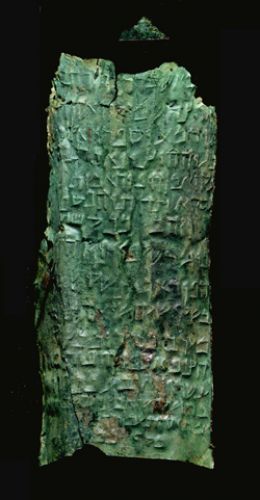
Now comes a story at Fox News and Haaretz concerning a small inscription said to overturn a key plank in the late dating of the Old Testament.

Haaretz reports:

“Did the writing of the Bible begin as far back as the 10th century B.C.E., during the time of King David? That is four centuries earlier than Biblical scholars currently believe – but an inscription recently deciphered by a scholar at Haifa University indicates that for at least some books of the Bible, the answer may be yes. . . .

“[Prof. Gershon] Galil said this discovery disproves the current theory, which holds that the Bible could not have been written before the 6th century B.C.E., because Hebrew writing did not exist until then.

“Moreover, he added, the inscription was found in what was then a minor, outlying community – so if scribes existed even there, Hebrew writing was probably sufficiently well developed to handle a complex text like the Bible.”

So now religious conservatives can take comfort that archaeology has once again thwarted the foes of Scripture.

Not exactly.

Something very bizarre is going on with this story. The first sentences are every bit as problematic as a piece opening: “Is the Pope Catholic? Current scholars believe he is the head of the Baptist church, but new evidence points in a Catholic direction.”

Scholarly consensus, even among liberal scholars, does not hold that “the writing of the Bible beg[a]n” in the sixth century B.C. Many may hold that certain books did not reach their present form until that time, or that particular books were not written until then, but the consensus is not that nothing had been written before then.

Much less is it claimed that the Bible couldn’t have been written prior to that time because of the supposed non-existence of Hebrew writing. The Ancient Near East had lots of writing systems, and sometimes people from one culture borrowed the writing system of another. In fact, that’s how the Hebrew alphabet arose.

The discovery of a Hebrew inscription from the tenth century B.C. also isn’t revolutionary, because we already have Hebrew writing from that period, such as the Gezer Calendar.

Either the newspapers are getting it wrong or Prof. Galil is miscommunicating or—since we’re dealing with an ink on clay inscription—there might be archaeological fraud in play.

This is a non-news story, either on grounds of it being hopelessly garbled or on grounds that we already knew of tenth century Hebrew writing.

FOX VERSION.

HAARETZ VERSION.

Filed under archaeology, bible, israel, news, old testament

Strange Fluffy Snow Cylinders

In his novella At the Mountains of Madness, which is set in Antarctica, H. P. Lovecraft's narrator at one point writes:

The newspapers have printed the bulletins we sent from the moving plane, telling of our nonstop course, our two battles with treacherous upper-air gales, our glimpse of the broken surface where Lake had sunk his mid-journey shaft three days before, and our sight of a group of those strange fluffy snow cylinders noted by Amundsen and Byrd as rolling in the wind across the endless leagues of frozen plateau.

This reference to rolling snow cylinders intrigued me, and I imagine that in Lovecraft's research for the story he did turn up references to them in reports by polar explorers Amundsen and Byrd, but Googling the phenomenon did not turn up any hits–at least back when I did the search, with the search terms I had.

So I was very interested to see a story about the phenomenon in The Telegraph reporting that it also occurs in the U.K.–and in North America for that matter.

The article came complete with pictures, so . . . behold!

Snow_cylinders
Snow_cylinder2
I just hope that the appearance of these snow cylinders in the U.K. and North America don't indicate a parallel appearance of shoggoths.

GET THE STORY.

Doing the Math

Over at CatholicCulture, Uncle Di has an interesting post about conflicting poll numbers in Massachusetts concerning which candidate is likely to win Ted Kennedy's former seat. 

He writes:

Last week, a Boston Globe poll of likely voters show the Democratic candidate, Martha Coakley, leading the Republican, Scott Brown, by a comfortable margin: 50- 35%.

A Public Policy Polling survey of likely voters, released the same day, showed Brown ahead, 48- 47%.

The Globe poll claimed a margin of error of +/- 4.2%; the PPP poll said its margin of error was 3.6%. Go ahead: try the numbers. They don't work.

Wait; there's a possible explanation. The Globe poll was taken January 2- 6; the PPP poll was January 7-9. So you might say that as a Little Christmas gift, Scott Brown got 13% of the likely voters.

Alternatively, you might say that there's a margin of error to the pollsters' margin of error.

Di is exactly right that there is a "margin of error" to the pollsters' margin of error–a margin that pollsters very seldom talk about.

What pollsters mean when they say that a poll has a margin of error of 4 percentage points (or whatever number) it does not mean that the true figure is really within 4 percentage points of the figure they name. They have no independent way of knowing what the true figure is. All they can do is estimate what the true figure is based on the sample of data they got.

But sometimes you get unrepresentative data, which is what the margin for error is supposed to allow for. It's a fudge factor that means, in essence, if we ran the same poll a bunch of times, the result would vary but would tend to remain within the stated margin of error.

Yet sometimes you get really unrepresentative data, and this is what pollsters don't generally point out.

In standard polling, the margin of error is based on what the result would be approximately 95% of the time, or nineteen out of twenty times. ( . . . keeping this simple so we don't have to get into standard deviations and normal distribution and confidence intervals and other technical minutiae).

So, for example, if pollsters went out and polled the right number of people to give them a 4 percent margin of error, and 48 percent of the people said that they'd vote for Candidate X then what this means is that if you re-ran the poll that nineteen out of twenty times the result you would get back should be between 44 and 52 percent, all else being equal.

But one time out of twenty the result you would get back would be wildly off, either below 44 or above 52.

So . . . bear that in mind when looking at poll numbers.

Even when the poll is properly done, one in twenty polls produces a reading so anomalous that it falls outside what the margin of error would be if you ran it another nineteen times.

On average.

We think.

Decent Films Doings: The Reluctant Saint on DVD

Good news for Catholic movie fans! The Reluctant Saint, starring Maximilian Schell as Saint Joseph of Cupertino, comes to DVD next week from Ignatius Press. (A previous DVD edition from Nostalgia Video is out of print. You can still get it on VHS — for $45 at Amazon. The new IP DVD sells at Amazon for $19.95. What’s more, the VHS edition lops off the coda, a real crime in my opinion. Don’t know about the previous DVD ed.)

My essay on the the film

I first saw The Reluctant Saint something like 18 years ago in Philadelphia with a group of friends who met regularly for Catholic movie nights — a formative time in my life as a new Catholic.

I enjoyed it at the time, but on rewatching it recently I found it to be a more sensitive and enjoyable film than I remembered. Films can surprise you when you haven’t seen them in a long time; sometimes they disappoint you, but other times the opposite happens.

Among other things, I appreciated the film’s beauty more than I did nearly two decades ago. Perhaps that’s partly because I saw it this time on a new DVD transfer rather than VHS, but I think it’s also because in 18 years I’ve seen a lot more movies and learned to appreciate beauty in a new way. 

I also have a new appreciation for the film’s spiritual milieu. Looking back today, I can’t be sure, but I suspect that in those days I may have judged all saint movies by A Man for All Seasons. The Reluctant Saint is a very different kind of film. I don’t know if anyone else has connected it to Rossellini’s The Flowers of Saint Francis, but I think there is a connection to be made, and I talk about that in my essay.

Has anyone else seen this film? (It doesn’t seem to have gotten a lot of attention outside Catholic circles.) What do you think of it?

Anyone else had that experience of revisiting a film after a bunch of years and being surprised, either positively or negatively?

More on The Reluctant Saint

Big Doings at Decent Films! Plus: St. Lucy Nativity

Well, here’s one big reason why I’ve been missing in action here at JA.o: I’ve been hard at work on the latest renovation of the Decent Films Guide. It just went live this Sunday.

There are a lot of things about the new Decent Films site that I’m excited about, but you can read about ’em at the Decent Films Blog. (Yes, Decent Films Blog!) OTOH, if you want to comment on the changes at the new site, you can do it here at JA.o (no blog post comments at Decent Films).

BTW, for my second Decent Films Blog entry, I posted a video that I shot a few days ago on my iPhone at St. Lucy’s Church in Newark, NJ, where my family sometimes attends weekday Masses. You can read more about the video and the subject matter at the blog, but the subject matter is worth cross-posting here for anyone who may not click over. Enjoy!