
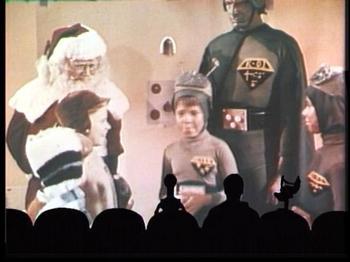
SANTA CLAUS CONQUERS THE MARTIANS . . . MST3K STYLE!
Funniest Christmas episode of any series . . . ever!
SANTA CLAUS CONQUERS THE MARTIANS . . . MST3K STYLE!
Funniest Christmas episode of any series . . . ever!
What is it with people who make DVDs?
With purchaser expectations of extras and higher picture quality than what one gets on VHS, one would think that DVD manufacturers would take the customer service ethic seriously and make their DVDs as easy to use and non-annoying as possible.
But sometimes they do inexplicably frustrating things, particularly when putting TV shows on DVD.
Here are a few rules all DVD manufacturers should follow:
And that’s my Andy Rooney moment for the day.
Time Magazine reports:
“Michael Moore’s got to be the worst for me,” former President George
H.W. Bush tells TIME’s Hugh Sidey when asked about the low point of
this last term. “I mean, he’s such a slimeball and so atrocious. But I
love the fact now that the Democrats are not embracing him as theirs
anymore. He might not get invited to sit in Jimmy Carter’s box (at the
Democratic Convention) again. I wanted to get up my nerve to ask Jimmy
Carter at the Clinton thing (the opening of Bill Clinton’s library),
‘How did it feel being there with that marvelous friend of yours,
Michael Moore?’ and I didn’t dare do it.”
Gotta admire his plainspokenness!
Wish he had asked Carter, but I guess manners prevailed.
Time Magazine reports:
“Michael Moore’s got to be the worst for me,” former President George
H.W. Bush tells TIME’s Hugh Sidey when asked about the low point of
this last term. “I mean, he’s such a slimeball and so atrocious. But I
love the fact now that the Democrats are not embracing him as theirs
anymore. He might not get invited to sit in Jimmy Carter’s box (at the
Democratic Convention) again. I wanted to get up my nerve to ask Jimmy
Carter at the Clinton thing (the opening of Bill Clinton’s library),
‘How did it feel being there with that marvelous friend of yours,
Michael Moore?’ and I didn’t dare do it.”
Gotta admire his plainspokenness!
Wish he had asked Carter, but I guess manners prevailed.
USA Today recently carried an editorial by culture-poisoner Steven Levitan (responsible for writing such atrocities as Greg the Bunny, which combined cute puppets and raunchy humor in prime time) under the title Hollywood "Elite": We’re Not Villains.
As if!
Here’s some excerpt with responses:
Even though I’ve been a member of the "Liberal Hollywood Elite" for 15 years, I have never been invited to an orgy.
Presumably because you’re married.
Instead, I get invited to roughly three dozen charity events a year.
And how many of these involve abortion, homosexual "rights," and the Democratic Party?
Why, then, do so many conservatives hold us in the same esteem as the
proprietor of the local porn shop?Porn? On the Hollywood view, what’s wrong with porn? Sure, out in the red states we disapprove of it, but what on earth do you in the snakepit see as wrong with it? Articulate a rational, Hollywood case against porn for me, please. (N.B., "It in some way diminishes boxoffice proceeds" doesn’t count.)
Are our morals and values so
different from the rest of America?Yep. See former point.
I believe "Hollywood" is more like
middle America than many people imagine.If by that you mean that people in Hollywood don’t have horns, I’m prepared to concede the point.
This was a typical weekend for us: Saturday, we went to our kids’
soccer games (one loss, one tie). Saturday night we took the kids to
see a movie (The Incredibles). Sunday, we went to a child’s birthday party. Sunday night, we had dinner at home.You may have noticed there was no mention of church or Temple.
Now that you mention it . . . There’s one point of difference from Middle America.
I was raised Jewish, my wife was raised Catholic. Though we respect
each other’s heritage, and while many of our friends are deeply
religious, we have chosen to focus on our similarities, not our
differences.In other words, by ceasing to practice any faith, you’re both a couple of sell-outs on the most single important subject in life and are trying to mask that fact to yourselves with pious-sounding pleasantries.
We teach our children compassion, charity,
honesty and the benefits of hard work. We teach them to help those who
aren’t as lucky as they are. I am confident that they will go into the
world with good morals and strong family values.Not if you’re also filling their heads with family-undermining values on abortion, homosexuality, and euthanasia. Let’s see how you feel about those values when you’re on your deathbed and your kids are itching to pull the plug lest you consume more of their inheritance with medical bills.
Friends in the Midwest often ask me what it’s
like to raise a family in Los Angeles. I say it’s just like where they
are, but warmer and with more traffic. I also tell them people here
seem a bit more tolerant of those who are different.So . . . you’re showing your superior tolerance of others by making an unflattering remark about Midwesterners?
My wife and I are friends with several gay
couples, many of whom have been together for 20-plus years.And this is supposed to convince me that you’re not morally warped and that you’re setting a good example for your children?
I have no problem befriending individuals who struggle with homosexual temptations. In fact, that’s praiseworthy. They lead a hard life, and they need support. But to befriend with no note of disappoval openly gay "couples" is to affirm them in an objectively disordered lifestyle.
While I can
joke that that’s a rare accomplishment even for heterosexual couples
here, in fact, many people have been together that long.About fifty or sixty.
What puzzles
me, though, is why Britney Spears can get drunk and then married for 55
hours in Vegas and have more rights than a successful, loving gay
couple who have been together for a quarter century.As if this snark-ument is supposed to convince anybody! One, Britney Spears’ "marriage" has ANNULMENT written all over it. Two, Vegas marriage laws are atrocious anyway (hardly representative of "family values"). Three, one can’t judge the legal status of a marriage at the time it is contracted by a fact that isn’t known at the time (i.e., how long it will last). And four, at least Britney wasn’t (to our knowledge) grossly violating the laws of biology.
Expecting universal agreement at a dinner party
just before the election, I voiced this view [i.e., that Kerry was to be voted for] rather passionately, only
to learn that half of the room was voting for President Bush. Huh? In
liberal Hollywood?So . . . you’re acknowledging that you did expect Hollywood to be out of step with where the election showed most Americans to be?
Also, with a sampling size this small, I’d put more faith in the exit polls that showed Kerry winning on election day. Just how blue was your county on November 2?
But what about the accusation that Hollywood is
trying to advance its liberal agenda? Well, the fact is, while the
creative community admittedly leans left,A notable admission!
Hollywood has become a
corporate town. Middle America may only see celebrities, but the real
power here lies with the heads of studios and networks. In the old
days, studio and network presidents answered to no one. Today, they
report to corporate boards and shareholders — not exactly a bunch of
lefties.Which is why y’all don’t try to foist on America a constant diet of Fahrenheit 9/11s and Last Temptations of Christ.
Sorry, Medved has already ably documented the fact that Hollywood sinks huge amounts of money in unprofitable loser movies that can be explained only by cultural bias.
The point is, this town can’t be summed up with
one ideology. To label and dismiss us, to vilify us, is to wrongly
assume that politically there exists an "us." In fact, we are just a
group of very different people, most of us trying to raise our
families, joined by the desire to grab an audience.You’ve already admitted that there are several "us"es in Hollywood. While one can dispute the leanings of the boardmembers and the studio heads who approve the filth with which you–and by that I mean you personally–have filled screens, you have already admitted that "the creative community admittedly leans left." Since it is the creative community (not the studio heads) that rush out into the press to advocate evil causes and candidates, you have little cause to complain about the impression of Hollywood that they generate for Midwesterners. If it helps you, parse criticisms of the "Hollywood elite" as criticisms of "the creative community."
It pains me that our nation is so divided.
Somewhere, I hear violins playing.
So,
during the next four years, I’m going to try to better understand the
so-called Christian Right that views Hollywood as the enemy.Good! Try taking this blog entry as a starting point!
Much like
in my marriage, I’m going to focus on our similarities, because I
believe, from the bottom of my heart, that if we try, we can find
common ground.No. This is precisely wrong. The problem is not failure to appreciate our similarities; it is the reality of our differences. You (presumably) believe that baby-killing via abortion should be allowed. I do not. As long as you hold the opinion that you do, our differences are irreconcilable, and no amount of "focusing on our similarities" will smooth things over.
Either you switch on the subject of baby-killing . . . or you’re the enemy.
The fact that we are similar in that we both lack horns counts for precisely nothing as long as you support the legalized murder of more than a million kids a year.
As far as I’m concerned, you’re not just from a different planet. You’re from a different universe–where the murder of the most defenseless members of society is wrapped in a cloak of false compassion.
God, I sound like such a liberal.
Yes.
Yes, you do.
The extended edition of The Return of the King is out!
Has 50 minutes of additional footage (including the end of Christopher Lee’s character arc as Saruman).
The Shire and the free peoples of Middle-Earth are depending on you!
I’d like to recommend something to you that may sound implausible at first.
Take another look at the TV show Star Trek: Enterprise.
Things are not as they were.
When Enterprise first took to the air, I was very hopeful. There were all kinds of dramatic potential in a prequel to the original Star Trek series. E.g., getting to see all those "lost ships" the Original Series Enterprise went in search of and, in particular, seeing the founding of the Federation.
Unfortunately, danger signals started coming from the series almost at once. It seemed to be set too far in the past for the show to deal with the founding of the Federation, and most of the shows seemed misdirected towards a kind of "gee whiz" exploration of the galaxy.
My personal ability to bond with the series was also hampered by the fact that (at the time it went on air) I couldn’t even get the series due to living in an apartment complex with the dinkiest cable in the world, though I managed to see some episodes anyway.
Things didn’t seem to get better in the show’s second season, and its ratings declined. Taking this decline seriously, the show’s third season focused on a year-long story arc that posed a direct threat to the survival of everyone on Earth (the Xindi arc).
I thought this was a step in the right direction, like the lengthy arcs that drove the shows Babylon 5 and (in its latter seasons) Deep Space 9. The quality of the show definitely improved in season 3.
Despite this, the series almost was not renewed for a fourth season, but in the end it was.
I thought, and still think, that the series needs to move to the Roman War that leads to the founding of the Federation as quickly as possible to get things back on track.
They’re not moving to that as quickly as I would if I were the show-runner (though they are definitely moving toward it), but the quality of the show has improved even more in the fourth season, and I want to recommend that you take another look at the program (or a first look, if you haven’t seen it before).
The characteristic of the present (fourth) season is that for the most part it features stories that are longer than one episode but shorter than a whole season. Most stories are three or four episodes long.
More important than the format is that the show’s creators are focused on integrating the series more closely with the established Star Trek mythology, letting us look at corners of things that we have heard of but never seen or never seen explored in detail.
One three-part arc, for example, featured Brent Spiner (Next Gen‘s Commander Data and his "father" Noonien Soong) as Data’s "grandfather" Arik Soong. At the time of Enterprise, the line of family geniuses was not intersted in robotics but in genetic engineering. Arik Soong tried to bring to fruition a line of genetically "improved" humans dating from the late-20th-century Eugenics Wars (a la Kahn Noonien Singh). His disastrous failure in these episodes convinced him that trying to improve on the breed was a mistake, and by the end he turned to cybernetics, paving the way for the creation of Commander Data by his son.
Another trilogy of episodes focused on the planet Vulcan. We got to see things we’d heard about before, like the harsh desert known as Vulcan’s Forge (a reference to Roman mythology, incidentally) and we got an explanation for something Enterprise fans had long complained about: The Vulcans we saw in the series don’t seem the same as the Vulcans we know from the Original Series. They aren’t pacifists. They’re (somewhat) more emotional. They aren’t normally mind-melders. And they tend to be suspicious toward humans rather than respectful of them. In fact, they’re more like Romulans than the Vulcans we know from previous Star Trek shows.
Turns out that these differences are explained by a simple fact: Under the (hidden) influence of Romulans, the Vulcans of Enterprise‘s day have strayed from the teachings of their planetary peacemaker, Surak (who we kind-of met in the Original Series). But due to the intervention of the Enterprise crew, a social revolution starts that will lead to the dominance of the philosophy of the Vulcans that we know and love.
Upcoming episodes and min-arcs seem no less ambitious.
One such episode features the inventor of transporter technology.
A quadrology of episodes focuses on the Andorians and their homeworld.
An upcoming trilogy focuses on the Klingons and holds the prospect of finally offering an on-screen explanation of why the Klingons we saw in the Original Series are so different visually from the Klingons of the movies and subsequent series.
And Bill Shatner is likely to appear soon.
However things work out, a change has definitely been made in the Star Trek: Enterprise series. I’m already seeing messages on Internet boards like "What’s happening to me? I am actually loving Star Trek again."
There’s something to love here, again.
Tune in Friday nights to see what it is.
Start watching this Friday and be ready for the dramatic episodes that will start airing in January.
You’ve got some new competition!
Former Secretary of State Colin Powell is now playing film critic.
At least regarding James Bond films.
His review: Gadgets good; plots bad.