Liturgical Pet Peeve #78: Changing the Prayer of the Faithful Response

DancinFeetJust today I was reviewing a proofread version of my forthcoming book Mass Revision: Your Essential Guide to the Changes in the Liturgy, which is scheduled to come out in just a few months. It seemed like an opportune time to do a post about liturgy, so here goes . . .

There’s a passage in C. S. Lewis somewhere in which he talks about liturgy being like dancing. As a dancer, dance instructor, and dance caller (I call square dances, contra dances, etc.) I recognize just how apt the comparison he makes is. What he says is that learning the liturgy is like learning to dance. At first you are focused on the mechanics and trying to get them right. When you’re new to the liturgy it’s rather like dancing and having to think about what your feet are doing. The result is clumsy and not particularly pleasant. But there comes a point when the mechanics of the dance becomes second nature and you don’t have to think about it, you can just do it. This is the point at which the dance becomes smooth, flowing, and enjoyable. You have been freed from having to think about the mechanics of individual moves so that you can grasp the overall flow and pattern of the dance.

The same thing happens when learning liturgy. If you’re a convert, as I am, or if you’re old enough to have clear memories of the liturgical reform that followed Vatican II, then there’s a stage in your life where you had to make a conscious effort to learn the liturgy. You didn’t just grow up with it. At first it was a awkward, clumsy process (“Is this the part where we stand up?”, “What’s the next word in the Creed?”, “Am I supposed to say ‘Thanks be to God’ or ‘Praise to you, Lord Jesus Christ’ now?”). But eventually it became second nature and, as in the dancing example, you were freed from the burden of having to think about the mechanics of individual actions and your mind could rise to contemplate the overall flow and pattern of the liturgy, the meaning of the symbols it contains, and the theological truths it expresses.

Even if you’re not a convert or someone who clearly remembers the liturgical reform, you’ll be getting something of that experience come this November, when the new translation of the Roman Missal goes into effect and—although the fundamental structure of the Mass will be the same—lots of individual prayers will be . . . different. And there’ll be a period of time where you have to think about the mechanics of the liturgy (“Am I supposed to say ‘And also with you’ or ‘And with your spirit’?”, “Oops! I almost said ‘Was born of the Virgin Mary’ instead of ‘Was incarnate of the Virgin Mary’!”, “Wow, you mean we’re supposed to stand after the priest finishes this invitation, not before it, like we’ve been doing the last ten years?”). But soon this phase will pass and you’ll be able to think about higher matters, like how the liturgy more profoundly expresses certain truths not that it’s not encumbered with a dumbed-down, 1970s translation.

Or whatever else you choose to think about at Mass.

The point I’m making is that changing the expressions people are used to will jerk them out of a contemplative mode and land them smack in the middle of a mechanical thought process—at least until the change becomes second nature. For this reason, you shouldn’t make changes lightly.

All the liturgical loosey-gooseyness of the last 40 years has had the effect of jerking the faithful out of a contemplative mode and putting them in other modes of thought (confusion, bewilderment, suspicion, rage).

I understand and appreciate the need for the new translation of the Mass, but it will be an adjustment. It will take some getting used to.

But one shouldn’t make arbitrary changes for no good reason, even when they are permitted by liturgical law.

A good example is the response used in the prayer of the faithful. In the United States the response is commonly “Lord, hear our prayer” (although some seem to mishear it as “Lord, hear our prayers”; a minor liturgical mondegreen).

This response is not mandated by liturgical law, and so it can be changed. That makes changing it not a liturgical abuse in the proper sense (a violation of liturgical law), but just because it can be changed doesn’t mean it should be changed. Changing it can result in the faithful being jerked out of their usual, prayerful mode of thought and into an awkward state where they have to think about the new response and even wondering whether it fits with the things being prayed for. This results in Bad Liturgy.

Take, for example, the practice of one of the local parishes near me. During certain liturgical seasons and on certain liturgical days they alter “Lord, hear our prayer” to something else.

For example, last Sunday (baptism of the Lord), they were using “Lord, send us your Spirit.” You might think that would be more appropriate for Pentecost, but because the Holy Spirit descended on Jesus at his baptism, they were using it there.

And since the action of the Holy Spirit is involved in every answered prayer, asking God to send the Holy Spirit is something that can be an appropriate response to any legitimate prayer intention.

But “Lord, send us your Spirit” is not the familiar response and it snatches the contemplative, prayerful mindset away and forces the congregation to think about the mechanics of what they’ve just been told to say.

Worse is what they were using on Epiphany, when the response they said to use was “O come let us adore him.”

Not only is response unfamiliar, it’s also a line from a well-known song (meaning that people are going to be thinking about the song), and it’s just too cutsey by half.

Worst of all, it is not a suitable response to all possible petitions. For example:

Lector: That God may guide our president as he makes decisions affecting the welfare of our nation.

People: O come let us adore him.

Now, that specific petition wasn’t one the parish used, but I’ve heard similarly problematic petitions used with “O come let us adore him” in the past.

Like I said, I can’t say that it’s a liturgical abuse in the technical sense to do this, but I can say that it’s Bad Liturgy, and thus it’s one of my liturgical pet peeves.

What are some of yours?

Abba: The Case of the Missing “B”

Over on Facebook, a reader writes:

Mr. Akin, could you possibly post "Abba" in Aramaic fully pointed. Why is the Beta repeated?~Thanks again

First let's look at "Abba" in Greek, which is displays the issue that the reader is wondering about. Here is how the word appears in Greek (cf. Mark 14:36 in a typical Greek New Testament):

Abba3

As you can see, the term is spelled alpha-beta-beta-alpha. The reader asks why the beta is repeated, and the answer is that this is how they said it, with a reduplicated "b" sound separating the two vowel sounds. The Greek is giving us a fuller phonetic explanation of the word (how it sounds)–at least in this respect. (The Greek, like the English, does not record the invisible consonant on the front of the word.)

Now here's how the same word looks in Hebrew/Aramaic block script (which is a stylized form of the Aramaic alphabet, though it is most familiar to us as the script used to write modern Hebrew):

Abba2

It's spelled aleph-beth-aleph, which prompts the reader's question: Why only one letter corresponding to "b" in this version?

The answer is that the original Semitic scripts were unpointed, meaning that they only included consonants (aleph is a consonant, believe it or not, though it later came to serve as a kind of vowel marker, making it a mater lectionis). Also, because of the way syllabification works in Semitic languages, their scripts often do not (or in unpointed versions do not) mark reduplicated consonants.

Thus even though you said the word "ABBA," you'd spell it "ABA." In an unpointed script, if you spelled it "ABBA" then the second "B" would suggest an extra syllable: "a-ba-ba" or something like that.

This reflects a fact that is also true of English (and even moreso French!): the script for the language is not fully phonetic. It is assumed that you already know the words you are reading and just need enough visual information to help you identify the word. You don't need how it's actually said spelled out in detail. That's what allowed the ancient Semites to get away without using VWLS N TH FRST PLC.

Eventually, they did come up with ways of indicating vowels–and other things–using a system of "points," which are small marks placed above, below, or within the letters. In the block script version of the word above, the marks under the first two letters (reading from right-to-left) are vowels–two different versions of the "a" sound.

The dot in the middle of the middle letter (beth), however, is not a vowel. It's a mark known as a dagesh forte (borrowing from Latin, meaning a "strong" dagesh). The dagesh forte (also called a dagesh hazak) tells you "double this consonant."

Thus even if you don't know the word "Abba," you could figure out how to say it using the modern, pointed version, because the dagesh forte tells you to say it "ABBA" rather than "ABA."

There are a variety of other Aramaic scripts that the word can be written in, and they have their own unique pointing rules, but the same basic issue applies.

Hope this clarifies the case of the missing "B"!

Fr. Cutie: Fallen Priest as Wholly Innocent Victim

Cutiebook

Parts in This Series: One (Celibacy in General) | Two (Cutie’s Options)

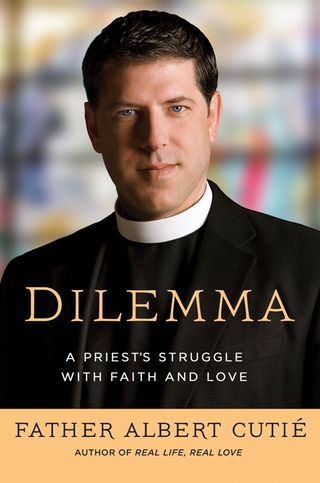
As of Tuesday (January 4th), Fr. Albert Cutié‘s book DILEMMA: A Priest’s Struggle With Faith and Love is supposed to be out. I have not yet seen a copy, but I have seen the press release that was sent around last week in anticipation of the book’s release. To lay the groundwork for the story, I’ve done two posts—the first giving the background to the Catholic Church’s discipline of celibacy in its Latin rite and the second explaining the options Fr. Cutie had when he began to be attracted and then involved with Ruhama Buni Canellis, a divorced mother who he began a romantic relationship with while still a Catholic priest.

The Spanish-language press discovered the relationship and took pictures of the two having romantic frolics on beaches and in clearly inappropriate situations, such as Buni Canellis romantically wrapping her legs around Fr. Cutie and Fr. Cutie putting his hands down her swimsuit to fondle her behind.

When the pictures were published, Cutie requested a leave of absence from the Archdiocese of Miami. In an interview that same month (May 2009) he said he respected the Latin Church’s discipline of celibacy and did not want to become the “anti-celibacy priest.”

By the end of the month, Fr. Cutie defected from the Catholic Church and joined the Episcopal Church, where he was assigned pastoral duties at a local Episcopal parish. The following month (June 2009) he attempted marriage with Buni Canellis in an Episcopalian ceremony. (Note: Because of his canonical situation, this marriage is not valid, meaning that the two are objectively living in sin.) The two have subsequently had a child.

Fr. Cutie has apparently changed his mind about not wanting to become the “anti-celibacy priest,” if the press release to it is any guide.

The press release was send with a cover e-mail by Barbara Teszler, of Levine Communications Office, Inc., a public relations firm.

Let’s look at it an note [in parentheses] some of the themes it contains (we’ll skip the hackneyed cliches it’s also stuffed full of).

Here is how her letter begins:

The man the media turned into a living

scarlet letter

[theme:Cutie as victim]

[NAME], when the paparazzi “caught” [theme:Cutie as victim] Father Cutié embracing the love of his life in a romantic moment on the beach [theme:Cutie as victim; how could anybody stand up to his emotions regarding “the love of his life”?], it sparked an explosive media scandal – the culmination of a private struggle [theme:Cutie as victim] that had been burdening him [theme:Cutie as victim] for years. He could live the lie no longer[theme:Cutie as victim]: his private agony [theme:Cutie as victim]was now national news.

Resolving that a pure hand needs no glove to cover it [theme:Cutie as forthright, honest man—wow is the glove statement audacious and bizarre], Father Cutié decided to take a leave from the Church [theme:Cutie as forthright, honest man; this is also spin since Cutie requested a leave of absence; he didn’t just decide to “take a leave”]. Many backs were consequently turned on him for good [theme:Cutie as victim; he apparently determined that these backs were turned “for good” rather quickly since he left the Church in under a month] – this, in the face of all the scandals kept quiet on the inside of the institution [theme:Cutie as victim; the Church is picking on him but not others].

His crime?

Falling in love. [theme:Cutie as victim; nobody should suffer for the “crime” of falling in love; two notes: (1) this is just too hackneyed a cliche to go by without comment, and (2) “falling in love” with someone you cannot legitimately pursue romantically is a “crime” in the sense of being immoral and gravely sinful; it is indeed a “crime” for a husband to “fall in love” with someone other than his wife or for an adult to “fall in love” with a small child or for a priest to “fall in love” with anybody except in some kind of spiritual, non-romantic, non-sexual way.]

As Father Cutié began the long, uphill battle ahead [theme:Cutie as victim]– one that continues today [theme:Cutie as victim]– it became increasingly clear that far bigger questions were now at hand.[theme:Cutie as forthright, honest man]

Ever adamant about his devotion and love for God,[theme:Cutie as forthright, honeset man] and now an Episcopal priest, Father Cutié’s actions reignite a debate that may very well never be laid to rest[theme:Cutie as forthright, honest man]: must Catholic priests be denied the right to physically express their love[theme:Cuties as victim & as forthright, honest man]?

Father Cutié’s DILEMMA: A Priest’s Struggle with Faith and Love [theme:Cutie as victim & as forthright, honest man]takes you through the life of a man torn between his devotion to the Church [theme:Cutie as forthright, honest man] and the passions and convictions of his own heart [theme:Cutie as forthright, honest man], as well as eloquently raising questions about the origins of the promise of celibacy, its logical fallacy,[Huh?] and the various reasons for abolishing it as a requirement for priesthood.[theme:Cutie as forthright, honest man]

I implore you to get in touch about featuring the very compelling and personable Father Cutié [theme:Cutie as forthright, honest man]to see if he won’t shake your notions on religion. I’ve included more info below.

All the best,

Barbara Teszler
Account Executive
Levine Communications Office, Inc.
1180 S. Beverly Drive, 3rd floor
Los Angeles, CA 90035
E. BTeszler@LCOonline.com
T: 310.300.0950 x 239
F. 310.300.0951
www.LCOonline.com
www.twitter.com/LCOonline
Passion. Focus. Results. Since 1983.
www.LBNElert.com
LCO is the winner of the Bulldog Award for Excellence in Media Relations and Publicity
2010 Arts & Entertainment Campaign of the Year

Of course, public relations firms are paid to present their clients in a good light and to write prose compelling enough to generate positive PR. That means some degree of hyperbole is inevitable. But if you look past Teszler’s writing style, it’s startling the number of times that Cutie is portrayed as a victim and as a forthright, honest man. There is no sense of personal culpability or responsibility. He’s an innocent saint who is being mercilessly victimized, the way this press release reads. His book may portray a different picture, but frankly, if I’d messed up the way Fr. Cutie did, I’d be ashamedto have my story represented with this kind of smug sanctimoniousness. Instead, I’d wan’t a far more humble tone about a gripping story of broken humanity, the desperate search for solutions, and honest questions for the benefit of others in the future. But we get none of that here. Nor do we get it in the accompanying press release that Teszler sent:


His love life became international news. Now Father Albert Cutié tells his side of the story: On falling in love, continuing priestly ministry outside the Roman Catholic Church, and becoming a father.
“As a Roman Catholic priest, I was forced to decide between a supernatural love—in a ministry serving the Lord—and natural love—in a forbidden relationship with a woman. Both were blessings given to me by the same God, the source of all love. This was my dilemma.”—Father Albert Cutie [Sorry, but no. God did not put Fr. Cutie in this dilemma. Don’t blame God. And don’t refer to an illicit relationship with a woman as a “gift” from God.]

In 1995, Alberto Cutie was ordained as a Roman Catholic priest in the Archdiocese of Miami. Years later, he was the internationally known host of a number of television programs, bestselling author of Real Life, Real Love [How ironic is that title, in hindsight?], and immensely popular figure known for his compassion and kind image. He was so beloved that he’d even come to be known as “Father Oprah.” He thrilled at spreading God’s word and never tired of the solace and comfort he brought to his congregation and his audience. But he was also chafing under a Church system that, he believes, too often treats priests inhumanely, denying them the chance to lead happy, fulfilling lives. Father Albert was facing a dilemma.

The celibate Roman Catholic priest had fallen in love and had gone through an ideological evolution on several controversial church policies.[As often happens when people seek to rationalize personal sin; they start rejecting the intellectual premises that require it to be sinful; homosexuals reject the obvious procreative aspect of sex in favor of homosexual acts; pedophiles reject the same in favor of sexual acts with children; husbands and wives reject the principle of fidelity so that they can cheat on their spouses; it’s quite common for people to subject their principles to their lusts rather than the other way around.]

DILEMMA: A Priest’s Struggle With Faith and Love (Celebra Hardcover; January 4, 2011; $25.95) is Father Albert Cutié’s personal hard-hitting indictment of the Roman Catholic Church [emphasis added; if the book is, indeed a “hard-hitting indictment” then he obviously has changed his mind about wanting to be the “anti-celibacy priest”], an institution he identifies as being stuck in the past, and often inhumane. Cutié relates his story of being cast out of the Church for the sin of falling in love with a woman [this is flat-out false; Fr. Cutie was not “cast out of the Church”; the Catholic Church has no procedures for casting out members; not even excommunication does that; Fr. Cutie voluntarily left the Church; his status as an Episcopalian is entirely his choice], and his no-holds-barred treatment of the Church’s rules will raise eyebrows and spark debate.[So, like, more on that whole, “I now want to be the anti-celibacy priest” thing]

When paparazzi captured Father Cutié and his then girlfriend (now his wife) in a romantic moment on the beach, it was the start of an explosive media scandal, but the culmination of a private struggle that he had been living with for years. He had made a promise of celibacy with every intention of keeping it for life– but how could he ignore true, earthly love, a love that God himself had put in front of him?[GAH! Please do not blaspheme God in this way!] And why would the Church, which had turned a blind eye to years of abusive, promiscuous and criminal behavior on the part of so many priests,[This indictment is in significant measure inaccurate; to the extent it is accurate, the Church has experienced a major shift for the better on this point; “All the other kids have been able to have illicit sex, so why can’t I?” is not a good defense; using the crimes of pedophiles to cover your own illicit sex is a cynical, manipulative, and degrading move] take such a hard line on this issue [Dude, what on earth did you expect?] and react so negatively toward the announcement by the popular priest to realize his dream of continuing priestly ministry as a married man and having a family?[What “announcement” are we talking about? “I’m ditching the Church to become an Episcopalian?” What was the negative reaction? “We regret Fr. Cutie’s decision?” Have officials of the Catholic Church said anything intemperate at all in this matter?]

In DILEMMA, Father Cutié opens up about answering the call to become a priest as a young man and falling in love with priesthood; the television and radio shows that made him famous and loved around the world; becoming “Father Oprah” and the immense joy he finds in spreading God’s word and comfort. But he also discusses feeling abandoned, neglected and overworked by absent Church leaders; the outdated, bigoted and hypocritical actions and beliefs of the Church; the open secret that many priests carry on love affairs – both gay and straight – and even have children; and the remarkable way the Church cast one of their own aside.[Dude, you left] He also eloquently illuminates the origins of the promise of celibacy, its logical fallacy,[Huh?] and the many reasons for abolishing it as a requirement for priesthood.

ABOUT THE AUTHOR: Father Albert Cutié has had the special privilege of entering millions of homes throughout the world with his television and radio talk shows, as well as his newspaper advice columns. He was the first priest to host a daily “talk-show” [Why does “talk show” need scare quotes?] as part of a major network on national and international secular television. His first self-help book, Real Life, Real Love was published by Penguin and became a best-seller in Spanish. He is now a married priest in the Episcopal Diocese of Southeast Florida.  Visit his website at:  www.fralbert.com.

#      #      #

DILEMMA A Priest’s Struggle With Faith and Love By Father Albert Cutié Celebra Hardcover; On-sale: January 4, 2011 $25.95; ISBN: 978-0-451-23201-4

Penguin Group (USA) Inc. is the U.S. member of the internationally renowned Penguin Group.  Penguin Group (USA) is one of the leading U.S. adult and children’s trade book publishers, owning a wide range of imprints and trademarks, including Berkley Books, Dutton, Frederick Warne, G.P. Putnam’s Sons, Grosset & Dunlap, New American Library, Penguin, Philomel, Riverhead Books and Viking, among others. The Penguin Group is part of Pearson plc, the international media company.

Obviously, much more could be said. But let’s pray for Fr. Cutie, for his civil law wife, his child and step-child, and for all who may be led astray by the scandal (in the theological sense: an example that encourages others to fall into sin) whose flames he and his press agency is so anxiously fanning. What do you think?

Fr. Cutie: What Options Did Fallen Priest Have?

Fr__Alberto_Cutie1

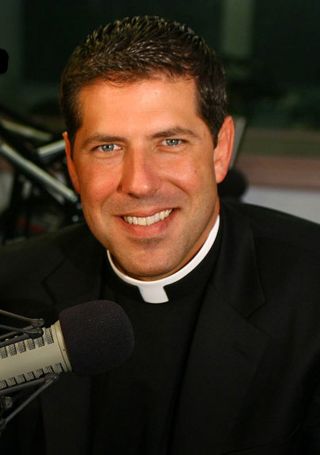
In our previous post, we looked at the situation regarding Fr. Albert Cutié, who has written a self-justifying book regarding the scandal he created by having an inappropriate romantic (and presumably sexual) relationship with a woman and, when this relationship was revealed through the press, abandoned his role as a Catholic priest, joined the Episcopalian church, and civilly married the woman, by whom he has subsequently fathered a child.

The previous post looked at the Catholic Church’s general discipline of celibacy (remaining unmarried) for the priests of the Latin Church that exists within it (the celibacy requirement operates differently in many of the Eastern Catholic churches also in union with the pope). In this post we will look at the options that were open to Fr. Cutie at different stages of events and the choices he made.

We will begin with the stage where he first began to be attracted to Ruhama Buni Canellis, the divorced woman with whom he eventually attempted civil marriage. What options did he have at this stage?

1) Just Say No.

This was the only morally legitimate option open to Fr. Cutie upon the onset of attraction to Buni Canellis. We do not know at this point in time (though his forthcoming book may reveal more about the matter) whether she first pursued him or he first pursued her or whether they simultaneously began pursuing each other, but Fr. Cutie had an obligation to neither make amorous advances toward her nor to respond to amorous advances on her part.

As part of the rite of ordination, Fr. Cutie had freely assumed the obligation to remain celibate (unmarried) and thus, via the virtue of chastity (behaving in a sexually appropriate manner) to remain continent (not have sex). This obligation is further canonically specified by Canon 277 §1 of the Code of Canon Law, which states:

Clerics are obliged to observe perfect and perpetual continence for the sake of the kingdom of heaven and therefore are bound to celibacy which is a special gift of God by which sacred ministers can adhere more easily to Christ with an undivided heart and are able to dedicate themselves more freely to the service of God and humanity.

Basic principles of moral theology also require that if one is not a potential, legitimate sexual partner (i.e., spouse) for another person, one also must not engage in behavior oriented toward generating romance, fostering sexual temptation, and raising hopes of a union with that person that one is not free to contract. Consequently, §2 of Canon 277 also specifies:

Clerics are to behave with due prudence towards persons whose company can endanger their obligation to observe continence or give rise to scandal among the faithful.

As was documented in part one of this series, Fr. Cutie was caught on film allowing Buni Canellis to amorously wrap her legs around him and also putting his own hand down Buni Canellis’ swimsuit to fondle her behind. Both of these actions were clear violations of his moral and canonical obligations, as discussed above.

While becoming ordained is not in every respect the same as becoming married, both involve the free assumption of a state of life that involves a sacred commitment regarding sexual matters. In the case of ordination, one makes a sacred commitment that one will not pursue sexual or romantic relationships with anyone, while in the case of matrimony one makes a sacred commitment that one will not pursue sexual or romantic relationships with anyone but one’s spouse. Fr. Cutie’s violation of this sacred commitment is thus analogous to a husband’s pursuit of a sexual or romantic relationship with someone who is not his wife. It counts as the violation of a grave obligation, freely undertaken (canon law is explicit that both ordination and matrimony must be freely chosen commitments), and in this regard it is thus analogous to “cheating” on one’s spouse.

There are also serious moral and canonical questions to be raised regarding the abuse of Fr. Cutie’s spiritual office as a priest in this regard.

In the realm of moral theology, it is gravely sinful for a priest in particular to cooperate with another person in sexual sin, particularly if that person is one of the souls entrusted to his spiritual care, but also in regard to anyone in general. The priest by virtue of his ordination has a sacred position that elevates him above the ordinary faithful in a way paralleling Jesus’ words:

“Whoever causes one of these little ones who believe in me to sin, it would be better for him to have a great millstone hung around his neck and to be drowned in the depths of the sea. Woe to the world because of things that cause sin! Such things must come, but woe to the one through whom they come! (Matthew 18:6-7).

On the canonical side, the Church is quite concerned that its ministers not abuse their sacred office by using it for purposes of seduction, or even for the willing subversion of another’s soul. This is illustrated by the canonical penalties to which a priest is subject if he solicits a sexual sin in conjunction with the sacrament of confession or if he sacramentally absolves one who is his accomplice in sexual sin, both of which are regarded by the Holy See as graviora delicta (Latin, “graver offenses”) that are reserved to the competence of the Congregation of the Doctrine of the Faith in Rome to deal with (cf. this resource).

We do not know at this point, and may never know, whether Fr. Cutie committed either of these offenses specifically, but the two illustrate the Holy See’s concern that priests not abuse their sacred office toward sexual ends.

Given that Fr. Cutie failed to exercise the morally legitimate option to “just say no” to the attraction he was feeling toward Buni Canellis (and please note: feeling attraction is not a sin; the question is how one chooses to deal with it) and dug himself in this deep, what further options were open to him? The morally legitimate one was . . .

2) Repent

Having cooperated with his own fall into sexual sin, as well as that of Buni Canellis, what should Fr. Cutie have done at some point—either when the press publicized his relationship or before or after this point?

An obvious solution would have been to repent—which is what we all need to do when we have fallen into sin, whether sexual or otherwise. Such an action is required by the terms of the gospel:

Jesus went into Galilee, proclaiming the good news [gospel] of God. “The time has come,” he said. “The kingdom of God has come near. Repent and believe the good news!” (Mark 1:14b).

Peter replied, “Repent and be baptized, every one of you, in the name of Jesus Christ for the forgiveness of your sins. And you will receive the gift of the Holy Spirit” (Acts 2:38).

A clear and obvious way in which his act of repentance could have been expressed would be to break off his romantic (and possibly sexual) relationship with Buni Canellis.

Given that the matter had now been made public, there would remain questions regarding his ability to function as a priest. He certainly would have had to accept a lesser role, certainly retiring from the high-profile work he had been doing on radio and television, and quite likely retiring from any exercise of priestly ministry apart from certainly highly specialized cases (e.g., hearing the confession of a person about to die).

Even if the matter had not become public at the time of his repentance, however, there would be various factors that could make the exercise of ministry doubtful—e.g., if Buni Canellis would not accept his decision and threatened to expose him to the press.

We do not know, and likely will never know, whether that would have been the case, but a simple “call off the affair” course of action may have been difficult for any number of reasons, including Cutie’s emotionally attachment to Buni Cannelis and commitments he may have made to her regarding their future. In that case, what options would be open to him? The obvious one would be . . .

3) Pursue Laicization

While the Church recognizes the sacred commitment that is entailed through ordination to the priesthood, it also recognizes that the ordained may be or become unsuitable for the role of priest.

In other words: There can be mistakes. Sometimes a man may be ordained to the priesthood who is not truly suitable for it. Alternately, a man can through his actions make himself unsuitable for priestly ministry. It could be the case that Fr. Cutie was unsuitable from the beginning for priestly ministry or that, though his actions, he had made himself such.

In such cases, the remedy that canon law provides is a procedure known as “laicization” or, more technically “loss of the clerical state.” This does not (automatically) mean that his ordination was invalid, but it does mean that—in the cases of a valid ordination—a laicized priest apart from certain carefully subscribed situations (e.g., hearing the confession of a dying person), is returned to the lay state such that he is prohibited from exercising his faculties as a priest. It also can (but does not always) involve release from the obligation of celibacy. (See this part of the Code for more on the loss of the clerical state in general.)

After reflection on his situation, Fr. Cutie thus could have deemed that he was unsuitable for priestly ministry from the beginning and pursued laicization. He also may have (with a very high degree of plausibility) thought that his actions with regard to Buni Canellis had made him unsuitable for it and pursued laicization on those grounds, including an appeal to the Holy See to allow him to be released from the obligation of celibacy so that he could marry Buni Canellis in view of the emotional/other attachments and obligations he felt existed between them.

Such a path would not have resulted in an instantaneous way of rectifying their situation, or an easy and quick means of resolving the situation (such decisions are left to the discretion of the Holy See), but pursuing this path could represent a fundamental act of repentance and an intention to “make things right.”

Regrettably, Fr. Cutie did not choose even this path. Instead, according to Wikipedia:

By the end of [May, 2009] Cutié announced that he had been in the process of discerning entering The Episcopal Church for the last couple of years, which in turn helped him consolidate marriage and his calling to serve God.

Father Alberto Cutié was received into the Episcopal Church on May 28, 2009, by the Rt. Rev. Leo Frade, the Cuban-born bishop of the Episcopal Diocese of Southeast Florida, and became the administrator and pastoral minister of the Episcopal Church of the Resurrection in Biscayne Park, Miami, where he was licensed as a pastoral assistant. He was subsequently received as an Episcopal priest and instituted as priest-in-charge of the congregation on May 29, 2010.

On June 26, 2009, Cutié and Ruhama Buni Canellis married in a church ceremony at St. Bernard de Clairvaux Church in North Miami Beach. [Episcopalian] Bishop Frade officiated, assisted by the Rt. Rev. Onell Soto (retired Episcopal Bishop of Venezuela) and several other Episcopal clergy.

Cutié is presently serving as the Priest-in-Charge at the Church of the Resurrection in Biscayne Park, Florida. On November 30, 2010, Canellis gave birth to the couple’s first child, daughter Camila Victoria Cutié. Canellis has one other child from a previous marriage.

Cutie thus chose to “jump ship”—to defect from the Catholic Church and enter the Episcopalian Church, where he attempted marriage with Buni Canellis.

Was this a legitimate option for him?

On objective moral and canonical grounds, the answer is no.

While one can never judge the subjective state of a person’s heart, from the perspective of objective moral theology, the answer is no. Objectively speaking, many non-Catholic communities retain elements of the patrimony willed by Christ for his followers, but only the Catholic Church retains these elements in their fullness. While a person in good conscience may find salvation in many faith communities, to deliberately to separate oneself from the fullness of truth and grace that the Catholic Church represents is gravely sinful. As an informed Catholic to whom God would provide sufficient light and grace to retain his faith, Fr. Cutie’s abandonment of the Church represents an objectively grave situation that could only be a non-mortal sin through a lack of due knowledge or a lack of due consent.

Further, from the canonical perspective, Fr. Cutie’s situation does not mean that he is validly married to Buni Canellis. According to Canon 1087:

Those in sacred orders invalidly attempt marriage.

The fact that Fr. Cutie was ordained and has not—so far as we know—been laicized with the ability to contract marriage—means that his attempt to contract marriage in the Episcopalian Church is just that—an attempt, and not a successful one.

Unless there are facts regarding the case that have not yet become public, his present civil marriage to Buni Canellis is invalid and thus in the category that Jesus warned us against, telling us that divorce does not entail an automatic right to marry someone else and can, thus, lead to situations of adultery.

From what is presently publicly known (so far as I can determine), Fr. Cutie is living in an invalid marriage and thus is engaging either in objective fornication or objective adultery (given Buni Canellis’s previous marriage).

Either way, things look bad.

In this part of the series, we have looked at the options available to Fr. Cutie at different steps in his life history. In the next part we will look at the book he has chosen to write, as represented by its press release.

In the meantime, what do you think?

Fr. Cutie: Fallen Priest Writes Self-Justifying Book

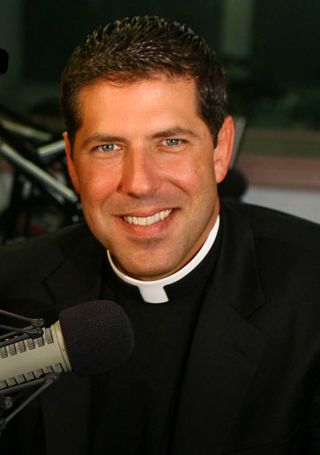
Fr__Alberto_Cutie1Of course all humans have an impulse to justify their sinful actions. It requires grace and humility to not try to justify them and to acknowledge their sinfulness.

That makes this kind of a dog-bites-man story, but it’s a dog-bites-man story that’s going to be getting a considerable amount of attention in the next few weeks, so we may as well deal with it in advance.

The basics of the story are this: Fr. Albert Cutié (a.k.a., “Padre Alberto,” a.k.a. “Father ‘Oprah’” due to his radio and television appearances), formerly of the Archdiocese of Miami, has now written a book titled, Dilemma: A Priest’s Struggle With Faith and Love, in which he justifies his actions in connection with the scandal that began in May 2009. That scandal has not ended, however. In fact, as we will see, the book continues and has the potential to amplify the scandal—taking “scandal” in its historical and theological sense, meaning that more people may be led into sin as a result of this book.

The scandal originally erupted, as summarized by Time magazine, when:

The Mexican celebrity magazine TVnotas recently published 25 paparazzi photos of the Rev. Alberto Cutié, the popular Miami Beach priest famous for his Spanish-language television and radio talk shows, cavorting amorously on a Florida beach with an attractive woman. Over a three-day period, the pictures also captured him kissing her in a bar. In one of TVnotas’s “in fraganti” [“caught red-handed” in Mexican Spanish idiom] shots, the woman wraps her legs around Cutié; in another, Cutié has a hand down her swimsuit, fondling her rear end.

So the photos were fairly unambiguous. There wasn’t the potential for an “It wasn’t what it looks like” defense.

Subsequently, according to Wikipedia,

On May 5, 2009, Cutié asked church officials for a time of reflection and a leave of absence from his media programs and pastoral work as a result of the publication of pictures in which Cutié was shown kissing Ruhama Buni Canellis (born March 7, 1974, Guatemala). Cutié asked the Archdiocese of Miami for some time to think and make a decision on where his life was heading.

On May 11, 2009, Cutié was interviewed by Maggie Rodriguez of CBS’ “The Early Show”. He said that he was thinking about leaving the Roman Catholic Church for a woman he loves. He said that he respected the church’s position that priests be celibate and recognized that some are very dedicated to that calling. He stated he did not want to become the “anti-celibacy priest”.

On May 13, 2009, Cutié was interviewed by Teresa Rodríguez on the Univision show Aqui y Ahora. Cutie said: “I do regret if my actions hurt people with all my heart”, adding “[t]here are other ways to serve God. I am not the same man I was when I entered the seminary 22 years ago.” By the end of month Cutié announced that he had been in the process of discerning entering The Episcopal Church for the last couple of years, which in turn helped him consolidate marriage and his calling to serve God.

Fr. Cutie (I’m not going to make the acute accent over the final letter of his name each time I type it because my keyboard is not set up that way; I’m not punning on his last name) then defected from the Catholic Church, entered the Episcopal Church, became an Episcopalian priest, and somewhere along the line civilly married his paramour and fathered a child.

Now he’s written a self-justifying book to stir the matter up again. If the press release already sent out for the book is reflective of its content, it appears that he may well have changed his mind about respecting the Church’s position on celibacy in the Latin rite, that he does want to “become the ‘anti-celibacy priest,’” and that he may not be so concerned about his actions hurting others anymore.

We’ll get to the press release in the next post in this series, but first let’s talk about a few things needed to understand this situation—the kind of things that your friends may ask you about around the Internet water cooler once the book is released on January 4th.

First, let’s be clear about what celibacy is: It’s the property of not being married. Anyone who is not married is, by definition, celibate. People often confuse this with two other concepts—continence (which in a sexual context means not having sex) and chastity (which means behaving in an appropriate manner sexually, based on your state of life). If a person is celibate (unmarried) and they wish to be chaste (act in a moral manner, sexually) then they will be continent (not have sex), because sex outside of marriage is immoral. By contrast, if you are not celibate (i.e., you are married) then you can be chaste (act in a sexually moral manner) even though you presumably are not continent (i.e., are having sex).

Second, the requirement of celibacy is neither a “doctrine” (teaching) nor a “dogma” (infallibly proclaimed teaching taught or implied by Christ and the apostles) of the Catholic Church. It is a “discipline,” a practice that has been adopted for prudential reasons but that can, and does, admit of exceptions, thus . . .

Third, while the requirement of celibacy applies to most priests in the Latin Church, and while the Latin Church is the largest church within the overall Catholic Church, there are other Catholic churches in full communion with the pope (e.g., the Maronite Church, the Malabar Church, the Chaldean Church, the Melkite Church). In many of these Eastern Catholic churches married (non-celibate) men can be ordained to the priesthood.

Fourth, even in the Latin Church exceptions are made to the celibacy requirement for some priests—i.e., those who have been married ministers in other Christian communities and who then become Catholic and desire to pursue a vocation as a Catholic priest. This is most common in the case of Anglican and Episcopalian married priests who become Catholic, though it can also happen with other non-Catholic ministers who become Catholic.

Fifth, because priestly celibacy is a discipline rather than a doctrine or a dogma, it is something that the Church can adjust for prudent pastoral reasons, as in the case of the previous two points. It is thus theoretically possible that the Church might one day radically restructure or even end the requirement of priestly celibacy in the Latin Church.

Sixth, a Catholic can hold the opinion that it would be pastorally prudent to make such a change. You are not being disloyal or a bad Catholic by holding such a view. In fact, Pope Benedict encouraged discussion of this point at the very first Synod of Bishops he presided over as pope, the 2005 Synod on the Eucharist.

Seventh, don’t expect a dramatic change on this point any time soon, however. After the discussion at the 2005 Synod, the bishops ended up recommending that a change in the Latin Church’s discipline on this point should not now be pursued. And while Pope Benedict has seen the issue as something that can be legitimately discussed, he does not seem likely to make any sudden, dramatic change in the Church’s practice. That is because . . .

Eighth, there are good reasons for the Latin Church’s discipline on this point. To deal with the immediate practical aspect first, a sudden, dramatic change would cause massive pastoral problems throughout the Catholic world (precisely because the Latin Church is so big compared to the other Catholic churches). It would rival, if not dwarf, the chaos that followed the Second Vatican Council. There would be massive and unprecedented pastoral, financial, and legal difficulties, complicated by the fact that each country has different laws regarding issues like marriage, inheritance, and employment.

There would also be a tremendous amount of confusion among faithful and clergy alike, with the possible loss of faith on the part of literally millions of faithful and clergy as well—for not everyone understands the issue in the factually precise terms we have been discussing it.

I could write a whole blog post (actually, much more) on the problems that would result from a sudden, massive change of policy on this point, without the proper preparation being done first. Suffice it to say that it would be pastorally inadvisable in the extreme for the Church to make a sudden, unprepared shift in its discipline on this point. Translating the Mass into the vernacular would be peanuts compared to this. Thus, even if one felt that the Church should move toward such a solution in the long-term, that does not in the least mean that it should be done precipitously. Or at all, because . . .

Ninth, apart from the considerations of how such a shift could be handled, there are good reasons for the policy itself. One such reason is practical: celibate clergy simple are able to devote themselves fully to ministry in a way that married clergy are not. By divine law, married persons must devote quite substantial energies to their spouses and children, and it is gravely sinful not to do so. The problems of balancing the duties of ministry with the duties of family are well known and amply documented in the numerous books published each year by Protestant publishers on the subject of how to balance these duties if you are a pastor, a pastor’s wife, or even a pastor’s kid. Lots of marriages, parent-child relationships, and pastor-church member relationships have suffered grave harm by not getting these balances right. How to avoid such tragedies is a subject of constant discussion in Protestant clerical circles, as I can testify from my observations in the days when I was a Protestant preparing for ministry. But the practical considerations (either immediate or long-term) of a change regarding celibacy do not exhaust the question, for as Pope Benedict has pointed out . . .

Tenth, there is a supernatural dimension to all of this. Clerical celibacy is not simply a matter of making ministers able to fully devote themselves to ministry (though it does enable that to happen). The fact is that we will all—all of us who end up in heaven—one day be celibate. As Our Lord told us:

At the resurrection people will neither marry nor be given in marriage; they will be like the angels in heaven (Matthew 22:30).

This is one way in which we will be conformed to the likeness of Christ, for he himself was unmarried (which is why the Church is depicted in Scripture as his mystical bride; there was no literal “Mrs. Jesus” of flesh and blood).

By participating in celibacy early so that they may serve Christ’s Church, priests conform themselves in a special way both to the way we will all exist in the age to come and to the model left for them by Christ, who served his Church to the point of shedding his own blood for it. Furthermore . . .

Eleventh, celibacy for the sake of the kingdom of God is recommended in Scripture itself. St. Paul pointedly practiced celibacy for the sake of the kingdom (see 1 Corinthians 7-9) and appears to recommend the same to St. Timothy (2 Timothy 2), though this is less clear. From Paul’s example alone we know that clerical celibacy was practiced in the first century by at least some of Christ’s ministers. But what’s more . . .

Twelfth, it was both practiced and recommended by Christ himself. Not only did he refrain from marriage and live a life in service to the Church that he was bringing into existence (which is why the Church is depicted as his bride in Scripture; had there been a flesh-and-blood “Mrs. Jesus” living just down the street, such a metaphor would never have arisen), Jesus also specifically recommended celibacy. He acknowledged that this was not a gift given to everyone, but he urged that—for those to whom it was given—they should accept it. When he stated that divorcing one wife and marrying another amounted to adultery, his disciples, said,

The disciples said to him, “If such is the case of a man with his wife, it is not expedient to marry.”

But he said to them, “Not all men can receive this saying, but only those to whom it is given. For there are eunuchs who have been so from birth, and there are eunuchs who have been made eunuchs by men, and there are eunuchs who have made themselves eunuchs for the sake of the kingdom of heaven. He who is able to receive this, let him receive it” [Matthew 19:10-12].

Literally speaking, a eunuch is a person who has been castrated so that he cannot have sex. They were sometimes used as harem-guards in the ancient Middle East. Here Jesus uses this image in a striking but somewhat metaphorical way, referring to those who (literally) from birth have been incapable of sex (those suffering from certain birth defects), those who (literally) were made eunuchs in ancient cultures, and those who (metaphorically) renounced sex “for the sake of the kingdom” of God.

One such individual was Jesus himself, who refrained from marriage “for the sake of the kingdom” both because it is the final state in which we will all exist in the kingdom of God and to serve his Church, by devoting himself fully to ministry, to the point of pouring out his blood on the Cross for his mystical bride, the Church.

In view of the example and words of Our Lord, no one should lightly dismiss the practice of clerical celibacy. One may question how this principle should be applied in different ages of the Church, but it is not a thing to be treated in a scornful or dismissive manner.

So what about Fr. Cutie?

We’ll get more into his situation in the next post.

For now . . . what do you think?

Caroline’s Christmas: or, The Inexplicable Infant

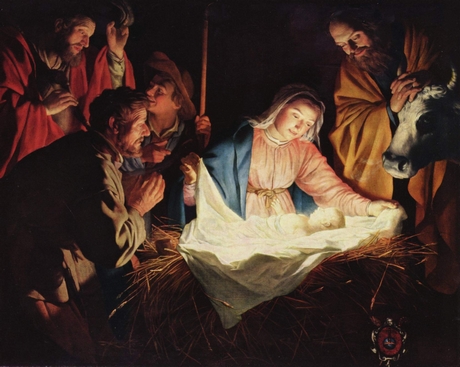
Rhonda-watson-all-is-calm-all-is-bright-christmas-homestead One of my favorite humorists is the early 20th century Canadian economics professor Stephen Leacock. No, really! A professor of "the dismal science" who had a really great sense of humor!

One of my favorite Leacock books is Nonsense Novels, which came out in 1911. In it, each chapter is a parody of a popular genre of fiction (chapter 1 is a parody of Sherlock Holmes, there's a rags-to-riches story, a ghost story, a science fiction story, a Russian tragedy, a seafaring/pirate tale, etc.).

There's also a Christmas story melodrama. 

Here's . . .

An oldfashioned text version if you like, you know, want to read with your eyes or something.

And a homemade audiobook.

And a Librivox volunteer recording.

BTW, I can't help but imagining this story unfolding in my family's ranch house in Deep East Texas, where my grandmother lives (talked to her for most of an hour today!), though it virtually never snows there.

Abortion Hospital Decree & Pushback

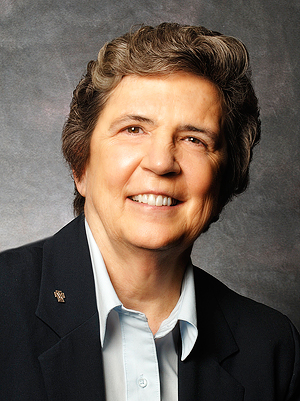
SrCarolKeehan2Web

The Diocese of Phoenix has now made available the decree of Bishop Olmsted revoking his permission for St. Joseph’s Medical Center to use the name “Catholic.” This is a welcome development, since it is always good to see the instrument itself by which such things are done (and they are only very rarely done)—as opposed to an explanatory text, which is what we initially got yesterday.

One of the things that had been missing from the public discussion up to now was the canonical basis on which Bishop Olmsted acted. The leaked correspondence did not contain references to the possible canons on which he could act. I assume that those canons were mentioned in other, unleaked correspondence with Catholic Healthcare West (CHW).

As I suspected, the Bishop was exercising his authority under Canon 216 (there are other potential canons that could have been cited, but this was the most relevant). This canon, as you will recall, states:

Can. 216 Since they participate in the mission of the Church, all the Christian faithful have the right to promote or sustain apostolic action even by their own undertakings, according to their own state and condition. Nevertheless, no undertaking is to claim the name Catholic without the consent of competent ecclesiastical authority.

So, with that as background, here is the official decree itself . . .

DECREE

Revoking Episcopal Consent to Claim the “Catholic” Name according to Canon 216

By virtue of my Episcopal authority as the Ordinary of the Particular Church of the Diocese of Phoenix, and in accord with Canon 216 of the Code of Canon Law, I hereby revoke my consent for the following organization to utilize in any way the name “Catholic.”

• St. Joseph’s Hospital and Medical Center, Phoenix, AZ

After much time and effort in cooperation with the leadership of Catholic Healthcare West and having studied the matter carefully with the assistance of experts in medical ethics, moral theology, and canon law, it has been determined that the aforementioned organization no longer qualifies as a “Catholic” entity in the territory of the Diocese of Phoenix. For the benefit of the public good, particularly amongst the Christian Faithful, I decree that the organization listed above may not use the name Catholic or be identified as Catholic in the Diocese of Phoenix.

The reason for this decision is based upon the fact that, as Bishop of Phoenix, I cannot verify that this health care organization will provide health care consistent with authentic Catholic moral teaching as interpreted by me in exercising my legitimate Episcopal authority to interpret the moral law.

This Decree of Removal of my consent goes into effect as of this day, and will remain in effect indefinitely, until such time as I am convinced that this institution is authentically Catholic by its adherence to the Ethical and Religious Directives of the United States Conference of Catholic
Bishops, in addition to the standards of Catholic identity set forth in official church documents,
Caholic theology, and canon law.

Given this day, December 21, 2010 at the Chancery of the Diocese of Phoenix

+ Thomas J. Olmsted
Bishop of Phoenix

Sr. Jean Steffes, CSA
Chancellor

The Diocese of Phoenix has materials devoted to the case on its website, HERE. This includes video of a press conference with Bishop Olmsted.

Meanwhile, St. Joseph’s Hospital and Medical Center has done its own press conference and issued its own statement. You can find them here.

Finally, the National Catholic Reporter (not Register) is reporting that the Catholic Health Association is backing the hospital over the bishop:

Daughter of Charity Sr. Carol Keehan, CHA president and CEO, said, “St. Joseph’s Hospital and Medical Center in Phoenix has many programs that reach out to protect life. They had been confronted with a heartbreaking situation. They carefully evaluated the patient’s situation and correctly applied the ‘Ethical and Religious Directives for Catholic Health Care Services’ to it, saving the only life that was possible to save.”

NCR received Keehan’s statement in an e-mail late Dec. 21. [SOURCE.]

So, the pushback to the Bishop’s decision has begun. The story will grow more involved.

What do you think?