Bishop Strips Abortion Hospital of Catholic Status!

OlmstedSmall

Parts in this series: one, two, three, four, five

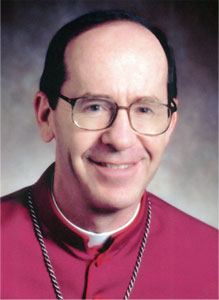
Bishop Thomas Olmsted of the Diocese of Phoenix has stripped St. Joseph’s Medical Center of its status as a Catholic institution.

The decision was announced Tuesday at a press conference in Phoenix.  The following is the statement released by the Diocese of Phoenix in the wake of the announcement:

St. Joseph’s Hospital no longer Catholic

Statement of Bishop Thomas J. Olmsted

December 21, 2010

Jesus says (Cf. Mt 25:40), “Whatever you did for the least of my brothers and sisters, you did for me.”

Caring for the sick is an essential part of the Gospel of Jesus Christ. Throughout our history, the Church has provided great care and love to those in need. With the advent of Catholic hospitals, the faithful could also be confident that they were able to receive quality health care according to the teachings of the Church.

Authentic Catholic care in the institutions of Catholic Healthcare West (CHW) in the Diocese of Phoenix has been a topic of discussion between CHW and me from the time of our initial meeting nearly seven years ago.

At that first meeting, I learned that CHW already did not comply with the ethical teachings of the Church at Chandler Regional Hospital. The moral guide for Hospitals and Healthcare Institutions is spelled out in what are called the Ethical and Religious Directives of the United States Conference of Catholic Bishops. I objected strongly to CHW’s lack of compliance with these directives, and told CHW leaders that this constituted cooperation in evil that must be corrected; because if a healthcare entity wishes to call itself Catholic (as in “Catholic” Healthcare West), it needs to adhere to the teachings of the Church in all of its institutions. In all my seven years as Bishop of Phoenix, I have continued to insist that this scandalous situation needed to change; sadly, over the course of these years, CHW has chosen not to comply.

Then, earlier this year, it was brought to my attention that an abortion had taken place at St. Joseph’s Hospital in Phoenix. When I met with officials of the hospital to learn more of the details of what had occurred, it became clear that, in the decision to abort, the equal dignity of mother and her baby were not both upheld; but that the baby was directly killed, which is a clear violation of ERD #45. It also was clear that the exceptional cases, mentioned in ERD #47, were not met, that is, that there was not a cancerous uterus or other grave malady that might justify an indirect and unintended termination of the life of the baby to treat the grave illness. In this case, the baby was healthy and there were no problems with the pregnancy; rather, the mother had a disease that needed to be treated. But instead of treating the disease, St. Joseph’s medical staff and ethics committee decided that the healthy, 11-week-old baby should be directly killed. This is contrary to the teaching of the Church (Cf. Evangelium Vitae, #62).

It was thus my duty to declare to the person responsible for this tragic decision that allowed an abortion at St. Joseph’s, Sister Margaret McBride, R.S.M., that she had incurred an excommunication by her formal consent to the direct taking of the life of this baby. I did this in a confidential manner, hoping to spare her public embarrassment.

Unfortunately, subsequent communications with leadership at St. Joseph’s Hospital and CHW have only eroded my confidence about their commitment to the Church’s Ethical and Religious Directives for Healthcare. They have not addressed in an adequate manner the scandal caused by the abortion. Moreover, I have recently learned that many other violations of the ERDs have been taking place at CHW facilities in Arizona throughout my seven years as Bishop of Phoenix and far longer.

Let me explain.

CHW and St. Joseph’s Hospital, as part of what is called “Mercy Care Plan”, have been formally cooperating with a number of medical procedures that are contrary to the ERDs, for many years. I was never made aware of this fact until the last few weeks. Here are some of the things which CHW has been formally responsible for throughout these years:

• Contraceptive counseling, medications, supplies and associated medical and laboratory examinations, including, but not limited to, oral and injectable contraceptives, intrauterine devices, diaphragms, condoms, foams and suppositories;

• Voluntary sterilization (male and female); and

• Abortions due to the mental or physical health of the mother or when the pregnancy is the result of rape or incest.

This information was given to me in a meeting which included an administrator of St. Joseph’s Hospital who admitted that St. Joseph’s and CHW are aware that this plan consists in formal cooperation in evil actions which are contrary to Church teaching. The Mercy Care Plan has been in existence for 26 years, includes some 368,000 members, and its 2010 revenues will reach nearly $2 billion. CHW and St. Joseph’s Hospital have made more than a hundred million dollars every year from this partnership with the government.

In light of all these failures to comply with the Ethical and Religious Directives of the Church, it is my duty to decree that, in the Diocese of Phoenix, at St. Joseph’s Hospital, CHW is not committed to following the teaching of the Catholic Church and therefore this hospital cannot be considered Catholic.

The Catholic faithful are free to seek care or to offer care at St. Joseph’s Hospital but I cannot guarantee that the care provided will be in full accord with the teachings of the Church. In addition, other measures will be taken to avoid the impression that the hospital is authentically Catholic, such as the prohibition of celebrating Mass at the hospital and the prohibition of reserving the Blessed Sacrament in the Chapel.

For seven years now, I have tried to work with CHW and St. Joseph’s, and I have hoped and prayed that this day would not come, that this decree would not be needed; however, the faithful of the Diocese have a right to know whether institutions of this importance are indeed Catholic in identity and practice.
EXPOSED! Catholic Abortion Hospital’s *Network*!

Chw

According to an agreement worked out last week, Catholic Healthcare West (CHW) has until tomorrow (Tuesday, December 21), to respond to Bishop Thomas Olmsted’s requirements concerning how it operates St. Joseph’s Medical Center in the Diocese of Phoenix.

Whatever happens in that case, the story just got a lot bigger.

Because CHW operates hospitals throughout California, Arizona, and Nevada, it was likely that new stories would turn up, either in Phoenix or in other western dioceses. I predicted as much in part two of this series (here’s part one, also).

I’ve been planning on doing some further scrutiny of CHW to see where the story might lead next, but the folks at American Life League have devoted the last few days compiling a dossier on CHW. I was fortunate enough to receive a couple of embargoed drafts of the report (which may have changed since the most recent one I got), but the embargo is now off, and so here’s a summary of ALL’s findings. Take it away, ALL . . . !

Catholic Healthcare West and its Anti-Catholic Activities

Catholic Healthcare West (CHW), headquartered in San Francisco, CA, is a system of 41 hospitals and medical centers in California, Arizona and Nevada. Founded in 1986, it is the eighth largest hospital system in the nation and the largest not-for-profit provider in California. According to its website:

CHW is committed to delivering compassionate, high-quality, affordable health care services with special attention to the poor and underserved. The CHW network of more than 7,500 physicians and approximately 40,000 employees provides health care services to more than four million people annually.

CHW member hospital St. Joseph’s of Phoenix, Arizona, became steeped in scandal earlier this year when the head of the ethics committee, Sr. Margaret McBride, approved the abortion of an 11 week preborn baby whose mother suffered from pulmonary hypertension.  Bishop Olmsted, prelate of the Diocese of Phoenix, investigated the case and after interviewing Sr. McBride, informed her that she had excommunicated herself by approving the abortion.  Since then, CHW has defended Sr. McBride’s decision, and after months of debate, Bishop Olmsted issued a letter to CHW declaring his intent to withdraw the Catholic identity of the hospital unless CHW met three specific conditions.

Prompted by Bishop Olmsted’s stern warning, American Life League conducted its own investigation into CHW’s activities and discovered that its scandals are not limited to one abortion in one member hospital.  In just two days, ALL found that

• CHW Arizona’s health care plan covers oral contraception and diaphragms
• CHW has granted money to at least six organizations that promote abortion, birth control and/or homosexual lifestyles
• At least one CHW member hospital promotes Planned Parenthood on its website, and another lists the provision contraception as a service
• 12 CHW members (as of 2001) performed tubal ligations
• 20 members currently refer for vasectomies by staff physicians on their websites
• CHW funded and helped create the “Healthy San Francisco” health plan, which covers elective abortion
• CHW CEO Lloyd Dean made donations to the Obama campaign and gave strong endorsements for the USCCB-condemned Patient Protection and Affordable Care Act.

ALL’s report goes on to substantiate its findings by providing detail—quotations and links—and you can read it here (.pdf).

It will take some time to drill down into all the citations the report provides and see how well the research holds up (and what else emerges), but CHW has some serious ‘spaining to do.

Which is not to say that they can’t.

For instance, according to the dossier, “CHW Members Saint Francis Memorial Hospital, Sequoia Hospital and St. Mary’s Medical Center donated $267,704 to 17 organizations in 2010.  At least five of these grantees are actively promoting ideologies antithetical to Catholic teaching.” It then cites one such entity as “San Francisco Health Plan,” which covers abortion, birth control, and other family planning services.

Okay, so San Francisco Health Plan is covering evil procedures. But remember where we’re talking about: San Francisco. They’re crazy enough up there—and in California generally—that there very well might be a local law requiring all health plans to have such coverage. If so then CHW could argue that their action involved only remote material cooperation with evil which would potentially be justifiable according to Catholic moral theology if the good done by the health plan overall was more than the evil done by certain individual procedures it covers.

In other words, they might make the argument: “We don’t approve of abortion and contraception services, but given the local law there was no way to extricate such services from a health plan, and the health plan itself saves more lives/does more good than the lives it takes/evil acts it promotes. We therefore considered this a legitimate act under Catholic moral theology’s principles concerning remote material cooperation with evil.”

But there might not be such a law. And this might not have been their intent. Though even if all that is the case, this looks really bad.

Another point singled out in ALL’s dossier concerns a medical plan offered to employees of CHW facilities in Arizona. According to ALL, “CHW’s 2008 Arizona Medical Plan and $250 Deductible Plan cover oral contraceptives and diaphragms.”

True. But bear in mind that CHW isn’t itself an insurance agency. This is a policy offered under the auspices of a professional insurance agency (a little digging reveals it to be Aetna), and so CHW has the potential defense, “This was the best policy we could find to offer our employees, all things being considered. We don’t approve of oral contraception and diaphragms, but we could not find a policy that didn’t cover these yet still offered decent benefits. Therefore this also was justified based on the principles regarding remote material cooperation with evil” Or there even could be an Arizona law requiring insurance plans in the state to cover these (states get to make such laws).

Or there might not be such a law. Or this might not have been CHW’s motive. And there might have been plenty of Arizona-legal insurance plans that offered good benefits without covering oral contraception and diaphragms. Still: CHW needs to explain, and this looks really bad.

And then there’s this: The ALL report shows that twenty (almost half of!) “CHW member hospitals and health centers refer for vasectomies by staff physicians on their own websites.”

For example, here’s the vasectomy referral page for the St. John’s Regional Medical Center/St. John’s Pleasant Valley Hospital in Oxnard, California.

Now, it may be the case that none of the vasectomy services are occurring on the grounds of St. John’s Whatever. But notice that all seven of the physicians listed are affiliated with St. John’s. Even if they weren’t though, why is a Catholic hospital (apparently formally one, given the name “St. John’s,” and not only by virtue of being run by Catholic Healthcare West) referring people on its web site to where they can get vasectomies?

The “remote material cooperation with evil” business wouldn’t appear to work here. (Not in a nation that has First Amendment protection of freedom of speech and medical conscience laws). The only explanations I can think of are either, “There’s a law requiring this,” or, “We didn’t know. Our web guys put that up. Or it was the local hospital’s decision to put that up. They did it. Upper CHW management didn’t know about it. It’s not our policy, and it will be swiftly taken down.”

Yeah. . . . Maybe.

We’ll see, won’t we?

Bottom line is: There is a huge amount of smoke here, and there appears to be a fire of a systematic nature going on underneath it.

This story will get bigger, and CHW has a lot of explaining to do.

What do you think?

Catholic Abortion Hospital Smackdown: Part II

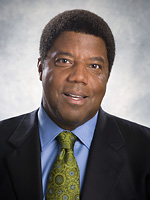
Bio_lloyd_dean_lgYesterday I reported on the situation between Phoenix Bishop Thomas Olmsted and St. Joseph’s Medical Center, which operates in his diocese as a Catholic hospital and whose parent company, Catholic Healthcare West, has been slow to comply with the good bishop’s requirements that it implement in his diocese the U.S. bishop’s Ethical and Religious Directives (ERDs) concerning healthcare as he understands them.

You can read about that here.

What happens will depend in significant measure on the decisions of Lloyd Dean (pictured), the president and CEO of Catholic Healthcare West.

To make a long story short, Bishop Olmsted has threatened to “publicly revoke [his] endorsement of St. Joseph’s Hospital as a ‘Catholic’ hospital.”

The result may already be known by the time you read this (reports on Thursday indicated that the parties were in discussion, trying to work out an agreement), but whichever way it goes, there are some interesting canonical aspects to this case—and we’re likely to hear more about the story in the future.

So let’s get to it . . .
Who Gets to Be a Catholic Hospital?

Some in the press (including folks who should know better), have been claiming that this doesn’t mean that the hospital would have to stop calling itself “Catholic.”

For example, USA Today states:

St. Joseph’s would not be required to stop calling itself Catholic. . . . Numerous Catholic institutions, from universities to hospitals to publications, call themselves Catholic without being affiliated directly with the church. St. Joseph’s has no official connection with the bishop, but it was founded by the Sisters of Mercy, a Catholic religious order.

And the National Catholic Reporter (not Register) states:

St. Joseph’s has no official connection with the bishop, but it was founded by the Sisters of Mercy, a Catholic religious order.

Numerous Catholic institutions, from universities to hospitals to publications, including the National Catholic Reporter, view themselves as Catholic without being directly affiliated with the official church.

The terms “affiliated directly,” “official connection,” and “directly affiliated” are canonically ambiguous. I don’t know what they mean, other than that St. Joseph’s Medical Center (and the Reporter and many other institutions) are not directly owned, operated, or erected by the bishop.

What I do know is that the Code of Canon Law says the following:

Can. 216 Since they participate in the mission of the Church, all the Christian faithful have the right to promote or sustain apostolic action even by their own undertakings, according to their own state and condition. Nevertheless, no undertaking is to claim the name Catholic without the consent of competent ecclesiastical authority.

And:

Can. 300 No association is to assume the name Catholic without the consent of competent ecclesiastical authority according to the norm of can. 312.

The competent ecclesiastical authority for a hospital operating in a particular diocese being the diocesan bishop:

Can. 312 §1. The authority competent to erect public associations is:

1/ the Holy See for universal and international associations;

2/ the conference of bishops in its own territory for national associations, that is, those which from their founding are directed toward activity throughout the whole nation;

3/ the diocesan bishop in his own territory, but not a diocesan administrator, for diocesan associations, except, however, for those associations whose right of erection has been reserved to others by apostolic privilege.

§2. Written consent of the diocesan bishop is required for the valid erection of an association or section of an association in a diocese even if it is done by virtue of apostolic privilege. Nevertheless, the consent given by a diocesan bishop for the erection of a house of a religious institute is also valid for the erection in the same house or church attached to it of an association which is proper to that institute.

The bottom line is that the term “Catholic” implies that an initiative is run or at least accepted and approved by the Catholic Church and that it operates under Catholic theological and moral principles. The Church doesn’t want people misled by initiatives that claim to be Catholic but act in non-Catholic ways (e.g., “Catholics for Choice”). Consequently, to use the name “Catholic” you need the approval of the competent ecclesiastical authority.

It doesn’t matter whether you “call” or “view” yourself as Catholic. You can even be a Catholic institution and yet not have the right to call yourself that, as illustrated by the case of Catholic schools:

Can. 803 §1. A Catholic school is understood as one which a competent ecclesiastical authority or a public ecclesiastical juridic person directs or which ecclesiastical authority recognizes as such through a written document.

§2. The instruction and education in a Catholic school must be grounded in the principles of Catholic doctrine; teachers are to be outstanding in correct doctrine and integrity of life.

§3. Even if it is in fact Catholic, no school is to bear the name Catholic school without the consent of competent ecclesiastical authority.

In light of these canons, the press should avoid such blithe statements regarding whether an institution can licitly be called “Catholic” when the competent local bishop says it is not a Catholic organization.
Who Gets to Interpret the Directives?

Another interesting canonical aspect of the case concerns the interpretation of the USCCB’s Ethical and Religious Directives, which Bishop Olmsted believes were violated. The ERDs do not address every possible medical situation explicitly, and so judgment is required to discern how a particular directive applies to a particular medical case. According to Bishop Olmsted, St. Joseph’s Medical Center violated the following directive (ERD 47):

Operations, treatments, and medications that have as their direct purpose the cure of a proportionately serious pathological condition of a pregnant woman are permitted when they cannot be safely postponed until the unborn child is viable, even if they will result in the death of the unborn child.

Because we aren’t privy to all the medical facts of the case, it’s impossible to determine which parts of this directive Bishop Olmsted believes were not fulfilled (was the direct purpose a cure? was it proportionately serious? could it not be safely postponed? what do we mean by “safely”? was the child already viable? was it not an operation on the mother that left the child intact but instead a direct dismemberment of the child?). Despite this, Bishop Olmsted seems to be making a reasonable claim in asserting that the local bishop has the right, at least in ambiguous cases, to determine the application of the bishops’ directives as they are exercised in his own diocese. It is not practical, on a medically sensitive case, to consult the entire body of U.S. bishops regarding the meaning and application of a directive, and so it would naturally fall to the local bishop to make this call.
How Might This Get Resolved?

Because different bishops might have different takes on the meaning and application of particular directives, this suggests a way that Catholic Healthcare West might respond to Bishop Olmsted’s requirements. As you may recall, his letter to CHW stated:

1. CHW must acknowledge in writing that the medical procedure that resulted in the abortion at St. Josephs’ hospital was a violation of ERD 47, and so will never occur again at St. Joseph’s Hospital.

2. CHW must agree to a review and certification process conducted by the Medical Ethics Board of the Diocese of Phoenix to ensure full compliance with the Ethical and Religious Directives of the USCCB. The Bishop and his representative from the Medical Ethics Board must have appropriate access to their facilities and protocols for review. (As hospitals and health care organizations submit to similar kinds of certifications from the government or from medical oversight organizations, it should not be unusual to have a group from the Catholic Diocese to certify that hospitals run by CHW are in full compliance with Catholic moral teaching).

3. CHW must agree to provide for the medical staff at St. Joseph’s Hospital ongoing formation on the ERD’s, as overseen by either the National Catholic Bioethics Center or the Medical Ethics Board of the Diocese of Phoenix.

If I were CHW, and if I were trying to work out a solution with Bishop Olmsted, I would accede to his second two requirements immediately and, in compliance with the first, I would propose a text like:

Catholic Healthcare West acknowledges that the medical procedure that resulted in the abortion at St. Joseph’s Hospital was a violation of ERD 47 as interpreted by the competent ecclesiastical authority, the local bishop in whose diocese the hospital operates, and so will it never occur again at St. Joseph’s Hospital.

And it would be somewhat hard for Bishop Olmsted to refuse such a formulation since he can scarcely claim to decide for all bishops everywhere how ERD 47 applies to particular medical cases.
What’s Going to Happen Next?

Hard to say, and it depends on what Catholic Healthcare West decides to do, but I expect there to be more on this case.

F’rinstance: CHW also operates another facility—Chandler Regional Hospital—which does not identify itself as Catholic—despite being run by CHW—and which according to Bishop Olmsted, “authorizes sterilizations and I know not what other immoral acts.”

The fact that it doesn’t identify as a Catholic institution—but is nevertheless run by an institution that does identify as Catholic (i.e., Catholic Healthcare West)—creates an interesting canonical situation, and Bishop Olmsted refers to addressing this situation in the near future, saying, “I recognize that my objections to how Chandler Regional operates are more involved, but I would foresee us needing to address those directly in the near future.”

He also (more than once) calls into question whether Catholic Healthcare West can be considered a Catholic organization, leading to another interesting question . . .
How Big Is This Story Going to Get?

You see, the thing is, Catholic Healthcare West is (as its name suggests) an initiative designed to serve the western part of the country, and it operates medical facilities in a variety of dioceses located in California, Arizona, and Nevada.

You can see a list of the facilities here.

Because CHW is a regional rather than a national or local organization, it falls squarely between the cracks of numbers 2 and 3 of Canon 312 §1, quoted above. The fact it operates regionally makes it the concern of more than one bishop, but not the whole conference of bishops. The most logical way to parse the situation is to say that the local facilities it runs are subject to the jurisdiction of the local bishops in whose territories they fall, while its home office is the proper subject of the bishop in whose territory its home office is located—which is to say, Archbishop George Niederauer of San Francisco.

This is why he gets carboned on the letter Bishop Olmsted sent, to keep him in the loop.

Only the situation is more complex than that since the case of a regional entity like this isn’t explicitly dealt with in the Code, and so Rome may need to be involved in how the case is resolved, which is why Archbishop Pietro Sambi (the Vatican’s “nuncio” or ambassador to the United States) is also carboned in the letter, to keep him in the loop.

The stage is therefore set (depending on what CHW decides to do, or has been doing) for this story to “go regional”—spreading across other dioceses in the western U.S., and especially the Archdiocese of San Francisco—or even “go global” (in a sense) if the Holy See gets involved and establishes canonical or moral principles that have application everywhere.

Time will tell.

What do you think?

You Know What the Most Unfair Thing in the World Is?

It's when you're totally exhausted and you're lying in bed trying to fall asleep but you're suffering from a bout of insomnia and you want to fall asleep more than anything and you don't realize it but you actually are asleep, having a nightmare about experiencing insomnia.

GAH!

I've had insomnia ever since I was a boy, but it's really awful when it follows you into your dreams.

UN! FAIR!

And how do I know I was dreaming and not just lying awake, trying to fall asleep?

Well, it's either that or I suddenly teleported from an alternate universe where I was sleeping in Alternate Arkansas in one of the bunk beds my brother and I had when we were boys, even though we never had them in the configuration that was in the "dream" about trying to fall asleep. 

This has to be the worst kind of nightmare. Being chased by an axe murderer? No sweat. Being naked in public? No problem. Realizing you haven't been to a class in college all semester and now it's finals time? I can deal.

But dreaming about not being able to fall asleep?

AAAARGH!

So what's your worst nightmare?

Bishop Threatens Smackdown on Catholic Abortion Hospital

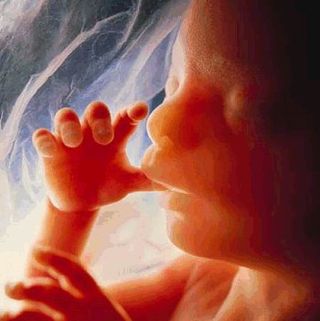
Embryo

Tomorrow (Friday, December 17th) there may be one less Catholic hospital in America.

Why?

Because Bishop Thomas J. Olmsted of the Diocese of Phoenix has set that date as the deadline for Catholic Healthcare West (based in San Francisco) to indicate that it will comply with his demands regarding St. Joseph’s Catholic Hospital, which is in his diocese. If the demands are not met, he will yank the hospital’s status as a Catholic entity.

The situation is based on a story we have covered before (more than once) in which a nun working at the hospital approved an abortion for a woman suffering from pulmonary hypertension. Bishop Olmsted informed her that she had excommunicated herself by the action. Following this, this fact was leaked to the press in an effort to embarrass the bishop and put pressure on him.

According to USA Today, the excommunication has been lifted and the nun reassigned to other duties in the hospital so that she will not be put in the position of approving abortions in the future.

Since that time Bishop Olmsted has attempted to engage Catholic Healthcare West (CHW) to ensure that there are not repeat offenses. On November 22 he wrote a letter to the president of CHW, Lloyd H. Dean (info on him), in which he threatened to remove the hospital’s Catholic status if compliance was not forthcoming. Also copied in the letter are Archbishop George Niederauer, in whose diocese CHW is based, and Archbishop Pietro Sambi, the Vatican’s apostolic nuncio to the US. The letter was subsequently leaked to the press in an effort to embarrass the bishop and put pressure on him.

A scan of the original is here (.pdf).

So what does the bishop say in the letter? It’s quite interesting!

November22, 2010

Lloyd H. Dean, President
Catholic Healthcare Wcst
185 Berry Street, Suite 300
San Francisco, CA 94107

Dear Mr. Dean,

I received your letter dated 27 October 2010 accompanied by the moral analysis from M. Therese Lysaught, Ph.D. [here’s who she is—ja]Undoubtedly, the assessment from Dr. Lysaught is extensive and I appreciate the diligence with which it was drafted. At the same time, however, I disagree with her conclusion. In point of fact, throughout our dialogue and cooperative efforts during these last few months, it is more than apparent that the position of CHW is that discerning minds can disagree. Specifically, you stated in a letter to me dated 6 July 2010, “As you know, many knowledgeable moral theologians have reviewed this case, and reached a range of conclusions. If we may assume that these individuals are motivated by their faith and desire and for justice, one must at least acknowledge that this is a very complex matter, on which the best minds disagree.” Thus, it would appear that your intention is to resolve our disagreement by asserting that there is no single “correct” answer to the question of whether the procedure that led to an abortion at St. Joseph’s hospital was morally permissible under the Ethical and Religious Directives of the USCCB [Bishop Olmsted will later refer to these as the “ERD’s”—ja]. In effect, you would have me believe that we will merely have to agree to disagree. But this resolution is unacceptable because it disregards my authority and responsibility to interpret the moral law and to teach the Catholic faith as a Successor of the Apostles.

The decisions regarding life and death, morality and immorality as they relate to medical ethics are at the forefront of the Church’s mission today. As a result, the Church and her bishops have a heightened moral responsibility to remain actively engaged in these discussions and debates. I have attempted to do my part in calling CHW and your hospitals to uphold the dignity of human life, and to embrace the fullness of what the Catholic Church teaches on the immorality of those actions that are an affront to the gift or human life and its inherent goodness from God. The irony of our present state of affairs is that an organization that identifies itself as “Catholic” (CHW) is operating a hospital in my Diocese that does not abide by the ERD’s, and in the case of St. Joseph’s Hospital, has actively engaged in an abortive procedure that is immoral. Thus far, you (CHW) have insisted that you are not doing anything wrong, but that your interpretation of the ERD’s simply differs with my own. According to Catholic teaching though, there cannot be a “tie” so to speak in this debate. Rather, it is my duty as the chief shepherd in the diocese to interpret whether the actions at St. Joseph’s and other hospitals meet the criteria or fulfilling the parameters or the moral law as seen in the ERD’s.

Until this point in time, you have not acknowledged my authority to settle this question but have only provided opinions of ethicists that agree with your own opinion and disagree with mine. As the diocesan bishop, it is my duty and obligation to authoritatively teach and interpret the moral law for Catholics in the Diocese of Phoenix. Because of this, the moral analyses of theologians are important elements that should assist and inform a bishop in the exercise of his teaching authority. However, it is ultimately the authority of the bishop as teacher and pastor that is determinative, something you yourself have rightly recognized. While the issues discussed in the moral analysis you provided are certainly technical and deeply philosophical, they are also foundationally “theological.” And the theology of the Catholic Faith, as concretized in the Code of Canon Law, dispels any doubt whose opinion on matters of faith and morals is decisive for institutions in the Diocese of Phoenix.

It is now my position that our deliberations regarding the tragic abortion at St. Joseph’s Hospital have gone on for far too long, and I believe that there is little hope that you intend to conclude that this case constitutes a violation of the ERD’s. Similarly, as you are aware, since my arrival in the Diocese of Phoenix, I have sought to engage you and the officials at CHW on the topic of my absolute objection to CHW operating hospitals without following the ERD’s; namely my objections to your administration of Chandler Regional Hospital, where as an organization calling itself “Catholic,” CHW authorizes sterilizations and I know not what other immoral acts. I continue to find this particular arrangement deeply troubling. I see no basis to conclude other than that there is no intention on the part of CHW to modify or change its operations at Chandler Regional.
However, in keeping with my moral authority as Bishop of Phoenix and my interpretation of the ERD’s based on that authority, I have determined after review of the facts and circumstances that an abortion did occur at St. Joseph’s. Additionally, my efforts to convince you of the impossibility of a “Catholic” organization to operate in such a way as to not adhere to the ERD’s, has fallen on deaf ears with no apparent progress in more than six years. If actions speak louder than words, your actions communicate to me that you do not respect my authority to authentically teach and interpret the moral law in this diocese. Moreover, your actions imply that you have no intention to acknowledge that what happened at St. Joseph’s hospital was morally wrong according to the ERD’s. Subsequently, this would entail that you will not change your mode of operation in assessing future cases in which similar circumstances are present.

In sum, my interpretation of where we stand at this point is that you would have me accept that: A) while tragic, what happened at St. Joseph’s Hospital was unfortunate, but an acceptable occurrence in line with the ERD’s. Further, if the same scenario would present itself again, your administration would likely carry out the same measures with the same result. B) Chandler Regional Hospital does not have to explicitly abide by the ERD’s since it is not a “Catholic” hospital, even though operated by “Catholic” Healthcare West.

The conclusion I take away from this analysis is that you do not intend to change anything. While my objections and our correspondence have garnered your undivided attention, you have discounted my legitimate authority. Because of this I must now act. I do so not only to assure that no further such violations of the ERD’s occur, but also to repair the grave scandal to the Christian faithful that has resulted from the procedure that look place at St. Joseph’s and the subsequent public response of CHW.

Accordingly, I now ask that CHW agree to the following requirements by Friday, December 17, 2010. Only if all of these items are agreed to, will I postpone any action against CHW and St. Joseph’s Hospital. Specifically, I require the following in order for me to postpone any further canonical action directed against St. Joseph’s Hospital:

1. CHW must acknowledge in writing that the medical procedure that resulted in the abortion at St. Josephs’ hospital was a violation of ERD 47, and so will never occur again at St. Joseph’s Hospital.

2. CHW must agree to a review and certification process conducted by the Medical Ethics Board of the Diocese of Phoenix to ensure full compliance with the Ethical and Religious Directives of the USCCB. The Bishop and his representative from the Medical Ethics Board must have appropriate access to their facilities and protocols for review. (As hospitals and health care organizations submit to similar kinds of certifications from the government or from medical oversight organizations, it should not be unusual to have a group from the Catholic Diocese to certify that hospitals run by CHW are in full compliance with Catholic moral teaching).

3. CHW must agree to provide for the medical staff at St. Joseph’s Hospital ongoing formation on the ERD’s, as overseen by either the National Catholic Bioethics Center or the Medical Ethics Board of the Diocese of Phoenix.

Failure to fulfill these three requirements will lead me to decree the suspension of my endorsement of St. Joseph’s Hospital, forcing me to notify the Catholic faithful that St. Joseph’s Hospital no longer qualifies as a “Catholic” hospital because of its failure to acknowledge the Bishop’s right and duty to judge whether the ERD’s are interpreted and implemented correctly. This is a decision that will be immensely difficult for me, but one that I can and must make. I intend to publicly revoke my endorsement of St. Joseph’s Hospital as a “Catholic” hospital unless I hear from you by Friday, December 17, 2010. Only when you agree to all three terms as described above, will I agree to refrain from my public announcement regarding the status of your Catholic identity. A revocation of my endorsement of St. Joseph’s Hospital would necessitate the following actions:

• Removal of the Blessed Sacrament from all Chapels and Tabernacles at St. Joseph’s Medical Center.

• Prohibition of all Masses celebrated in Chapels within St. Joseph’s Medical Center.

• Public advisory from the Bishop’s Office issued through the Catholic Sun Newspaper and website that St. Joseph’s no longer qualifies as a “Catholic” hospital.

• Priestly ministry and other ministry to the sick will most certainly continue within St. Joseph’s Hospital, as it does in any hospital when the sacraments or pastoral care are requested by patients.

As for Chandler Regional, I simply invite you to put into motion a process for chancing your modus operandi with respect to the implementation of the ERD’s at Chandler Regional. While my decision regarding Catholic identity does not affect Chandler Regional in the same way, the issues about which we disagree are also related to the authentic identity or CHW as a whole. I recognize that my objections to how Chandler Regional operates are more involved, but I would foresee us needing to address those directly in the near future.

As the chief shepherd of the Diocese of Phoenix, I sincerely hope that you will respect my authority to be vigilant over all entities wishing to represent themselves as Catholic organizations. For the sake of the salvation of souls and in the interest of justice for the scandal that this present arrangement has created amongst the Catholic community, I ask you to reconsider your position and adhere to my requests.

Sincerely yours in Christ,
Thomas J. Olmsted
Bishop of Phoenix

cc: Most Reverend George H. Niederauer, Archbishop of San Francisco
Most Reverend Pietro Sambi, Apostolic Nuncio of the United Sites

There’s quite a bit that can be said here. This is a very interesting case, canonically. I’ll have more to say about this in a forthcoming post, but for the moment let me just say how good it is to see a bishop being so diligent and forthright regarding this case.

Go Team Olmsted!

What are your thoughts?

America’s 1st Approved Apparition Was WHAT???

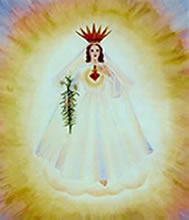
Mary2Yesterday’s news reports that Our Lady of Good Help had just become America’s first approved apparition caused many folks to do a doubletake.

Some wondered whether Our Lady of Guadalupe should count as such since Mexico is part of North America. If one wants to say that Guadalupe was North America’s first approved apparition, fine. However, one can’t say Guadalupe was “America’s” first approved apparition since, when used in the singular, “America” refers to the United States of America. The continent Mexico is part of is “North America,” and the overall landmass that includes “South America” is known as “the Americas” (plural, with the definite article).

But enough linguistic hairsplitting!

Others had the question, “What about Our Lady of America? Wasn’t that already approved?”

The short but understandably surprising answer is “no.” It’s not approved.

“But didn’t then-Archbishop/now-Cardinal Raymond Burke issue a letter in 2007 that said it was approved?”

Again, the short but understandably surprising answer is “no.” He didn’t.

The reason that the answer is understandably surprising is that he did in 2007 send a letter to the U.S. bishops explaining Our Lady of America, speaking highly of it, and noting that the devotion connected with it has been approved, but this is not the same as saying that apparition itself is approved.

Am I just linguistic hairsplitting again?

Not according to the Holy See—or, more specifically, the Congregation for the Doctrine of the Faith. I’m actually articulating a point that the CDF wants people to understand.

Lemme ‘splain.

Back in 1978 the CDF issued an instruction on apparitions which was privately (sub secreto) circulated to the bishops of the world. Because it was so widely circulated, it was leaked, which means that now you can read a copy of it in English here. These represent the norms currently in force to guide bishops in dealing with apparitions.

So what do the norms say?

A key passage describes a three-stage process that apparition approval is to follow (assuming the approval happens at all; the process can be aborted at any stage):

So that the ecclesiastical authority is able to acquire more certainty on such or such an apparition or revelation, it will proceed in the following way:

a) Initially, to judge the facts according to positive and negative criteria (cf. below, n.1).

b) Then, if this examination appears favorable, to allow certain public demonstrations of cult and devotion, while continuing to investigate the facts with extreme prudence (which is equivalent to the formula: “for the moment, nothing is opposed to it”).

c) Finally, after a certain time, and in the light of experience, (starting from a particular study of the spiritual fruits generated by the new devotion), to give a judgement on the authenticity of the supernatural character, if the case requires this.

Stage 1 is thus for the bishop to do an initial investigation. If that checks out then in Stage 2 he may provisionally authorize public demonstrations of cult and devotion in connection with the apparition while continuing a diligent examination. Then, after more time and investigation, should the circumstances warrant, he may in Stage 3 approve the apparition itself.

The final Stage 3 approval of the apparition is distinct from the provisionary Stage 2 authorization of public devotion. That is why the CDF norms gloss this authorization by saying it is equivalent to “for the moment, nothing is opposed to it.”

“For the moment, nothing is opposed to it” is not the same as what Bishop Ricken said yesterday concerning Our Lady of Good Help, which was:

It remains to me now, the Twelfth Bishop of the Diocese of Green Bay and the lowliest of the servants of Mary, to declare with moral certainty and in accord with the norms of the Church:

that the events, apparitions and locutions given to Adele Brise in October, 1859 do exhibit the substance of supernatural character, and I do hereby approve these apparitions as worthy of belief (although not obligatory) by the Christian faithful.

That’s a Stage 3 approval: The apparition itself, not just devotion connected with it, has been recommended to the faithful as worthy of (non-obligatory) belief.

So what is the status of Our Lady of America?

Basically, it’s at Stage 2—the same stage that Our Lady of Good Help was at until December 8th. Some years ago the local bishop (who was himself the seer’s former spiritual director) authorized devotion connected with Our Lady of America, and granted an imprimatur to a book connected with it (which is a totally separate issue, canonically), but neither previous local bishops nor the current local bishop has given Stage 3 authorization to the apparition itself.

If you read now-Cardinal Burke’s letter carefully (you can read it here), he is careful always to speak of the devotion having been approved. He never says that the apparition itself has been approved.

That’s because of its Stage 2 status. The local bishop (who was not Burke; this was when Burke was Archbishop of St. Louis, but the Our Lady of America phenomena were reported in the dioceses of Fort Wayne and Toledo) had not proceeded to Stage 3. Burke is thus giving an interesting and supportive treatment of the apparition and the devotion connected with it, but he only claims formal approval for the devotion.

This distinction is one that the CDF wants the public to understand because a little later on in the norms it has more to say about Stage 2 situations. Section II, 2 of the document states:

At the legitimate request of the faithful (when they are in communion with their pastors and are not driven by a sectarian spirit), the competent ecclesiastical Authority can intervene to authorize and promote various forms of worship and devotion if, assuming the criteria given above having been applied, nothing is opposed to it. But there must be vigilance nevertheless, to ensure that the faithful do not regard this way of acting as an approval by the Church of the supernatural character of the event in question. . . .

So the distinction between Stage 2 approval (of devotion related to the apparition) and Stage 3 approval (of the supernatural character of the apparition) is something that the CDF itself wants the public to understand.

Presumably, the CDF expects bishops granting Stage 2 approval to stress the difference between the two, so that the public understands.

It is evident from the confusion in this case, though, that more work needs to be done in alerting the public to this difference.

BTW, in his letter on Our Lady of America Cardinal Burke alludes to some question of the canonical status of a “community” (actually, it appears to be just one person) promoting Our Lady of America. He rightly notes that the status of this community is a separate canonical question from whether the devotion has been approved. But this passage in his letter is bound to raise curiosity about what the issues are connected with this community and what the current local bishops’ stand is. Therefore . . .

HERE’S A STATEMENT FROM THE DIOCESE OF TOLEDO ON THE SITUATION

What are your thoughts?

Diocesan Statement On OLA Center

STATEMENT OF THE DIOCESE OF TOLEDO REGARDING THE CENTER DEVOTED TO “OUR LADY OF AMERICA” IN FOSTORIA (SENECA CO.), OHIO

In response to a number of inquiries which have been received, the Diocese of Toledo wishes to provide the following clarifications:

  • References have been made in promotional materials to The Our Lady of America center in Fostoria (Seneca Co.), Ohio. However, it should be noted that the Diocese of Toledo has never been asked to give, nor has it given, any approbation or recognition to the center or its activities.
  • References have also been made in promotional materials to “The Contemplative Sisters” of Our Lady of the Nativity Convent in Fostoria.  It should be pointed out that there is no canonically recognized religious community connected with the center.  There is one individual, Patricia Ann Fuller, who identifies herself as Sister Joseph Therese.  She is not a member of a canonical institute of consecrated life, having been dismissed from the Society of the Precious Blood community in 1982 after she and two other sisters, now deceased, left the order to live their own contemplative way of life.
  • Patricia Ann Fuller maintains that she has continued to live as a Religious, and that it is her intention eventually to found a new community of women devoted to the promotion of “Our Lady of America.” At this point, no canonical steps have been requested or taken in this regard. Patricia Ann Fuller has met with Bishop Blair of Toledo and has assured him of her desire to act in full harmony with the Church.
  • In a letter to the Bishops of the United States dated May 31, 2007, Archbishop Raymond Burke offered his positive assessment of the history and content of devotion to Our Lady of America. The following words of Archbishop Burke have the full endorsement of Bishop Blair of Toledo: “Some have raised with me the canonical question regarding the status of Our Lady of the Nativity Convent in Seneca County, Ohio, which has been the residence of any remaining member of the suppressed contemplative branch of the Congregation of Sisters of the Most Precious Blood of Jesus. In response, I observe that the canonical question has no bearing on the devotion or its approbation.”

September 10, 2008


America Gets Its 1st Approved Apparition!

OlghYippie!

Approved apparitions are cool!

The apparition took place in 1859 in what is now the Diocese of Green Bay, Wisconsin. For the last two years a diocesan commission has been evaluating its authenticity, and on Wednesday (Dec. 8, the feast of the Immaculate Conception), Bishop David Ricken announced its approval.

Apparently, he was surprised to learn that this was the first such approval of an apparition in the United States. He also reportedly was surprised to learn that it hadn’t already been approved since his predecessor bishops had supported it (albeit without giving it formal approval—note well that this is something that can happen; just because a bishop says something nice about an apparition does not mean it has been formally approved).

As this is the first American approval of an apparition, it is instructive to see the kind of language that Bishop Ricken used (most other such approvals were done pre-Internet and/or in other languages and thus have not been seen by most).

THE COMPLETE TEXT OF HIS DECREE CAN BE READ HERE (.pdf)

After the bishop briefly reviews the history of the apparition and the investigation of it, he arrives at the money part:

It remains to me now, the Twelfth Bishop of the Diocese of Green Bay and the lowliest of the servants of Mary, to declare with moral certainty and in accord with the norms of the Church:

that the events, apparitions and locutions given to Adele Brise in October, 1859 do exhibit the substance of supernatural character, and I do hereby approve these apparitions as worthy of belief (although not obligatory) by the Christian faithful.

These Marian apparitions are now commemorated under the title “Our Lady of Good Help,” and there is a corresponding shrine in Champion, Wisconsin.

So what happened in 1859?

A young woman named Adele Brise—28-year old Belgian immigrant to what was then the American frontier—was taking wheat to a local mill when she saw a lady in white standing between two trees (and, yes, she did report the lady as having golden hair in the vision, which would most likely be based on Adele’s ethnic background). The lady then vanished. She saw the same thing the next day. At first Adele thought the lady might be a soul in purgatory who needed prayers, and she was frightened. She communicated this to several people, one of whom, a local priest,

told her that if it were a heavenly messenger, she would see it again, and it would not harm her, but to ask in God’s name who it was and what it desired of her.


Note that these are a paraphrase of the two classic, basic questions, “Who are you?” and “What do you want?” (I once recommended the same questions to a child who called in to Catholic Answers Live reporting that he heard a voice from an unknown source—if the voice came back. Unfortunately, I never heard whether it did or what the voice answered. But I’m glad to see the advice I gave in modern times echoed in this case. They seem to me the best questions to ask of an unknown, possibly supernatural agency.)

Meanwhile, back in 1859, what happened next?

After that, Adele had more courage. She started home with her two companions, and a man who was clearing land for the Holy Cross Fathers at Bay Settlement accompanied them.

“As they approached the hallowed spot, Adele could see the beautiful lady, clothed in dazzling white, with a yellow sash around her waist. Her dress fell to her feet in graceful folds. She had a crown of stars around her head, and her long, golden, wavy hair fell loosely around her shoulders. Such a heavenly light shone around her that Adele could hardly look back at her sweet face. Overcome by this heavenly light and the beauty of her amiable visitor, Adele fell on her knees.

” ‘In God’s name, who are you and what do you want of me?’ asked Adele, as she had been directed.

“ ‘I am the Queen of Heaven, who prays for the conversion of sinners, and I wish you to do the same. You received Holy Communion this morning, and that is well. But you must do more. Make a general confession, and offer Communion for the conversion of sinners. If they do not convert and do penance, my Son will be obliged to punish them’

“ ‘Adele, who is it?’’ said one of the women. ‘O why can’t we see her as you do?’ said another weeping.

“ ‘Kneel,’ said Adele, ‘the Lady says she is the Queen of Heaven.’ Our Blessed Lady turned, looked kindly at them, and said, ‘Blessed are they that believe without seeing. What are you doing here in idleness…while your companions are working in the vineyard of my Son?’

“ ‘What more can I do, dear Lady?’ said Adele, weeping.

“ ‘Gather the children in this wild country and teach them what they should know for salvation’

“ ‘But how shall I teach them who know so little myself?’ replied Adele.

“ ‘Teach them,’ replied her radiant visitor, ‘their catechism, how to sign themselves with the sign of the Cross, and how to approach the sacraments; that is what I wish you to do. Go and fear nothing. I will help you.’”

The manifestation of Our Lady then lifted her hands, as though beseeching a blessing for those at her feet, and slowly vanished, leaving Adele overwhelmed and prostrate on the ground [SOURCE].

And that was all, in terms of the apparitions. They were short and straightforward.

Following this, Adele devoted herself wholeheartedly and despite obstacles to her mission of educating children. She became a Third Order Franciscan Sister. Many people began to hold pilgrimages to the site, where a shrine was built. Healings were reported, and twelve years later the site of the shrine was spared from a tremendous wildfire that scorched large swaths of forest around it.

And so, given the convergence of (1) the (obvious) compatibility of the message with the Christian faith, (2) the revolution in the life of Sr. Adele, and (3) the apparent fruit—including apparent answered prayer—that followed the apparition in the lives of others, Bishop Ricken approved the apparition, concluding with “moral certainty” (not absolute certainty) that it was of divine origin and could be recommended to the faithful as such, though this recommendation does not carry an obligation of belief. One is free to discount the idea that the apparition is of supernatural origin, and in doing so one does not sin.

While apparitions differ from one to another, it may be noted that this case corresponds fairly closely to the core paradigm for approved Marian apparitions, which may be phrased along these lines: On a limited number of occasions, the Virgin Mary appears to a young, uneducated person—usually female—and imparts a message of that proclaims no new doctrine but instead conveys both warning and consolation focusing on the salvation of souls and suggesting a way to promote this; the life of the visionary is revolutionized, and the visionary pursues some form of religious vocation (if not already undertaken); the visionary seeks the guidance of competent authorities in the evaluation of the manifestations and is obedient to ecclesiastical authority; some form of further evidence of answered prayer or the miraculous is forthcoming.

So.

America gets its first approved apparition. Kewl beans.

And, its a straightforward and uncomplicated one that should be uncontroversial and thus serve to highlight it as a useful spiritual signpost. Kewler still.

OFFICIAL SITE OF THE SHRINE.

BIO OF THE VISIONARY, ADELE BRISE.

ACCOUNT OF THE APPARITIONS.

REGISTER COVERAGE.