SAYS THE DEMS NEED TO "GET" RELIGION.
Say a bunch of other insightful things, too.
Wonder if this’ll show up on The McLaughlin Group.
(Too bad I can’t stand watching that show.)
SAYS THE DEMS NEED TO "GET" RELIGION.
Say a bunch of other insightful things, too.
Wonder if this’ll show up on The McLaughlin Group.
(Too bad I can’t stand watching that show.)
. . . and I enjoy reading his stuff. Have several of his books on my shelves.
He also does a little politics, and from what I have seen his politics are far more sane than another linguist-turned-political-commentator (Noam Chomsky).
IN THIS ARTICLE MCWHORTER ARGUES WHY AFRICAN-AMERICANS NEED TO BECOME A SWING VOTE.
He’s right. At present African-Americans vote so solidly for one party that neither party is incentivized to go out of its way to foster their interests. The way to gain influence with parties is to make it clear to them that you will not support them if they don’t look out for your interests.
That’s one reason I’m happy that the Catholic vote can’t presently be taken for granted by either party. In the old days, Catholics voted solidly Democrat–and they got taken for granted. Now they are starting in a greater way to vote based on principle (e.g., support of life issues) than on partisan grounds. This means that both parties have a reason to take the principled Catholic voter seriously, as he represents a body that–like Evangelicals–can swing an election.
Republicans cannot take pro-lifers for granted either. Almost enough Evangelicals stayed home in 2000 to cost Bush the election. This time the GOP get-out-the-vote effort focused strongly on Evangelicals. The same clout will be wielded by pro-life Catholics in future elections if real progress (in the form of anti-Roe SCOTUS appointments) is not made in advancing the pro-life cause.
Catholics will have this clout as long as they vote–or withhold their votes–based on principle rather than on party.
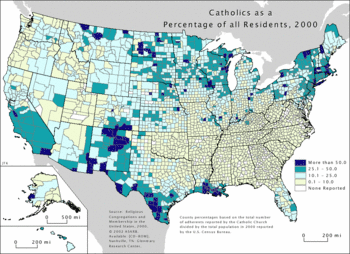
Down yonder a reader points us to a map of where the Catholics are by county. Here ’tis:
Click the image to enlarge.
Down yonder a reader points us to a map of where the Catholics are by county. Here ’tis:
Click the image to enlarge.
THE HORROR . . . THE HORROR . . .
UPDATE! The folks who brought you Microsoft Bob now plan to create a search engine to compete with Google.
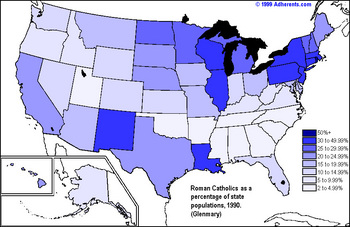
Since we’ve been looking at maps of the U.S. with different data on them, let’s look at where Catholics live.
Click the map to enlarge.
Incidentally, don’t forget that population density doesn’t tell you overall population. For example, my home state of Texas is less Catholic-dense than neighboring states Louisiana and New Mexico, but its population is so much larger that it has more total Catholics. Rhode Island, by contrast, is the most Catholic-dense state in the nation, but its population is so tiny that most states have more Catholics than it does.
Since we’ve been looking at maps of the U.S. with different data on them, let’s look at where Catholics live.
Click the map to enlarge.
Incidentally, don’t forget that population density doesn’t tell you overall population. For example, my home state of Texas is less Catholic-dense than neighboring states Louisiana and New Mexico, but its population is so much larger that it has more total Catholics. Rhode Island, by contrast, is the most Catholic-dense state in the nation, but its population is so tiny that most states have more Catholics than it does.
Getting a thumbs up from Usama bin Laden probably didn’t help the film’s chances at the Oscars, either.
A reader writes:
Is it a virtue (minor as it may be) to have or possess "good manners", ie, decent table manners?
It seems to me that if one has never had the opportunity to have been "taught" good manners, then no one would expect such niceties. (For instance, someone in a remote area that has not had any need or exposure to the Western idea of good table manners.) but, on the other hand, if someone has grown up in a culture that has placed some value on nice table manners – and has been taught them as such, and if that person were a Christian, it might be considered part of his/her Christian duty to display these nice manners out of concern for others, (ie, by not grossing-them-out with unsightly table manners – or lack there of.)
This "concern for others" might be interpreted as part of the virtue of charity for others – not just thinking of oneself , and what is easiest or most comfortable for oneself, if others is not important to him/her.
The following thoughts occur to me:
1) Humans need to interact with each other in a smooth manner.
2) In many circumstances, manners and etiquette facilitate smooth interaction with humans.
3) Therefore, in many circumstances humans need manners and etiquette.
4) To faciliate human needs is an act of charity.
5) Therefore, in many circumstances manners and etiquette are a matter of charity.
6) Whatever is a matter of charity is a virtue.
7) Therefore, in many circumstances manners and etiquette are a matter of virtue.
This being said, several additional thoughts suggest themselves:
8) Manners and etiquette tend, by their nature, to be either largely or completely arbitrary. They are like driving on the right or the left side of the road. Neither is markedly better than the other in and of itself, but only due to common usage. Therefore, manners and etiquette should not be looked upon as sacrosanct. In some cultures, burping during a meal is considered rude, while in others it may be considered a sign of appreciation for the food one is eating.
9) The seriousness with which a particular set of manners should be taken depends on the circumstances. For example, it is of the utmost importance that proper protocol be observed when negotiating a peace treaty between nations, but far less significant when close friends or family members are interacting in a private setting. In the former setting, the consequences of a violation (e.g., loss of human life) are greater and the amount of tolerance that may be expected is lower. In the latter setting, the consequences are lower (e.g., loss of human life) is lesser and the amount of tolerance that may be expected is greater.
10) There is such a thing as placing too much weight on manners and etiquette. The whole point of manners and etiquette is that they facilitate certain human goods, but if the niceties of social interaction take precedence over these good or other equal goods then they are becoming counterproductive. Some individuals in particular may be sufficiently concerned with the proper observance of "the rules" that sight is lost of the goods that these rules are intended to foster. For example, it is considered rude to yell at a person, but if a child is about to do something highly dangerous, yelling is appropriate. Observing the "Don’t yell" rule in that case would endanger the child.
11) The relaxation of the rules in particular cases therefore itself cann be a matter of charity. It is not charitable to insist on the observation of standard etiquette rules (e.g., not yelling at a person) when a greater good is at stake (e.g., a child wandering into traffic).
12) We have a greater incentive to relax the rules with those closest to us, both because we have a greater duty to look after their interests (as with a child who may stray into traffic) or because we stand to benefit from them in a greater manner (as with spouses). Therefore, with those closest to us we generally both assume greater tolerance and show greater tolerance.
13) Simultaneously, since (as Aquinas points out) we have a greater duty of love toward those closest to us, we have a greater motive to observe the rules of manners and etiquette with regard to them.
There is thus something of a paradox in the calculus of charity: We should show greater charity for those closest to us, which leads to both a motive for greater observance of the rules and greater tolerance of their violation.
Oh, and one las thing:
14) Men, by nature, tend to be less concerned with manners than women. That’s not to say that they are unconcerned, just less concerned. Probably has something to do with the fact that men are physically and psychologically designed to provide the primary family defense functions.
In the wake of the recent Democratic defeat there are sure to be calls for the abolition of the electoral college and its replacement with the election of the president by a direct vote with a simple majority.
The way the electoral college works, the president is elected by a majority vote of the electors. Each state has one elector per member in the House of Representatives plus one elector per member of the Senate. States have members of the House based on their population (with the stipulation that each state has at least one), with a total of 435 House members. But the Senate does not have proportional representation. Each state has two senators, regardless of its population. With fifty states, that means a hundred senators. The District of Columbia also gets three electors, so 435 + 100 +3 = 538, the current number of electors.
Of those, you need a simple majority, or 270 for a clear win. (If there is a tie, then there is a special procedure in which the House picks the president and the Senate picks the vice president, but let’s not go there.)
Now, a word about the way the House and the Senate: As you likely know, the reason that the House has proportional representation and the Senate does not is that it’s an attempt to balance the interests of the many with the interests of the few. The fact that populous states get more representatives in the House means that the interests of populous states get looked after. The fact that all states have equal representation in the Senate means that the interests of low-population states are looked after, so that the representatives of a simple majority of the population can’t simply step on the interests of the low-population states.
A similar role is played in the electoral college by having electors corresponding to a state’s Senate representation. It keeps the electoral college from having purely proportional representation and thus helps balance the interests of high and low population states.
That’s a good thing.
Here’s a map I came up with illustraing why:
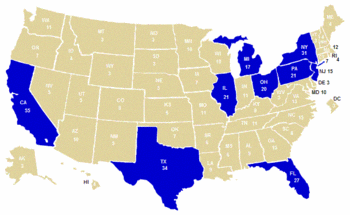
The blue colored states are what you might call "the Big 9"–i.e., the states with the most population. Together, the Big 9 have more than 50% of the U.S. population in them. The other 41 states–"the Little 41," as we might say–have just under 50%.
Since the Big 9 have nowehere near 50% of the U.S. landmass, the only way they can have more than 50% of the population is for them to have Big Cities in them. They are Urbanized (even Texas and California, though to a lesser degree than the northeastern blue states in this illustration).
(FWIW, the states are not all shown to scale due; Alaska in particular should be way bigger.)
Here is why we need the electoral college: It’s a way of protecting the small (less populous) states from domination by the giant (high population) ones. All a candidate would need to do to win the presidency with a simple majority of the population vote would be to get the votes of the Big 9 (e.g., by making them elaborate promises to be paid for by the Little 41) and then he could completely ignore the interests of the Little 41.
In practice, of course, no candidate would get all and only the votes of the folks in the Big 9. His opponent would get some of those votes as well, but then he himself would get some votes in the Little 41, so the principle still remains: By targeting just these nine states, which in the main are urbanized or at least contain large urban centers, a candidate could win the presidency and completely ignore the interests of the Little 41.
The electora college prevents that from happening by giving the Little 41 extra clout in the presidential election, meaning that a broader mix have their interests taken into account than otherwise would happen. It’s not a perfect system, but there’s a logic to it that you might want to be aware of the next time you hear someone calling for the abolition of the electoral college.