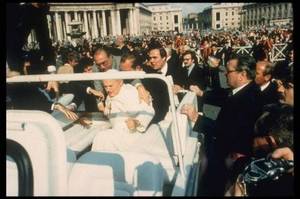
 May 13.
1981.
The day the pope was shot.
This is a picture that was taken just after the horrible incident.
But it was an event that rehaped the future course of the 20th century.
May 13.
1981.
The day the pope was shot.
This is a picture that was taken just after the horrible incident.
But it was an event that rehaped the future course of the 20th century.
 Lemme tell you a story: Here in San Diego there is a place called Mission Valley, which is where Mission San Diego ("California’s First Church") is located. (It–the church, not Mission Valley–was built over 200 years ago, before the founding in the U.S.)
I used to live right next to Mission San Diego and thus in Mission Valley.
Down the midst of Mission Vallue is the I-8 interstate.
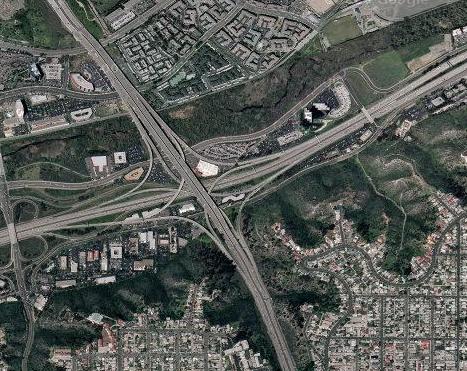
Bisecting Mission Valley along its north-south axis is the 805 freeway.
The 805 doesn’t cross the bottom of Mission Valley, though. Instead, flung across the valley is a huge bridge, (what seems like) hundreds of feet in the air.
I get a little nervous whenever I have to cross the Mission Valley Bridge. (I once saw a too-quickly-lane-changing pickup there flip over right in front of me, killing the man and pregnant woman inside it.)
But it’s a major traffic exchange point in San Diego (photographed above by satellite), and when I lived in Mission Valley, I regularly used it.
Particularly because had friends who lived on the north side of Mission Valley, right near where the 805 bridge rejoins solid ground.
It was really convenient to go over to their house! I’d just get on the I-8, head towards the Mission Valley Bridge, and then zoom up ramp to the 805 and the point where their house was.
On the way home afterwards, I’d head down the Mission Valley Bridge, take the exit ramp curving down to the I-8, and in a few minutes I’d be home.
Now: One Friday night I was heading down the 805/Mission Valley Bridge ramp and my car (didn’t have a pickup at the time) suffered a DOUBLE BLOW-OUT. Both of my rear tires popped.
Quickly, I worked my way into the emergency lane and stopped the car. I got out to see if I could change the tires and discovered this was impossible. Not only did I not have two spares, the car consumed the entire width of the emergency lane on the bridge, meaning that my body would have to hang out into Friday night traffic if I even attempted to change the tires.
Not a good solution.
I therefore started trudging back up the incline until I reached an emergency callbox, where I could call for help. (This was in the ’90s, before I had a cell phone.)
After trudging up half a mile or so (that’s how big the bridge is), I finally reached the callbox and summoned a tow-truck. I then returned to my car to wait.
At this point in my life, I was (foolishly) suppressing the Southern elements in my speech, except that they would come out when I was either very relaxed or under stress. Needless to say, I was twangin’ up a storm by the time the tow-truck guy arrived.
Once he got there, I waited in the cab of the truck and he used it’s mechanism to slide a big metal plate under my car, which the truck then lifted up and redeposited it onto the back of the truck.
As it picked my car up off the roadway and redeposited it, the truck vibrated MIGHTILY, ROCKING BACK AND FORTH IN THE EMERGENCY LANE PRECIPITOUSLY, WITH ME IN THE CAB LOOKING DOWN INTO (WHAT SEEMED LIKE) HUNDREDS OF FEET OF DARKNESS OVER THE CONCRETE RAILING AND SAYING PRAYERS TO WHOEVER THE PATRON SAINT OF BRIDGE-BUILDING MIGHT BE (St. Patrick, among others, as I later determined).
The tow-truck guy towed me home in mere minutes, and all was well that ended well. (I bought new tires the next day.)
Now: What brings this story to mind?
When I was walking up the incline to get to the emergency phone, I noticed something very disturbing: The Mission Valley Bridge . . . BOUNCED.
As cars would zoom past me toward whatever Friday night merriments they had planned, the roadway under my feet . . . BOUNCED. It wasn’t rigid. It was made out of concrete, of course, but still it . . . BOUNCED.
In earthquake-prone California, bouncy bridges are important.
The reason is that structures that have a little "give" in them have less of a tendency to break. That’s why the wings of an airplane are designed to bounce when they encounter turbulence. If they were rigid, they’d snap off. I therefore know I’m safer if I’m sitting over the wings and see them bouncing–thought I still don’t like it. It annoys my pre-reflective sensibility that rigid structures are stronger than flexible structures.
 Tonight I was thinking about this because I ran across
A STORY ABOUT EXTRA-FLEXIBLE CONCRETE.
It may not have the zing of transluent concrete, but it’s zingy (and bouncy) enough.
EXCERPTS:
By mixing fiber in concrete scientists have created a bendable material that is lightweight, resists cracking, and lasts longer.
Fiber-reinforced concrete is not new. But this variety, developed at the University of Michigan, is said to be 500 times more resistant to cracking than what your sidewalk is made of. It’s also 40 percent lighter.
The stuff is called Engineered Cement Composites (ECC).
The Michigan Department of Transportation (MDOT) will use the ECC to replace part of a bridge that crosses Interstate 94. The slab will eliminate the need for expansion joints, which are moveable steel teeth that separate sections of regular concrete. With the ECC, a longer continuous slab will be possible.
The Mihara Bridge, a new structure in Hokkaido, Japan, has a deck of ECC that is a mere 2 inches (5 centimeters) thick. It is expected to open this month.
God bless the folks who have blow-outs on the Mihara Bridge!
HIGHLIGHTS:
HIGHLIGHTS:
Suppose that you are an accountant at a defense contractor working on a really hush-hush but very exciting new project to protect Earth from pesky flying saucers.
Then you go out and get married. You’re a good Catholic, and you and your wife want to have kids right away, and you do! Soon you have a bouncing baby bundle of baptized joy.
Now, accountants make a good bit of money, but with the new family, it’s time for a raise.
You go to your boss and point out that Catholic social teaching holds that in determining a just wage, both the contributions and the needs of an individual must be taken into account.
Being a good Catholic himself, he happily agrees. After all, he point out, you’re a good accountant, you have on-the-job knowledge of how this company works, and it would be harder to go out and get and then break-in a new accountant than to accomodate your request for a raise.
You’re now making (a bit) more than the other accountants in the department, who are all single (for some reason).
Then you’re abducted by aliens.
They brain-poison you so that your sense of personal prudence is severely damaged.
You’re still an ace #1 crackerjack accountant–one of several in your department–but when it comes to your personal finances, you’re now a total nitwit.
So you go to VegaVegas and rack up hundreds of thousands of dollars in gambling debts.
You purchase a lavish mansion and a Rolls-Royce.
You adopt twenty-five special needs babies who require extensive medical care.
You purchase every product from every Internet advertisement that you run across.
Soon you need a warehouse for all the political T-shirts you have.
But then one last little prudence neuron that the aliens missed is able to send you the message that your current needs outstrip your current salary and it’s time for a raise.
You go in and explain that since your last raise, your needs have grown dramatically. The size of your new family and its medical needs alone–besides all the gambling debts, Internet purchases, and the mansion–severely outstrip your salary.
Since Catholic social teaching says that your needs as well as your contributions need to be taken into account in determining a just wage for you, you are confident that your boss will give you one.
But he doesn’t.
Though he is a good Catholic himself, your boss (whose prudence-center is still intact except when it come to building fighterplanes out of toothpicks and glue) argues that your needs now so vastly outstrip your contributions that the business cannot possibly comply with your request.
You disagree and shove the Catechism of the Catholic Church under his nose.
He suggests that what the Catechism says is meant to express a goal that ethical business should set for themselves–paying everyone a wage able to sustain them and their families in at least a modest and dignified lifestyle–but that it does not mean that an employer is called upon to pay employees what is required to cover the kinds of massive needs that you have that so vastly outstrip their contributions.
He further points out that it would be irresponsible and contrary to the virtue of prudence for the company to try to pay you the wages that you now need. With those wages it could hire not only an accountant just as good as you who doesn’t have such massive needs, it could also hire more line workers and allow them to make a decent living while they crank out even more of the toothpick fighterplanes that the nation so desperately needs in its conflict with the flying saucers.
To the extent that you have massive needs that vastly outstrip your contributions, these should be dealt with by a common entity–such as the state–in keeping with the common destination of goods. They should not fall on a single, individual employer.
He suggests that you either
A) Develop a new technology that will make you as rich as Bill Gates, or
B) file for bankruptcy protection under the provisions of civil law, return the special needs children that you have adopted to the custody of the state, sign papers turning control of your finances over to you un-brain-poisoned wife, and seek the help of neurosurgeons and psychiatrists.
What does this teach us?
That you should go buy How I Did It by Bill Gates?
That there’s a misprint in the Catechism of the Catholic Church?
That your boss is a cruel man who is in disobedience to Catholic social teaching?
No, but it does teach us that the needs-and-contributions formula is not meant to suggest that employers are to disregard the costs associated with accomodating a particular employee’s financial needs. While the needs an employee has play a proper role in his remuneration, the employer is not required to foolishly use his money to cover the needs of individuals who have made life choices that result in financial needs that dramatically outstrip the contributions that the employee makes.
The contributions that the employee makes–the value of the work he performs and not his personal needs–are the primary determinant of a just wage. His personal financial needs, while they should be taken into account, play a subordinate role.
In the real world, a person’s financial needs may be vastly greater than the value of the work he does–or vastly lower than the value of the work. Employers are not required to pay massive-need workers wages that are vastly inflated compared to the value of their work. Neither should they required to pay minimum-needs workers wages that are vastly less than the value of their work.
For employers to behave otherwise–to allow need rather than value to be the primary determinant–would completely disrupt the market mechanism for determining economic value, and thus would completely disrupt the economy, to the harm of all.