Erring Pastor Followup

Down yonder (keep scrolling), a reader writes:

Do you really believe that you are sufficiently informed on the specifics of this matter to make such an unequivocal determination of the priests guilt?

Have you communicated with the Pastor to determine what exactly he has done? Or with the parents of the children?

I’m just wondering, because I didn’t realize that "Canon Law" provided for such judgements as you have made.

If you go back and read the original post, you’ll see that I quite carefully noted that I’m relying on a press report and that the press may have gotten it wrong. Consequently, I’m not making unequivocal determinations regarding anybody’s guilt. I’m speaking to whether the pastor’s actions were lawful if the press report is accurate.

The reader continues:

Regarding some of your points specifically.

Canon 213: The spiritual goods of the church to which they are entitled are all available to them at mass. It does not say they are entitled to spiritual goods in the form of regular religious education classes.

This interpetation of the canon is not accurate. It is patently untrue that "all" the spiritual goods referred to in the canon are available at Mass since the canon expressly refers to "the sacraments" (plural). This means all the sacraments, and you can’t get all the sacraments at Mass. Such a reductionistic reading of the canon is simply wrong.

Neither can the faithful’s right to receiving goods "from the word of God" limited to what happens in Mass. It also includes, as later canons spell out–the duty of pastors to assist with the catechetical preparation of children to receive the sacraments.

Canon 843: You conveniently ignore the "proper disposition" which would include regular mass attendance.

I in no way ignore this. I don’t mention it because this clause is not germane to the legal issue being discussed. Some have tried to make it relevant by arguing that you have to fulfill your Sunday obligation to be properly disposed to receive Communion but this fails because the mechanism by which failure to fulfill Sunday obligation results in lack of proper disposition is because it results in folks being in mortal sin.

Only that doesn’t happen in this case because any child whose parents refuse to take him to Mass has a valid excuse for missing Mass and thus is not in mortal sin. (At least not on that ground alone.)

Further, as I have pointed out elsewhere, frequent attendance at a Mass is simply not required for one to be properly disposed to receive Communion. If you have people who live up in the hills, with only one parish within driving distance, and the diocese only sends around a priest every two months to say Mass for them then they do not thereby lose the proper dispositions needed to receive Communion when it is offered at a Mass. Same goes for shut-ins who are too physicaly infirm to go to Mass. And same thing goes for those who can’t get to Mass on their own (e.g., kids) and who don’t have someone who is willing to take them (as in this case).

Canon 912: There is no evidence that anyone is being denied Holy Communion.

Please go read the news article in question. It makes it quite clear that the pastor is preventing the kids from attending the catechetical classes needed for the children to make their First Holy Communion. They are thereby being denied Communion by denying them the prerequisites for Communion.

Canon 913: The fact that they do not attend regular mass is proof that they do not have careful preparation.

No it is not. Canon 18 expressly states that laws restricting the exercise of a right must be given a strict interpretation.

Applying this to the requirements for the exercise of the right to receive Communion requires one to take a strict understanding of the preparation that is necessary: It is that catechetical preparation needed for initiation into the Eucharist, not attending Mass each week–or even attending Mass frequently.Otherwise the people living up in the hills who don’t have regular access to Mass would never be able to get any of their children initiated into the Eucharist.

Canon 18 requires one to give these canons a strict interpreatation favoring the right of the child to both the catechesis and the reception of the Eucharist.

Since you seem to lean heavily on the assumption that much of the detriment here is sacramental preparation, which I don’t believe it is all about, what would you have him do?

I would have him encourage the parents to engage in regular Mass attendance in ways that do not involve obstructing the child’s right to catechesis or the Eucharist. For example: Making personal calls on them to urge them to attend Mass more frequently and explaining how important it is, both for themselves and for their children. If there are too many such parents, he should enlist others to aid in the effort.

Should he acknowledge their right to attend the classes and ignore that their mass attendence is insufficient to qualify them for receiving the sacrament due to proper disposition, and careful preparation?

No, because that’s not what’s going on here. The children’s Mass attendance is not insufficient to qualify them from receiving the sacrament, either on grounds of proper disposition or careful preparation. He therefore does not need to ignore this fact because it is not a fact.

What is a fact is that the child has a right to both catechesis and, following that, the Eucharist, in a timely manner that cannot be obstructed because of the delinquency of his parents.

Shelby Foote: RIP

Shelby_footeI’m a few days late with this, but famed American writer and historian Shelby Foote has gone to meet his Maker.

He was 88 years old.

Following an early career as a novelist, Foote turned to history, writing extensively about the Civil War, which he described as America’s equivalent to the Illiad.

He was a keystone interviewee in Ken Burns’ 11-hour documentary The Civil War, which made him nationally famous.

Foote was the best friend of fellow-novelist Walker Percy, and once the two went to visit William Faulkner. Percy was too shy to enter Faulkner’s dwelling. Foote knocked on the door, entered, and spent several hours there while Percy waited in the car.

REQUIESCAT IN PACEM.

Happy Birthday, Thomas Sowell!

Sowell1Yesterday, June 30, Thomas Sowell turned 75.

Normally I’d put a birthday listing in the "Current Events" category, but I decided to put this one in history because Sowell chose to celebrate his birthday by writing a column in which he reflects on the seventy-five years he’s been alive and all that’s happened in them.

They form one third of the time the United States has been around, and a lot has happened, both here and abroad.

His conclusion?

There is much to complain about today and to fear for the future of our children and our country. But despair? Not yet.

We have all come through too much for that.

GET THE STORY.

NOTE: I make a conscious point of listening to my elders, and for a very simple reason: They know stuff that I don’t. I recommend the policy generally, and it’s a treat to have someone like Sowell reflect on the events of his life–so far!

Many happy returns, Dr. Sowell!

This Rock Giveaway

A friend writes:

I’ve been slowly going through the endless piles of "stuff" that I’ve accumulated over the years, and I have decided that I am going to get rid of all my back issues of This Rock.  (I’ve already distilled out of them whatever material I will need.) 

I haven’t done an actual tallying, but I’m sure that I probably have the past 10 years or so–in full.  Do you know of anyone who would want these back issues?  (Or do you know where they could be best used?) 

I am willing to give them away, but there is one hitch.  It would probably be somewhat costly to ship them, and I’m not really in a position to do that at this time.  So whoever is going to get these magazines would have to pay for shipping.

If folks want to call dibs in the combox, I’ll forward the names and e-mail addresses to the friend doing the This Rock giveaway on a first come, first served basis (i.e., if for any reason it doesn’t work out with the first person who calls dibs, I’ll send him the second persons’s name).

These This Rocks have a lot of uses. Not only can you use them for yourself, you give them as gifts, use them for evangelization, turn more folks on to This Rock, send them to prisoners, etc., etc.

All yours just for the asking (and the shipping)!

Compendium Excerpts

Earlier today I linked a couple of Zenit stories on the release of the Compendium of the Catechism. Zenit also carried a story excerpting certain questions from the Compendium. Here goes:

3. How is it possible to know God only with the light of reason?

Starting from creation, that is, from the world and the human person, man, with reason alone, can know with certainty a God as origin and end of the universe and as the highest good, truth and infinite beauty.

23. What unity is there between the Old and New Testaments?

Scripture is one, as the Word of God is one; the salvific plan of God is one, the divine inspiration of both Testaments is one. The Old Testament is a preparation for the New, and the New is the fulfillment of the Old: both illuminate one another mutually.

32. How should non-Catholic Christians be regarded?

There are many elements of sanctification and truth in the Churches and ecclesial Communities, which have distanced themselves from the full communion of the Catholic Church. All these goods come from Christ and lead to Catholic unity. The members of these Churches and Communities are incorporated to Christ in Baptism: for this reason, we recognize them as brothers.

171. What is the meaning of the affirmation: "There is no salvation outside the Church"?

It means that all salvation comes from Christ-Head through the Church, which is his Body. Therefore, those cannot be saved who, knowing the Church as founded by Christ and necessary for salvation, do not enter it and do not persevere. At the same time, thanks to Christ and to his Church, those can attain eternal salvation who, without fault, do not know the Gospel of Christ and his Church, but seek God sincerely and, under the influence of grace, try to do his will known through the dictates of their conscience.

471. Why must society protect every embryo?

The inalienable right to life of every human individual, from his conception, is a constitutive element of civil society and of its legislation. When the State does not put its force at the service of the rights of all, and, in particular, of the weak, among whom are the unborn conceived, the very foundations of the State of law are undermined.

475. When are scientific, medical or psychological experiments with persons or human groups morally legitimate?

They are morally legitimate if they are at the service of the integral good of the person and society, without disproportionate risks for life and the physical and psychic integrity of the individuals, opportunely informed and with their consent.

482. What is required for peace in the world?

It requires the just distribution and protection of the goods of people, free communications between human beings, respect for the dignity of persons and peoples, [and] the assiduous practice of justice and fraternity.

502. What are the offenses to the dignity of marriage?

They are: adultery, divorce, polygamy, incest, free unions (living together, concubinage), the sexual act before or outside of marriage.

514. To what type of work does every person have a right?

Access to secure and honest work must be open to all, free of unjust discrimination, in respect of free economic initiative and a just compensation.

533. What is man’s greatest desire?

Man’s greatest desire is to see God. This is the cry of his whole being: "I want to see God!" Man attains his authentic and full happiness in the vision and the blessedness of the One who created him out of love and attracts him to Himself by his infinite love.

SOURCE.

Now, I don’t know how the official English translation will come out, but if it reads like this one in some places, the Compendium will not–as advertised–be suitable for all people of all ages. Seven year-olds are not going to find it easy to memorize and understand what it means to say that "The inalienable right to life of every human individual, from his
conception, is a constitutive element of civil society and of its
legislation."

The answer to question 514 also gets progressively more unintelligible as it goes. I’m thinking that’s just a translation problem, though.

In any event, thanks to Zenit for giving us this glimpse into the Compendium!

Happy Tunguska Event Day!

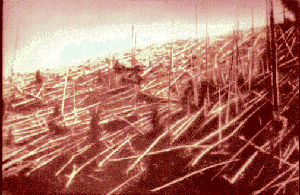
Tunguska01Today, June 30, in the year 1908 was the day something really mysterious happened over the Tunguska region of Siberia. It also flattened a lot of trees in the area.

Folks in the region saw a fireball streaking across the sky, following which there was a huge explosion and half the sky lit up. Then there was a shockwave that knocked them off their feet and broke window panes 400 miles away from the explosion.

The sky didn’t get dark that night in Europe. There were "skyglows" for several nights, and on the first people said it was so bright that you could read newspapers without artificial light.

Nobody knows what caused this–not for sure, anyway. When folks finally got around to investigating the site (20 years later!), they didn’t find any obvious impact crater, suggesting an airburst event fairly high up in the atmosphere.

Leading theories are that it was a meteorite that exploded in the air–or a comet fragment.

More exotic (and less likely) theories include a chunk of antimatter or a small black hole or an alien spaceship.

LEARN MORE.

(Also, SPACE.COM HAS A STORY ABOUT SOME FOLKS STILL ADVOCATING THE SPACESHIP THEORY AND CLAIMING WRECKAGE WAS RECOVERED.)

ALSO TODAY IN HISTORY:

On Jordan's Filthy Banks

Your travel tip for the day: If you go the Holy Land, scratch "Swimming in the Jordan" off of your To-Do List:

"The Jordan River, where Christians believe Jesus was baptized, is heavily polluted with sewage and is in danger of drying up after decades of conflict and intense agricultural use, environmentalists said on Friday.

[…]

"’The Jordan River will disappear if nothing is done soon. More than half of it is raw sewage and runoff water from agriculture. What keeps the river flowing today is sewage,’ Munqeth Mehyar, chairman of Friends of the Earth Middle East (FOEME), an Israeli-Jordanian-Palestinian group, told Reuters."

GET THE STORY.

Glad I didn’t know any of this when I went to the Holy Land on pilgrimage in the Jubilee Year 2000. It would have sucked some of the magic out of being sprinkled with Jordan River water while we renewed our baptismal promises.

Compendium Info

Lotsa good stuff in the news about the Compendium of the Catechism of the Catholic Church (CCCC or 4C).

HERE’S A BASIC ARTICLE ABOUT IT BEING RELEASED.

Highlights of this piece include the facts that the Compendium is 200 pages long and has 598 questions in it (so, I guess about three or so questions per page on average, which would suggest really small pages given what we’ll see below).

The Compendium is divided in the same four parts of the Catechism.

Part I, "The Profession of Faith," includes 217 questions; Part II, "The Celebration of the Christian Mystery" covers questions 218 to 356; Part II, "Life in Christ," questions 357 to 533; and Part IV, "Christian Prayer," questions 534 to 598.

The book ends with a double appendix on "Common Prayers" (from the sign of the cross, the Gloria and the Our Father, to the Prayer for the Dead and the act of contrition) and "Catholic Doctrine Formulas" (such as the seven gifts of the Holy Spirit, corporal and spiritual works of mercy, the Beatitudes, etc.).

It’s also (unfortunately) out only in Italian at the moment, so we’ll have to wait to get an English version. (I’m currently being tempted to order the Italian version and start studying Italian. . . . Subito, y’know?)

Now: HERE’S THE MOTU PROPRIO (A KIND OF PAPAL DOCUMENT) IN WHICH B16 AUTHORIZES THE WORK.

The money passage of this is the following:

The Compendium, which I now present to the Universal Church, is a
faithful and sure synthesis of the Catechism of the Catholic Church.

This conveys the level of authority for the Compendium. It is describe as "a faithful and sure synthesis of the Catechism of the Catholic Church," which makes its authority corelative to that of the Catechism. The Catechism, as we’ve quoted Ratzinger here before to demonstrate, synthesized Catholic teaching without changing the authority level of any of the teachings. Since the Compendium doesn’t do anything but synthesize the Catechism accurately, it therefore also doesn’t affect the doctrinal authority of any of the teachigns it contains.

B16 also goes on to make a rather interesting claim:

It
contains, in concise form, all the essential and fundamental elements
of the Church’s faith, thus constituting, as my Predecessor had wished,
a kind of vademecum which allows believers and non-believers alike to
behold the entire panorama of the Catholic faith.

It is important to note here that this does not claim that everything in the Compendium is an essential or fundamental element of the Church’s faith. It would be a basic logical fallacy to take that from what the pope said. ("This contains all X" is not equivalent to "All this contains is X.") Undoubtedly there will be items in the Compendium of different levels of authority, and some may not fit the bill of being "essential and fundamental."

I’m a little surprised, though, that he would claim that the Catechism contains all the essential and fundamental elements. I haven’t read the text, of course, but my native instinct would be to shy away from claims of that nature on the off chance that someone could mount a case that we left out something that is essential or fundamental. Nevertheless, he’s probably on safe ground here because (a) it probably does contain all such truths and (b) because "essential" and "fundamental" are sufficiently ambiguous words that one could defend the claim in any event.

One other tidbit: You may remember that when the Catechism was released there were all kinds of theological dissidents in the catechetical establishment (and elsewhere) who tried to assure us that the Catechism was "just for the bishops and experts" and that we layfolk need not trouble ourselves with reading it as it would be too much for us and that the Vatican never intended for us to read it. This was part of a strategy to minimize the impact of the Catechism and allow faulty catechetical texts to stay in place.

The reception that the Catechism got–at least in many places (the U.S. among them) totally steamrollered this stratagem.

Well, there’ll be none of that this time. Not only does the format of the work itself cry out that it is meant for the common layperson, the pope himself in his motu proprio says:

I entrust this Compendium above all to the entire Church and, in
particular, to every Christian, in order that it may awaken in the
Church of the third millennium renewed zeal for evangelization and
education in the faith, which ought to characterize every community in
the Church and every Christian believer, regardless of age or
nationality.

But this Compendium, with its brevity, clarity and
comprehensiveness, is directed to every human being, who, in a world of
distractions and multifarious messages, desires to know the Way of
Life, the Truth, entrusted by God to His Son’s Church.

Erring Pastor Addendum

Thought I’d mention another aspect of the case of the New York pastor who reportedly is denying the rights of children to be catechized and then receive the Eucharist because their parents aren’t attending Mass or (presumably) taking the kids ot Mass.

As we noted, what he’s doing is unlawful under Church law.

But in pointing this out, I didn’t dwell on one aspect of what he’s doing: Using bar-coded donation envelopes to track their attendance. Apparently, each family gets a batch of donation envelopes with a bar-code unique to them and are then expected to drop one in the plate each week.

Something that may immediately occur to you as problematic about this is that the pastor may be extorting donations out of the kids’ parents in exchange for allowing them access to catechesis and then the sacraments.

If he were doing this, he would be guilty of simony and subject to ecclesiastical penalties.

But that’s not what he’s doing.

THE ARTICLE MAKES CLEAR that he’s not charging anything. People are free to simply drop an empty envelope in the plate. (This has, presumably, been communicated to the parents in question. Otherwise, we’re back to a species of simony.)

Nevertheless, there’s a problem: There is NO REQUIREMENT WHATSOEVER that the faithful fulfill their Sunday obligation at the parish at which their kids are receiving catechesis. Canon law provides that:

Can.  1248 ยง1. A person who assists at a Mass celebrated anywhere in a Catholic rite either on the feast day itself or in the evening of the preceding day satisfies the obligation of participating in the Mass.

Parents are perfectly at liberty to go to a different parish, even a parish of a different rite, or even a Mass celebrated somewhere other than a parish (e.g., in a monastery) to fulfill their Sunday obligation.

If they exercise that prerogative, they won’t be at the erring pastor’s parish to drop their bar-coded envelope in the plate.

The pastor is thus not only obstructing the rights of the children to catechesis and the sacraments he is further violating the law by imposing on the families the burden to attend Mass at one particular parish (his) in order for their children’s rights to catechesis and the sacraments to be honored.

Any way you slice it, this guy’s in the wrong.

If Rome hears about this, they will not be pleased.