Tithing & Giving Recommends

A reader writes:

I have another question about tithing in the Catholic Church?  Is there any teaching of the Church or in Canon Law, that recommends how much Catholics are to give financially out of their income, to support the Church?  Take for example, if one makes 45,000/year, what would be a reasonable amount to give in terms of every Sunday at collection?

Okay, first let me clear away a potential linguistic issue.

Tithing is a word that many people abuse, using it to refer to regular giving to the Church in any amount. That’s not what tithing is. Tithing is giving ten percent of something. That’s what the word "tithe" means–a tenth. So if a person isn’t giving ten percent of something then he’s not tithing. He’s giving, but he’s not tithing.

Now, tithing was required under the Old Law, and the Old Testament laws regarding tithing were rather complex (and somewhat unclear, at least from our latter-day perspective).

We, however, are not under the Old Law, and Christ chose not to repeat the law of tithing as part of the New Law. Instead, we are simply encouraged to give according to our means.

How much we are to give is not something that canon law presently specifies. It’s very general on this question, saying:

Can. 1262 The
faithful are to give support to the Church by responding to appeals and
according to the norms issued by the conference of bishops.

The U.S. conference of bishops also didn’t get any more specific on this. This relevant complementary norm says:

The National Conference of Catholic Bishops authorizes diocesan bishops
to establish norms for Church support by the faithful for their own
dioceses [SOURCE].

And my impression is that most bishops leave it pretty general, too, though I have heard suggested guidelines like giving one or two percent of your annual income for most parishioners, perhaps in the form of one percent ot the Church and one percent to other charities.

That level is calibrated to be within the reach of almost everyone. Many people will be able to give much more than that.

It’s really hard to give a one-size-fits-all rule here, because the economic conditions of different people vary widely. A family with several children and medical bills is likely not as able to give the same percent of their income as a single person with no children, good health, and a good-paying job.

What God is ultimately concerned about is whether we are cultivating the virtue of generosity with our giving, and generosity involves some degree of going out of our way to do something to help others. This suggests that, whatever level is appropriate for us to give, it should be a level where we feel its financial impact in some way. We shouldn’t give so much that we harm our selves or those to whom we have obligations (e.g., by giving so much that we fail to provide a decent education for our children and a decent retirement for ourselves if we have the ability to afford these things), but it should be enough that we in some way feel the financial impact.

Another piece of advice here is to start small and ratchet up the amount you give. You might want to start with a one percent figure and then adjust it upward over time until you find a good level that fits your overall finances.

You may also wish to talk to your diocese’s stewardship office (every diocese has one, and there’s likely a stewardship page on your diocesan web site) to see if your bishop has further guidelines.

So: Wish I could give you a specific number, but I hope this helps!

The “Religion Of Peace” Gets Offended

MuslimyahooI’m going to have more to say about this over the next few days, but let’s get a few things down first.

In case you’ve not been following the news, a Danish newspaper published several cartoons of Muhammad that have enraged many in the Muslim world. Other European papers later reprinted the cartoons.

BASIC INFO HERE, WITH LINKS TO CARTOONS.

Now they are doing the usual protest thing, which in the Muslim context means flag and effigy burnings, hopping up and down and chanting, and violent threats being made. And not only threats. They’ve also taken to committing arson against various European embassies.

In other words, many Muslims acting so as to confirm every stereotype that’s out there to the effect that Muslim culture is a vicious, self-centered, savage culture that is incapable of controlling its emotions.

This is a bad thing, and I’m sure that there are many Muslims who are aghast at what the protestors are doing–at the same time that they are offended by the Muhammad cartoons.

I don’t have a problem with them being offended. Muslims consider Muhammad in some way sacred as a prophet of God, and Muslims hold depicting a prophet in art is a form of profanation. Anybody gets offended when what they hold sacred is profaned, especially if it is also held up to ridicule, as happened in the case of at least some of the Danish cartoons (such as depicting Muhammad with a bomb-shaped turban, though others cartoons did not depict him in a bad light, they just depicted him).

I don’t believe in giving unnecessary offense to others, particularly when the offense concerns something as deeply felt as the subject of a person’s religion. I know what that feels like, as I’ve had to bear countless insults to Christ and the Christian faith (and ones far worse than anything in the Danish cartoons, none of which depicted God Incarnate hanging in a jar of urine).

But when an offense is committed, I do believe in a proportionate response. Protesting is fine. Boycotting the people involved–like the paper and its advertisers–is fine.

But issuing death threats and destroying property is not.

That behavior is completely unacceptable, and this kind of bullying is the thing which one must stand up to.

After so many countless public angerfests in the Muslim world, it’s easy to dismiss these as just more of the same, but people need to recognize what is going on here, and not just in the Muslim world.

UPDATE: LINK FIXED. CHECK OUT THESE MUST-SEE PICTURES OF MUSLIM PROTESTS IN EUROPE.

AND THIS STORY ABOUT EMBASSY BURNINGS IN THE MUSLIM WORLD.

AND THIS VIDEO BY MICHELLE MALKIN.

YEE-HAW!!!

I had quite an accomplishment Friday night.

Here’s the story: A couple of years ago I went through a square dance class and made it through graduation, but work-related travel and other things made my attendance toward the end spotty. As a result, although I learned the moves at end of the program, I didn’t learn them well and did not feel comfortable going to ordinary dances.

I planned to start the class over the next fall, but didn’t know when the class was starting and missed it.

So this year I ran across a handbill at a western wear store saying when a class was starting and went.
In fact, I started attending several different clubs.

Many of the moves were familiar, of course, and for others my dim memories of them quickly began to reawaken, and soon I was able to dance along with the club (not just the class) at a couple of these groups.

But I couldn’t do that at one of them.

Y’see, different clubs have different preferences about how easy or challenging they like it when they dance.

The Friday night group has the toughest caller in the county (at least as far as I am aware). He’s a really good teacher, but for club dances he does the most challenging calling of anybody around these here parts. By that I mean that he calls the dance faster, uses more the more complex moves more often, and uses impromptu variants a lot. You really have to be good in order to dance in a club session that he calls.

As a result, after starting back to square dancing, it took the longest for my skills to get back to where they needed to be if I were to dance with the Friday night club.

I mean, there was no way that I’d be able to do the fearsome Load The Boat or the dreaded Teacup Chain or the sanity-shattering Relay The Deucey or the soul-destroying Spin Chain And Exchange The Gears.

Not without some review and practice.

I mean, compared to those moves of elder madness things like Dixie Style To An Ocean Wave are nothing.

But Friday night I made the breakthrough!

With the encouragement of some of the club members, I stayed after the class period and danced with the club.

I was able to keep up with the other dancers, even at the
high-challenge level that this club and caller enjoy. I even got
through Relay The Deucey and Spin Chain And Exchange The Gears.

I danced every single tip except for the first. (A tip is a unit of two dances, typically a patter call followed by a singing call.)

This means that, between the class and the club, I danced for THREE HOURS Friday night, and on Saturday I had the muscle strains and aches all over my body to prove it.

My dancing ability at this level is still shaky, but I expect that within a couple of months I’ll have it smoothed out, especially with the amount of practice I’m getting these days.

I also imagine that my body will adjust fairly quickly to the level of activity I’m putting it through in these dances.

Friday night isn’t even the longest dance night I’m doing.

At my Sunday night group I’m doing a two hour class of round dancing, followed by a two hour club of square dancing, for a total of FOUR hours.

Body aches are normal on Monday at this point.

More SSPX Rumors

Rumors have been going around about an effort to reconcile the SSPX (Society of St. Pius X) with the Catholic Church.

SEE HERE, FOR EXAMPLE.

JOHN ALLEN HAS MORE.

Ed Peters has the canonical angle on the story and considers what scenarios might be possible that would allow a reconciliation, along with some commentary on how likely they respectively are.

GET THE (CANONICAL) STORY.

I’d also add another scenario that strikes me as a possibility (at least hypothetically).

What we’re dealing with here is healing a schism, and the approach that has been taken in recent years in efforts to do that (i.e., in authentic ecumenism) has been to not worry about who was at fault in the past and instead make sure that we share those elements (or grow toward sharing those elements) that are needed for ecclesial communion.

Thus, for example, the joint declaration on Christology that was signed with the Assyrian Church of the East sidestepped the question of who was at fault back when the split occurred and instead said, in effect, "Look, regardless of what was said in the psat, we agree on this now, so this no longer a point that would bar us from ecclesial communion with each other."

A similar approach is used with the churches of the Reformation when it is possible to make common cause with them.

Since those in schism don’t like to admit that they’re in schism, this word also wouldn’t be used should we be able to reunite with the Assyrians. The Church would note the "separation" that existed historically between two groups but say that we now recognize that we share what is needed for full ecclesial communion, and so we’re announcing that fact.

(Forget being able to ever visibly reunite with any significant Protestant bodies–at least any time in this millennium. There’s just too much that’s not there at present.)

The thing that makes this "let’s not focus on the past" approach possible in a case like the Assyrian Church of the East or the Reformation churches is that the splits occurred so long ago that the original actors aren’t around any more.

That’s not the case with the SSPX. We’re talking about trying to heal this schism in its first generation, and that makes it a lot harder to take a "let’s not worry about who was at fault" approach.

Some version of this reasoning, though, could come into play if the SSPX schism is healed. It’ll certainly be a temptation since that’s the approach being used with others.

But it may not be prudent to proceed in that fashion with the SSPX.

A question that B16 should ask himself (and the SSPX bishops) is: "You guys disobeyed the direct orders of my predecessor in a grave matter pertaining to the structure of the Church, so what assurances do I have that you won’t do the same thing all over again?"

Only if B16 gets serious and credible assurances of fidelity should a face-saving method like the one mentioned above be considered.

Two Notable Resignations

The head of the Jesuit order, Fr. Hans Kolvenbach, has announced his resignation.

This is a very unusual move, as Jesuit superior generals normally hold office for life. According to some reports, he’s been trying to resign for the last ten years, but JP2 wouldn’t let him.

Now B16 has.

In announcing his resignation, Fr. Kolvenbach also announced the calling of a general congregation to elect his successor and to deal with other (apparently unnamed) serious problems affecting the order.

In view of the opposition that many in the Jesuit order have been giving to authentic Catholic teaching and practice in recent years on many issues but notably in recent months on the issue of whether homosexuals should be ordained, it will be interesting to see how the pope may intervene in this matter in the runup to the general convention in 2008.

This may be the beginning of the shakeup folks have been predicing under B16.

GET THE STORY.

In related news, B16 has approved the resignation of Auxiliary Bishop Thomas Gumbleton of Detroit, who is now 76 and past the age for turning in his retirement letter (which the pope can accept or decline). Bishop Gumbleton has expressed his discomfort with the Church’s teachings on homosexuality, suggested future doctrinal change on this point, advocated the ordination of homosexuals, and been known for once wearing a mitre with a pink triangle on it in solidarity with homosexuals.

Maybe there isn’t a truce of 2005 after all.

Most Bizarre Blog Entry?

Just a reminder that there’s still a little time to make nominations for the 2006 Catholic Blog Awards.

Here on JA.O, we’ve had quite a number of really unusual posts for a Catholic blog. Michelle, Tim J, and myself have handled quite a number of odd subjects–now in the archives–and folks might want to consider whether any of these are suitable for the Most Bizarre Blog Entry posts. If you think any are,

YOU CAN NOMINATE THEM HERE.

How Much Is It Worth?

A reader writes:

i have 3 antique typewrites that i would like to know the value of them.

  • webster shows no date in good condition
  • royal deluxe no date in good condition
  • olivetti underwood do date in good condition

they still all are in their cases

I’m afraid that appraising typewriters isn’t one of my specialities, but I’ll be of what help I can.

Since the monetary value of an item is based on the perceived utility it has in the eyes of its potential market, what you really need to do is determine what someone would pay for this, and there’s a quick way to do that: Put them on eBay and see what they sell for.

Of course, if they sell then you’ve got to give them to the person who bought them (or eBay will have your house burned down).

If you don’t want to sell them just yet but just want to get an idea then the thing to do is look at the prices of similar items that have recently been sold on eBay (not ones that people are still bidding on, since many people do what I do and wait until the last second to place a bid so as to minimize the chance of being outbid by someone else).

eBay really is the place to go for getting an idea of the market value of things like this. I heard an interview with an appraiser a while back talking about the fact that eBay has become the standard for accurate values these days, whereas before there were inefficient, market-constraining books that didn’t give you that good of an idea.

You could also try to find an antiques appraiser in your area (who will better be able to tell you if you’ve got a rare model on your hands–and thus whether you should set a special minimum price when you sell them on eBay) or go on the Antiques Roadshow if you can find where it’s being taped.

THERE’S ALSO AN ONLINE ANTIQUES APPRAISAL SERVICE HERE.

If you use it, be sure to include as much information about the typewriters as possible–including their model numbers.

Oh, and you could probably find some of those old appraiser’s books. Maybe you could get them on eBay!

Language Questions

A reader writes:

A few quick questions:

1)  Is the only difference between classical latin and ecclesiastical latin the pronunciation?

No. Ecclesiastical Latin also has vocabulary that classical Latin doesn’t (esp. biblical and theological terms). The grammar and syntax are also a little different. For example, ecclesiastical Latin has a tendency to use prepositions where classical Latin would rely on cases alone. This makes ecclesiastical Latin easier for English-speakers since we are used to using prepositions rather than cases.

2)  I know there are at least three different versions of the Vulgate floating around currently . . . is there a particular version/edition you recommend? I checked out a version of the Vatican’s edition of the ‘Nova Vulgata’ and it has absolutely no footnotes, introductions, etc., so I’m looking for something a bit different . . .

I’m afraid that I don’t have a special recommendation, here. I tend to use the Neo-Vulgate because it’s available for free, in electronic form, on the Vatican’s web site. (HERE.) I’ve seen a nice edition of the Vulgate NT with the Greek NT on the facing page, but with my preference for electronic formats (makes it easier when I’m writing), I haven’t bothered getting one. (And, unfortunately, I don’t have the name of it, though Googling should turn it up.)

3)  Similar question for the Septuagint . . . what edition should I pick up?

Same kind of answer as before. I don’t really have a recommendation. Almost any edition of the Septuagint will suffice for most purposes. Unless you’re doing someting of a scholarly nature, it really doesn’t matter which edition of the Vulgate or the Septuagint you use. Neither are original-language versions of the Bible, and if you’re just wanting them for language study or personal Bible study or for writing non-academic articles then any edition will work well.

Readers are welcome to share their favorite editions in the combox, though.

A Rosary A Day

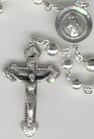
Rosary

Michelle here.

Confession time: I am not a fan of the rosary.

Well, let me be a bit more clear: I appreciate the wonderful history and heritage attached to the rosary; I was impressed and grateful when John Paul II gave Catholics the luminous mysteries of the rosary (I even wrote an article with a sidebar on that event); I admire those who are have a devotion to the rosary. But I don’t. It’s always been a difficult prayer for me to pray. When I use my rosary beads, I usually use them to say the Divine Mercy chaplet, a prayer devotion that I personally prefer.

So, you can imagine my horror when a friend suggested that I pray a 54-day novena, a novena that entails saying five decades of the rosary for 54 days in a row! This friend is a spiritual mentor, so I didn’t reject her suggestion out of hand. I thought about it.

Then I said no.

My friend, like a good spiritual mentor should be, was perfectly fine with that. Then she had a brainstorm. She knew of a particular intention for which I had been praying for years. She suggested that I offer up some of the trials I had experienced over this past year for that particular intention to be fulfilled. Sounded like a great idea. She never even mentioned the 54-day novena.

It did occur to me though that a 54-day novena would be a significant and, for me, sacrificial, means by which I could offer up those trials for that intention. I sighed and told both my friend and the Blessed Mother that they had won. I’d do the 54-day novena.

I’ve been doing it for the few weeks and have about twenty days left. The reason I tell this story to you is because of a side benefit that praying this novena has had for me.

At first I prayed the novena while sitting on my couch in typical couch-potato style. Then I had a brainstorm.

I had been wanting to establish a walking routine for some time now, but for various reasons this had proven a fruitless effort. Then I realized that the rosary usually takes me about twenty minutes to pray. If I walked while I prayed the rosary, I would be walking twenty minutes per day. Not exactly an Iron Woman regimen, but it would be a good place for me to start.

You might think that a Couch Potato like me would have difficulty doing the whole rosary before needing a break. The first night I only got through three decades before needing to sit down, but after that I could do all five. And so, for twenty minutes per night I’ve been pacing my living-room floor praying the rosary in this 54-day novena.

At this rate, and assuming I maintain my Rosary A Day after the novena is finished, I expect to reach China sometime in the next century.

NOTE: Any and all prayers you want to add to mine for my special intention would be greatly appreciated.

St. Blase Questions

A reader writes:

Every year, our pastor offers the blessing of throats on the feast of St. Blaise.  The folks at Mass line up in two rows, just like for communion, and the priest gives blessings on one side while a woman from the congregation gives blessings on the other side.

My understanding of canon 1169 is that only ordained persons can give blessings.  (Oh, I should have mentioned that the woman in question is not a priest or a deacon.)  So I worry that the non-priest blessing throats is in fact simulating a sacred thing, and that there is some kind of sacriledge involved.

Let’s start with canon 1169, since you mention it. Here ’tis:

Can.  1169 §1. Those marked with the episcopal character and presbyters permitted by law or legitimate grant can perform consecrations and dedications validly.

§2. Any presbyter can impart blessings except those reserved to the Roman Pontiff or bishops.

§3. A deacon can impart only those blessings expressly permitted by law.

If that’s all the law said then your conclusion that only a cleric can give sacramentals like the St. Blase blessing would be arguable, but that’s not all that the law says. There is also canon 1168:

Can.  1168 The minister of sacramentals is a cleric
who has been provided with the requisite power. According to the norm of the
liturgical books and to the judgment of the local ordinary lay persons who
possess the appropriate qualities can also administer some sacramentals.

So the question is: Is the St. Blase blessing one that the liturgical books empower lay people to give?

Yes.

The Book of Blessings provides the following:

1626 The blessing of throats may be given by a priest, deacon, or a lay minister who follows the rites and prayers designated for a lay minister. If the blessing is conferred during Mass, the blessing follows the homily and general intercessions, or, for pastoral reasons, the prayer of blessing may take the place of the final blessing of the Mass. When the blessing is given outside Mass, it is preceded by a brief celebration of the word of God. If the blessing is to be celebrated at Morning Prayer or Evening Prayer, it is given after the reading and responsory (and homily) and before the gospel canticle.

While we at it, let’s clear up a few other potential worries that folks might have based on what they see and hear at Mass today regarding the St. Blase blessing.

1627 The blessing may be given by touching the throat of each person with two candles blessed on the feast of the Presentation of the Lord (February 2) and which have been joined together in the form of a cross.

1628 If, for pastoral reasons, each individual cannot be blessed in the manner described in no. 1627, for example when great numbers are gathered for the blessing or when thememorial of Saint Blase occurs on a Sunday, a priest or deacon may give the blessing to all assembled by extending hands, without the crossed candles, over the people while saying the prayer of blessing. A lay minister says the prayer proper to lay ministers without making the sign of the cross.

1629 The blessing may also be given to the sick or the elderly in their homes when they cannot attend the parish celebration.

1633 . . . During trhe blessing suitable psalms or other suitable songs may be sung.

Hope this helps!