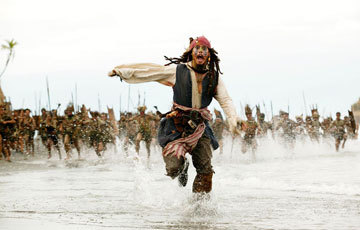
Dead Man’s Chest

Deadmanschest1The Pirates of the Caribbean turned out to be the surprise summer hit of 2003 and left the newly-minted fans of the franchise wanting more.

They got a little more later that year when the pirates returned for a brief, cameo appearance to wipe out an orc army at the endmiddle (beginning? it’s hard to tell with a sixteen hour film) of Lord of the Rings: Return of the King.

They should have been in that film for longer than they were, but Aragorn foolishly released Captain Jack Sparrow from his oath before Sauron had been thoroughly defeated.

But now the pirates are back for another installment of their own franchise!

It instantly became THE BIGGEST OPENER IN BOX OFFICE HISTORY.

And STEVE GREYDANUS’S REVIEW has me anxious to see it!

Here’s a taste (EXCERPTS):

[L]ike Raiders of the Lost Ark, Dead Man’s Chest takes the kinds of things that others have done before, and then does them so inventively that it becomes the new standard.

The sequel takes the slapstick swashbuckling to a completely new level, evoking the ingenuity and physical comedy of a Buster Keaton or Jackie Chan set piece, crossed with the Rube Goldberg logic of a Chuck Jones cartoon.

A slight but distinct spiritual vibe runs through Dead Man’s Chest,
particularly in regard to an uneasy awareness of judgment after death.
“Do you fear death?” Jones asks the sailors of a ship he has taken as
he offers them a Faustian choice between death and eternal service on
his ship. “Life is cruel. Why should the afterlife be any different?
Why not postpone the judgment?” Most of the sailors accept this
Faustian bargain, though one sane soul demurs (“I’ll take my chances”)
and is quickly dispatched.

In a comic variation on the theme, one of the formerly cursed
pirates from the first film has taken a new interest in spiritual
matters. “We’re not immortal any more — we got to take care of our
immortal souls,” he warns his companion while leafing intently through
his Bible.

The other eyes him dubiously. “You know you can’t read…”

But the first is undeterred: “It’s the Bible — you get credit for trying!”

GET THE STORY.

Many have been comparing Dead Man’s Chest to The Empire Strikes Back in that it is (a) reportedly really good and (b) has a cliffhanger ending meant to spring us into a third film.

That film–Pirates of the Carribean: At World’s End–is due out next summer.

I haven’t seen an actual in-theater movie in I don’t know how long (maybe a year or two), but I’m going to see this one.

See you at the movies!

INFO ON WHAT THAT WHOLE "DEAD MAN’S CHEST" THING IS ABOUT.

Sunday Money For College

A reader writes:

I’m a teenager that needs money for college, is it a sin to work on Sunday?  I will fulfill my Sunday oligation to go to Mass.   I’m involved in activities after school that might restrict the amont of hours I can work and will probably have to work on Sundays.  I would appreciate any light that you can shed on this. 

It is not a sin to work on Sunday if you are required to do so by your employer. If you need to make money and your employer requires you to work on Sunday then you work on Sunday. It is not a sin.

That said, one would want to try to find a job that doesn’t require one to work on Sunday. For most people–at least after their college years–this is achievable. But for many folks who are still in school or just starting out, it is not.

The Catechism states:

Family needs or important social service can legitimately excuse from the obligation of Sunday rest. the faithful should see to it that legitimate excuses do not lead to habits prejudicial to religion, family life, and health [CCC 2185].

It also says:

Traditional activities (sport, restaurants, etc.), and social necessities (public services, etc.), require some people to work on Sundays, but everyone should still take care to set aside sufficient time for leisure [CCC 2187].

Now, getting money for college is an important need and would clearly allow for Sunday work. Getting a college degree will open innumerable doors that would otherwise be closed to you in later life, so the gravity necessary for Sunday work is clearly present.

Assuming that there isn’t another possibility.

And here’s where we get to a judgment call: You mention that you are participating in activities after school that may be pushing you toward working on Sundays.

I don’t know what these activities are. They may be things that are themselves important to making your school record look good (so as to get into a better college) or they may be things that will look good on future job resumes (e.g., social service things) or they may just be personally psychologically important to you. So you may have reason to keep doing them on weekdays and then going to work on Sunday.

But I’d at least ask the question of whether the afterschool activities are of sufficient value that they should be done instead of Sunday work. If it were possible to get an afterschool job on weekdays and then rest and do leisure activities on Sunday, that would be preferable.

What the right thing to do in this situation is a judgment call, and I can’t make that for you. I’d therefore advise you to talk it over with your parents and see what they think.

Just make the best judgment call you can and act on it, entrusting the situation to the Lord.

Those three things–using our reason to make judgment calls, acting on them, and trusting God with the results–bring glory to the Lord for they show the attitude of faith coupled with the exercise of the gifts that God gave us to employ.

20

Bug Fixed!

Everything seems to be working fine now. Turned out it was a DNS problem.

BTW, the reason for the DNS change (which is now working fine, though it may take 24-48 hours for it to propagate to you) was to make it easier to get to the blog.

Up to now, you’ve had to type www. in order to get here. Otherwise you got a blank page.

Now you don’t.

TRY IT: jimmyakin.org

Temporary Bug

Typepad seems to be having a bug that is preventing the comments pages from working right. I’ve created a help ticket, and hopefully they’ll have it resolved soon. I’ll let y’all know. Sorry for the inconvenience.

Open Theism

A reader writes:

I’m a Protestant who is seriously considering the Catholic faith.  I’ve enjoyed, very much, listening to you on the Catholic Answers Live podcast.

Are you familiar with the controversy over open theism within evangelicalism?  How does Roman Catholic theology square with the view of God as envisioned by open theists?

I am familiar with the controversy, and Catholic theology would have significant problems with the overall picture of God painted by open theists. Historically, Catholicism has been very firm on the classical theism model.

For those who aren’t familiar with this distinction,

HERE’S A BACKGROUNDER.

That being said, not all aspects of open theism are equally problematic. The open theist’s assertion that humans have libertarian free will is something that Catholics would have not a problem with. What would be problematic is the inference that because humans have this kind of free will the future must contain things that God doesn’t know.

It is not true that knowing what someone will choose to do next year means that their choice is not the product of libertarian free will. From his perspective outside of time, God sees your future free will choices next year the same way he sees your current choices right now. Both "now" and "next year" are equally present to God, so if his seeing what your current choices are does  not deprive you of free will now then his simultaneously seeing what you are choosing next year does not deprive free will then either.

While open theists have made some interesting arguments regarding God’s omniscience (e.g., omniscience doesn’t require God to know things that are logically impossible to know the way omnipotence doesn’t require God to be able to do things that are logically impossible to do, like make square circles or stones too heavy for him to lift), these arguments are only relevant if God is inside of time and if certain theories about time are true. From an atemporalist perspective, the concerns they are meant to address simply don’t arise because God’s knowledge of the future is equally possible as his knowledge of the present and the past.

Once one recognizes God’s atemporality his immutability immediately falls out of this as a logical consequence.

Open theists’ language about God voluntarily limiting his exercise of power in order to allow free will in the universe can be taken in an orthodox sense (though only if it is understood that his exercise of the power–not the power itself–is what is limited). Something like that might seem to be necessary for free will to exist, and there is nothing unorthodox about saying that God can choose how far he’s going to do something. If he chooses to make beings with libertarian free will so that he doesn’t determine all their choices for them then that’s God’s choice.

The best argument that open theists have is why God allows evil if he has the power to stop it, and here we run into a matter that is significantly mysterious, though classical theists have a framework for answering it even if it does not exhaust the mystery.

An orthodox Catholic theologian would thus tend to view open theism as, to a significant extent, an attempt to alleviate the cognitive tension caused when man is confronted by the divine mystery by positing a God small enough that the mystery doesn’t arise (i.e., God doesn’t stop all evil instantly because he doesn’t have the power to do so).

There are thus a few individual aspects of open theism that could be harmonized with Catholic thought but the system as a whole posits a view of God that would not at all be favorably received.

St. Thomas Aquinas’ articulation of classical theism has been the standard Catholic account for centuries, and the First Vatican Council taught:

The Holy, Catholic, Apostolic and Roman Church believes and acknowledges that there is one true and living God, creator and lord of heaven and earth, almighty, eternal, immeasurable, incomprehensible, infinite in will, understanding and every perfection.

Since he is one, singular, completely simple and unchangeable spiritual substance, he must be declared to be in reality and in essence, distinct from the world, supremely happy in himself and from himself, and inexpressibly loftier than anything besides himself which either exists or can be imagined [Dogmatic Constitution on the Catholic Faith, ch. 1].

Hope this helps!

Purgatory & The Sufficiency Of Christ’s Sacrifice

A reader writes:

I am currently trying to explain the Catholic position on purgatory to a co-worker.  I have given him some info I found on the internet. He looked it over and discussed with a fellow church member. He came back with, “if you believe in purgatory, then you are saying that Jesus dying on the cross was not good enough to save us!” How do I respond?

The purpose of purgatory is to purify us so that we are thoroughly holy and thus fit for heaven. It is part of the process by which we gain "the holiness without which no one will see the Lord" (Heb. 12:14).

But the process of purification doesn’t start in purgatory. It starts in this life, and in Protestant circles it’s known as sanctification. (Catholics also use this term, though not always in exactly the same fashion; the term justification is also used in both circles though not always in the same ways.)

Now, where does sanctification come from? Is it something God gives us by his grace or something that happens apart from his grace?

Protestants will agree with Catholics that it is the product of God’s grace in our lives.

But why is God giving us this grace? Is it because of what his Son did on the Cross or is it separate from that?

Once again, Protestants will agree with Catholics that it is because of what Christ did on the Cross that God sanctifies us.

So sanctification–the process of being made holy–is something that happens to us only because of Christ’s death on the Cross.

Sanctification–including the final stage of sanctification in purgatory–thus presupposes the sufficiency of Christ’s sacrifice. It is so sufficient that it is not only enough to justify us but enough to sanctify us as well. The difference is that (to use language in a Protestant way) justification is something that happens at the beginning of the Christian life while sanctification is something that happens over the course of it.

So that’s what I’d tell him.

Secret Project #4 Update

I’ve had some folks request an update–even a vague one–on the status of Secret Project #4.

I can’t tell you much, but I can tell you that it is going well.

Currently there are around eleven people working full or part time on it.

The project has a technological side and an informational side, and we have the technology in place and now we are doing the informational side.

There are two different arms of the informational side. One is proceeding a bit slower than I had hoped, but the other is going much faster than I expected.

All that’s required for Secret Project #4 to be announced later this summer is for one of the two arms of the informational side to substantially achieve its goals, and we seem to be well on the way to that at the moment.

Wish I could tell y’all more, but that’ll have to do for now.

1978 CDF Document On Apparitions

In 1978 the Congregation for the Doctrine of the Faith issued an instruction containing norms for the evaluation of reported apparitions.

This document has generally not been circulated publicly, but it seems that someone in France got a copy of it, and I found an unofficial English translation online.

Reading the document, it struck me as having the ring of authenticity. This is written the way that the CDF would have done such a document, and I assume that it’s genuine.

I’ve placed the translation in the below-the-fold section of this post and may be able to interact with it some in future posts. For now, I’d like to see what kinds of questions it raises in folks’ minds.

Continue reading “1978 CDF Document On Apparitions”

That’s About The Size Of It

I normally don’t read Jeff Rense’s site because . . . well, because he’s a nut. I used to find his show interesting because of all the crazy people he would talk to (like on Art Bell’s show, only crazier), but after 9/11 he went off of a deep end that soured me on the whole thing.

I was therefore quite surprised when I was reading Jerry Pournelle’s blog Chaos Manor and saw him make this recommendation:

Go see
http://www.rense.com/general72/size.htm
. You’ll be glad you did.

I clicked the link and discovered Jerry was right.

Cool presentation!

BTW, be sure to check out Chaos Manor. Jerry Pournelle’s been blogging since before there were blogs and has a bunch of interesting stuff to say.

Medjugorje

I normally don’t write much about apparitions–particularly ones that have not been either approved by the Church or specifically condemned as incompatible with the faith, but there is currently going around the blogosphere a statement by Bishop Peric of Mostar-Duvno regarding the apparitions reported at Medjugorje, which is in his diocese.

I’m not going to address the question of whether the apparitions reported at Medjugorje are real or not. I haven’t yet done the kind of research I would need to in order to satisfy myself on that question. But it’s worth noting the way that the topic is presently being handled on the official level.

DIANE OVER AT TE DEUM HAS THE FULL TEXT OF A HOMILY THE BISHOP GAVE ON THE SUBJECT, ALONG WITH HER OWN COMMENTARY.
(CHT to those who e-mailed.)

YOU CAN ALSO READ IT DIRECTLY ON THE DIOCESE OF MOSTAR WEBSITE.

Poking around the Mostar website, I also discovered

THIS BACKGROUNDER AND STATEMENT ON MEDJUGORJE BY THE BISHOP.

NOTE: Both the homily and the backgrounder are translations and so it should not be assumed that everything they say has the same force in the original language as it does in English. Things in the original may be stronger or weaker than they come across in translation.

Here is the nut of what the bishop said in the homily:

The judgements of the bishops, after all the canonical investigations made thus far, can be summarized in these following points:

1 – Medjugorje is a catholic parish in which liturgical and pastoral activities are carried out, just as in all the other parishes of this diocese of Mostar-Duvno. No-one except the official Church authorities is then authorized to attribute the formal title of “shrine” to this place.

2 – On the basis of Church investigations of the events of Medjugorje, it cannot be determined that these events involve supernatural apparitions or revelations. This means that till now the Church has not accepted, neither as supernatural nor as Marian, any of the apparitions. 

3 – Priests who canonically administer this parish of Medjugorje or those who come as visitors, are not authorised to express their private views contrary to the official position of the Church on the so-called “apparitions” and “messages”, during celebrations of the sacraments, neither during other common acts of piety, nor in the Catholic media.

4 – The Catholic faithful are not only free from any obligation to believe in the authenticity of the “apparitions” but they must also know that church pilgrimages are not allowed, whether official or private, individual or group, or from other parishes, if they presuppose the authenticity of the “apparitions” or if by undertaking them attempt to certify these “apparitions”. 

5 – As the local Bishop, I maintain that regarding the events of Medjugorje, on the basis of the investigations and experience gained thus far, throughout these last 25 years, the Church has not confirmed a single “apparition” as authentically being the Madonna.

He then makes the following dramatic appeal:

Therefore I responsibly call upon those who claim themselves to be “seers”, as well as those persons behind the “messages”, to demonstrate ecclesiastical obedience and to cease with these public manifestations and messages in this parish. In this fashion they shall show their necessary adherence to the Church, by neither placing private “apparitions” nor private sayings before the official position of the Church.

I can’t help wondering if that’s also tied to something else he said:

The fact that during these 25 years there has been talk of tens of thousands of “apparitions” does not contribute any authenticity to these events, which according to the words of our current Pope, who I encountered during an audience on 24 February this year, commented that at the Congregation for the Doctrine of the Faith they always questioned how all these “apparitions” could be considered authentic for the Catholic faithful.

This sets off my spider sense a little bit. I’m thinking that there may be a connection between these two events.

In his pontificate, B16 has been quietly (or not so quietly) dealing with issues that appeared to drift during the pontificate of John Paul II. He reined in the Franciscans in Assisi; he reined in the Neocatechumenal Way; he dealt with the Fr. Maciel matter. I’m wondering if the discussion he had with Bishop Peric included an initiative to clarify where the Church is regarding the subject of Medjugorje.

If it didn’t then I’d say that Bishop Peric made a big mistake repeating what B16 told him in private. This is a sensitive matter, and if the pope hasn’t authorized you to disclose his private views on a matter then it is a big mistake to do so.

He also would be making a mistake to call on the seers to cease their public activities in the parish unless he had reasonable assurances that he would be backed up on this point if he were challenged on it.

I don’t have any proof here–I’m just speculating–but I’m wondering if his discussion with B16 didn’t involve the subject of a new iniative to more forcefully clarify the Medjugorje situation and seek greater pastoral control over it since, as the bishop reports:

[I]n this local Church of Mostar-Duvno, there exists something similar to a schism. A number of priests that have been expelled from the Franciscan OFM Order by the Generalate of the Order, due to their disobedience to the Holy Father, for years now have been forcefully keeping a few parish churches and rectories along with church inventory. They have not only been illegally active in these parishes, but they have also administered the sacraments profanely, while others invalidly, such as Confession and Confirmation, or they have assisted at invalid marriages. This type of anti-ecclesial behaviour is shocking to all of us. At the same time, this scandal of sacrilegiously administering the sacraments, especially of the Most Holy Body of Christ, must shock all the faithful as well who invalidly confess their sins to these priests and participate in sacrilegious liturgies. We pray to the Lord that this scandal and schism be uprooted as soon as possible from our midst. 

If I were B16, that’s the kind of situation I would want to get sorted out.