Former Muslim Martyr Saints

Over at the First Things blog First Thoughts there is a post in which a (necesssarily) unnamed missionary in the Middle East is quoted as follows:

In August of 2008 a young lady named Fatima al-Mutayri, age 26, was martyred in Saudi Arabia. She is from that country and became a Christian there by means of internet and satellite TV ministries, and was martyred there—she had her tongue cut out and was burned to death by her brother, who was carrying out the command of the Prophet who said, “who changes his religion, kill him” (man badala diinahu faqataluuhu).

This is, of course, horiffic. Words cannot convey the emotions that such an incident calls forth.

The missionary goes on to as some thought provoking questions, and I was asked for an opinion on them, so I'll do my best.

The missionary continues:

She was most certainly a Christian. I suspect that she was baptized but do not know for certain. And here is my two-part question: first, was she in full communion with Rome? I believe that she knew nothing of the debates between Catholics and Protestants. Moreover, I don’t think she ever had access to becoming a Catholic because the Catholic Church does not evangelize in Saudi Arabia and, of course, there no actual church buildings in that country.

The Catholic Church doesn't evangelize openly in Saudi Arabia, for obvious reasons, but there are certainly Catholics there who share their faith in an underground way, and these are able to baptize people, so the absence of above-ground evangelization and the lack of church buildings would be a practical impediment to a Catholic baptism but not something that would have made it altogether impossible.

So if she was baptized, it was at least possible that she was secretly baptized in an explicitly Catholic ceremony. If so, she would have by that fact been placed in full communion with the Catholic Church.

But let's suppose, as is likely, that if she was baptized that it was not in a Catholic ceremony. What then?

My understanding is that in former centuries it was common to regard any baptism as a Catholic one unless there was an express intent otherwise. On this view a person who was baptized with no specific knowledge of the Catholic Church would be regarded as a Catholic up until such time as the person might learn of and repudiate the Catholic understanding of the Christian faith.

Apart from very usual circumstances–especially in the Internet age–this kind of situation would be unlikely to arise, and current canon law seems to handle the situation differently.

The Code does not spell it out in the detail I would like, but the Green Commentary on the Code summarizes what I take to be common canonical opinion on the matter, which is that a person receiving baptism from a non-Catholic is held to be a non-Catholic unless there is a conscious intent for the person to be Catholic–for example, you are on a desert island and, before you die, you want to be baptized Catholic and the only person there is a Methodist, but he is willing to baptize you so you can be Catholic. (See the paragraph starting on the botton of the first column and its continuation in the second column, here.)

We don't have any evidence (so far as I know) that Fatima specifically intended to be Catholic if she was baptized, so it would be presumed that she wouldn't have been–that she would have been reckoned as a member of whatever specific church she was baptised into (if any) or just as a "generic Christian" if she was baptized non-denominationally.

At least the way such matters would be handled now, mere ignorance of disputes between Protestants and Catholics would not result in a baptism performed by a non-Catholic putting the baptizand in full communion with the Catholic Church.

I also wouldn't be quick to underestimate Fatima's awareness of the fact that there are different kinds of Christians. She was, it is reported, a Arabic-language blogger, and any amount of poking around on the Internet will reveal that there are different kinds of Christians. The pope being in the news on al-Jazeera and other Arabic news stations will result in awareness of the same thing. Fatima is supposed to have watched al-Haya (a Christian Arabic channel) and seen the programs of Fr. Zakaria Botros, who is Coptic. She also was involved with a significant variety of Christians on the Internet, and I strongly suspect she knew about Christian differences.

Does that mean she intended to join a specific Christian group upon her baptism? Maybe. Maybe not. Maybe she just wanted to be a Christian and would figure out the who-to-affiliate-with question later (or never). No one can really say unless someone who knew her were to come forth and shed light on the subject.

On the other hand, maybe she wasn't sacramentally baptized at all. (We've been making a lot of assumptions thus far.)

In that case she could be described as having "baptism of desire"–either implicitly or explicitly–by virtue of her adopting the Christian faith. She also could be described as having "baptism of blood" by virtue of her death for the faith. 

These would suffice for salvation (nothing else standing in the way), praise God!

But they would not place her in full communion with the Catholic Church in this life.

The missionary then asks another ques
tion:

And second: given this information, is it possible for her to be canonized? The canonization of an ex-Muslim woman who was born, lived, and died in Saudi Arabia, and who was martyred by her own family, would be perhaps the single most powerful statement that the Church has made on Islam since Vatican II (hardly a clear statement, and one that led many Catholics to believe, incorrectly, that the Church no longer was interested in evangelizing Muslims).

Vatican II's statement regarding Islam could definitely have been better phrased, and canonizing Fatima would indeed be a powerful statement. And if the circumstances were different, it could even be a possibility. It would not, however, be done as a statement on Islam. Instead, it would be a statement about the heroic virtues of this young woman who accepted martyrdom for her love of Jesus.

Pope Benedict certainly has the wherewithal to do such a canonization. He personally–as pope, at Easter Vigil–baptized the notorious Muslim apostate Maghdi Allam. Allam is a firebrand and a controversialist who repeatedly got into disputes with Muslims in Italy long before his conversion to Catholicism, and now there are pictures of the pope baptizing him and everything.

Pope Benedict did this not as a statement about Islam but as an illustration of the Church's willingness to accept everyone, regardless of their background, and of the right of everyone to embrace the gospel.

Given his willingness to do this, I have little doubt that he would be willing to canonize a former Muslim who was martyred for the faith. (Providing it was a genuine martyrdom; early in his papacy Pope Benedict notably clarified what martyrdom is to prevent the concept from being used sloppily.)

I can easily imagine Benedict asking, "Should we deny canonization to someone who died for the faith simply because the person who killed them was Muslim? Why should Muslims be an exception? If we do not deny canonization to one who was martyred by atheists or polytheists or any other group, why should we do so in this situation? Is their heroic witness to Christ worth less because their killers were Muslim?"

So I don't doubt that Benedict would be willing to do this . . . if the circumstances were different.

But they are what they are.

At least at this time, we don't have evidence that Fatima entered full commmunion with the Catholic Church in her life or that he had embraced the Catholic faith specifically at the time of her baptism by blood. Consequently, I don't see grounds for her canonization.

That's not to say that she's not in heaven and is not, in fact, a saint. If the facts are as described, I am very, very hopeful of her salvation and thus her objective sainthood (I can't say I'm certain, because in this life we can never be certain), but the Church tends only to canonize those who were members of it or who were intending to be members of it at the time of their martyrdom.

If evidence were to emerge that overcame this hurdle, there would still be many others, of a practical nature, that would have to be overcome before canonization could occur.

There would have to be someone petitioning for her canonization, and the relevant local bishop would have to oversee the initial phase of the process. That would be tricky since there are no bishops in Saudia Arabia.

Investigating the case would also prove difficult since, so far as we know, there were no witnesses outside the family. Unless one or more of them decided to speak freely on the subject and describe what happened at the end, investigators would not be able to distinguish evidentially between a scenario in which she maintained her faith to the end and a scenario in which she renounced her faith at the last moment but was too injured to survive (or was killed anyway out of rage).

Given the sensitivity of the subject in Saudi society, getting any people with knowlege of the situation–even non-family members who weren't eyewitnesses–to speak freely could be very difficult.

Internet hearsay is not enough, given the difficulties of verifying it. 

One of the first things I did in preparing to write this post was to do some checking to see if I could verify that Fatima al-Martayri even existed. I don't want to be overly skeptical, but there is a reason God created Snopes.com.

While I wasn't able to find the kind of evidence I would have liked (perhaps because it's largely in the Arabic-language Internet), I was eventually able to find and verify enough pieces of the story that it looks like it's real.

(I also verified that Mutayri is real clan and thus "al-Mutayri" is not simply an Arabic term for "the Martyr.")

Even then, though, details of the story diverge. Some sources say that it was her father who killed her. Others (who seem to be the majority) say that it was her brother (though it may only have been him who exposed her). Details also differ over whether she was 23 or 26 and whether the murder occurred in Qassim Province or in the Eastern Province. (One source, which claims to be a Muslim friend of Fatima but who nevertheless disapproved of the killing, tries to set the record straight; I'll link the source below
).

These facts aren't to say that the matter couldn't be sorted out, but they illustrate the problems of fact-finding in such a situation.

I thus don't see a plausible path to canonization for Fatima.

But we may still pray for her and all in similar situations–and there are many of those. (I know; I've dealt with delicate situations like this, with people behind the Muslim curtain who wish to be Christian. Fortunately, none of the ones I've dealt with have suffered Fatima's fate–yet.)

(And if anyone wonders why one might pray for a martyr–it may be a common and pious belief that martyrs go straight to heaven, but this isn't a doctrine of the Church; I'd rather pray on the safe side, trusting God at least to apply the prayers to the person cross-temporally in their final moments of life.)

READ MORE ABOUT FATIMA–INCLUDING HER WRITINGS AND INTERNET MESSAGES–HERE. (.pdf)

A further note about Fatima: If she is in heaven, as an uncanonized saint, then her feast day is November 1st–All Saints Day.

At the First Thoughts blog, Joseph Bottum–who authored the post–has some additional insightful things to say, but he doesn't go into it at this length. (I'm long winded–at least if you don't give me a word count. Sorry.)

Oh, and as Lt. Columbo would say, there's one more thing . . . 

If Fatima's case doesn't present a good instance for the canonization of a former Muslim who was martyred for faith in Christ, it should be pointed out that the Church actually does have saints who were former Muslims, such as St. Josephine Bakhita and St. Casilda of Toledo.   

Furthermore, the Church also has saints who were former Muslims who were martyred by Muslims for their Christian faith. These include St. Abo the Perfumer, St.s Nunilo and Alodia of Huesca, and St.s Aurelius, Natalia, and Felix of Cordoba.

They may not be modern, contemporary individuals like Fatima, but they trod the same path, suffered the same fate, and may serve as inspiring examples for the many, many people today who yearn for Christ while being forced to live in the Islamic world.

May those in such situations look to them, and may their intercession guide us all.
Pizza of the Future

Still working on part 2 of Age of the Universe. Unfortunately hit a setback when some autodownloaded Microsoft updates caused my computer to repeatedly slam into the Blue Screen of Death (thanks, Microsoft!). 

It's being fixed now.


In any event, here's a video that proves (surprise, surprise) that the ACLU not only isn't 100% evil but also that it has a sense of humor.


They're still just about as evil as it gets, but they're getting the following issue right.


Vatican Downplays

There are lots of stories out there with headlines beginning "Vatican Denies . . . "

There have to be.

The crazy Italian press guarantees lots of stuff that the Vatican needs to deny.

Sometimes the person doing the denying is even using a mental reservation (or something along those lines) when making the denial.

But you know it's significant when the headline only says "Vatican Downplays . . . " If the headline is accurate, it means that there is an implicit, up-front admission on the part of the person that the press interviewed that there is at least some truth to the story.

That's why I really like this headline:

Vatican official downplays report of planned liturgical reforms

As the story indicates, there apparently have been some liturgical reforms proposed by the CDWDS and some of its individual members to Pope Benedict. 

We'll have to see what comes of that. Maybe a few things; nothing huge (I very much would doubt an outright ban on Communion in the hand); maybe nothing at all. But it's good that reformist proposals are being made.

(NOTE: I'm working on the next installment of the Age of the World series, but the text I'm dealing with is so rich that it's taking me a while to get the post done, which is why I went with this one today.)

The Age of the World–Part I

A subject that comes up from time to time is how old the world is–either the earth or the cosmos as a whole.

The responses to this question are typically divided into the well-known "old" and "young" camps, the former holding that the earth and the cosmos are billions of years old and the second holding that they are a few thousand or perhaps tens of thousands of years old. So, depending on just how many thousands or billions of years you posit, there are four to six orders of magnitude separating the two schools of thought.

In a short series of posts, I'd like to look at some magisterial texts that have a bearing on this question and offer a few thoughts on them.

The first thought, before I even get to the magisterial texts, is that both positions are compatible with the Catholic faith. You can be a good Catholic and hold that the universe is thousands or millions or billions or trillions or quadrillions or other numbers of years old. The Church does not teach any particular age or age-range for the earth or the cosmos. You can follow the evidence where you think it leads.

This is because the Magisterium has determined that the question of the ages of the earth and the cosmos are principally scientific questions that are not (or at least that do not appear to be) settled by the sources of faith.

This may not always have been so. I would not be at all surprised if there are past papal, curial, or conciliar texts that do indicate an age-range for the earth or the cosmos as part of ordinary magisterial teaching, perhaps in the thousands or tens of thousands of years range. 

In fact, if a reader knows of such passages, I'd love to see them.

Such a prior position, at least of itself, would not pose a problem for the Church's current determination since ordinary magisterial teaching is nondefinitive and thus can be revised, as with the case of the Church removing the theological speculation of limbo from its ordinary teaching while still allowing the theory of limbo to be held (a rather striking parallel for what might be the case on the age of the world question).

However that may be, recent magisterial statements have made it clear that the age of the world is an open question and we are not limited to the thousands or tens of thousands of years age-range.

We will look at some of these texts in this series.

A second thing I'd like to point out before going to the first text is that the Magisterium's current judgment that this is primarily a scientific question puts the Magisterium in an interesting position in terms of how to articulate the position.

Of course, they could always say, "This is a scientific question; the sources of faith don't determine it," and leave it at that, but they usually aren't that concise in how they answer such questions. They want to say a little more about it, and so what they often do is express openness to the modern scientific view but without making a formal endorsement of this view as correct (i.e., "The universe is billions of years old, as modern science tells us").

It's good that they don't take that extra step because science can get things wrong and, after getting their fingers burned with Ptolemaic astronomy, they don't want to lock believers into having to accept a particular scientific account that might one day be proven wrong.

So that's all to the good.

Here is how the Catechism handles the question:

283 The question about the origins of the world and of man has been the object of many scientific studies which have splendidly enriched our knowledge of the age and dimensions of the cosmos, the development of life-forms and the appearance of man.These discoveries invite us to even greater admiration for the greatness of the Creator, prompting us to give him thanks for all his works and for the understanding and wisdom he gives to scholars and researchers. With Solomon they can say: "It is he who gave me unerring knowledge of what exists, to know the structure of the world and the activity of the elements. . . for wisdom, the fashioner of all things, taught me."

Here the Catechism takes an appreciative stance toward recent scientific studies on the question but without mentioning any particular numbers. It doesn't say anything about billions of years.

Yet surely that is what it has in mind. It could not be credibly claimed that the "many scientific studies" it refers to are ones being done at the Institution for Creation Research in El Cajon, California–or by similar young earth/young universe groups.

Surely it has in mind mainstream scientific studies which point to an old earth, and older universe, and some kind of evolutionary process working through the development of life forms and the appearance of man.

But note: None of those things are points of faith.

The results of particular scientific studies or the claims of particular scientific theories (e.g., evolution) are scientific matters, not things taught in the sources of faith.

As a result, these studies and claims cannot be binding on believers are matters of faith. And so one can be a good Catholic (good in his faith) even if he rejects all of them. If you accept the modern scientific account then you might ju
dge such a person a bad scientist (or at least badly informed on scientific matters) but not a bad Catholic.

This means that what we have in the first sentence of paragraph 283 of the Catechism is not per se a doctrine of the Church. Instead, it is a pastoral expression that seeks to appreciate and respect the findings of modern science without imposing them on the faithful as matters of faith.

That's not unusual. There are quite a number of places in the Catechism that are best classified as pastoral expressions rather than per se doctrinal or dogmatic ones. 

There are also, of course, loads of doctrinal and dogmatic ones. (This is, after all, a catechism!)

It is important, when dealing with questions like this, to have an awareness of the fact that the Catechism uses different modes of expression. What particular mode is being used in a particular passage must be determined by the text itself as well as an awareness of the dynamics of the question theologically, as the above illustrates.

Next . . . another text.

Peak Nonsense

Periodically there are stories saying that we are running out of petroleum and natual gas, that we are near or even have passed "peak" production of these resources because Earth is running low on them.

Not so fast.

While there is, undoubtedly, a finite amount of this stuff on earth because there are a finite number of atoms on earth, the fact that there is a limit-in-principle doesn't in any way mean we're near it. 

Folks I know in the industry tell me that there are lots of resources there–even known resources–that they simply can't tap because environmentalists and global warming alarmists have taken over local governments and they are using every trick in the books to keep drilling from happening.

Remember a while back when gas was at $4 a gallon and people were saying, "Let's drill in the Artic National Wildlife Reserve," and people in Congress were saying, "That won't help; it'll take ten years to get that online," and their opponents were responding, "Funny . . . that's exactly what you said ten years ago when we wanted to drill"?

Nuff said.

Well, Investor's Business Daily has an interesting editorial about current attempts to tap a natural gas resource right here in the U.S. that could supply our natural gas needs for 65 years.

Is the proposal meeting opposition?


Oh, and there's an eye-opening word in the editorial. In this context it means something totally different than what the same word means on Battlestar Galactica, but given how often it occurs in the article, I'm guessing that whatever editor wrote the piece for IBD is a BSG fan who experienced enormous secret glee while penning the piece.

President Opposes Free Speech! (Mostly. For Some.)

It's true!

In the video clip below, Barack "I'm the President" Obama discourages the widespread use of free speech by certain parties, saying that he doesn't want those who got us into "this mess" to do "a lot of talking."

Instead, he wants them to "get out of the way" and let his administration clean up "the mess."

So, these parties should take warning. The president wants them to not oppose his administration's efforts (get out of the way) and not exercise free speech much (not do a lot of talking).

Got it?


Presumably, if they do exercise their free speech right too much, they could be reported to the president's "fishy speech" reporting center.

Now, how are the parties to know who they are? Well, in the clip above the president doesn't specify which issues he's talking about (presumably he did before the clip began), but I'm guessing that they're financial and related to the housing crisis.

In that case, the president is opposing the use of too much speech by people like Barney Frank and Chuck Schumer. . . .

Or maybe, if he was thinking of the mess of Medicare and Medicate, he's putting LBJ ON NOTICE.

Orwell Update

Sen. John Cornyn (Texas) has sent a letter to President Obama about the White House's program to have Americans snitch on fellow citizens who they believe are saying "fishy" things about health care and undermining the administration's position.

In the letter, Cornyn asks Obama to contemplate the massive outrage that would have been unleashed if former President Bush's White House had asked Americans to report fellow citizens who were saying things critical of his administration's policies.

He also asks what the White House plans to do with the data it collects–specifically what action it intends to take regarding the people reported as engaging in "fishy" speech and how it will use their names, e-mail addresses, and IP addresses.

It's a good letter.

READ IT. (WARNING: .pdf) 


SECOND UPDATE: The White House program may be illegal. QUOTES:

The Obama White House may be breaking the Privacy Act of 1974 by asking citizens to report “fishy” political speech.

It turns out, even asking for citizens to report on each other may be illegal. According to the Department of Justice, “the purpose of the Privacy Act is to balance the government’s need to maintain information about individuals with the rights of individuals to be protected against unwarranted invasions of their privacy stemming from federal agencies’ collection, maintenance, use, and disclosure of personal information about them.”

Further, anything is considered a “personal record” if it identifies an individual (an e-mail address would qualify), and “federal agency” specifically includes “the Executive Office of the President.”

SOURCE.

How Orwellian Is This?

Appearing on the White House blog creatively titled "The Blog" yesterday was a post that said the following (EXCERPTS):

Scary chain emails and videos are starting to percolate on the internet, breathlessly claiming, for example, to "uncover" the truth about the President’s health insurance reform positions.

There is a lot of disinformation about health insurance reform out there, spanning from control of personal finances to end of life care. These rumors often travel just below the surface via chain emails or through casual conversation. Since we can’t keep track of all of them here at the White House, we’re asking for your help. If you get an email or see something on the web about health insurance reform that seems fishy, send it to flag@whitehouse.gov.

Huh?

I can understand the desire on the part of people in the White House to keep a handle on the claims and arguments being used in a policy debate, but . . . isn't it their job to keep track of those?

I mean, just yesterday there was that video of the former totally objective ABC reporter turned Democratic White House staffer Linda Douglass explaining that that was one of her jobs (along with, no doubt, others at the White House). She even showed us her computer, which was using the lame program Microsoft Internet Explorer to connect to the Internet, so we know she can read blogs with the best of them.

But the White House seems concerned that it doesn't have the resources to monitor everything that goes on in America "below the surface via chain emails or through casual conversation." So they're asking citizens to report "fishy" statements made by other American citizens to the White House.

Color me skeptical, but creating a program to "flag" e-mails and web sites that take a contrary position to the White House's–a program that relies on citizens reporting their fellow citizens when they send or post something that "seems fishy" (meaning: contrary to the message the White House wants to get out)–strikes me as a misstep.

I imagine whoever is monitoring the e-mail address will get a lot of protests in addition to whatever tips come in. And there will be negative coverage of this on the Internet.

On the other hand, the folks at ReasonTV are taking a constructive attitude . . .


White House Handwaving

I really don't understand why President Obama is so interested in passing the type of health care bill he and his colleagues have been trying to ram through Congress. 

Any reasoned look at what is being proposed will lead to the conclusion that the long term effects of the program will be to increase costs (something bureaucracy does exceedingly well), increase taxes, lead to greater deficits, lead to health care rationing, drive private insurance out of the market, promote euthanasia, lead to more nanny state interventions in people's lives, promote greater dependency on government, stifle the development of new medical treatments (just when we're getting to the point that we might start seriously extending the human life), and basically kill a lot of people, both here in the U.S. and in other countries, which have been relying on American innovation since their own socialized medical systems put the squeeze on domestic innovation.

Why would anyone want that?


I understand that some people might want individual parts of that. Nanny staters, for example, would be in favor of more nanny statism. Euthanasia supporters would want more euthanasia.


But the package as a whole would be a disaster.


Why would he want that as part of his legacy?


It's not like we haven't had experience with seeing what happens with massive federal entitlement programs and how they morph into major threats to the nation.


This isn't the 1930s or 1960s when people could pretend that these things could be sustained indefinitely. The writing is now on the wall, with crises for Social Security, Medicare, and Medicaid looming.


So I dunno what is in our president's mind.


But the following video provides some peeks . . . 


When this video got linked on Breitbart and Drudge, the White House was quick to respond and put out the following video by Linda Douglass, who you may remember from her time as an ABC reporter. (An ABC reporter getting a job in a Democratic White House . . . fancy that.)


While I confess that I wasn't pleased that the first video has as many cuts in it as it did, I don't find Ms. Douglass's video to be anything other than
handwaving.

She alleges statements being taken out of context, without showing how the statements in the first video were taken out of context.

That won't do. 

It's just a slimy political tactic to claim you've been taken out of context and then not provide the original context and demonstrate it.

What she does provide is some recent clips of the president talking about health care, saying reassurring things like if you like your insurance plan or your doctor then you can keep them–clips she says people on the other side of the debate aren't likely to show you. (I did.)

The "out of context" charge also suffered a blow when Breitbart and Drudge linked another video of the 2003 Obama event without a cut in it:


In her video, Ms. Douglass ends with an appeal for people to focus on what the President is saying about health care.

This is more handwaving.

What the President is saying (present tense) about health care isn't sufficient. 

The fact is that Obama's previous statements about health care do shed light on his desires and intentions.

And the impression that he is being disingenuous with his present statements is reinforced by his Pinocchio-like style of government, his repeated bait and switch tactics, and his ram-it-through-Congress-before-anyone-including-Congressmen-can-read-and-digest-it behavior.

Ms. Douglass's efforts notwithstanding, there is just no reason to see the President's desire for a "public option" as anything other than a deliberate attempt to get the government into compe
tition with private health insurance companies so it can drive them out of the market and lead to a single payer system.

That is clearly his and his allies' intent, as quotations in the first video show. (The same quotations also disprove the President's assertion that "nobody is talking some government takeover of healthcare"–which is what single payer is.)

Since the American people do not want a single payer system, what we have is the President, again, trying to pull a fast one on the people of his own nation.

It's a disgrace.

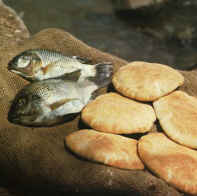
Five Loaves And Two Fish


Loaves-fishes-tilapia002
Right now in the Sunday liturgy we're working our way through John 6, which contains the feeding of the 5,000 (John's version of it) and the Bread of Life discourse.

Last Sunday contained the feeding of the 5,000, and I was annoyed when the priest at the Mass I was attending emphasized a perceived "sharing" aspect of the passage. 

He didn't go so far as to fully subvert the miracle. That is, he didn't say that it was a "miracle of sharing" where people's hearts were moved to share what they had rather than hording it for themselves–a repudiation of the physical miracle that occurred.

But he seemed to be skirting the edge of that idea, without saying anything that would explicity mandate this interpretation.

What he did do was emphasize the idea of sharing, and particularly the generosity of the little boy with the five loaves and two fishes.

This Sunday there was a new priest, and he did the same thing. He didn't spend as much time on feeding (that was last week's reading, natch), but he did stress the generosity of the little boy sharing his lunch.

He also misinterpreted the loaves as probably like rolls instead of probably like pitas or tortillas in form, though we can let that pass.

What I find annoying is all the confident talk about how the miracle occurred because the little boy was selflessly willing to share his lunch.

Not only does that make it sound like God's omnipotence would have been hamstrung if the little boy had said no, and thus giving the little boy's action way too much credit in an ontological sense, it's also giving the little boy undeserved credit in the generosity department.

First of all, who says this was the little boy's lunch–or dinner for that matter?

Five loaves of bread, even if they aren't as big as what you'd buy in a modern supermarket, and two fish, even if they're relatively small, is way too much food for a little boy in that time and culture to have for a single meal. It was too much for a full grown adult to have for a single meal. (When was the last time you had five pitas and two fish for lunch?)

Of course, the boy might have brought food for more than one meal, not knowing how long he'd be at the event, but is there another, better explanation that might be suggested by the text?

Let's look at it. Here is the text in the squishy NAB (so there can be no argument I'm pulling something out of the text that shouldn't have been obvious to the priests just from reading the lectionary version):

When Jesus raised his eyes
and saw that a large crowd was coming to him,
he said to Philip,
Where can we buy enough food for them to eat?”

He said this to test him,
because he himself knew what he was going to do.

Philip answered him,
Two hundred days’ wages worth of food would not be enough
for each of them to have a little.”

One of his disciples,
Andrew, the brother of Simon Peter, said to him,
"There is a boy here who has five barley loaves and two fish;
but what good are these for so many?” 

This isn't exegetical rocket science.

The topic that Our Lord has introduced is where can they buy enough food for the crowd, not how they can get people to share or how they can find somebody who has a little bit of food to share. The topic is buying food.

If you look at the Greek, the verb is agorazo, which means things like "attend market," "do business," "buy or sell," etc. It's a specifically commercial, marketplace term, not a more general one like "get" or "find." So the NAB gets it right with rendering it "buy."

The theme of buying is thus carried on in the conversation, with Philip and Andrew pointing out problems for the proposal.

First, Philip points out the huge expense of feeding the crowd–presumably because the disciples don't have that much money in the purse.

Andrew then carries the theme forward by pointing out a source where food can be bought–the little boy–but that the source doesn't have enough food for the crowd. (Incidentally, he may have started with more but have already sold the rest of what he had.)

It makes much more sense, given the context and the flow of the conversation, to see the little boy not as a local who happened to pack an extraordinarily large amount of food for him to eat at the day's event but as an enterprising young salesman who brought food to where he knew there would be a lot of people spending the day and he could sell it.

Like the kids who swarm over Israel's holy sites to this day trying to sell trinkets or snacks or bottled water to the pilgrims who have shown up for religious reasons.

Jesus' crowds were bound to attract such kids, and Andrew happened to spot one.

Presumably, then, before the miracle of the feeding the disciples paid the little boy for his five loaves and two fishes.

That's not a dead certainty. Of course, I'm sure that they didn't steal them from the little boy, and while it's possible that he was overcome by religious feeling and simply donated them (or decided not to charge once he saw them being multiplied), given that his interest in bringing them to the site was probably commercial, it's not unreasonable to infer that he was paid for them.

We're not told one way or the other, but given the clear buying and selling theme in the text, preachers ought not be rhapsodizing about the generosity of the little boy or how he was willing to share with others or how without his act of sharing the miracle might not have occurred.

If anything, the miracle might have had to start with another source of food if the little boy hadn't been paid for his wares.

Of course, the above doesn't amount to a proof. It could be that the little boy had brought a surprisingly large amount of food for himself and then, for unknown reasons, mentioned this to Andrew and then generously shared it with Jesus and the disciples.

But this isn't the way the text reads.

And it's just annoying when preachers get so wrapped up in a sickly sweet, Hallmark card spirituality that they go off rhapsodizing about human sharing and generosity in a way that flies in the face of the text.

The point here is that God did a miracle through Jesus, not that a little boy was generous.

Sheesh!

UPDATE: MORE FROM STEVE RAY.