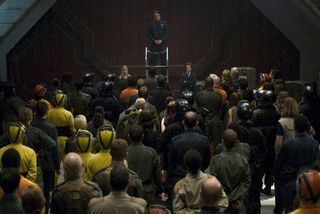
Okay, Let’s Talk Galactica Finale (Part 1)

Daybreak So. I am finally getting around to re-writing the Galactica finale review that got eaten by the mist monsters of cyberspace.

Thanks to those who have waited patiently . . . and to the reader who keeps sending emails that just say “bsg finale analysis?” Polite. Succinct. I like that.

So here goes . . . 

The reimagined series of Battlestar Galactica ended with a 3-hour finale called Daybreak. In case you’ve forgotten what happened in it,

HERE’S A SUMMARY OF PART ONE.

AND ONE OF PART TWO.

For those who (still) haven’t seen it, I’ll put the spoilers below the fold. But let’s answer the first, more general question here: Love it or hate it?

Mmmmmmmm . . . neither.

I certainly didn’t hate it, but I didn’t find myself thinking it was the best possible ending, either. I put it in the “Basically liked it but had some stupid parts” category.

So I wasn’t disappointed. I wanted to come out basically liking the ending, and I did. I don’t expect shows to wow me in the final episode with a “Best. Episode. Evah!” experience. That’s too much to ask. The Best Episode Evah is statistically far more likely to come before the series finale, so I don’t go into the ending with my hopes set too high. 

I just want them to tell an engaging story that answers the series’ major questions, ties up the major loose ends, and gives me a sense of closure and satisfaction.

I thought the BGS finale did that, with a few blemishes that I’ll talk about.

To give you a sense of how I think this finale compared to other sci-fi finales, I guess I’d rank them this way (series that got cancelled and didn’t have a proper finale, I won’t cover):

Star Trek: Deep Space 9: * * * * of 5 stars (fire cave sequence needed to be better and Sisko should have become a prophet, per the plan)

Babylon 5: * * * 1/2 (nice closure, but not the series’ best/most exciting, which wasn’t what I was looking for; get to see the main characters 20 years later in their lives; Sheridan’s final goodbye to Delenn, etc.)

Battlestar Galactica: * * * 1/2 (better than B5 in some ways, but also marred by stupid stuff, making them about equal)

Star Trek: Next Generation: * * * (okay; didn’t wow me; didn’t deserve the Hugo it got; felt like an ordinaryish 2-hour episode; drama hampered by the fact that there was no overarching series goal to be resolved, so they had to come up with the fakey “you’re still on trial” thing in an attempt to provide one; it’s such a pity that–although there was still a lot of good Next Gen to come–the series technically jumped the shark with “the best of both worlds” (2nd3rd season cliffhanger (thanks for the correction!); Picard becomes a borg); that really should have been one of the feature films)

Star Trek: Voyager: * * (no post-climax cooling off period; very important for this kind of story; we need to see the returnees starting their new lives and enjoying (or not) the home they’ve struggled so long to get to, not just sighting the planet in the distance; also BTW, this is where the bottom of the barrel starts; if your series finale scored lower than this, you really have something to be ashamed of, no matter how good it was in its heyday–or even one episode before)

Stargate SG-1: * 1/2 (ihh. that was an ending? sit around for a long time and hit the reset button? it wasn’t unending, it was uninteresting as a finale)

Star Trek: Enterprise: * (horrible! abominable! never do this! the holodeck thing was bad enough, but the worthless death of a major character was insane! this episode was so bad that the producers deserve to be doomed to a sisyphean ordeal of constantly struggling to get new sci-fi shows on the air only to have them swiftly cancelled and . . . oh, wait.)

The X-Files: * (gaaahhh! unbelievably bad writing in the final episode! the whole mulder-on-trial thing was a disaster! and that franchise-killing movie you followed it up with was horrible, too! LISTEN, CHRIS CARTER!: BEG, BORROW, OR STEAL WHAT YOU NEED TO DO A THIRD MOVIE IN 2012, TELL US THE STORY OF THE ALIEN INVASION THE SERIES WAS LEADING UP TO, AND THEN PUT THE FRANCHISE DOWN AND BACK AWAY SLOWLY, KEEPING YOUR HANDS IN SIGHT AT ALL TIMES!)

Hrm.

Okay, I have more on this to say than will make a comfortably sized post, so up next will be things I liked about the finale, then things I didn’t like.

In the mean time, why don’t y’all argue about the relative merits of series finales like the ones above? (That’s the whole point of rankings–to quantify an opinion for purposes of discussion, after all.)

MESSAGE TO CARDINAL: Shut Up, They Explained

From Canada’s National Post comes this urgent message:

Stop the presses! Cardinal Marc Ouellet, the primate of the Roman Catholic Church in Canada, has created shock waves across Canada by … reiterating conventional Church doctrine on the subject of abortion.

Now, it must be admitted that the good Cardinal was reiterating Church teaching on a point that is difficult for many to accept—that abortion is wrong even in cases of rape, that a child should not be killed for the crime of its father. Even many pro-life American politicians allow for rape and incest exceptions.

Mistakenly.

But the climate toward unborn babies is so . . . er . . . cold in Canada that the Cardinal’s comments have occasioned what the National Post refers to as a “freaked out reaction by many pro-choice politicians and pundits.”

How freaked out?

Parti Quebecois leader Pauline Marois said she was “completely outraged” by the Cardinal’s remarks. A columnist with Montreal’s La Presse newspaper, Patrick Lagace, said he wished that the Cardinal “dies from a long and painful illness.” Even Intergovernmental Affairs Minister Josee Verner—whose international maternal-health policies the Cardinal supports—declared that the man’s remarks were “unacceptable.”

The National Post thus asks a reasonable question:

When, exactly, did it become “unacceptable” for a man of faith to articulate his Church’s position on a controversial bioethical issue? Are there any other issues that Ms. Marois, Mr. Lagace and Ms. Verner would like Christians to shut up about? Gay marriage? Stem cells? Pre-marital sex? Perhaps they should make a list, just so everyone can keep track.

For years now, this newspaper and other conservative outlets have been warning Canadians that the trend toward liberal dogmatism among much of Canada’s political class—buttressed by an out-of-control human-rights constabulary—is serving to muzzle religious Christians who are doing nothing else than giving voice to their cherished beliefs. The appalling reaction to Cardinal Ouellet’s speech demonstrates how serious the problem has become.

Indeed.

While I hate to see our neighbor to the north playing the lead role for a cautionary tale, Americans also need to recognize that our country could go in the same hard anti-family, anti-faith direction that Canada has—if Americans don’t resist the same trends in our own culture that have seized the reins in Canada.

In fact, there has been a good bit of reins-seizing here in America of late.

Fortunately, there is an opportunity to correct some of this coming up in . . . oh . . . November.

What do you think?

Grant Official Threatens Catholic Schools over Lesbian Case

Rainbow_flag(1)  Since Lord Alfred Douglas’s 1894 poem “Two Loves,”which was used at Oscar Wilde’s trial, homosexuality has been referred to as “the love that dare not speak its name.”

But that’s so 19th century.

We’re living in the 21st century now, so that was . . . like . . . 200 years ago, right?

Why, then, can’t Michael Reardon—executive director of the Catholic Schools Foundation—just come out and state the facts about a recent incident in the Archdiocese of Boston’s Catholic schools?

In a statement on the Catholic Schools Foundation website (.pdf), Reardon writes:

Dear School Administrators:

You may be aware from recent publicity about an exclusionary admissions practice at St. Paul School in Hingham, which does not receive support from the Catholic Schools Foundation. In light of those media reports, we thought it important to clarify the position of the Catholic Schools Foundation – – namely, that no school that promotes an exclusionary admissions policy or practice will be considered for support.

We believe a policy or practice that denies admission to students in such a manner as occurred at St. Paul’s is at odds with our values as a Foundation, the intentions of our donors, and ultimately with Gospel teaching. Our concern is the education of young people. We will not fund any school that that treats students and families in such a manner. This policy has been unchanged since our founding in 1983.

We are proud that Catholic schools are known for being welcoming communities for all students. So although this incident is disturbing, we know that it is isolated, not a policy of the Archdiocese, or indicative generally of the Catholic schools of the Archdiocese. Know that we appreciate all you do to make your schools places where all feel welcome.

Please contact me at 617-778-5981 if you have any questions or if I can be of any assistance to you.

With hope for the students we serve and the future of Catholic education, I am

Sincerely yours,

Michael B. Reardon
Executive Director

From Reardon’s letter, you’d have no idea whatsoever was at issue in the St. Paul School case. He vaguely refers to “an exclusionary admissions practice” and ominously warns that “no school that promotes an exclusionary admissions policy or practice will be considered for support.” He speaks opaquely of “a policy or practice that denies admission to students in such a manner as occurred at St. Paul’s.” He uses lofty rhetoric about the values of the foundation, its donors, and “Gospel teaching.” He warns that they will not fund “any school that treats students and families in such a manner.” He uses touchie-feelie language about Catholic schools being “welcoming communities,” “where all feel welcome.” And he says that the St. Paul School incident “disturbing.”

So disturbing, apparently, that he can’t even speak forthrightly about the subject. The whole thing has to be shrouded with indirectness, shielded from frank discussion, and wrapped in comforting PC rhetoric.

It certainly isn’t the case that Reardon would want Catholic schools to accept any student whatsoever. If Catholic schools set no limits whatsoever on enrollment, the sheer volume of potential students would overtax the schools’ resources to the point that they couldn’t fulfill their mission. Schools must for economic reasons alone have “exclusionary admissions practices.” Similarly, some students are so disruptive that they cannot function in a normal classroom environment. Some students, frankly, belong in the juvenile justice system. So it isn’t a question of whether Catholic schools should have “exclusionary admissions practices.” The question is which exclusionary admissions practices they should have, and Reardon knows that full well. He just isn’t being forthright about the kind of exclusionary policy he has in mind.

Mr. Reardon may not understand the importance of being earnest, but let’s look at what he might have said had he chosen to be frank.

Dear School Administrators:

You may be aware from recent publicity that St. Paul School in Hingham has declined to enroll an eight-year old boy who has two lesbian “mothers.” St. Paul’s School does not receive support from the Catholic Schools Foundation, so we have no leverage over them, the way we do you. In light of the media reports, we thought it important to clarify the position of the Catholic Schools Foundation so that none of you get the idea of copying St. Paul’s example. Consider this letter a shot across your bow. Our policy is that no school will be considered for support if it either by policy or in practice declines enrollment for students with same-sex “parents.”

It does not matter how disruptive a situation such enrollments would create. It does not matter how difficult a position it would put the thus-enrolled children in. It does not matter how it would put pressure on teachers not to fully and vigorously proclaim Church’s teaching about marriage. It does not matter what other parents in the school might say about the way their children should be educated. None of these things count. What matters is that these children be admitted. This is the sine qua non.

We believe a policy or practice that denies admission to students with openly homosexual parents is at odds with our values as a Foundation, the intentions of our donors, and ultimately with Gospel teaching. Gospel teaching requires that we turn a blind eye to all the concerns named in the previous paragraph. The necessity of admitting children with openly homosexual parents trumps them all. There can be no rational disagreement on this point, and if you do disagree, you are opposing Gospel teaching.

Our concern is the education of young people. We will not fund any school that that treats students and families (note that I am classifying two homosexuals and a child as a family without qualification) in such a manner. You heard me right. We are so concerned with the education of young people that we will deny funding to all the other students in your school if even one child is not enrolled because he has openly homosexual parents. The need of the one outweighs the needs of the many. We care more about providing a Catholic education for this one student more than providing Catholic education for all the other students we would otherwise provide assistance to. This tells you what our values are. We will use financial scorched-earth tactics against any school that disagrees with us, even at the urging of the parents whose children attend the school. This policy has been unchanged since our founding in 1983. [Really? They would have yanked funds in 1983 over this issue?—ja]

We are proud that Catholic schools are known for being welcoming communities for all students except the ones who must be denied enrollment for various rational reasons that I am ignoring here. So although this incident is disturbing to politically correct sensibilities, we are thankful that it is isolated, not a policy of the Archdiocese, or indicative generally of the Catholic schools of the Archdiocese. Know that we appreciate all you do to make your schools places where all, including open and active homosexual partners but not including parents who would disagree with us, will feel welcome. And remember that if you fail in such efforts, we will withdraw all financial support from your school and the other students it has. Consider them financial hostages to this issue.

Please contact me at 617-778-5981 if you have any questions or if I can be of any assistance to you.

With hope for the students we serve and the future of Catholic education, I am

Sincerely yours,

Michael B. Reardon
Executive Director

Ahhhhhhhh.

Isn’t a little forthrightness refreshing?

What do you think?

Most Recent Favorite Walter Moment

I’ve been meaning to blog about the TV show Fringe in a little over a week, after the season finale, so that if anyone is interested in trying out the show they’d have the summer to catch up (rather than being exposed to all the season-finale spoilers that are about to be broadcast), but I just discovered this nifty share thingie on hulu, and since the episodes are available there for a limited time, I thought I’d share this one particular moment with you.

The moment features Dr. Walter Bishop, one of the lead characters, and the who often gets the best, or at least the funniest, character moments on the show.

Here’s what you need to know for the clip, and below the fold I’ll tell you what I like about it.

Walter is a brilliant scientist. 

Years ago he arrogantly conducted nature-defying experiments that led to tragedy and resulted in him being put in a mental hospital.

Back then, when he was playing God, he didn’t believe in God. Now he does.

He is a humbled man trying to make amends for his past, despite the fact that he often can’t remember the details of what he has done.

Most of the time he is sweet, childlike, humorous, and caring. He also is in need of constant adult supervision.

In this clip we find him trying to cope with the real world–on his own–for the first time in twenty years.

NOTE: This doesn’t seem to work for people outside the U.S. due to copyright issues.

Continue reading “Most Recent Favorite Walter Moment”

“Grave Sin” = Mortal Sin

Confessional The Catechism of the Catholic Church states:

1857 For a sin to be mortal, three conditions must together be met: "Mortal sin is sin whose object is grave matter and which is also committed with full knowledge and deliberate consent."

What if a sin has been committed that has grave matter but lacks the knowledge and consent needed to make it mortal? How might one refer to such a sin?

Since it has grave matter, one might refer to it–logically–as a grave sin. That would seem pretty straightforward: Sin with grave matter is grave sin. Add the needed knowledge and consent and it becomes mortal. Right?

Well, you'd think that. Only you wouldn't be right.

For some years it's been clear (to me, anyway) that ecclesiastical documents like the Code of Canon Law and the Catechism of the Catholic Church regularly use the phrase "grave sin" to mean "mortal sin."

But until recently I haven't had an explicit statement documenting this fact. Now I do (CHT to the reader who provided it!)

The statement is found in a post-synodal apostolic exhortation by John Paul II from 1984. The synod of bishops had been held the previous year on the theme of reconciliation and penance, and in the resulting exhortation, 

During the synod, some apparently proposed a spectrum of sins consisting of venial, grave, and mortal sins–apparently using the middle category not the way proposed above but as a sin that is worse than venial but less than mortal. This is perhaps related to the mistranslation of "grave" as "serious" in English that was common for a long time.

In any event, that kind of division would be wrong, and so John Paul II wrote:

During the synod assembly some fathers proposed a threefold distinction of sins, classifying them as venial, grave and mortal. This threefold distinction might illustrate the fact that there is a scale of seriousness among grave sins. But it still remains true that the essential and decisive distinction is between sin which destroys charity and sin which does not kill the supernatural life: There is no middle way between life and death.

And so (here comes the money quote) . . .

Considering sin from the point of view of its matter, the ideas of death, of radical rupture with God, the supreme good, of deviation from the path that leads to God or interruption of the journey toward him (which are all ways of defining mortal sin) are linked with the idea of the gravity of sin's objective content. Hence, in the church's doctrine and pastoral action, grave sin is in practice identified with mortal sin.

So. Glad we've got that cleared up.

Blog Operations Note

I just thought I'd do a little lunchblogging to let folks know what's going on with the blog right now.

I am writing on deadline to finish a major book project, and it's spilling over my work time and into my free time, so for the next couple of weeks blogging is likely to be lighter than it has been of late.

I'll still put up some things when I can get a few free minutes, but the more sustained, longer posts will likely have to wait until the book manuscript is done.

A particularly frustrating thing is that this weekend I typed out my review of the series finale of Galactica, and just as I was proofing it and about to put it up, it vanished entirely–and irretrievably–leaving me with only a small portion of the beginning of it.

The good news, though, is that I just have to re-type it when I can get the time. I've already processed my thinking on the subject, and the re-written version is likely to be better than the original draft, anyway.

So . . . that's coming.

Members of Medjugorje Commission Announced

Italy-vatican-museum

The Vatican Information Service has announced that the new Medjugorje commission has had its first meeting.

The press release stating this also contains a list of the members of the commission. Here is the text, reformatted to make reading the names easier:

“The International Investigative Commission on Medjugorje met for its first session on 26 March 2010.”

“The Commission, presided over by Cardinal Camillo Ruini, His Holiness’ vicar general emeritus for the diocese of Rome, is composed of the following members: 

  • Cardinal Jozef Tomko, prefect emeritus of the Congregation for the Evangelisation of Peoples;
  • Cardinal Vinko Puljic, Archbishop of Vrhbosna, president of the Bishops’ Conference of Bosnia-Herzegovina; 
  • Cardinal Josip Bozanic, Archbishop of Zagreb and vice-president of the Council of European Bishops’ Conference; 
  • Cardinal Julian Herranz, president emeritus of the Pontifical Council for Legislative Texts;
  • Archbishop Angelo Amato, S.D.B., prefect of the Congregation for the Causes of Saints; 
  • Msgr. Tony Anatrella, psychoanalyst and specialist in Social Psychiatry; 
  • Msgr. Pierangelo Sequeri, professor of Fundamental Theology at the Theological Faculty of Northern Italy; 
  • Fr. David Maria Jaeger, O.F.M., consultant to the Pontifical Council for Legislative Texts; 
  • Fr. Zdzislaw Jozef Kijas, O.F.M. Conv., relator of the Congregation for the Causes of Saints; 
  • Fr. Salvatore M. Perrella, O.S.M., teacher of Mariology at the Pontifical Marianum Faculty of Theology; and 
  • Fr. Achim Schutz, professor of Theological Anthropology at the Pontifical Lateran University as secretary. 
  • Msgr. Krzysztof Nykiel, an officer of the Congregation for the Doctrine of the Faith serves as additional secretary.”

“Other experts have also participated in the commission’s work: 

  • Fr. Franjo Topic, professor of Fundamental Theology in Sarajevo; 
  • Fr. Mijo Nikic, S.J., professor of Psychology and Psychology of Religion at the Philosophical and Theological Institute of the Society of Jesus in Zagreb, 
  • Fr. Mihaly Szentmartoni, S.J., professor of Spirituality at the Pontifical Gregorian University, and 
  • Sr. Veronica Nela Gaspar, professor of Theology at Rijeka.”

“As announced previously, the work of the Commission will be carried out with the utmost reserve. Its conclusions will be submitted to the Congregation of the Doctrine of the Faith for study.”

I’m not a veteran Medjugorje watcher, so I don’t have a feel for the individuals on or working with the commission when it comes to Medjugorje.

Does anybody have thoughts on how the members lean–or if they’re all neutrals, or what?

So When Can You Get Them At Wal-Mart?

Plain-white-t-shirt-psd21759 SCIENTISTS TURN T-SHIRTS INTO BODY ARMOR.

IT'S TRUE!!!

QUOTES:

Researchers at the University of South Carolina, collaborating with others from China and Switzerland, drastically increased the toughness of a T-shirt by combining the carbon in the shirt’s cotton with boron – the third hardest material on earth. The result is a lightweight shirt reinforced with boron carbide, the same material used to protect tanks.

The scientists started with plain, white T-shirts that were cut into thin strips and dipped into a boron solution. The strips were later removed from the solution and heated in an oven. The heat changes the cotton fibers into carbon fibers, which react with the boron solution and produce boron carbide.

The result is a fabric that’s lightweight but tougher and stiffer than the original T-shirt, yet flexible enough that it can be bent, said Li, who led the group from USC. That flexibility is an improvement over the heavy boron-carbide plates used in bulletproof vests and body armor.