BTW, I just this morning got my hands on my first physical copy of the book. The printer overnighted us a few review copies. The main shipment is due in later this week, and I'm supposed to sign more than a thousand of them next week. Whew!
BTW, I just this morning got my hands on my first physical copy of the book. The printer overnighted us a few review copies. The main shipment is due in later this week, and I'm supposed to sign more than a thousand of them next week. Whew!
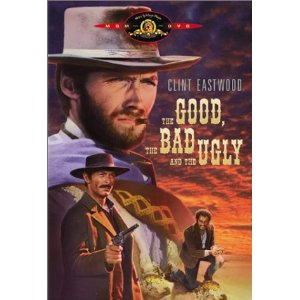 The final installment of the Man with No Name trilogy is the film The Good, the Bad & the Ugly (two-disc edition)
(For my review of the first two films, see: A Fistful of Dollars and For a Few Dollars More.)
There are two things that, if you know them before you watch the picture, you will probably enjoy it much more:
1) Despite being the third part of the trilogy, this film is not a continuation of the story of the characters we've met. It's about different characters who are reminiscent of the ones in the first two films.
2) This film is really long, so be prepared for a marathon movie-watching session. The American version is 2 hours and 40 minutes long, and the Italian version is apparently a full 3 hours (compared to the 90 minutes of the first film and the 2 hours of the second).
I didn't know either of these before I started watching, and I found my enjoyment hampered as a result. I'd probably like it more on a second watching.
Why isn't this a continuation of the characters established in the first two films? Two reasons: First, at the end of the second film Clint Eastwood's character had become rich. He therefore would have no need to continue bounty hunting, which is–and which certainly was then–a dangerous and unpleasant profession.
Second, and more importantly, Sergio Leone wanted to set this story during the American Civil War. This is earlier than the classic period of the "Old West" genre, which focuses on the years from about 1870 to 1900, which saw great western expansion and settlement, in significant measure driven by the need to get out of the economically impoverished, Reconstruction-era South.
Leone therefore needs to yank us back about 25 years in time from when the first two films were apparently set, to what seems to be approximately 1863 (plus or minus a year).
Why does Leone want to set this film during the Civil War?
Because he's an Italian director and he wants to make a point about the brutality and senselessness of war. What other reason could there be?
The thing is, though … it helps first-time watchers if you clearly communicate right from the beginning that we're in the 1860s rather than the 1880s and that these are not the same characters we met in the first two movies. If you don't tell them that then the viewers will experience cognitive dissonance until they figure it out.
That takes some time due to Leone's slow-pacing of this film. We don't even meet Clint Eastwood's character until something like 30 minutes into the movie. He's the last of the three title characters to be introduced.
Speaking of which, let's talk about the title. The films in this trilogy seem to be plagued with title problems. In themselves, the titles are awesome. A Fistful of Dollars. For a Few Dollars More. The Good, the Bad, and the Ugly. Good titling!
But the titles don't always actually fit the movie. And that's especially true in this case.
Admittedly, they came up with a better title for this one than what the purely descriptive one would have been: "For a Heaping Huge Pile of Dollars"–which is what the stakes are this time ($200,000 in gold, in 1863 dollars).
Leone loved the title they finally came up with for this movie. He loved it so much that–just to make sure you appreciate it–he explicitly identifies Clint Eastwood, Lee Van Cleef, and Eli Wallach as (respectively) "the Good," "the Bad," and "the Ugly."
He does this at the beginning and the end of the film by writing these words on the screen during a freeze frame of each character.
How is it, then, that the theatrical trailer misidentifies Wallach as "the Bad" and Van Cleef as "the Ugly"? Leone made the identifications pretty clear.
The problem is with the identifications themselves. On the one hand, none of the three characters in the film is actually good. They are all vicious criminals out to make a buck.
Despite being explicitly identified as "the Good," Clint Eastwood's very first act in the film is to gun down three innocent men to keep them from lawfully claiming a bounty that he wants to claim himself. While he does do one genuinely altruistic thing in the movie (comfort a dying soldier toward the end, at very little cost to himself), he is–as the final line of the movie says–"a dirty S.O.B." (Only the final line doesn't say "S.O.B." but what it stands for.)
In terms of moral rectitude, Eli Wallach's character actually has a better claim on the term "good." He does bad things, but it's clear that he has a more robust conscience than the other two title characters, and while he isn't above taking revenge, he doesn't gratuitously kill people like the other two.
Ultimately the primary good that Eastwood has in comparison to the other two is good looks. Both Wallach and Van Cleef could vie for the title "the Ugly" (as the theatrical trailer made clear).
The one identification that is really solid, though, is "the Bad."
That is Van Cleef's character in spades. He is a brutal, sociopathic killer whose villainy dwarfs those of his title companions.
In this movie.
The thing is, he wasn't like that at all in the previous movie. He was a good guy. Gooder, even, than Eastwood's character! Which only adds to the cognitive dissonance until you figure out he's not playing the same character.
And it's not like Leone helps you with this. The Eastwood and Van Cleef characters are meant to evoke the ones they played in the second film. Eastwood still wears the same hat, the same brown poncho, and smokes the same little cigars. Van Cleef is still better dressed and smoking a pipe. And they're both still gunslingers. Visually they are the same, but they're not the same people.
It's like … Invasion of the Character Snatchers or something.
Or at least like an episode of The Goon Show, where protagonist Neddie Seagoon can be prime minister of England one week and a private detective the next and a postal inspector the third.
The basic plot of the movie is as old as The Pardoner's Tale: Three thieves competing for a stash of gold.
It's a well told tale in the sense that it has a lot of interesting, inventive stuff in it. There are twists and surprises. In fact, given the length of the film, one at times feels like there may be a few too many twists and surprises.
The Eli Wallach character is the true soul of the movie. It's more about him than about the other two. And he is an interesting, rambunctious, comedic, and annoying character. He is capable of getting the best laughs of the film and the most pathos. You feel for him in a way you can't for Van Cleef or Eastwood–the first because he is pure evil and the second because he is pure stoic.
Sergio Leone reportedly said, "I like Clint Eastwood because he has only two facial expressions: one with the hat, and one without it."
Like the previous two movies, his one has amazing music and scenery, both effectively used by Leone.
In fact, it may have a little too much music. Leone reportedly could not bring himself to cut some shots because he wanted to let the music play out, thus adding to the film's bulk and slowing its pacing.
The pacing is the single biggest flaw in terms of craft with the film. Leone has become too self-indulgent in the film. There is a point, about two hours into the movie, where they've set up all the pieces they need for the climax and they could proceed directly to the conclusion, but you realize, "Oh, no! They're going to insert a whole 'nother act before they let us get to the conclusion! Just so that the director can make his 'futility of war' statement, we have to take a big, huge plot detour."
When we finally get to the climax, though, it's a good one. And, oddly, the pacing isn't the problem that it has been up to now.
I didn't believe it at first but the climactic, Mexican standoff between the three characters in this film really does go on for five minutes! (I timed it.)
I thought it could have been cut a little, but it is so gripping that I felt like a character in a Monty Python sketch, declaring, "That was never five minutes just now!"
Oh, and speaking of humor, that's one thing that this movie has much more than the other two. It really does have multiple laugh-out-loud moments and some great zingers in the script.
Like its predecessors,it is both compelling and flawed. It's easy to see why it is considered a classic of the genre. It's by far the most ambitious of the three films, which leads both to its best and worst elements.
Morally it is unsatisfying. Clint Eastwood just is not "the Good" that the title promises. He's not even "the Good" relative to the two other characters. Eli Wallach is just as good as Eastwood. and the very ending (after the showdown is over), while not sad like that of the Pardoner's Tale, comes off as contrived.
Still, it's a landmark film in the history of Westerns, and it's loaded with style and camp appeal.
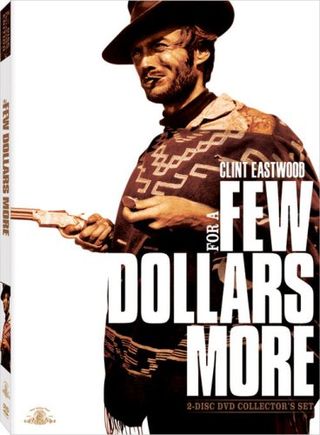 The second installment of the Man with No Name trilogy is the film For a Few Dollars More (two-disc edition).
(For my review of the first film, see: A Fistful of Dollars.)
This time they translated the title from Italian correctly!
Unfortunately, while it's a good title in itself, it doesn't perfectly reflect the content of the movie–in at least two respects.
First, we aren't talking about "a few dollars." The number of dollars that are on the line in this movie is huge. Better than $40,000–which was an enormous sum back in the 1880s/1890s, when the film presumably takes place. As Lee Van Cleef tells Clint Eastwood at one point, he stands to be "rich" if his plans meet with success.
Second, the title doesn't point to a man's-inhumanity-to-man story nearly as well as the first film's true title ("For a Fistful of Dollars"). Why? Because in this film Clint Eastwood's character–the Man with No Name–isn't a drifter out to make a buck and willing to amorally play two sides against each other to get it.
Instead, he's a bounty hunter. And thus, in principle, he is an agent of law and justice.
Sure, the rule of law was shaky in the Old West, and justice was often hard to come by, but the work Eastwood's character does is in principle on the side of the angels.
He may be rough-edged, but he's doing work that needs to be done.
Oddly, perhaps in an attempt to preserve some of the moral ambiguity of the first film, Eastwood and others like him are referred to as "bounty killers" rather than bounty hunters, but it's clear that they aren't simply soulless killers–a fact that the conclusion of the movie more than amply demonstrates.
As a result, this got an A-III (adults) from the U.S. bishops' movie review service rather than an O (morally offensive) or an L (limited adult audiences, which then would have been styled A-IV, adults with reservations, if I understand correctly).
The A-III rating is probably about right.
The fact that the film is on safer moral ground means that I don't have to say as much about the plot and so can leave more plot elements unspoiled in providing a review.
What I will note is that Eastwood's character starts out, again, as a ultracool, supercompetent, Old West Mary Sue, just like he was in the first film.
So how do you top that?
Confront him with his equal: another Mary Sue.
Enter Lee Van Cleef.
Van Cleef plays another ultracool, supercompetent Old West bounty hunter . . . uh, bounty killer.
But he's different than Eastwood, you see? He's older. And he uses different weapons. And while Eastwood is always smoking a cigar, Van Cleef is always smoking a pipe. Get it? These two characters are totally different, while they're also totally the same.
(Memo to both characters: Smoking during a gunfight is a Bad Idea. You don't need extra distractions. I'm sure that this is covered in the NRA gun safety course. Please review!)
And like any two such larger-than-life characters, what's the first thing they have to do? If you've ever read an issue of Marvel Team-Up or Marvel Two-In-One, you guess right: Fight each other!
But before you can say "Epic of Gilgamesh" (or at least "Gilgamesh and Enkidu at Uruk"), they've become friends.
Sort of.
Partners, at least.
And their partnership will be tested.
Why that is the case is a little hard for me to fathom. With 40,000 1885-dollars on the line, it seems that there is plenty to share! (Especially when it turns out that money isn't the only motive involved here. This isn't just about "a few dollars more.")
We also get more of the stunning visuals and haunting music that are series trademarks. The plot is nicely complicated, though it doesn't have the same element of mystery as in the first film. The first time around Eastwood's character was clearly way ahead of the game and part of the fun was trying to figure out what he was planning. There's some of that here, but not as much.
One thing that does recur–and probably necessarily so–is a scene in which Eastwood gets the snot beaten out of him. Only this time he isn't alone. Van Cleef get's the same treatment–at the same time–again with a maniacally laughing villain in the background.
The reason that this scene is necessary is that we're watching two ultracompetent characters playing their opponents for fools. We need their luck to run out at some point. To create real drama (as opposed to simple wish-fulfillment) the bad guys need to become a credible threat at some point. If you haven't established that early in the picture, you need to do it before the climax or the climax won't have the punch you need.
Back in the 60s, when these came out with a year between them, the similarity probably would have gone unnoticed, but watching the movies back to back I found myself thinking, "Hey, didn't I just watch this same scene—also at the 3/4 mark–in the previous film?"
Another minor annoyance in the film is that–despite the fact that Clint Eastwood is famously playing "the Man with No Name" (something explicitly pointed out as early as the theatrical trailer for the first film)–they appear to give him a name in this film: Manco.
Actually, that's not a name but a nickname. "Manco" is Spanish for "one-armed," and supposedly Eastwood does almost everything in the movie with his left hand, only using his right hand to shoot. Or that's the claim. Personally, I didn't notice that and didn't care enough to keep track. It's too much of a subtlety, as is expecting an English-speaking audience to know what "manco" means in Spanish.
Despite its flaws, For a Few Dollars More is probably the most watchable film of the trilogy. It's less ingenious but more fun than the first film. Watching Eastwood and Van Cleef outcool and play headgames with each other is definitely fun. The film is also less ambitious–and thus less drawn out–than the third film.
Too bad that, as the middle child of the trilogy, it's probably the most overlooked of the three.
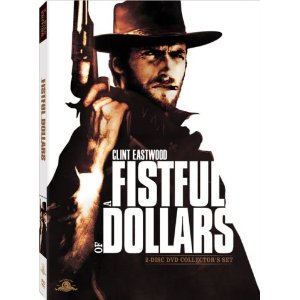 I recently watched the Man with No Name trilogy
This series originally came out when I was a baby (pre- and post-born), and if my parents took me to it when it was in theaters, I have no memory of it.
What I do remember is my dad's copy of the album (remember vinyl?) and the haunting, wailing, chanting music that was used to score the films.
I never saw them growing up (this was pre-cable and pre-VCR), but I finally got around to watching them, and thought I'd review them here.
The first film–A Fistful of Dollars (2-disc edition here)
Clint Eastwood's character has no name. What he also doesn't have is a well defined sense of morals. Upon learning that the Mexican town in which he has arrived is dominated by two rival families–the Rojas and the Baxters–he decides to make money for himself by playing the two sides off against each other. He alternately hires himself out two both groups, sometimes at the same time.
And large numbers of people die as a result.
This was part of director Sergio Leone (operating under the absurdly Americanesque pseudonym "Bob Robertson")'s effort to reinvent the Western film genre using more morally ambiguous characters and even anti-heroes.
The film's point is somewhat blunted by the slight mistranslation of the title from Italian. In Italian the title would literally translate as "For a Fistful of Dollars"–i.e., that's why Clint Eastwood's character started the bloodbath in the first place, a grim statement about man's capacity for inhumanity.
The Man with No Name isn't completely sociopathic, however. He does do one, major, genuinely selfless thing in the movie, which is to help a captive family escape. When the mother in the family asks him why, he says that he knew someone like her once (his own mother?) but there was no one there to help.
Ironically, this proves to be his big mistake. Up to this point, the character has been a total, supercompetent, gun-slinging Mary Sue, who can not only shoot better than anyone else but who is also five steps ahead of the people on both sides.
To keep the character from being totally consumed by Mary Sueness, he needs to be taken down a peg, and when his act of kindness is discovered Eastwood is beaten to a pulp while one of the villains laughs maniacally.
Eventually one of the families massacres the other, and Eastwood–in an impressive and inventive final duel–brings a kind of belated justice to the conclusion.
At the end of the movie he rides off with his dollars (which are rather more than a fistful; he made out well from these two families) and the audience is left to contemplate the morality–or lack of it–of his actions.
This got an O (morally offensive) rating from the U.S. bishops' film review service.
Though I wonder if it would today. Back in the 1960s, when this came out, the kind of brutal violence that the film contains would have been quite a bit more shocking than today.
Actually, the violence is amazingly bloodless. It's basically "bang, you're dead." One shot per customer; no visible wounds; the victim falls over and doesn't move again. What's startling is that Eastwood will do it to three people right in a row–bang! bang! bang! And we get a hip-level camera shot, so it's rather like watching a first-person shooter game.
Also, if the title had been properly translated it would have been clearer that the filmmakers are showing what man can do for a fistful of dollars but they're not approving of it.
In other words, we've got a man's inhumanity to man story here.
I probably would have given it an L (limited adult audience) rating.
While Leone was trying to get away from some of the cliches of Westerns, he was only partially successful. The film embraces as many cliches as it eschews.
On the positive side, the film has beautiful visuals (who knew that Andalusia in Spain looks so much like the deserts of Northern Mexico and the American Southwest?), haunting music, an intricate plot with a good number of twists and surprises (which I have not spoiled), and something to think about: How justifiable–or not–are Eastwood's actions at different turns.
It's easy to see why it was popular (very popular), why it's considered an iconic film, a classic of the genre–and why it got a couple of sequels.
 In my previous postwe talked about whether anti-Catholicism is the last socially acceptable prejudice remaining in America, as is often claimed.
We saw that, while what counts as “socially acceptable” can be debated, there are a number of easily namable prejudices that are quite acceptable in America, including prejudices against conservative Protestants (Evangelicals and Fundamentalists), against organized/western religion as a whole, and against Muslims (in the sense of actual undue hostility, not just prudent caution due to 9/11). (There is also, of course, some anti-Semitism, but it is not socially acceptable in general American culture.)
Contemporary America’s socially acceptable prejudices go way beyond religion, however. Let’s name a few non-religious ones . . .
1) Prejudice against large families: This is something that some Catholics end up experiencing. Stories about of people with large families encountering those who sneeringly ask them (even in front of the children), “Haven’t you heard of birth control?”
This form of prejudice—originally inspired by the Rev. Thomas Malthus and reinvigorated in the 1960s & 1970s—is particularly short-sighted since children are the economic future of the country. We need more children to stave off a demographic winter like the ones poised to sweep across Japan and Europe.
This leads to another prejudice . . .
2) Prejudice against non-environmentalists: Environmentalists have been so successful in worming their way into American media culture that you can’t watch TV or listen to the radio without a constant, Chinese-water-torture-like series of exhortations to “Go green,” minimize your “carbon footprint,” and promote “sustainability.”
Story after story focuses on environmental issues with either no challenge at all to the environmentalist viewpoint (it is simply assumed to be true) or with only lip service (frequently sneering lip service) given to alternative viewpoints.
3) Prejudice against traditional values concerning homosexuality: Homosexuals have achieved great success in framing their cause in terms of the civil rights model, with the result that objectively disordered behavior is commonly treated as normal, and anyone who disagrees with this is treated as a pariah.
The way the trend is going, expect anyone with traditional sexual values to be regarded as the equivalent of a Klansman within a generation.
On the other hand, there is also:
4) Prejudice against homosexuals: While the Holy See has been quite firm that homosexual behavior is objectively disordered and not to be given societal approval, it also recognizes that there is such a thing as unjust discrimination against homosexuals (see also here, and here).
While conscientious Catholics studiously avoid such prejudice, not everybody is a conscientious Catholic, and all one has to do is look at the bullying behavior of teenage boys toward those they even suspect of homosexual tendencies to see the malice that is out there.
These prejudices go beyond religion and into the realm of moral values, but then there are prejudices that are at best only peripherally related to such values.
Those will be the subject of our next post.
What are your thoughts?
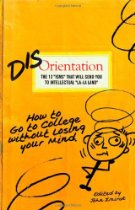 No, not the one you're thinking of. A different one.
You see, recently John Zmirak, Elizabeth Scalia (the Anchoress), Eric Metaxas, Peter Kreeft, Robert Spencer, Dwight Longenecker, Eric Brende, George Rutler, Donna Steichen, John Keck, Mark Shea, Jeffrey Tucker, John Zulhsdorf, and I were sitting around the pool shooting the breeze and talking about how it would be nice to collaborate on a project with each other.
So we did.
We wrote a book together.
That afternoon.
At John Zmirak's suggestion, we took on the most common ideologies infesting college campuses today–sentimentalism, relativism, hedonism, progressivism, multiculturalism, anti-Catholicism, utilitarianism, consumerism, cynicism, feminism, Americanism, Marxism, and modernism.
And we trounced them thoroughly, with each of us contributing a chapter. (I did the one on anti-Catholicism.)
Now that book is out. It's called Disorientation: The 13 "isms" That Will Send You to Intellectual "La-La Land."
While it's pitched in a special way for those in or entering college (hint: Christmas gift idea for high-school or college-age relations!), it's also fun to read and of interest to anybody who would like short, snappy responses to the ideologies of our day.
And it comes with cartoons! Did I mention that it comes with cartoons?
While the above poolside story is entirely fictitious, the book is not, so . . .
 You sometimes hear Catholics express the opinion that anti-Catholicism is the last remaining socially acceptable prejudice in America.
For example, in a recent piece defending Archbishop Dolan, James Farrell of Irish Central writes:
Archbishop Timothy Dolan has come out swinging against The New York Times, accusing it of anti-Catholic bias in two recent articles.
He is right.
Anti-Catholicism is the last acceptable prejudice it seems to me in America. If the same comments that were made about Catholic religious figures were aimed at Rabbis, immams [sic] or Dali Lamas there would be widespread outrage.
The substance of what Farrell says is quite true, and I’m glad to see him stepping up and adding his voice to Archbishop Dolan’s. You can read Archbishop Dolan’s original piece here.
Nevertheless, the claim that anti-Catholicism is the last acceptable prejudice in America is incorrect.
It is certainly true that people publicly say things about Catholics they would never say, for example, about religious groups like Jews or Muslims—or about particular racial or ethnic groups.
It’s also understandable that many Catholics would perceive anti-Catholicism as the last remaining prejudice since it may be the only one they personally experience, the only one many of them feel.
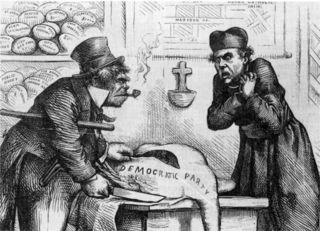
And, indeed, anti-Catholicism does have a long history of social acceptance in the United States, as illustrated by the accompanying 19th century cartoon by Thomas Nast, which features one of his trademark ape-like Irishmen carving open the goose that laid the golden egg (the Democratic Party), to the delight of an avaricious priest.
But anti-Catholicism is far from being the last socially acceptable prejudice in America.
What are some others?
To a degree, it depends on what you mean by “socially acceptable.” What’s acceptable in one social circle is not acceptable in another, and there are degrees to the phenomenon of social acceptability. If you define your group small enough, you can find some social circle in which it is acceptable to say any arbitrary thing you want. If you define your group large enough, you’ll find someone in it who will object to the same arbitrary thing.
Nevertheless, it is possible to find prejudices that are given voice, without immediate censure, in a wide range of contexts, both private and public.
For instance, there is anti-Evangelicalism/anti-Fundamentalism. This is hostility towards conservative Protestantism. Many Catholics tend not to be aware of this prejudice because they are not the object of this kind of hostility, but those of us who are converts from conservative Protestantism have vivid memories of the way the press and other elements in modern culture would mock and look down upon our beliefs.
For us the equivalent of the priestly pedophilia scandal was the 1980s televangelism meltdown. The televangelists had always been an embarrassment to many of us, but they were the most visible faces of the movement, and when the financial and sexual scandals erupted, we were subject to the same kind of searing public criticism that the Catholic Church would be subject to a few years later.
Then there is the more general anti-organized-religion prejudice that is hostile toward anybody who takes their faith seriously, or at least anyone who takes a western religion seriously. You can find this among the people who say that they are not religious but “spiritual” and from militant atheists like Dawkins and his crowd.
And, if we want to be frank, there are some anti-Muslim sentiments that get expressed in America without being automatically censured. (I’m talking actual, undue hostility toward Muslims as a group, not prudent caution—though this is far less than the raging anti-Americanism and anti-Christianism harbored in the worldwide Islamic community.)
Prejudice in America goes beyond religion, though.
That will be the subject of our next post.
What are your thoughts?