Ring Of Mom

Ashring

In our ever more utopian society, not only are people eagerly seeking ways to cull out unproductive human beings from the herd and mark them for warehousing and death, but it is now seeking ways to make even the dead productive.  If you thought that the one blessing of being dead was that you would be safe from such designs, think again.

So, your mother, sister, uncle, grandfather, or child didn’t earn his or her keep and is now "departed this Earth"?  Or perhaps that person was someone you deeply loved who died a natural death and so you want to cling to his remains.  What do you do with the ashes?

If you’re Michael Schiavo, you bury them beneath a marker that acts as an eternal apologist for your agenda. But if you are the more sentimental sort, you might turn your relative’s ashes into jewelry:

"Laura Curtin falls silent as she slowly lifts the jewelry box lid.

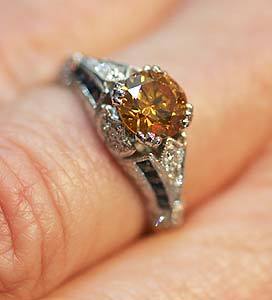
"The 1.27-carat yellow diamond inside glistens brilliantly as it catches the sunlight through the funeral home window.

"Curtin’s eyes fill with tears.

"This isn’t just any diamond. It’s a tribute to her mother, created from her ashes."

GET THE STORY.  (Use BugMeNot.com to bypass the Evil Registration Requirement.)

SEE THE SITE OF LIFEGEM.COM.

(Nod to the friend who forwarded to me the links.)

Of course, in this particular case, Laura Curtin’s mother wasn’t particularly helpful to her daughter’s understanding of a dignified means of handling her remains. Curtin reports that when she asked her mother what she thought of the idea of becoming a cultured diamond, her mother said "That’s fine. I’ll be your problem then. You figure out what to do with me."

So, not only did this mother not request a dignified disposition of her body, but she equated the disposition of her remains with being her daughter’s "burden." Just such thinking is what spawns the quest to make human beings productive by any means possible.

The Virgin Birth & Egyptian Mythology

The reader with biblical questions concludes:

3. Okay, this one’s from the New Testament:  someone argued that the

notion of Mary being a virgin comes from an Egyptian belief in a virgin

mother & child ("Isis/Osiris").

Okay, this one is much easier than the former two.

First, in the accounts from Egyptian mythology that I am familiar with, there is no virgin birth here. In these accounts, Osiris was the son of the earth god Geb and the sky goddess Nut. (No virgin birth there.) Then he married Isis. Then he got kilt by Set. Then he got reanimated. Then he (or part of him) conceived a son with Isis. (No virgin birth there, either.) That son was Horus.

So I’m not seeing a virgin birth.

That being said, Egyptian mythology is a mess. I mean, it’s a horrible jumble of conflicting accounts.

I mean, no matter what contradictions skeptics charge the Bible with (which can be explained), they PALE in comparison with those of Egyptian mythology, which is a huge, disorganized, shifting chaos. (And I say that as one who has an interest in Egyptian mythology.)

That being the case, I can’t rule out that there is, somewhere, an Egyptian text that contains some kind of virgin birth in it.

If so, what does that prove?

Not much.

It certainly doesn’t prove that the Virgin Birth in the Bible "came from" the Egyptian counterpart. That would be the post hoc, ergo propter hoc ("After this, therefore because of this") fallacy.

Even if there were already Egyptians who believe in some kind of virgin birth for one of their deities, why does that explain the birth of Jesus? Couldn’t the explaination be this:

  • Suppose that you are the true God and that you have a Son.
  • You send your Son to be born among men, and you want men to understand that he is your Son.
  • You could choose to have him be born of a human mother via a human father, but if you do that you know that he will be faced with the challenge, "How can you be God’s Son when your father is obviously Joseph the carpenter"?
  • Therefore, you choose to have your Son be born without a human father so that the effect of this objection is blunted and you have done a miracle that–at least for those who accept the miracle–demonstrates that your Son is none other than your Son.

In history, Jesus did face the question "Is this not Joseph’s son?" but at least there was the miracle on record for those who would accept it.

For those who do accept the miracle, it’s a certain proof of Jesus’ identity. How could there be any clearer sign that a man is God’s Son than that he be born of a Virgin by a miracle involving no human father?

It might not convince those who won’t have faith in your son (who can always posit a natural explanation for Jesus being born), but for those who accept the miracle, it is a clear sign of who your Son really is.

The Virgin Birth & Egyptian Mythology

The reader with biblical questions concludes:

3. Okay, this one’s from the New Testament:  someone argued that the
notion of Mary being a virgin comes from an Egyptian belief in a virgin
mother & child ("Isis/Osiris").

Okay, this one is much easier than the former two.

First, in the accounts from Egyptian mythology that I am familiar with, there is no virgin birth here. In these accounts, Osiris was the son of the earth god Geb and the sky goddess Nut. (No virgin birth there.) Then he married Isis. Then he got kilt by Set. Then he got reanimated. Then he (or part of him) conceived a son with Isis. (No virgin birth there, either.) That son was Horus.

So I’m not seeing a virgin birth.

That being said, Egyptian mythology is a mess. I mean, it’s a horrible jumble of conflicting accounts.

I mean, no matter what contradictions skeptics charge the Bible with (which can be explained), they PALE in comparison with those of Egyptian mythology, which is a huge, disorganized, shifting chaos. (And I say that as one who has an interest in Egyptian mythology.)

That being the case, I can’t rule out that there is, somewhere, an Egyptian text that contains some kind of virgin birth in it.

If so, what does that prove?

Not much.

It certainly doesn’t prove that the Virgin Birth in the Bible "came from" the Egyptian counterpart. That would be the post hoc, ergo propter hoc ("After this, therefore because of this") fallacy.

Even if there were already Egyptians who believe in some kind of virgin birth for one of their deities, why does that explain the birth of Jesus? Couldn’t the explaination be this:

  • Suppose that you are the true God and that you have a Son.
  • You send your Son to be born among men, and you want men to understand that he is your Son.
  • You could choose to have him be born of a human mother via a human father, but if you do that you know that he will be faced with the challenge, "How can you be God’s Son when your father is obviously Joseph the carpenter"?
  • Therefore, you choose to have your Son be born without a human father so that the effect of this objection is blunted and you have done a miracle that–at least for those who accept the miracle–demonstrates that your Son is none other than your Son.

In history, Jesus did face the question "Is this not Joseph’s son?" but at least there was the miracle on record for those who would accept it.

For those who do accept the miracle, it’s a certain proof of Jesus’ identity. How could there be any clearer sign that a man is God’s Son than that he be born of a Virgin by a miracle involving no human father?

It might not convince those who won’t have faith in your son (who can always posit a natural explanation for Jesus being born), but for those who accept the miracle, it is a clear sign of who your Son really is.

Blunt Commands In The Old Testament

The reader with biblical questions continues:

2. What about God giving commands that seem to our post 9/11
consciousness to be more like those given by Osama Bin Laden:  i.e., I
think the prophet Samuel tells Sauls to kill all the women and children
of some town that they are fighting.

The
Church has not yet given guidance as explicit on this question as it
has on the previous one, but it has already recognized that there is a
divine pedagogy in which the children of Israel were led over the
course of time into a fuller and fuller understanding of God’s will.
Thus polygamy was tolerated under the Old Law but is not under the New.
Similarly, divorce was regulated at the time of Moses, strongly
discouraged during the time of the Prophets, and remarriage following
divorce was forbidden under the New Covenant.

In dealing with the commands in the Old Testament that seem
particularly barbarous, the logical approach would involve taking
account of this pedagogy and recognizing that God was gradually leading
his people into a fuller understanding of his will. In earlier times
(when these occurred), he was dealing with a people that had not yet
been fully catechized in his will and who were still heavily influenced
by the warfare practices of the cultures around them (which included
genocide). He was thus dealing with a "blunt instrument" in
moral-cultural terms and this may play a role in the bluntness with
which some of these commands are expressed.

This bluntness undoubtedly plays a role in these commands, but one may see the bluntness playing out in different ways:

1) On one interpretation, God himself may have decided that the
people of Israel were not yet at a stage of moral-religious development
in which they could approach the question in the nuanced manner that we
today can (and must!) approach it. Therefore, he gave them blunt
orders, these being the only kind they could effectively implement.

2) On another interpretation, one might say that God himself gave
more nuanced orders but the consciousness of the prophet or the
biblical author was not sufficiently nuanced to be able to articulate
these orders in a nuanced form. Whatever nuanced motions of grace the
prophet or author may have received, they ended up expressing
themselves in a blunt fashion due to the intellectual condition of
their day.

3) On a third interpretation–which grants the most nuance–one
might say that these accounts are written after the fact and the blunt
commands were not given in the original historical circumstances but
instead were written to symbolically express the unconditional break
with paganism that the children of God must make.

Each of these interpretations has challenges to face. The first one
is hard to square with the absolute goodness of God. If he is
absolutely good, why should he give such blunt commands? Against this
it might be argued that God is the author of life and so it is up to
him when and how one dies. All life is a gift, and if God chooses to
give some people less of it than others and to have them die in
particular ways, that is his choice.

The second interpretation is hard to square with God’s absolute
truthfulness. Since very assertion of sacred Scripture is an assertion
of the Holy Spirit, how could God allow such blunt commands to find
their way into the sacred text? In the case of the historical reporting
of what prophets said, this could be explained. If Samuel issued blunt
commands then the sacred author might accurately report this without
endorsing these commands (at least in an unqualified sense). However,
the same kinds of commands appear in non-historical texts, such as the
books of Moses, where this explanation is not as clearly available.

The third interpretation has the challenge that it is not obvious
(to us) that this is what is going on in the sacred text. However,
despite the fact that the ancients were at a lower level of moral
pedagogy than we are, they were at a remarkably high level of literary
development and thus capable of recognizing the non-literal nature of
many texts that we today tend to take literally (e.g., Genesis 1). This
being the case, the ancient audience reading the biblical text might be
much more able to recognize the symbolic nature of these commands and
that they were not necessarily given in the original historical
circumstances.

Not all ancient readers might have recognized this, but God has
shown that he is willing to write in a way that not all people will
understand.

Further, one might point out that few ancient readers at the time
the texts were written would be in a position to commit wholesale
genocide but all were in a position in which they needed to understand
the decisiveness of the break with paganism that God required.

As indicated, each of these views have challenges to face, though I
suspect that the third interpretation would be the preferred one of the
current pope and most current members of the Magisterium.

Adam, Noah, And Science

A reader offers three questions about the Bible that we will treat in three different posts today. Here we deal with the first one.

He writes:

I have follwed your blog for the past couple of months with interest.  Recently, it occurred to me that you might be able to steer me in the right direction on a few questions about the Catholic faith.  You should know that I graduated from one of those hyper-orthodox (my term) colleges (Christendom), so I guess I already have a few good theology courses under my belt.  Oh yeah, I got a doctorate in philosophy as well.  But I don’t know diddly about the Old Testament, and at least a couple of things going on there bug me.  They are listed in #1 & 2 below:

1. What if science offers evidence that seems to disprove the story of Noah and/or Adam ?

The Church teaches that the narrative of Gen 1-3 reflects real historical events but also is written in a stylized manner that incorporates symbolic elements. Thus the Catechism of the Catholic Church states:

337 God himself created the visible world in all its richness, diversity
and order. Scripture presents the work of the Creator symbolically as a
succession of six days of divine "work", concluded by the "rest" of the
seventh day.

390
The account of the fall in Genesis 3 uses figurative language, but affirms a
primeval event, a deed that took place at the beginning of the history of
man. Revelation gives us the certainty of faith that the whole of
human history is marked by the original fault freely committed by our first
parents.

The Church does not have a similar contemporary statement on the historicity of the Flood narrative (Gen. 6-9), but it would likely apply the same considerations to it that are applied above to Genesis 1 and 3. In other words: The account should be taken to reflect actual history but to be written in a stylized manner that may incorporates symbolic elements.

With this approach there is considerable latitude of how to understand the accounts. They might contain many historical elements and few symbolic ones or they might be primarily a literary construct built around a core historic nucleus. It is up to the individual interpreter to decide.

In making that determination–to the extent that making a precise determination is necessary–the interpreter would need to draw on all the resources available to him, including the text itself, knowledge of the biblical languages, knowledge of biblical modes of writing (including comparisons to other, non-biblical ancient texts), the understanding of the Church Fathers, subsequent interpreters, and science.

To the extent that science offers evidence that particular elements of the early Genesis narratives were are non-historical, that pushes the interpreter in the direction of viewing more elements of these narratives as symbolic. The Church would hold that some kind of historical nucleus remains, but that is consistent with saying that large amounts of the text are symbolic.

Now, short of the invention of a time machine or at least a form of remote temporal viewing, I know of no evidence that science could offer that would outright proof that particular elements in these narratives are symbolic, but as the amount of scientific evidence offered increases, the more reasonable it is for an interpreter to view particular elements as symbolic.

Hypothetically (and I am not advocating this), an interpreter might conclude that Adam and Eve represent the early human community as a whole. Pius XII strongly discouraged this interpretation in his enecyclical Humani Generis, but did not altogether preclude the possibility that the Magisterium might be open to it in the future, and some members of the Magisterium (such as the German bishops’ conference) have been explicitly open to it in recent years.

Simiarly, one might conclude that the Flood narrative does not deal with a global flood and that Genesis’ language saying that the flood covered the whole of the land is meant more restrictively–e.g., the land with which Scripture is concerned–though there certainly were numerous and at times catastrophic floods in this region and science cannot exclude the idea that one of these serves as the historical nucleus around which the biblical Flood narrative is built.

How Not To Get Published #1

It’s been a while since I did anything in the "About Writing" category in the lefthand margin, but I’m about to do a string of them over the next few days.

Today’s post deals with a really good way not to get published. If you want not to get published, this is definitely a way to accomplish your goal.

Here’s what you do: Start your literary career by writing a book. It can be fiction or non-fiction, but make sure it’s a full-sized book (at least 40,000 words long).

If you do this and you send your literary firstborn off to a normal, professional publisher, I guarantee that you will not get published.

Now what is that?

For the same reason that I shouldn’t begin my musical career by writing a symphony: I don’t know how. I don’t write music, but if I did then a really good way for me not to get my music published would be to start by writing a symphony

On the other hand, if I wanted to get my music published then the thing to do would be to start small, with a simple melody, then try to figure out how to be successful writing longer and longer pieces until I’d worked my way up to symphony-length works.

Same exact dynamic applies to writing and publishing text rather than music. People who want to get published need to start small and build up from there.

Unfortunately, book publishers receive countless manuscripts from people who have never published anything before. These manuscripts go into what is known in the industry as the "slush pile," which is so named because reading these things feels like wading through endless tracks of slush.

Consequently, the job of reading the slush pile is not a highly desirable task in the publishing industry. Therefore, if at all possible it gets inflicted uponassigned to assistant editors and even interns. If (and this is a HUGE "if") the slush pile reader finds something promising then he reports it to someone up the chain of command (such as the commissioning editor), who takes a second look at the manuscript to see if its worth pursuing further.

The vast majority of manuscripts in the slush pile are rejected. Sometimes the reader doesn’t even get as far as the manuscript itself before making the decision to reject. There are signals the amateur author can send off with the cover letter (like not having one) that signal that the author simply doesn’t know what he’s doing.

If the reader does get as far as reading the manuscript (and usually he does), he normally discerns–within the first two pages, often the first paragraph, and sometimes even the first sentence–the following things:

  1. This author is an amateur who has never published anything before.
  2. It would require a huge amount of editorial work for the publishing house to get this manuscript up to professional standards.
  3. Our limited resources would be better spent on other manuscripts that require less work.
  4. My boss would never approve this.
  5. I would injure my career here by advancing this manuscript to the next level and thus calling my own judgment into question.

At this point the reader stops reading. He may flip around a little in the manuscript to double-check his judgment, but soon a rejection slip is winging its way toward the author, along with the returned (and mostly unread) copy of the manuscript–IF the author included a self-addressed, adequately-stamped envelope with the original submission. (Otherwise the manuscript goes into the round file.)

The way to avoid the slush pile or at least maximize your chance of getting your manuscript accepted is to start small and hone your skills on shorter published works–articles if you want to write a non-fiction book, short stories if you want to write a novel. Find a periodical that publishes stuff as much as possible like what the book you want to write and publish there. Publish in a sci-fi mag if you want to write sci-fi novels. Publish in a detective mag if you want to write detective novels. Publish in a popular science mag if you want to write popular science books. Publish in an apologetics mag if you want to publish apologetics books.

If the right kind of genre magazine doesn’t exist for the kind of book you want to write, at least start publishing somewhere so that you can start getting a sense of the rules that apply in the publishing industry.

Once you can consistently get your articles or stories published (i.e., you get very few rejection notices any more), you’re ready to try your hand at a book-length work. You also have a track record of prior publications that you can mention (briefly)  in your cover letter. Your short pieces may even attract the attention of a commissioning editor who thinks, "Hey, this kid’s pretty good. Wonder if he’s got a book in him? I’ll have to send him a query."

On the other hand, if your goal is not to get published then don’t do any of that. Go for the book first time out.

You’ll thank me.

Seduced By The Dark Side

It has been often commented upon recently that Supreme Court justices who don’t have a firm commitment to originalism tend to slide leftward in their time on the Court.

There have been those who have challenged whether this is really so, but in the case of one justice, it seems undeniable.

Harry S. Blackmun, the author of the majority decision in the infamous case Roe v. Wade, which doomed millions of children to be murdered.

HERE’S HOW THAT HAPPENED.

An interesting thing about this article, for me, was its unintentional comparison to Citizen Kane. I have long regarded Citizen Kane as the classic cinematic portrait of the doomed soul who is so desperate for human love that he will do absolutely anything–no matter how immoral–to obtain it.

In the author’s words:

Roe vs. Wade is the "law of the land" or, as scholar Mark Levin says, the methodical seduction of a chronically insecure man [Harry S. Blackmun] by flattery, of a man who desperately wanted to be loved by all those who adore the New York Times.

In Blackmun’s case, he was terminally afraid of being lost in the shadow of his patron, Chief Justice Warren Burger, who got him his position on the Supreme Court.

Blackmun began voting more and more liberal in order to distinguish himself from Warren, lest they be referred to any longer as "the Minnesota twins" (based on the fact that they were from that state, which was home to a sports team of that name).

He felt compelled to prove himself, to prove that he was his own man, and to receive the adulation of others in his own right.

In the end, Blackmun didn’t even attend Warrent’s funeral.

How black is that?

Cindy Sheehan Is At Home

May she find peace there.

In case you have not been following the secular news, Cindy Sheehan is the mother of a gentleman named Casey Sheehan, who enlisted in the Army at the age of 21 in the year 2000 and became a specialist. After the September 11th Attacks, and the ensuing War on Terror, he re-enlisted for a second hitch. Assigned to fight in Iraq, he volunteered to go on a rescue mission in Sadr City in 2004.

On this mission he was killed. God rest his soul and honor his sacrifice.

Subsequent to this, Specialist Sheehan was posthumously awarded the Bronze Star and the Purple Heart.

President Bush met personally with Specialist Sheehan’s parents, Pat and Cindy, to honor their son. This was a rare symbolic event, as a president cannot meet with the grieving parents of most soldiers who have died in a war.

According to the Sheehans’ hometown newspaper:

"We haven’t been happy
with the way the war has been handled," Cindy said. "The president has
changed his reasons for being over there every time a reason is proven
false or an objective reached."

The 10 minutes of face time with the president could have
given the family a chance to vent their frustrations or ask Bush some
of the difficult questions they have been asking themselves, such as
whether Casey’s sacrifice would make the world a safer place.

But in the end, the family decided against such talk,
deferring to how they believed Casey would have wanted them to act. In
addition, Pat noted that Bush wasn’t stumping for votes or trying to
gain a political edge for the upcoming election.

"We have a lot of respect for the office of the president, and
I have a new respect for him because he was sincere and he didn’t have
to take the time to meet with us," Pat said.

Sincerity was something Cindy had hoped to find in the meeting. Shortly after Casey died,

Bush sent the family a form letter expressing his condolences, and Cindy said she felt it was an impersonal gesture.

"I now know he’s sincere about wanting freedom for the Iraqis,"
Cindy said after their meeting. "I know he’s sorry and feels some pain
for our loss. And I know he’s a man of faith."

"That was the gift the president gave us, the gift of happiness, of being together," Cindy said

That was then.

THIS IS NOW.

Since their meeting with Pres. Bush, Mrs. Sheehan became a shrill political activist, camping out in front of the President’s ranch in Crawford, Texas, giving interviews to various members of the national media, and demanding a second meeting with Pres. Bush so that she may obtain from him the answers to questions she failed to put to him the first time.

Here are some samples of what she has said. These are taken from a speech she gave August 8 to a group of veterans opposed to the Iraq war:

  • Then we have this lying <expletive>, George Bush, taking a 5-week vacation in a time of war.
  • . . . but I’m either gonna be in jail or in a tent in Crawford, waiting until that jerk comes out and tells me why my son died.
  • So what really gets me is these chickenhawks, who sent our kids to die, without ever serving in a war themselves. They don’t know what it’s all about.
  • So anyway that filth-spewer and warmonger, George Bush was speaking after the tragedy of the marines in Ohio, he said a couple things that outraged me.
  • And I know I don’t look like I’m outraged, I’m always so calm and everything, that’s because if I started hitting something, I wouldn’t stop til it was dead.
  • And I’m gonna tell them, "You get that evil maniac out here, cuz a Gold Star Mother, somebody who’s blood is on his hands, has some questions for him."
  • And I’m gonna say, "And you tell me, what the noble cause is that my son died for." And if he even starts to say freedom and democracy’ I’m gonna say, <expletive>.
  • You’re taking away our freedoms. The Iraqi people aren’t freer, they’re much worse off than before you meddled in their country.
  • You get America out of Iraq, you get Israel out of Palestine
  • And if you think I won’t say <expletive> to the President, I say move on, cuz I’ll say what’s on my mind.
  • What can we do to get him out of power? And I’m gonna say the ā€œIā€ word. Impeach. And we have to have everybody impeached that lied to the American public, and that’s the executive branch, and any people in congress, and we gotta go all the way down and we might have to go all the way down to the person who picks up the dog<expletive> in Washington because
  • We can’t let somebody rise to the top who will pardon these war criminals. Because they need to go to prison for what they’ve done in this world. We can’t have a pardon. They need to pay for what they’ve done.
  • And I want them to come after me, because unlike what you’ve been doing with the war resistance, I want to put this frickin’ war on trial. And I want to say, "You give me my son, and I’ll pay your taxes."
  • It’s up to us, the people, to break immoral laws, and resist. As soon as the leaders of a country lie to you, they have no authority over you. These maniacs have no authority over us. And they might be able to put our bodies in prison, but they can’t put our spirits in prison.

The most charitable interpretation that one can put on this is that Mrs. Sheehan is so enraged with grief that she is no longer rational when it comes to the subject of a meeting with President Bush. One can put other readings on it, but these would involve charging Mrs. Sheehan with some degree of disingenuity and thus would be less charitable.

Regardless of whether one supports or opposes the current war in Iraq, it simply is not rational to propose in all seriousness that you and the president of the United States have the kind of meeting described in this speech.

If Mrs. Sheehan is not proposing this meeting in all seriousness then she is in some measure disingenuous. If she is proposing it in all seriousness then she is not rational.

Proceeding on the assumption that Mrs. Sheehan is a mother so grief-stricken by the death of her son that she has lost rationality in regard to this subject, what is the charitable response?

The answer, of course, depends on who you are–what relationship you have with Mrs. Sheehan. However, common to all responses should be the idea of doing NOTHING to feed Mrs. Sheehan’s rage and grief or to expose her to the human degradation of having her lapse of reason exposed in public.

To the best of one’s ability, one should encourage Mrs. Sheehan to retire to private life, in which she could best come to terms with her loss, find healing, and get on with life, efforts that would be best assisted by professional counselling.

Viewed from this perspective, it was utterly despicable for various anti-war protestors, politicians, and the news media to EXPLOIT her and her situation by egging her on and shoving cameras and microphones into her face. This cynical, exploitative response merely fed Mrs. Sheehan’s frenzy and exposed a grieving mother to further public degradation through the making of irrational demands.

One of Mrs. Sheehan’s children reportedly did appeal to her to come home to California and be with her family. (Most likely, other family members did so as well, but I have only heard one report.) This was the charitable and compassionate response and seeks to protect and preserve as much dignity as possible for Mrs. Sheehan in her grief.

Mrs. Sheehan’s tragedy was further compounded by the disintegration of her marriage (her husband filed for divorce) and her mother suffering a stroke. Following the latter, Mrs. Sheehan did return home, though she promised to return to her protest.

I hope for her own sake that she doesn’t, at least until such time as she has regained the rationality needed to make reasoned arguments for her point of view and correspondingly reasonable requests. I suspect, though, that the psychological pressures of participating in protest activities are such that, given all that has happened to her thus far, she will find the most healing if she remains in private life.

I hope those around her will be able to embrace her and love her and help her heal in the midst of a now multi-faceted human tragedy of enormous proportions.

I encourage everyone to pray for her and for those around her, that they will be able to help her get through this superhumanly difficult time.
Jokes From Fr. "You Decide!"

There is a priest who I often run into at Mass who always preaches homilies that have exactly the same format (I suspect he is using a homily service). I don’t know his name, so I think of him as Fr. "You Decide!"

The reason is that these are the closing words of each and every one of his homilies. He always starts with a joke, then comes something of a discussion of the biblical text, this builds up to a moral question of some kind that has an obvious answer, and having posed the question he says "You decide!" and walks back to his seat.

(NOTE: These are rhetorical questions. It’s obvious that he means one of the possible answers to be the moral one; it’s just a question of whether you make the decision to be moral.)

Fr. "You Decide!"’s jokes aren’t always that funny, but occasionally he comes up with a really good one. I particuarly liked the following two (with which I have taken slight liberties in the telling):

A couple of hunters are out in the woods and they get lost. When they realize that their situation is hopeless, one says to the other: "Look, we’re going to die out here if we don’t get some help. Let’s fire three shots in the air and see if anyone comes to our rescue." (NOTE FROM JIMMY: This is a bit of actual hunter lore. They teach you in hunter education class to fire three shots in the air as an emergency signal.) So they fire three shots in the air and wait for somebody to come. Nobody does. After a while, they fire three more shots. Again, nobody comes. Finally, the first hunter says, "Well, I guess we better try again." To which the second replies, "Okay, but we’re down to our last three arrows."

This Sunday he told the following joke:

A woman immigrates from Eastern Europe, but upon arriving in America, she discovers that she’s having trouble with her eyes. The people she’s saying with take her to an optometrist, who has her look at an eye chart, which reads "C Z R T J Y L S P D X." "Can you read it?" the eye doctor asks. "Read it!?" say the incredulous lady. "She’s my neighbor!"

Not bad for Sunday homily humor!

Jokes From Fr. “You Decide!”

There is a priest who I often run into at Mass who always preaches homilies that have exactly the same format (I suspect he is using a homily service). I don’t know his name, so I think of him as Fr. "You Decide!"

The reason is that these are the closing words of each and every one of his homilies. He always starts with a joke, then comes something of a discussion of the biblical text, this builds up to a moral question of some kind that has an obvious answer, and having posed the question he says "You decide!" and walks back to his seat.

(NOTE: These are rhetorical questions. It’s obvious that he means one of the possible answers to be the moral one; it’s just a question of whether you make the decision to be moral.)

Fr. "You Decide!"’s jokes aren’t always that funny, but occasionally he comes up with a really good one. I particuarly liked the following two (with which I have taken slight liberties in the telling):

A couple of hunters are out in the woods and they get lost. When they realize that their situation is hopeless, one says to the other: "Look, we’re going to die out here if we don’t get some help. Let’s fire three shots in the air and see if anyone comes to our rescue." (NOTE FROM JIMMY: This is a bit of actual hunter lore. They teach you in hunter education class to fire three shots in the air as an emergency signal.) So they fire three shots in the air and wait for somebody to come. Nobody does. After a while, they fire three more shots. Again, nobody comes. Finally, the first hunter says, "Well, I guess we better try again." To which the second replies, "Okay, but we’re down to our last three arrows."

This Sunday he told the following joke:

A woman immigrates from Eastern Europe, but upon arriving in America, she discovers that she’s having trouble with her eyes. The people she’s saying with take her to an optometrist, who has her look at an eye chart, which reads "C Z R T J Y L S P D X." "Can you read it?" the eye doctor asks. "Read it!?" say the incredulous lady. "She’s my neighbor!"

Not bad for Sunday homily humor!