Today, August 6, back in 1991, was the day the first web page went online.
The World Wide Web was the brainchild of Sir Timothy John "Tim" Berners-Lee, who proposed it back in 1980.
That was presumably sometime after Al Gore invented the Internet.
Today, August 6, back in 1991, was the day the first web page went online.
The World Wide Web was the brainchild of Sir Timothy John "Tim" Berners-Lee, who proposed it back in 1980.
That was presumably sometime after Al Gore invented the Internet.
On August 6, 1945, the United States dropped an atomic bomb on the city of Hiroshima, Japan. Sixty years later, Hiroshima remembers the atrocity:
"Though Hiroshima has risen from the rubble to become a thriving city of 3 million, most of whom were born after the war, the anniversary underscores its ongoing tragedy.
"Officials estimate about 140,000 people were killed instantly or died within a few months after the Enola Gay dropped its payload over the city, which then had a population of about 350,000.
[…]
"The true toll on Hiroshima is hard to gauge, however.
"Including those initially listed as missing or who died afterward from a loosely defined set of bomb-related ailments, including cancers, Hiroshima officials now put the total number of the dead in this city alone at 237,062.
"This year, about 5,000 names are being added to the list."
On August 9, Japan will mark the sixtieth anniversary of the atomic bomb attack on another Japanese city, Nagasaki, which has been the epicenter for Catholicism in that country. For a Catholic perspective on the atomic bombings of Japan, see this e-letter by Karl Keating, written to commemorate the anniversary last year. For an overview of Catholic principles of just war, see Catholic Answers’ Answer Guide: Just War Doctrine.
STARTING CAPTIONS:
A reader writes:
Under what circumstances outside of imminent death (or equally
concerning situations) can/should a priest invite Protestants to come
to receive Communion (or, in my particular instance, to "come as the
Lord calls you")?
The Code says the following:
Can. 844 §4. If the danger of death is present or if, in the
judgment of the diocesan bishop or conference of bishops, some other grave
necessity urges it, Catholic ministers administer these same sacraments licitly
also to other Christians not having full communion with the Catholic Church [in context, this is other than Eastern non-Catholic Christians and thus means Protestants],
who cannot approach a minister of their own community and who seek such on
their own accord, provided that they manifest Catholic faith in respect to
these sacraments and are properly disposed.
The other conditions are thus those that would involve a grave necessity in the judgment of the diocesan bishop or the conference of bishops, not the individual priest.
Also it is right out for the priest to issue a general invitation for them to come since in that case they are not "seek[ing] such on their own accord" but being prompted by the priest.
Would a Catholic silent retreat be such acceptable?
Definitely not.
Is it appropriate for me, as among the laity, to confront the priest
and hope to change his mind about such an invitation?
Appropriate? Yes. Obligatory? Not necessarily.
Is it
appropriate for me to approach the Protestants directly to correct any
mistakes the priest has made?
Appropriate? Yes. Obligatory? Not necessarily.
Would it be appropriate to approach the
Protestants directly only after the Priest made it clear he thought he
was right (because, regardless of Church teaching, he thinks it
wrong)?
Appropriate? Yes. Obligatory? Not necessarily.
Do I have any other obligations?
It depends on your relationship with the parties involved (the priest and the Protestants) and on the circumstances. If you have a close relationship with any of them then you may have a stronger obligation to do something about the situation than if you have a more distant relation. (E.g., if you are married to or close friends with one of the Protestants then you have a stronger obligation to correct the person than if you don’t know him at all.)
Such obligations are also defeasible, which is where circumstance comes in. For example, if the only way you could effectively deal with the situation were to jump up during the silent retreat and yell "What that priest just said is FALSE! DO NOT LISTEN TO HIM! BEWARE! BEWARE!" then this would cause problems great enough that it would defeat any obligation you were likely to have in this regard. The act of doing something that disruptive could scandalize the audience you are trying to help and push them away from the Church.
Tell my pastor and/or bishop? Write
the priest’s bishop or ordinary? Continue talking with this priest?
If you’ve talked to the priest already then you might continue to talk to him if you perceive that it has a significant likelihood of bearing fruit. However, if you do not foresee that then the thing to do would be to escalate to the next higher level (the pastor, the bishop, the priest’s religious superior, etc.). If that doesn’t work, contacting the Congregation for Divine Worship and the Discipline of the Sacraments would be the final recourse.
This is a very serious matter that the Church takes very seriously. The CDWDS does get complaints of this nature and it does act on them (though not always in a way visible to the public; for example, I’ve seen copies of letters that were privately sent to bishops telling them to straighten a priest out on matters such as this).
My own inclination would be very strongly to pursue the matter further, but working up the chain of command one step at a time so that the problem can be solved on the lowest level possible (which might still be the priest himself).
If you do take it to the next level, be specific, giving names, dates, and exact quotations to the extent possible.
A reader writes:
Under what circumstances outside of imminent death (or equally
concerning situations) can/should a priest invite Protestants to come
to receive Communion (or, in my particular instance, to "come as the
Lord calls you")?
The Code says the following:
Can. 844 §4. If the danger of death is present or if, in the
judgment of the diocesan bishop or conference of bishops, some other grave
necessity urges it, Catholic ministers administer these same sacraments licitly
also to other Christians not having full communion with the Catholic Church [in context, this is other than Eastern non-Catholic Christians and thus means Protestants],
who cannot approach a minister of their own community and who seek such on
their own accord, provided that they manifest Catholic faith in respect to
these sacraments and are properly disposed.
The other conditions are thus those that would involve a grave necessity in the judgment of the diocesan bishop or the conference of bishops, not the individual priest.
Also it is right out for the priest to issue a general invitation for them to come since in that case they are not "seek[ing] such on their own accord" but being prompted by the priest.
Would a Catholic silent retreat be such acceptable?
Definitely not.
Is it appropriate for me, as among the laity, to confront the priest
and hope to change his mind about such an invitation?
Appropriate? Yes. Obligatory? Not necessarily.
Is it
appropriate for me to approach the Protestants directly to correct any
mistakes the priest has made?
Appropriate? Yes. Obligatory? Not necessarily.
Would it be appropriate to approach the
Protestants directly only after the Priest made it clear he thought he
was right (because, regardless of Church teaching, he thinks it
wrong)?
Appropriate? Yes. Obligatory? Not necessarily.
Do I have any other obligations?
It depends on your relationship with the parties involved (the priest and the Protestants) and on the circumstances. If you have a close relationship with any of them then you may have a stronger obligation to do something about the situation than if you have a more distant relation. (E.g., if you are married to or close friends with one of the Protestants then you have a stronger obligation to correct the person than if you don’t know him at all.)
Such obligations are also defeasible, which is where circumstance comes in. For example, if the only way you could effectively deal with the situation were to jump up during the silent retreat and yell "What that priest just said is FALSE! DO NOT LISTEN TO HIM! BEWARE! BEWARE!" then this would cause problems great enough that it would defeat any obligation you were likely to have in this regard. The act of doing something that disruptive could scandalize the audience you are trying to help and push them away from the Church.
Tell my pastor and/or bishop? Write
the priest’s bishop or ordinary? Continue talking with this priest?
If you’ve talked to the priest already then you might continue to talk to him if you perceive that it has a significant likelihood of bearing fruit. However, if you do not foresee that then the thing to do would be to escalate to the next higher level (the pastor, the bishop, the priest’s religious superior, etc.). If that doesn’t work, contacting the Congregation for Divine Worship and the Discipline of the Sacraments would be the final recourse.
This is a very serious matter that the Church takes very seriously. The CDWDS does get complaints of this nature and it does act on them (though not always in a way visible to the public; for example, I’ve seen copies of letters that were privately sent to bishops telling them to straighten a priest out on matters such as this).
My own inclination would be very strongly to pursue the matter further, but working up the chain of command one step at a time so that the problem can be solved on the lowest level possible (which might still be the priest himself).
If you do take it to the next level, be specific, giving names, dates, and exact quotations to the extent possible.
 EXCERPTS:
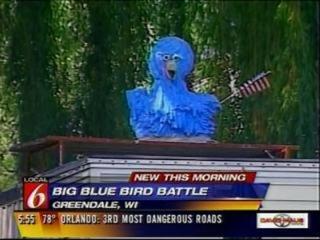
Al Emmons of Greendale, Wis., has been displaying the statue on his home’s chimney located at Bluebird Court.
However, neighbors complained that the bird diminished the historic integrity of the community and went to officials to get Emmons to remove the statue.
"It’s just an unhealthy obsession," Emmons said. "It’s such a silly thing to get upset about. That’s also what the big to-do is, is that everyone is wondering why would they get so upset about having a blue bird on a guy’s chimney that the kids made."
The Village’s Historic Preservation Board ordered Emmons to take the blue Big Bird off the chimney or face a $100 a day fine.
A reader writes:
I don’t know if this is of any interest to you, but EWTN has THIS ARTICLE about a Chilean band that is slated to perform at World Youth Day who openly deny the authority of the pope.
Incidently, here is THE OFFICIAL WYD WEBSITE if anyone wants to complain:
Oh, no, this is of quite a lot of interest to me! I read about this band earlier today and was going to blog on them. It’s an outrage that a group of artists who deny the role of the pope as the vicar of Christ and who have attacked B16 in particular would be invited to perform at World Youth Day. Assuming the press reports are accurate, they should never have been invited.
Incidentally, the group is from Argentina rather than Chile. (The latter is where they gave an interiew dissing B16 and the papacy.)
… And it might look something like Musum Pontificalis, a parody blog that imagines how Pope Benedict XVI might blog were he a blogger. (Here is a link to the satirist’s disclaimer.) Now that the Pope has a blog, so to speak, you might be curious about "his thoughts" on the Harry Potter brouhaha:
"I sure didn’t see this one coming. Sometimes I just want to say, ‘Come on, people; get a life.’
"Obviously, I haven’t reinstated Index Librorum Prohibitorum and placed Harry Potter on it. Believe me, there are any number of Jesuit publications that would make it to the Index before Harry Potter."
(Nod to Whispers in the Loggia for the link.)
A reader writes:
Hi Jimmy I could not find this exact permutation on your blog, although I’m sure it has come up. I hope you can take a moment to help me out.
No prob! Let’s work our way through it . . .
Sally and Bill, both catholics get married according to form in a church with a priest. This marriage ends in divorce.
Without anything else affecting the situation, the Church will presume that Sally is married to Bill. Obtaining a civil divorce does nothing to affect the status of their marriage before God. As far as the Church is concerned, Sally and Bill are hitched unless and until they obtain an annulment.
Sally then marries Tom, not a catholic, in a civil wedding outside the church. This also ends in divorce.
Okay, this marriage will be invalid since (a) Sally is presumed to be married to Bill and (b) Sally–the Catholic party to this marriage–failed to observe the Catholic form of marriage (without a dispensation) this time. Thus the impediments of ligamen (prior bond) and the impediment of defect of form will both block the new marriage from coming into existence.
Sally then marries Joe, a catholic, in a civil ceremony outside the church.
This also will be invalid since (a) Sally is still presumed to be married to Bill (from the first marriage) and (b) Sally and Joe both failed to observe the Catholic form of marriage (without a dispensation). As a result, ligamen and defect of form once again block the marriage from coming into existence.
Am I correct in thinking this last marriage of Sally’s is both illicit and invalid?
Yes.
My absence at this last wedding has caused a great deal of grief and I am having difficulty explaining to Sally and Joe why there is a problem with this wedding between two very loving people who are clearly devoted to each other.
You’ll want to explain it to them in as gentle and loving a way as possible, of course, but the basic fact of the matter is that Sally is presumably married to Bill and thus not free to marry Joe. Further, Sally and Joe failed to fulfill their responsibility as Catholics to observe the Catholic form of marriage or to obtain a dispensation from this requirement (something analogous to getting married without a wedding license, which is enough to invalidate a marriage in different states).
For you to have shown up at the wedding would have sent the message to Sally and Joe that what they were doing was okay, when it is not (Jesus was very firm on this point; see Mark 10). It thus would have been an offense against the truth for you to show up at the wedding.
That being said, you can offer to do everything you can to assist them if they wish to see about rectifying their marital situation. The first step in this process would be to begin pursuing an annulment on Sally’s prior marriages.
HERE’S THE BEST BOOK THERE IS ON THAT SUBJECT, TO HELP THEM OUT.
A reader writes:
What is the official Church teaching and/or guidance on attending both Mass and
a church service at another Christian denomination on Sundays? Here is some
more specific background information. My family (wife + kids) and I are
currently members of a Protestant church. I have been reading up on
the Catholic faith for a number of years now and I’m considering pursuing it
further and possibly joining the Catholic Church. However, my wife does not
share this desire.I was wondering if I could attend both on Sundays if I
became Catholic. I’m assuming that on days when our Protestant church serves
communion that I would need to refrain. I have not really brought up the issue
of the kids with my wife either, but one step at a time.
Thank you for writing! I pray that God will smooth your journey as you work your way through these issues.
You are correct that, as a Catholic, you could not receive communion in your current church since Protestant churches (unfortunately) did not retain a sacramental priesthood and therefore, apart from very exceptional circumstances, do not have the Real Presence when they celebrate the Lord’s Supper. Canon law does not allow Catholics to receive communion in these circumstances (CIC 846 §2).
Present canon law does not, however, prohibit Catholics from attending non-Catholic services. Therefore, you would be able to continue to attend Protestant services with your wife and family as long as doing so does not pose a problem for your Catholic faith.
You would have the obligations other Catholics do, such as the duty to attend Mass. In some mixed-marriage families this is solved by attending Mass on Saturday evening and then going to Protestant services on Sunday morning, or the reverse, or by going to both services on Sundays (e.g., a morning service at once church and an evening service at the other). In some cases, both spouses go to both services.
Hope this helps, and God bless you!

