Noble Metals

I found it poetically comforting that today, on the very day that Benedict XVI was installed as Pope, our parish went back to the old custom of using precious (or "noble") metals to administer the Body and Blood of our Lord. I thought, "Of course! How fitting."

In our everyday lives we eat and drink out of glass and ceramic containers all the time. Nothing special about that. Receiving the Body and Precious Blood from vessels made of gold or silver reminds us that this is no ordinary meal, no run-of-the-mill family get-together. Aside from the Mass, when do we expect to eat or drink from silver or gold? It is one of those times when the art of the liturgy is so important. It practically shouts, "this is important!". It is also one of those small particulars in which the recent decades of liturgical experimentation have proved such a failure.

A few months ago kneeling was re-introduced at our Life Teen Mass. There are no more crowds of teens around the altar during the consecration. And now we are receiving the Eucharist from vessels of "noble metals".

Thanks be to God, indeed.

Are We Modern Yet?

From CNN.com comes another balanced piece about how the new Pope had better change to meet the expectations of a bunch of whining babies the more modernist members of his flock. Balanced, as is fairly typical for CNN, means drawing insights from a broad range of liberals. They lament-

Some experts are skeptical that Benedict will embrace modernity, believing he will instead focus more on internal church changes than on reaching out globally. That said, he remains — by definition — the leader of hundreds of millions of Catholics in most every corner of the world.

That’s nice at the end, there, where they grudgingly admit that he is the Pope.

I think (and hope) that those who expect this Pope to put his finger to the wind to test doctrine will be, not just disappointed, but dismayed. Of all the things for a Pope to embrace, mere "modernity" would be the most fatuous. Modern, by definition, means something that is already fading, already passing away, to make room for something even more modern. What is astonishing about modernity is how blindingly fast it becomes quaint and outmoded. Remember beanbag chairs? Polyester suits? Poodle skirts, for cryin’ out loud?

Mankind needs timeless truths, not the latest fads whipped up by doctrinal fashionistas. I can’t wait for the first encyclical.

In the words of G.K. Chesterton –

"My attitude toward progress has passed from antagonism to boredom. I have long ceased to argue with people who prefer Thursday to Wednesday because it is Thursday."

Oxyrhynchus!

Oxyrhynchus! It’s not something you use to wash your clothes!

It’s a place in Egypt where, a century ago, a huge load of ancient manuscripts were found. (This tends to happen in Egypt, where the desert climate better preserves documents written on papyrus, which has a nasty tendency to rot in wetter climes.)

A BUNCH OF STUFF WAS DISCOVERED AT OXYRHYNCHUS,

including some fragments of what later turned out to be the Gospel of Thomas (we got the full text from the Nag Hammadi find later on) and the Gospel of the Hebrews–both being apocryphal gospels that are not inspired and do not belong in the New Testament.

This much is common knowledge among folks with a passing familiarity with biblical archaeology.

But what many have been less familiar with is the fact that many of the Oxyrhynchus texts remained unread because they were simply illegible. In fact, 800 boxes of the things remained unread at Oxford.

NOW THEY’RE BEING READ.

A new technique using infra-red has enabled scholars to finally read the documents, and the results thus far have been stunning.

EXCERPTS:

The original papyrus documents, discovered in an ancient rubbish dump in central Egypt, are often meaningless to the naked eye – decayed, worm-eaten and blackened by the passage of time. But scientists using the new photographic technique, developed from satellite imaging, are bringing the original writing back into view. Academics have hailed it as a development which could lead to a 20 per cent increase in the number of great Greek and Roman works in existence. Some are even predicting a "second Renaissance".

The papyrus fragments were discovered in historic dumps outside the Graeco-Egyptian town of Oxyrhynchus ("city of the sharp-nosed fish") in central Egypt at the end of the 19th century. Running to 400,000 fragments, stored in 800 boxes at Oxford’s Sackler Library, it is the biggest hoard of classical manuscripts in the world.

The previously unknown texts, read for the first time last week, include parts of a long-lost tragedy – the Epigonoi ("Progeny") by the 5th-century BC Greek playwright Sophocles; part of a lost novel by the 2nd-century Greek writer Lucian; unknown material by Euripides; mythological poetry by the 1st-century BC Greek poet Parthenios; work by the 7th-century BC poet Hesiod; and an epic poem by Archilochos, a 7th-century successor of Homer, describing events leading up to the Trojan War. Additional material from Hesiod, Euripides and Sophocles almost certainly await discovery

Now, as this story starts to break further into public consciousness, you’re going to hear a lot about the possibility of new gospels being discovered, and the secular media will do its part to try to suggest that any that are found are as early as possible, so as to make them rivals for the canonical gospels.

Take all this with a big spoonful of salt.

While it is theoretically possible that documents from the first century could be found, it is more likely that additional works from later than that would be found. These might be simply copies of Gnostic works we found at Nag Hammadi and be no big deal (despite media hype) or they might be new documents. In any event, it would take a good bit of time to figure out what their dates are, and the first dates proposed would likely turn out to be wrong.

It is possible that documents could be discovered that would contain accurate historical traditions of Jesus or the apostles, but the discovery of anything actually by them is unlikely (which is not to say that we mightn’t find things falsely attributed to them).

If we did discover, say, a new letter of Paul that looked authentic, it would set off a huge debate in the Christian community over what to do with it, but the odds of it being added to the New Testament (certainly in our lifetimes) would be remote.

What it might do, though, is prompt a lot of folks to realize how dependent on Tradition we are for the canon of Scripture–that it was Tradition that guided the early Church in identifying as authentic the manuscripts that we now have in the Bible. Any new document appearing to be authentic would lack a tradition of use in the churches and thus would not readily be added to the Scriptures of any group of Christians–except those already favorable to Gnostic texts out of an attraction to heterodoxy and novelty.

More later on what would happen if we found such a document. In the meantime,

GET THE STORY.
Me Want Broccoli!

Cookiemonster
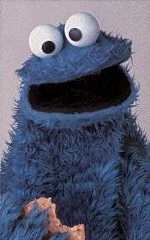
First Scary Monster disappeared because he was too, well, scary – then Elmo came along, and now the writers of the Sesame Street have apparently staged an intervention with Cookie Monster and have helped him to confront his addiction to sweets. He has now learned that cookies are a "sometimes" food. How did they accomplish this, I wonder? Did they force his eyelids open and make him watch movies of obese children? Wait, no! Cookie has no eyelids on his googly eyes. Did they quietly send him off to rehab, like an aging rocker?
I readily confess that I watched Sesame Street well into my teen years because there was a fair amount of semi-brilliant comedy on the show. Attention: Jim Henson has left the building.
The brilliance of the early Sesame Street was that it did not take itself too seriously. Sure, help the kids learn to count and spell and all, but throw in a lot of broad, goofy, stupid humor, too,  along with some pratt falls and pie fights. Well, I never actually saw a pie fight (those muppets would be hard to clean) but you get the idea. In those days Bert and Ernie were like Laurel and Hardy, or Abbot and Costello. A great number of their skits had no point at all, except a few minutes of idiotic fun. Ernie was a consumate pest, and Bert the ultimate straight man… er, straight muppet. Think Sponge Bob and Squidward.
PBS, though, has had to deal with the same changes as the Big 3 networks: Increasing competition leading to growing irrelevance. Hardly anyone is watching anymore, and the median age of the average Sesame Street viewer has been dropping over the years. It is now almost exclusively a pre-kindergarten show.
So, goodbye, Cookie. We’ll always have the "rectangle" sketch.
GET THE "HEALTHFUL!" STORY.

A Libertarian Case For Marriage

In order to win the battle on marriage in this country, pro-family individuals need to be able to make their case in a way that is not dependent on religious arguments because so many (even persons of faith) will allow these to be partitioned in public debate and ignored at voting time.

Fortunately, the natural law basis for marriage is clear enough that this is fairly easy to do.

Some even have hopes of putting the argument in a way that may appeal to libertarians.

JENNIFER ROBACK MORSE, FOR EXAMPLE.

Beauty, eh?

Bowlapples2
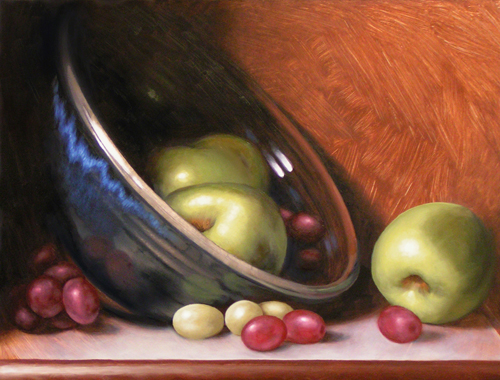
For as long as I can remember, I have been fascinated with the way things are made, the way they look. As a kid I was extremely nearsighted for a while before anyone discovered the fact. The result was that: (A) I had no interest in school, and (B) I developed the habit of examining things really closely, because that was the only way I could see anything. I appreciate artists who can paint in a very impressionistic style, but for me the details are the fun part. Hopefully, the other aspects of the composition are strong as well, so the details are part of a well-balanced whole. Detail is a big part of the beauty of any object. I don’t feel that my job as a Catholic artist is to bring beauty into the world, but to bring attention to what is beautiful in the world.
Now, I said all that to say this: If you have not yet discovered the music of Alison Krauss and Union Station, you owe it to yourself. She and her bandmates, particularly Jerry Douglas, display a rare depth and genius, as well as just pure musicianship; the details of a musical expression that is as meticulously crafted as it is heartfelt. Alison Krauss’s vocal cords should be declared a national treasure, and Jerry Douglas – well, he should be bronzed, or something.
Don’t settle for "interesting".  Life is short. Go straight for beauty.

Animal Yucks

No! This post ain’t about yucky animals! It’s about animal laughter.

Back in grad school, my Medieval philosophy professor was convinced that her dogs laughed–or rather, had a canine equivalent to laughter–but didn’t have a scientific study or report of one to back it up.

But LiveScience.Com has one.

EXCERPT:

"Indeed, neural circuits for laughter exist in very ancient regions of the brain, and ancestral forms of play and laughter existed in other animals eons before we humans came along with our ‘ha-ha-has’ and verbal repartee," says Jaak Panksepp, a neuroscientist at Bowling Green State University.

When chimps play and chase each other, they pant in a manner that is strikingly like human laughter, Panksepp writes in the April 1 issue of the journal Science. Dogs have a similar response.

Rats chirp while they play, again in a way that resembles our giggles. Panksepp found in a previous study that when rats are playfully tickled, they chirp and bond socially with their human tickler. And they seem to like it, seeking to be tickled more. Apparently joyful rats also preferred to hang out with other chirpers.

GET THE STORY.

Stealth Deer

DeersmallThought some of you might enjoy this picture I snapped looking out the window into our back yard. The bush on the right in the photo is apparently a favorite deer snack, especially during the winter. I was interested to find that there are two distinct types of White-tail deer in this area. The indigenous herd is almost a grey color. This happens to blend in extremely well with oak trees, and can make them hard to spot. The others (and I have this on very reliable heresay) were introduced from the Great Plains, and are more of a tawny color that might blend well with tall grasses and such.
So, Arkansas deer are, like – STEALTH deer.

New Pope's Reaction To Ratzinger Fan Club

Apparently the former Joseph Cardinal Ratzinger, now Pope Benedict XVI, was once presented with a Ratzinger Fan Club t-shirt, enjoyed it, but claimed he couldn’t keep it because he couldn’t be his own fan:

“He was humble, outgoing and laughed at a T-shirt that read ‘The Cardinal Ratzinger Fan Club.’

“That’s how Chris Haehnel, 15, of St. Charles, remembers his visit in Rome with the man who Tuesday became Pope Benedict XVI.

[…]

“Chris, then a freshman at Duchesne High School in St. Charles, already had studied Ratzinger and papal politics. He said he liked Ratzinger’s conservative stands on moral issues. He gave Ratzinger a T-shirt he bought from an online fan club.

“On the front, it read ‘The Cardinal Ratzinger Fan Club. Putting the smackdown on heresy since 1981.’ Ratzinger was head of the Congregation for the Doctrine of the Faith, and combating heresy was part of his job.

“Ratzinger laughed at the shirt, Chris said, but said he couldn’t keep it because he couldn’t be his own fan. When he flipped over the shirt to find a quote attributed to him — ‘Truth is not determined by a majority vote’ — he laughed again and said, ‘That’s true. That’s true.’ Chris still has the shirt.”

GET THE STORY.

New Pope’s Reaction To Ratzinger Fan Club

Apparently the former Joseph Cardinal Ratzinger, now Pope Benedict XVI, was once presented with a Ratzinger Fan Club t-shirt, enjoyed it, but claimed he couldn’t keep it because he couldn’t be his own fan:

“He was humble, outgoing and laughed at a T-shirt that read ‘The Cardinal Ratzinger Fan Club.’

“That’s how Chris Haehnel, 15, of St. Charles, remembers his visit in Rome with the man who Tuesday became Pope Benedict XVI.

[…]

“Chris, then a freshman at Duchesne High School in St. Charles, already had studied Ratzinger and papal politics. He said he liked Ratzinger’s conservative stands on moral issues. He gave Ratzinger a T-shirt he bought from an online fan club.

“On the front, it read ‘The Cardinal Ratzinger Fan Club. Putting the smackdown on heresy since 1981.’ Ratzinger was head of the Congregation for the Doctrine of the Faith, and combating heresy was part of his job.

“Ratzinger laughed at the shirt, Chris said, but said he couldn’t keep it because he couldn’t be his own fan. When he flipped over the shirt to find a quote attributed to him — ‘Truth is not determined by a majority vote’ — he laughed again and said, ‘That’s true. That’s true.’ Chris still has the shirt.”

GET THE STORY.