In the wake of the recent Democratic defeat there are sure to be calls for the abolition of the electoral college and its replacement with the election of the president by a direct vote with a simple majority.
The way the electoral college works, the president is elected by a majority vote of the electors. Each state has one elector per member in the House of Representatives plus one elector per member of the Senate. States have members of the House based on their population (with the stipulation that each state has at least one), with a total of 435 House members. But the Senate does not have proportional representation. Each state has two senators, regardless of its population. With fifty states, that means a hundred senators. The District of Columbia also gets three electors, so 435 + 100 +3 = 538, the current number of electors.
Of those, you need a simple majority, or 270 for a clear win. (If there is a tie, then there is a special procedure in which the House picks the president and the Senate picks the vice president, but let’s not go there.)
Now, a word about the way the House and the Senate: As you likely know, the reason that the House has proportional representation and the Senate does not is that it’s an attempt to balance the interests of the many with the interests of the few. The fact that populous states get more representatives in the House means that the interests of populous states get looked after. The fact that all states have equal representation in the Senate means that the interests of low-population states are looked after, so that the representatives of a simple majority of the population can’t simply step on the interests of the low-population states.
A similar role is played in the electoral college by having electors corresponding to a state’s Senate representation. It keeps the electoral college from having purely proportional representation and thus helps balance the interests of high and low population states.
That’s a good thing.
Here’s a map I came up with illustraing why:
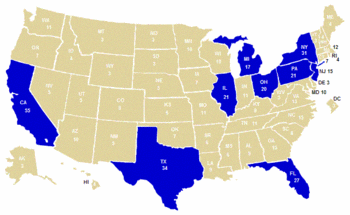
The blue colored states are what you might call "the Big 9"–i.e., the states with the most population. Together, the Big 9 have more than 50% of the U.S. population in them. The other 41 states–"the Little 41," as we might say–have just under 50%.
Since the Big 9 have nowehere near 50% of the U.S. landmass, the only way they can have more than 50% of the population is for them to have Big Cities in them. They are Urbanized (even Texas and California, though to a lesser degree than the northeastern blue states in this illustration).
(FWIW, the states are not all shown to scale due; Alaska in particular should be way bigger.)
Here is why we need the electoral college: It’s a way of protecting the small (less populous) states from domination by the giant (high population) ones. All a candidate would need to do to win the presidency with a simple majority of the population vote would be to get the votes of the Big 9 (e.g., by making them elaborate promises to be paid for by the Little 41) and then he could completely ignore the interests of the Little 41.
In practice, of course, no candidate would get all and only the votes of the folks in the Big 9. His opponent would get some of those votes as well, but then he himself would get some votes in the Little 41, so the principle still remains: By targeting just these nine states, which in the main are urbanized or at least contain large urban centers, a candidate could win the presidency and completely ignore the interests of the Little 41.
The electora college prevents that from happening by giving the Little 41 extra clout in the presidential election, meaning that a broader mix have their interests taken into account than otherwise would happen. It’s not a perfect system, but there’s a logic to it that you might want to be aware of the next time you hear someone calling for the abolition of the electoral college.
 The BBC is reporting (excerpts):