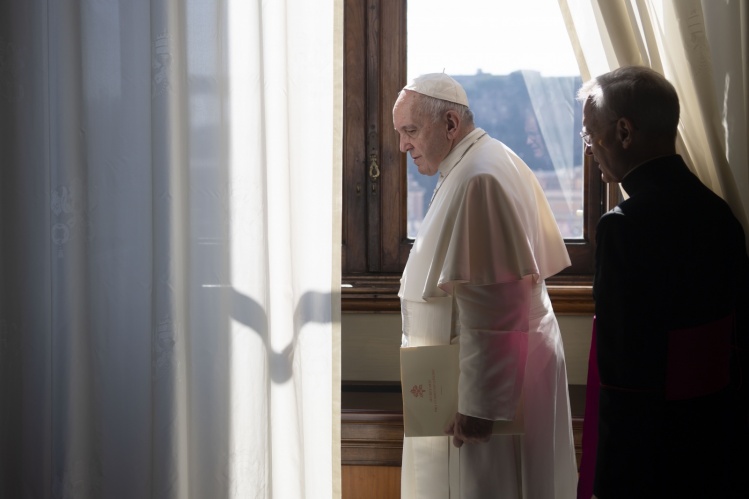
Pope Francis is having his "Inaugural Mass"? What's happens in this Mass, and why is it important?This version of The Weekly Francis covers material released in the last week from 22 May 2013 – 2 June 2013 (subscribe hereget as an eBook version for your Kindle, iPod, iPad, Nook, or other eBook reader):

Angelus

General Audiences

Homilies

Speeches

Papal Tweets

  • “Dear young people, the Church expects great things of you and your generosity. Don’t be afraid to aim high.” @pontifex, 28 May 2013
  • “The Church is born from the supreme act of love on the Cross, from Jesus’ open side. The Church is a family where we love and are loved.” @pontifex, 29 May 2013
  • “The whole of salvation history is the story of God looking for us: he offers us love and welcomes us with tenderness.” @pontifex, 31 May 2013
  • “In this Year of Faith, we pray to the Lord that the Church may always be a true family that brings God’s love to everyone.” @pontifex, 1 June 2013
  • “The world tells us to seek success, power and money;
    God tells us to seek humility, service and love.” @pontifex, 2 June 2013

The eBook version of The Weekly Francis

If you liked this post, you should join Jimmy's Secret Information Club to get more great info!


What is the Secret Information Club?I value your email privacy

An image from the recent worldwide Eucharistic exposition. An image from the recent worldwide Eucharistic exposition.

This Sunday I went out for breakfast after Mass, which is something I very rarely do.

I almost never eat out, but I decided to do so as a way of celebrating the Lord’s Day.

While I was waiting in the restaurant, I was reading Facebook and discovered that the planned worldwide, Eucharistic exposition was going on right then–a fact I had not previously known.

Here are a few thoughts on the event . . .


1) These are the days of miracle and wonder.

As I sat in the restaurant, I downloaded, for free, The Pope App from News.va (iOS version, Android version) to let me watch the event live and then was able to do so–to join countless people from all over the planet in a simultaneous act of worship.

To quote Paul Simon, “These are the days of miracle and wonder.


2) How unique was this event?

KEEP READING.

If you liked this post, you should join Jimmy's Secret Information Club to get more great info!


What is the Secret Information Club?I value your email privacy

June 1 is a special day for me, and it has been for the last 20 years.

One reason is that it's the memorial day of St. Justin Martyr, who is one of the main patron saints of apologists.

As an apologist, that makes it special to me.

But there is another reason as well.

I didn't plan it this way, but my report-to-work day at Catholic Answers happened to be June 1.

It's a significant day to embark on a career of apologetics, and I've always regarded it as a gift of divine providence.

Since I started doing apologetics professionally on June 1, 1993, that makes June 1, 2013 my 20th anniversary in the field. (Professionally speaking, at least; I'd been doing apologetics informally before that or I wouldn't have got the job.)

So this June 1 is my platinum anniversary, and I'm celebrating.


The More Things Change . . . 

Things have changed a lot in the field of apologetics in the last twenty years.

One of the biggest changes was the commercial availability of the Internet, which emerged from its shadowy origins as a DARPA research project to facilitate communication during a nuclear war and became the civilization-changing technology that it is today.

When I started in apologetics, it was uncommon for anybody to have an email address, and research was done exclusively though books and journals.

When I wanted to find something out, I think, "What book or journal should I look in to find the answer to this?"

I remember the moment in the mid-1990s when I realized that–via the Internet–I had the World's Greatest Research Library sitting on my desktop. A light went on in my head, and I said, "From now on, this is going to be the thing I turn to first to find research leads on a question." (Of course, that still means verifying the data, since not everything you read on the Internet is true.)

The advent of the Internet opened up new possibilities for apologetics as well. I've tried to be an early-adopter as web-based opportunities have come along, and in the mid-90s, I started a web site, which still exists today as JimmyAkin.com.

In the years since, I've started a blog (now pat of JimmyAkin.com), an internet radio show or podcast, and a YouTube video series–as well as other efforts, including Facebook and Twitter.

I've also done work in other media, including publishing books, booklets, and audio sets, appearing on Catholic radio (which has blossomed in recent years), and reaching out in every practical way I can think of.

My goal has been to reach as many people for Christ as I can, through the best means I have available to me, and to do so in a way that's fair, accurate, kind, and–when appropriate–playful.

BTW, if I've helped you–in person or at a distance–in the last twenty years, I'd love to hear how I've done so. Just let me know in the comments box or by email.

It's been my honor to serve Christ and serve others these last twenty years.

Here's hoping for twenty more.


What Now?

If you like the information I've presented here, you should join my Secret Information Club.

If you're not familiar with it, the Secret Information Club is a free service that I operate by email.

I send out information on a variety of fascinating topics connected with the Catholic faith.

In fact, the very first thing you’ll get if you sign up is information about what Pope Benedict said about the book of Revelation.

He has a lot of interesting things to say!

If you’d like to find out what they are, just sign up at www.SecretInfoClub.com or use this handy sign-up form:

Just email me at jimmy@secretinfoclub.com if you have any difficulty.

In the meantime, what do you think?

If you liked this post, you should join Jimmy's Secret Information Club to get more great info!


What is the Secret Information Club?I value your email privacy

If Jesus died on the cross in A.D. 33 and made forgiveness possible, how does that apply to people who lived before or after this event? (Like us!) If Jesus died on the cross in A.D. 33 and made forgiveness possible, how does that apply to people who lived before or after this event? (Like us!)

Jesus died on the Cross so that people could be forgiven their sins.

But if he died in A.D. 33, what about all the people who lived and died before that time? Were their sins forgiven?

And if their sins were forgiven, does that mean Jesus’ sacrifice applies to all of history?

If so, does that mean that we’ve been forgiven for all of our sins—past, present, and future—so that we don’t need to go to confession?

How does this all work?

Here’s the story . . .


The Bottom Line

It may seem unusual to put the bottom line at the top of a post, but I generally find it better to state things in a straightforward, literal manner and only then (if necessary) use analogies to help clarify them.

So here’s are the literal facts:

1) Jesus’ death on the Cross made it possible for all human beings to be forgiven of their sins, regardless of whether they lived before, during, or after his time.

2) In order to appropriate that forgiveness, people have to repent and turn to God. When they do so, God forgives them, regardless of when in history they lived.

3) During this life, people have free will, so if they un-repent (backslide, fall from grace, commit mortal sin) then they have committed new sins that are not (at that moment) forgiven.

4) In order to be forgiven of these new sins, they need to once more repent and turn to God. Then they will be forgiven of the new sins they committed.


Forgiveness B.C.

Suppose there is a person living in 800 B.C. Let’s call him King Bob.

KEEP READING.

If you liked this post, you should join Jimmy's Secret Information Club to get more great info!


What is the Secret Information Club?I value your email privacy

Are we all born atheists?

One of the most common topics in discussion between Christians and atheists is the question of what atheism actually is.

For a long time, the word has been defined as the view that there is no God–i.e., the claim “God does not exist.”

More recently, some atheists have begun to define it differently.

According to them, atheism is simply a lack of belief in the existence of God. On this view, a person would be an atheist if he thought there was no God, thought it unlikely that there is a God, or didn’t know if there is a God.

Simply not agreeing with the claim “There is a God” would make you an atheist.

Some atheists have claimed that this is the natural state of humanity. On this view, we all start out as atheists and we have to learn belief in God.

In other words: Babies are atheists.

Are they right?


What’s the Attraction?

I understand why the atheists who make this claim would be attracted to it. At least, I understand why I would find it attractive if I were an atheist:

  1. It can be plausibly claimed that babies do not have a belief in God, which makes one of the premises of the argument seem true.
  2. If every position other than outright assertion of God’s existence falls under my banner, my position would seem larger and more popular.
  3. I could claim atheism as mankind’s natural state, thus creating an implicit argument for it. Being in accord with human nature is good, right?
  4. I could claim atheism as the default human belief, and thus relieve me of the burden of proof in arguing with others. I could then claim that the burden of proof is on those who want to believe in God. Until I’m satisfied by their arguments, I’m entitled to act on the assumption that God does not exist.

But consider this . . .

KEEP READING.

If you liked this post, you should join Jimmy's Secret Information Club to get more great info!


What is the Secret Information Club?I value your email privacy

This version of The Weekly Francis covers material released in the last week from 15 May 2013 – 27 May 2013 (subscribe hereget as an eBook version for your Kindle, iPod, iPad, Nook, or other eBook reader):

Angelus/Regina Caeli

General Audiences

Homilies

Speeches

Papal Tweets

  • “I am close to the families of all who died in the Oklahoma tornado, especially those who lost young children. Join me in praying for them.” @pontifex, 21 May 2013
  • “To live according to the Gospel is to fight against selfishness. The Gospel is forgiveness and peace; it is love that comes from God.” @pontifex, 22 May 2013
  • “Do I take the Gospel message of reconciliation and love into the places where I live and work?” @pontifex, 23 May 2013
  • “On the feast of Mary Help of Christians I join the Catholics in China who trust in the protection of Our Lady of Sheshan and I pray for them” @pontifex, 23 May 2013
  • “Miracles happen. But prayer is needed! Prayer that is courageous, struggling and persevering, not prayer that is a mere formality.” @pontifex, 24 May 2013
  • “We all have in our hearts some areas of unbelief. Let us say to the Lord: I believe! Help my unbelief.” @pontifex, 25 May 2013
  • “Every time we give in to selfishness and say “No” to God, we spoil his loving plan for us.” @pontifex, 26 May 2013

The eBook version of The Weekly Francis

If you liked this post, you should join Jimmy's Secret Information Club to get more great info!


What is the Secret Information Club?I value your email privacy

The Holy Trinity is the central mystery of the Christian Faith. Here are 12 things to know and share . . .

The Church teaches that the Holy Trinity is the central mystery of the Christian Faith.

But how much do you know about this mystery?

What is its history?

What does it mean?

And how can it be proved?

Here are 12 things to know and share . . .


1. Where does the word “Trinity” come from?

It comes from the Latin word trinitas, which means “three” or “triad.” The Greek equivalent is triados.


2. When was it first used?

The first surviving use of the term (there may have been earlier uses that are now lost)  was around A.D. 170 by Theophilus of Antioch, who wrote:

In like manner also the three days which were before the luminaries, are types of the Trinity [Τριάδος], of God, and His Word, and His wisdom. And the fourth is the type of man, who needs light, that so there may be God, the Word, wisdom, man [To Autolycus 2:15].


3. What is the Trinity?

The Compendium of the Catechism of the Catholic Church explains it this way:

The Church expresses her trinitarian faith by professing a belief in the oneness of God in whom there are three Persons: Father, Son, and Holy Spirit.

The three divine Persons are only one God because each of them equally possesses the fullness of the one and indivisible divine nature.

They are really distinct from each other by reason of the relations which place them in correspondence to each other.

The Father generates the Son; the Son is generated by the Father; the Holy Spirit proceeds from the Father and the Son [CCCC 48].

4. Is the Trinity the central mystery of the Christian Faith?

Yes. The Compendium explains:

The central mystery of Christian faith and life is the mystery of the Most Blessed Trinity.

Christians are baptized in the name of the Father and of the Son and of the Holy Spirit [CCCC 44].

KEEP READING.

If you liked this post, you should join Jimmy's Secret Information Club to get more great info!


What is the Secret Information Club?I value your email privacy

Did Pope Francis recently say that atheists can get to heaven by "good works"? Or was he talking about something else entirely?

Color me annoyed.

The press has been going nuts about remarks concerning atheists that Pope Francis made at one of his daily homilies.

As usual, the press is hyping the remarks as if they are earthshaking, unprecedented, and in contrast to mean ol’ Pope Emeritus Benedict.

I know this will come as a shock, but . . . they’re getting the story wrong.

Here’s the story . . .


Daily Homilies

Let’s start with the context in which Pope Francis made the remarks: One of his homilies at daily Mass, celebrated in St. Martha’s House (where he lives).

Pope Francis is in the habit of saying daily Mass for the people at St. Martha’s House and invited guests, and when he does so he gives an off-the-cuff homily (rather than reading from a prepared text).

This is actually something new.

John Paul II and Benedict XVI did not do this. They did not celebrate daily Mass as publicly as Pope Francis, and they did not have daily homilies published in this way. Instead, they occasionally delivered prepared homilies at public Masses on special occasions, and only these were published. As a result, if you look at the Vatican web site, there are surprisingly few homilies listed in their sections!

As a result, the Vatican web people aren’t scaled up for this volume of homilies, and–MADDENINGLY–you can’t find complete texts of Pope Francis’s daily ones on the site.

They, apparently, aren’t running these homilies through “the usual process,” which involves transcribing what the pope says in off-the-cuff remarks, showing him the transcript so that he can revise it if needed, and then translating and publishing them.

As a result, we’re not getting complete transcripts of these homilies, only partial ones, such as those carried by Vatican Radio.

And that, right there, is a problem. It drives me nuts, because these homilies contain interesting information, but I hesitate to comment on anything for which I don’t have a complete text.

As they say, a text without a context is a pretext. Without seeing the full text, we run the risk of misunderstanding.


The Homily in Question

On Wednesday, Pope Francis gave a homily based on the Gospel reading of the day (Mark 9:38-40), in which the disciples have told a man to stop casting out demons in Jesus’ name because he doesn’t follow along with them.

Then, according to Vatican Radio’s maddeningly incomplete and poorly edited transcript of the homily:

The disciples, Pope Francis explains, “were a little intolerant,” closed off by the idea of ​​possessing the truth, convinced that “those who do not have the truth, cannot do good.”

“This was wrong . . . Jesus broadens the horizon.” Pope Francis said, “The root of this possibility of doing good – that we all have – is in creation.”

Pope Francis first applies this principle to non-Catholics in general, engaging in dialogue with an imaginary interlocutor:

“‘But, Father, this [person] is not Catholic! He cannot do good.’ Yes, he can. He must. Not can: must! Because he has this commandment within him. . . .

“Instead,” the Pope continued, “the Lord has created us in His image and likeness, and has given us this commandment in the depths of our heart: do good and do not do evil”:

“The Lord has redeemed all of us, all of us, with the Blood of Christ: all of us, not just Catholics. Everyone!

So far so good: Christ redeemed all of us, making it possible for every human to be saved.


What About Atheists?

Now we get to the subject of atheists, as the imaginary interlocutor asks:

“‘Father, the atheists?’ Even the atheists. Everyone! And this Blood makes us children of God of the first class! We are created children in the likeness of God and the Blood of Christ has redeemed us all! And we all have a duty to do good.”

Here is where “the usual process” might be helpful in clarifying the pope’s thought. Everyone, when speaking off-the-cuff, encounters occasions where things could be further clarified, and this may be one of them.

We can be called children of God in several senses. One of them is merely be being created as rational beings made in God’s image. Another is by becoming Christian. Another sense (used in the Old Testament) is connected with righteous behavior. And there can be other senses as well.

Here Pope Francis may be envisioning a sense in which we can be called children of God because Christ redeemed us, even apart from embracing that redemption by becoming Christian.

This, however, was not what caught the press’s eye.

Pope Francis continued:

“And this commandment for everyone to do good, I think, is a beautiful path towards peace. If we, each doing our own part, if we do good to others, if we meet there, doing good, and we go slowly, gently, little by little, we will make that culture of encounter: we need that so much. We must meet one another doing good.”

Nothing particularly controversial here.

But then comes this, as the imaginary interlocutor says:

“‘But I don’t believe, Father, I am an atheist!’ But do good: we will meet one another there.”


Where Is “There”?

The press latched onto this, taking the phrase “we will meet one another there” as a reference to heaven.

They then inferred that the pope was saying that if atheists merely “do good” then they will go to heaven.

This, in turn, alarmed some in the Protestant community, who thought that the pope was saying that atheists can get to heaven by “good works.”

We can deal with the possibility of salvation for atheists in another post, but first we need to ask a question . . .


Was Pope Francis Even Talking About Heaven?

If so, you wouldn’t know it from the transcript of what he said.

Let’s back up a bit. Remember, Pope Francis was just talking about the duty to do good:

“And we all have a duty to do good. And this commandment for everyone to do good, I think, is a beautiful path towards peace.”

So if everyone does good, we have a path toward peace. That’s the goal.

“If we, each doing our own part, if we do good to others, if we meet there, doing good, and we go slowly, gently, little by little, we will make that culture of encounter: we need that so much. We must meet one another doing good.

Note the parallelism between the phrases. Pope Francis is talking about a path “toward peace” and wants us to “meet there” by doing our part and doing good so that we build “that culture of encounter” and “meet one another doing good.”

He’s not talking about heaven at all.

He’s talking about earth.

It’s in that context that he has the imaginary interlocutor say:

‘But I don’t believe, Father, I am an atheist!’

And he replies:

“But do good: we will meet one another there.”

What he’s saying is that even atheists need to do good on earth to build their part of the culture of encounter that promotes peace and allows people to “meet together” in harmony.

At least that’s what appears from a careful reading of the text.

Another translation, found in The Guardian (of all places), better conveys the idea:

“Even them, everyone,” the pope answered, according to Vatican Radio. “We all have the duty to do good,” he said.

Just do good, and we’ll find a meeting point,” the pope said in a hypothetical reply to the hypothetical comment: “But I don’t believe. I’m an atheist.”


Text Without Context

Remember that saying I mentioned earlier, that a text without a context is a pretext for misunderstanding?

This is why.

This is exactly why.

And it is why I am so annoyed that we aren’t getting the full text of Pope Francis’s daily homilies.

Of course, even with the context we had at hand, which clearly suggests that Pope Francis wasn’t talking about meeting atheists in heaven but meeting with them in fraternity and peace here on earth, that didn’t stop the press from getting it wrong.

If you liked this post, you should join Jimmy's Secret Information Club to get more great info!


What is the Secret Information Club?I value your email privacy

Wouldn't it be great if scientists invented a device that would let us look into the past and see it with our own eyes? Guess what! They have!

Wouldn’t it be great if scientists invented a device that enabled us to have a clear window into the past–so that we wouldn’t just have to read about the past in books?

Instead, with the new device–let’s call it a Time Window–we could actually see events occurring in the past in real time, with our own eyes?

That would be wicked awesome, wouldn’t it?

The exciting news is that scientists have invented this device!

That’s right! The Time Window is real!

What’s more, they invented it just over 400 years ago, so they’ve had the chance to mature the technology to the point that now it’s really, really good.

For comparison, imagine how good an iPhone would be today if Steve Jobs had invented the first one 400 years ago.

The only problem is that they missed a great marketing opportunity.

Instead of calling it the Time Window ™ they gave it a much more boring name . . . the telescope.


How the Time Window Works

The reason that the Time Window–er, telescope–lets us look into the past and see it with our own eyes is that it takes time for light to reach our eyes. The speed of light is not infinite.

Technically, this means that any time you see anything, you are technically witnessing something that happened in the past.

Since light travels so fast, however, if you see someone across the room pick up an iPhone, that happened only the tiniest fraction of a second ago. In fact, you started seeing it while it was still happening. That’s not long enough ago to make it an exciting glimpse into history.

But things get more interesting when you take a telescope at point it at something really distant.


By Jove!

For example, back in 1609, Galileo Galilei pointed his telescope at the planet Jove–er, Jupiter–and discovered that by it there were several moons.

Now the thing is, depending on where Earth and Jupiter are in their orbits, Jupiter is between 33 and 54 light minutes away from Earth.

Let’s just say it’s an average of 44 light minutes away for the sake of simplicity.

That means, it takes 44 minutes for the light from Jupiter to reach an astronomer on Earth.

So when Galileo looked at Jupiter through his telescopes and saw its moons, he was seeing where those moons were 44 minutes ago.

He was viewing actual history that occurred 44 minutes in the past!

Woo-hoo!


Party Like It’s 1879!

The same thing keeps happening when you look further out.

Back in 2008, scientists used one of their spiffy modern telescopes to capture the light in this image . . .

KEEP READING.

If you liked this post, you should join Jimmy's Secret Information Club to get more great info!


What is the Secret Information Club?I value your email privacy

Since it was proposed by Fr. Georges Lemaître, the Big Bang has been common in discussions of the existence of God.

The reasons are obvious. The Big Bang looks like a plausible beginning for the physical universe. Things that begin need causes. The beginning of the physical universe would need a cause, which would seem to lie outside the physical universe. This coheres well with the Christian claim that God is a non-physical being who created the physical universe.

The argument has been elaborated various ways, but that’s the basic idea.

One of its fans was Pope Pius XII, who elaborated a version of it in a speech about this to the Pontifical Academy of the Sciences back in 1951.

It’s basically a version of the Kalaam cosmological argument that uses evidence from modern cosmology to support the premise that the universe had a beginning.

It even resonates with the “Let there be light” moment in Genesis.

I think that there is a proper role for the Big Bang in discussions of God’s existence, but it has to be used with some caution.

Here’s why . . .


“Let There Be Light”?

One temptation is to identify the Big Bang not just as the moment of creation but specifically as the creation of light in Genesis 1. That’s problematic because Genesis does not portray the creation of light as the moment the world came into existence. Let’s look at the text:

1 In the beginning God created the heavens and the earth.
2 The earth was formless and void, and darkness was over the surface of the deep, and the Spirit of God was moving over the surface of the waters.
3 Then God said, “Let there be light”; and there was light.

In the text, the earth already exists in a formless and empty state, with a deep of waters that has a surface, which the Spirit of God hovers over. Then light gets created.

So Genesis depicts the creation of light happening when the heavens and the earth and its waters already exist. At least that is how the text depicts it. You can argue that this isn’t to be taken literally, but that only makes the same point another way: We shouldn’t be too quick to identify the Big Bang with the creation of light in Genesis. We have to be careful about mapping Genesis onto modern cosmology.

In fact, Pope John Paul II warned specifically against trying to draw scientific conclusions from the creation account in Genesis 1:

Above all, this text has a religious and theological importance. It doesn’t contain significant elements from the point of view of the natural sciences. Research on the origin and development of the individual species in nature does not find in this description any definitive norm or positive contributions of substantial interest [General Audience, Jan. 29, 1986].


The Moment of Creation?

There is another thing we need to be careful about, which is identifying the Big Bang as the moment of the physical universe came into existence.

It may well have been. I would love for us to find a way to prove that scientifically.

But we’re not there at present.

KEEP READING.

If you liked this post, you should join Jimmy's Secret Information Club to get more great info!


What is the Secret Information Club?I value your email privacy