“If We Confess Our Sins . . . “

A correspondent writes:

I’m asking for answers to the following two questions because I’m
genuinely curious.  I believe the Lord wants His people, the body of
Christ, to be united.  And, I believe understanding is one of the first
steps toward unity.
 
Why do Roman Catholics confess to a priest instead of directly to
God?  1 John 1:9 seems to indicate to me I can confess directly to God,
and He’ll forgive me.
 

I have a friend who prays to Mary, the mother of Jesus.  I don’t find any biblical basis for praying to anyone other than God.

Thanks for writing and for seeking to understand these matters from a Catholic perspectie. I have a special appreciation for the as I am a former Evangelical, and I didn’t understand why Catholics hold the positions they do on these matters, either.

In regard to the first, 1 John 1:9 says:

If we confess our sins, he is faithful and just, and will  forgive our sins and cleanse us from all unrighteousness.

You’ll note that this is an affirmation of the value of confession (i.e., God will forgive us if we confess our sins), but it does not address the mode of confession. That is, it does not say whether we should confess directly to God or Jesus or whether he will us to confess through the agency of a priest.

The latter matter is addressed in John 20:21-22 (also by St. John, it is worth noting), where we read the following:

Jesus said to them again, "Peace be with you. As   the Father has sent me, even so I send you." And when   he had said this, he breathed on them, and said to them, "Receive   the Holy Spirit. If you forgive the sins of any, they   are forgiven; if you retain the sins of any, they are retained."   

Jesus thus commissioned his ministers to forgive or retain sins. For a minister to know whether he should forgive or retain a particular sin, he must know about the sin and whether the person has repented of it. Only with such information could he know whether the sin should be forgiven or whether it should be retained. Since most priests are not telepathic and are not given knowledge of such matters directly by God, if follows that we must tell them about the sin and about the present state of our will toward it. Hence, we have to confess the sin and that we have repented.

Confession is thus indicated as the mode by which we are to confess, at least for those sins grave enough to require this.

Incidentally, it is worth noting that 1 John 1:9 indicates that we must continue to approach God via confession when we have sinned. This means that, contrary to a popular impression among many Protestants, it is not the case that all our sins past, present, and future are forgiven when we become Christian. Only our past sins are forgiven. If we commit new sins, we need to repent of these and be forgiven of them. This is why he established confession, so that we might have a visible and efficacious sign (i.e., a sacrament) of God’s forgiveness as an ongoing part of the Christian life.

The fact that he established it indicates that we should avail ourselves of it.

And thus the early Christians understood the matter.

SEE HERE FOR INFO ON THAT.

In regard to praying to the saints, I’d recommend that you check out THIS PAGE and also THIS ONE.

Thanks for your willingness to investigate these matters. Hope this helps, and God bless!

Morning After Pills

A reader writes:

Jimmy,

I am wondering what your thoughts on the "morning after pill" are?

It’s evil.

First, it’s contraception, and contraception is evil.

Second, it frequently works (or is thought to work) by preventing the unborn baby from being able to implant in the mother’s womb, which makes it abortifacient.

Either way, it’s evil.

Which evil a person using it is guilty of depends on her knowledge of its effects and which effect is willed.

Objectively, though, it’s evil in that it’s contraception that also has a strong likelihood of causing abortion.

"I'll Take Sweden . . WOWNOT!"

Okay, there’s still too many drawbacks to Sweden for me to want to move there, but at least there’s

THIS SIGN OF HOPE.

A piece back, a Swedish pastor of a Pentecostal church made inflammatory remarks about homosexuals (among other things, he called them a cancer on society) and got slapped with Sweden’s hate-crimes law.

I would distance myself very far from the language the pastor used. It does not treat persons with homosexual temptations with the respect and compassion they deserve.

I do, however, (a) value freedom of speech–even offensive speech, (b) value freedom of religion, and (c) oppose hate crimes legislation as counterproductive and a cause of balkanizing harm to society by its special protection of some classes and not others (i.e., it’s a violation of equal justice under law).

Therefore, I am heartened to learn, though, that an appeals court overturned the conviction. It may get reinstated by the Swedish supreme court, but it’s still a hopeful sign.

GET THE STORY.

(Cowboy hat tip to the reader who sent this in!)

NOTE: Two points to whoever can identify the two commedians the title of this post references!

“I’ll Take Sweden . . WOWNOT!”

Okay, there’s still too many drawbacks to Sweden for me to want to move there, but at least there’s

THIS SIGN OF HOPE.

A piece back, a Swedish pastor of a Pentecostal church made inflammatory remarks about homosexuals (among other things, he called them a cancer on society) and got slapped with Sweden’s hate-crimes law.

I would distance myself very far from the language the pastor used. It does not treat persons with homosexual temptations with the respect and compassion they deserve.

I do, however, (a) value freedom of speech–even offensive speech, (b) value freedom of religion, and (c) oppose hate crimes legislation as counterproductive and a cause of balkanizing harm to society by its special protection of some classes and not others (i.e., it’s a violation of equal justice under law).

Therefore, I am heartened to learn, though, that an appeals court overturned the conviction. It may get reinstated by the Swedish supreme court, but it’s still a hopeful sign.

GET THE STORY.

(Cowboy hat tip to the reader who sent this in!)

NOTE: Two points to whoever can identify the two commedians the title of this post references!

Inerrancy of Scripture

Well!

The post below on possible sources in the Pentateuch really triggered an avalanche of comments regarding the subject of inerrancy.

Rather than do a reader roundup on this, lemme address the subject in a more general way and see if that helps folks out.

First, the teaching of the Church is and always has been that the Scriptures are free of error.

This has to be understood with some nuance, however, as there are things in Scripture that could be taken in a sense that is erroneous. That does not make them errors. It means that the understanding being ascribed to them is erroneous.

For example, when Jesus teaches a parable and says that there was a man who rented our a vineyard and, when it was time to collect his share of the crop, he sent them servants who got beaten, stoned, and killed, and who later sent his son, on whom they fixed murderous designs–it would be erroneous to assume that there was such a man who did all these things. Jesus is asserting something in the parable, but what he is asserting is the deeper spiritual truth that the parable is meant to teach. He is not asserting the literal existence of such a man.

Thus we need to attend to what Vatican II said about the matter in Dei Verbum 11:

Therefore, since everything asserted by the inspired authors or sacred writers must be held to be asserted by the Holy Spirit, it follows that the books of Scripture must be acknowledged as teaching solidly, faithfully and without error that truth which God wanted put into sacred writings for the sake of salvation [SOURCE].

Some have tried to argue that the clause "for the sake of our salvation" narrows the scope of inerrancy to just truths connected in a more or less direct manner with salvation. This won’t work, however, because the passage affirms that "everything asserted by the inspired authors
or sacred writers must be held to be asserted by the Holy Spirit." The only way this could be maintained while simultaneously maintaining that biblical inerrancy is restricted to soteriological truths would be if the only things the sacred authors assert are soteriological truths.

That hypothesis would clearly be false.

It is clear that Scripture does assert things, including matters of history, that are not soteriological. For example, Scripture clearly asserts that Peter was the brother of Andrew in some accepted first century meaning of the word "brother." It teaches the same for James and John, the sons of Zebedee. These matters are historical (at least from our perspective), not soteriological.

Consequently, Scripture contains assertions of a non-soteriological nature, including assertions about history, and such assertions are therefore assertions of the Holy Spirit and therefore without error.

The “for the sake of our salvation” clause thus refers to the purpose for which God put his truth into Scripture, not to a restriction on the scope of God’s truth.

The tricky part is figuring out what is an assertion and what isn’t. Scripture is a complex and rich text that uses many different means of conveying God’s truth. Since some of these involve ancient modes of writing and speech that are not used in 21st century English literature, it isn’t always clear to us what precisely is being asserted. Indeed, Scripture acknowledges that it isn’t always clear, as when St. Peter notes that St. Paul’s writings contain many things that are hard to understand (2 Pet. 3:16).

This difficulty in figuring out what is being asserted by the sacred author has thus been with us since the beginning. It is a principal cause of theological disagreements among Christians, and it is a sign that God wishes us to (a) use the intellects he gave us to try to figure out what he was saying to us and (b) since "no prophecy of Scripture is a matter of private interpretation" (2 Pet. 1:20) to also exercise the theological virtue of faith in relation to the Church, "the pillar and ground of truth" (1 Tim. 3:15) to help us when our own intellects fail.

Above I used the example of a parable of Jesus to show the difference between what the sacred author is asserting and how this could be misunderstood by misinterpreting the sense in which the particulars of the passage are to be taken (i.e., as a literal story of an actual historical event). I picked this because it is an obvious example.

Most of the time, the difficulty is not so obvious. The historical books of the Old and New Testament contain real history, but it is not history written the way we would write history today. It obeys the rules of ancient historical writing, which are significantly different (e.g., you don’t have to footnote everything you claim).

Because we do not today have a full understanding of the rules by which the ancients wrote history (and the rules varied from culture to culture and from time to time), it can be difficult figuring out what is being asserted in the proper sense and what is not being so asserted.

When we encounter something that is not being asserted, we cannot charge the sacred author with error because only assertions can be erroneous. If I’m not asserting that something is true then I am not making a claim that can be in error. The most that could be said is that what I said would be erroneous if taken as an assertion of fact.

Thus if I talk about the sun rising in the morning, and someone fails to note that I am using phenomenological language (the language of appearances), he might say that what I said was false, but he would be wrong. I was not asserting that the sun literally rises in relation to a stationary earth. That is not the sense in which I meant my words to be understood, and so that is not what I was asserting. I would be wrong if I had meant that, but I didn’t mean that. Therefore, my assertion was not false.

When we approach Scripture, we must be sensitive to the fact that there are many things in it that may strike us as being assertions that, to the ancient audience, would not have been so understood. If we run across something that seems false or seems to contradict some other passage, we know that what Scripture says is not wrong. We simply have not correctly identified what is being asserted in one or both passages.

MORE INFO HERE.

UPDATE: HERE, TOO.

Chupacabras In New Mexico?

Chupacabra3bThe rush of people with guns discovering chupacabra-like creatures continues . . . this time in New Mexico.
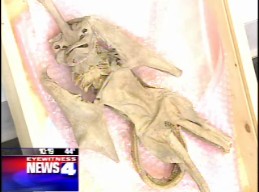
On Albuquerque’s West Mesa a gentleman was out shooting when he "kicked [a chupacabra-like creature] out of the dirt." (Not word on whether it was kicked out with a foot or a bullet.)

Pictures of the creature ran on a local TV channel, whose story (including video) is

ONLINE HERE.

Chupacabra3The dessicated (but apparently not fossilized) creature appears to have wings, a tail, a long snout that some have compared to a horn, and lips that are described as "sponge-like."

It was taken to the New Mexico Game & Fish Commission for identification, and the TV channel promised to annouce what they concluded it was, but so far as I can tell they haven’t posted a follow-up report on their site.

They did say in general terms that the game & fish officials thought this was a creature that lived under the sea a long time ago.

This raises a question, though: If it’s old enough to date from when New Mexico was underwater, why ain’t it fossilized?

If it’s more recent, how did it get there? Did it survive in a lake that dried up? Did someone or some animal catch it elsewhere and transport it? Are any of these things still alive?

Maybe . . . someday . . . the answers will surface.

(Cowboy hat tip to the reader who sent this in!)

East Of Jordan

Eason Jordan, who has a history of making vile remarks about the U.S. military, has resigned from his position as top news executive for CNN, following a controversy carried out largely on the blogosphere:

NEW YORK (AP) – CNN chief news executive Eason Jordan quit Friday amid a furor over remarks he made in Switzerland last month about journalists killed by the U.S. military in Iraq. Jordan said he was quitting to avoid CNN being "unfairly tarnished" by the controversy.

During a panel discussion at the World Economic Forum last month, Jordan said he believed that several journalists who were killed by coalition forces in Iraq had been targeted.

He quickly backed off the remarks, explaining that he meant to distinguish between journalists killed because they were in the wrong place when a bomb fell, for example, and those killed because they were shot at by American forces who mistook them for the enemy.

"I never meant to imply U.S. forces acted with ill intent when U.S. forces accidentally killed journalists, and I apologize to anyone who thought I said or believed otherwise," Jordan said in a memo to fellow staff members at CNN.

But the damage had been done, compounded by the fact that no transcript of his actual remarks has turned up. He was the target of an Internet and Web site campaign that was beginning to rival the one launched against CBS’s Dan Rather following the network’s ill-fated story last fall about President Bush’s military service [SOURCE].

The conference was videotaped, and the videotape
had been found. Bloggers demanded the release of
the video tape, but Eason, et al., were stonewalling. Eason offered an only semi-plausible semi-denial/semi-retraction of his comments and did not call for the release of the tape to allow everyone to see what he really did or did not say. The MSM then largely turned a blind eye to the controversy.

MORE.

Excerpt from MORE:

If, like most people, you relied on the conventional media for your
news, you would not only be late to the party, you would have no idea
what is going on–your first knowledge of anything out of the ordinary
would be Jordan’s resignation. Assuming even that will be reported. It
would be an interesting assignment: trying to write a story on Jordan’s
resignation for a paper that has not heretofore covered the
controversy. If Jordan had just announced he wanted to spend more time
with his family, he would have made their task easier.

STILL MORE.

Excerpts from STILL MORE:

To paraphrase Instapundit: Well, I guess we know what was on that tape.

I have a feeling that the discussion of the "blogs as a lynch mob" is going to get a lot of coverage in the coming days.

Could it be that Rony Abovitz’s account was most accurate, that the
tape would show Jordan making the accusation, only halfway
backtracking, and many in the audience applauding his courage for
making the accusation?

Bill at
InDCJournal: "I’m actually shocked. I’m starting to believe in Hugh
Hewitt’s theories about blogs having the omnipotence to warp space and
time, cure baldness and raise the dead."

ORIGINAL JIMMYAKIN.ORG POST.

FOX: Embryo Suit Could End IVF

Kewl!

From the story:

CHICAGO — All Alison Miller and Todd Parrish wanted was to become parents. But when a fertility clinic didn’t preserve a healthy embryo they had hoped would one day become their child, they sued for wrongful death.

A judge refused to dismiss their case, ruling in effect that a test-tube embryo (search) is a human being and that the suit can go forward.

Though most legal experts believe the ruling will be overturned, some in the fertility business worry it could have a chilling effect, threatening everything from in vitro fertilization (search) to abortion rights and embryonic stem cell research.

"If the decision stands, it could essentially end in vitro fertilization," said Dr. Robert Schenken, president of the American Society for Reproductive Medicine (search). Few doctors would risk offering the procedure if any accident that harmed the embryo could result in a wrongful death lawsuit, said Schenken, chairman of obstetrics and gynecology at the University of Texas in San Antonio.

While this one’s a real long-shot, here’s hoping!

GET THE STORY.