“They Just Whooped The Hell Out Of Him”–Parte Dieux

Napoleon1_1Today, June 18, in 1815, Napoleon Bonaparte went to his Waterloo.

Literally!

And I don’t mean a waterslide theme park!

The Battle of Waterloo took place today in Waterloo, Belgium, where the ornery French dictator (is there any other kind?) was defeated by a valiant alliance of non-French persons, bringing his reign of obnoxiousness and tyranny to an end forever.

No word on whether the victors celebrated their victory by victoriously eating Freedom Fries afterward.

LEARN MORE ABOUT THE BATTLE.

HEREZA PICTURE OF THE WATERLOO MEMORIAL.

The Church Teachings That Aren't

A reader writes:

I was recently told by my sister that the father where she attends mass, had said that tattoos  were bad because catholic doctrine says they’re bad.  I have read your March 2004 response on the subject of tattoos and confirmed that there is NOT a catholic doctrine on this.  My question would then be, what gives a deacon, father, or bishop the right to say these things?  My sister believes her deacon, father, and bishop on this subject.  My sister is also a catechism teacher that is teaching her students that the religion condemns tattoos and any kind of body piercings (including earrings).  How can a father say this, if in fact, it’s not part of the catholic teachings.  I believe in the Catholic Church and it’s teachings, but I’m reluctant to accept anybodys personal opinion on any subject. Please help me clear this up.

To answer your first question as posed: Nothing gives the a deacon, priest, or bishop the right to say that things are Church teachings when they aren’t. Doing so is misrepresenting the Church, and nobody has a right ot misrepresent the Church.

That being said, there are many people–and the priest may be one of them, as is your sister–who are simply misinformed about what constitutes Church teaching and who are not intentionally misrepresenting it. In such circumstances, they are not likely culpable for their misrepresentation and are even attempting to do a spiritual service to others by trying to communicate what they perceive to be Church teaching.

On the other hand, anyone who seeks to convey Church teaching to others has a responsibility to do due diligence in verifying that what they are telling others is, in fact, something taught by the Church. Regrettably, many fall down on this duty and are responsible for the damage they do to others’ belief systems by leading them to think that the Church teaches something when it doesn’t.

Sometimes they are even aware that they are stretching Church teaching because they want the Church to support something even though they know that this isn’t quite what the Church’s documents say.

I would talk to your sister, if you are able, and encourage her to go back and examine the Church’s official documents–things written by the popes or ecumenical councils or Vatican congregations–and try to back up her statements regarding tattoos and her even more extreme statements regarding ear piercings (which the Church clearly will not support). She will not be able to back these up, of course.

She may find certain passages that she may wish to use in this regard–like the Mosaic Law’s prohibition on tattoos or the Catechism’s statement regarding mutilating our bodies–but Christians are not bound by the Mosaic Law, and the Catechism has in mind things like cutting off your fingers–things that actually impede bodily function, not just making minor, harmless pricks in one’s skin or flesh. (Clearly not all such actions are illicit or one could never have surgery or sand off callouses or cut a hangnail or snip excess skin around your finger and toenails to prevent getting an ingrown nail–nor could one circumcize a baby as was required under the Mosaic Law!)

The only way to get these passages to support your sister’s position would thus be to stretch them beyond their proper meaning, which cannot be done legitimately. Once your sister realizes this, she needs to go back and tell her class that she was wrong about this and use the instance as an illustration about how important it is to distinguish personal opinion from Church teaching.

Even before then she needs to stop telling the kids this until she can undertake a careful study of the relevant Church documents. If she needs assistance with that, I’d be happy to help.

The Church Teachings That Aren’t

A reader writes:

I was recently told by my sister that the father where she attends mass, had said that tattoos  were bad because catholic doctrine says they’re bad.  I have read your March 2004 response on the subject of tattoos and confirmed that there is NOT a catholic doctrine on this.  My question would then be, what gives a deacon, father, or bishop the right to say these things?  My sister believes her deacon, father, and bishop on this subject.  My sister is also a catechism teacher that is teaching her students that the religion condemns tattoos and any kind of body piercings (including earrings).  How can a father say this, if in fact, it’s not part of the catholic teachings.  I believe in the Catholic Church and it’s teachings, but I’m reluctant to accept anybodys personal opinion on any subject. Please help me clear this up.

To answer your first question as posed: Nothing gives the a deacon, priest, or bishop the right to say that things are Church teachings when they aren’t. Doing so is misrepresenting the Church, and nobody has a right ot misrepresent the Church.

That being said, there are many people–and the priest may be one of them, as is your sister–who are simply misinformed about what constitutes Church teaching and who are not intentionally misrepresenting it. In such circumstances, they are not likely culpable for their misrepresentation and are even attempting to do a spiritual service to others by trying to communicate what they perceive to be Church teaching.

On the other hand, anyone who seeks to convey Church teaching to others has a responsibility to do due diligence in verifying that what they are telling others is, in fact, something taught by the Church. Regrettably, many fall down on this duty and are responsible for the damage they do to others’ belief systems by leading them to think that the Church teaches something when it doesn’t.

Sometimes they are even aware that they are stretching Church teaching because they want the Church to support something even though they know that this isn’t quite what the Church’s documents say.

I would talk to your sister, if you are able, and encourage her to go back and examine the Church’s official documents–things written by the popes or ecumenical councils or Vatican congregations–and try to back up her statements regarding tattoos and her even more extreme statements regarding ear piercings (which the Church clearly will not support). She will not be able to back these up, of course.

She may find certain passages that she may wish to use in this regard–like the Mosaic Law’s prohibition on tattoos or the Catechism’s statement regarding mutilating our bodies–but Christians are not bound by the Mosaic Law, and the Catechism has in mind things like cutting off your fingers–things that actually impede bodily function, not just making minor, harmless pricks in one’s skin or flesh. (Clearly not all such actions are illicit or one could never have surgery or sand off callouses or cut a hangnail or snip excess skin around your finger and toenails to prevent getting an ingrown nail–nor could one circumcize a baby as was required under the Mosaic Law!)

The only way to get these passages to support your sister’s position would thus be to stretch them beyond their proper meaning, which cannot be done legitimately. Once your sister realizes this, she needs to go back and tell her class that she was wrong about this and use the instance as an illustration about how important it is to distinguish personal opinion from Church teaching.

Even before then she needs to stop telling the kids this until she can undertake a careful study of the relevant Church documents. If she needs assistance with that, I’d be happy to help.

"They Just Whooped The Hell Out Of Him"

My family’s ranch is located in Deep East Texas, about 20 miles from the Lousiana border, where the Piney Woods blend into the bayous. The closest large city is Shreveport, on the Lousiana side of the border.

My ears pricked up, then, when I encountered the following story from the Mudville Gazette:

An armed robber brandishing a revolver and some tough talk entered Blalock’s Beauty College demanding money Tuesday afternoon.

He left crying, bleeding and under arrest, after Dianne Mitchell,

her students and employees attacked the suspect, beating him into

submission.

Mitchell tripped the robber as he tried to leave and cried aloud

"get that sucker" as the group of about 20, nearly all women, some

wielding curling irons, bludgeoned him until police arrived.

"You can tell the world don’t mess with the women here," said the

53-year-old who manages the Shreveport beauty school in the 5400 block

of Mansfield Road.

GET THE STORY.

(CHT: Southern Appeal.)

“They Just Whooped The Hell Out Of Him”

My family’s ranch is located in Deep East Texas, about 20 miles from the Lousiana border, where the Piney Woods blend into the bayous. The closest large city is Shreveport, on the Lousiana side of the border.

My ears pricked up, then, when I encountered the following story from the Mudville Gazette:

An armed robber brandishing a revolver and some tough talk entered Blalock’s Beauty College demanding money Tuesday afternoon.

He left crying, bleeding and under arrest, after Dianne Mitchell,
her students and employees attacked the suspect, beating him into
submission.

Mitchell tripped the robber as he tried to leave and cried aloud
"get that sucker" as the group of about 20, nearly all women, some
wielding curling irons, bludgeoned him until police arrived.

"You can tell the world don’t mess with the women here," said the
53-year-old who manages the Shreveport beauty school in the 5400 block
of Mansfield Road.

GET THE STORY.

(CHT: Southern Appeal.)

Moviegoers to Hollywood: Make better movies!

The last three or four months have seen a remarkable sign of box-office slump: For sixteen consecutive weeks, domestic weekend box-office receipts have been lower than the corresponding weekends from the previous year, 2004. Added: That’s one week away from the record 17-week recession set in 1985 — "one box office record we don’t want," Exhibitor Relations chief Paul Dergarabedian commented this week.

It’s not just that ticket sales are down — that’s been happening for at least three years. But because ticket prices continue to climb, Hollywood seldom takes in less  money each week on a year-over-year basis for more than two or three weeks in a row. (For example, during the same 16-week period in 2004, the weekend box office never dipped below 2003 levels for more than two consecutive weeks. Of course, as a friend of mine observed, the early part of last year might have been unusually strong due to the lingering effects of The Return of the King and the powerhouse presence of The Passion of the Christ.)

In any case, in the last 16 weeks not even the release of a the third and final Star Wars prequel could boost the box office to the levels it enjoyed a year ago. Nor could media blitzes, drummed-up controversies, or big names like Ron Howard, Russell Crowe, Adam Sandler, and Ridley Scott, Orlando Bloom pump movies like Cinderella Man, The Longest Yard, and Kingdom of Heaven to box-office success.

Hollywood execs, of course, are scrambling to point to all kinds of factors, from the continuing rise of DVDs and Internet use. But a few bold voices are wondering whether the problem isn’t the movies themselves. Amy Pascal, chairwoman of Sony Pictures Entertainment’s motion picture group, has a startling suggestion for Hollywood: Try making better films.

"We can give ourselves every excuse for people not showing up – change in population, the demographic, sequels, this and that," she said. "But people just want better movies."

Better movies. What a concept. Mrs. Pascal’s suggestion may not be the most popular advice in Hollywood — but it sounds pretty good to Paul Dergarabedian, who actually puts a positive spin on this view of things:

"It is much more chilling if there is a cultural shift in people staying away from movies… Quality is a fixable problem."

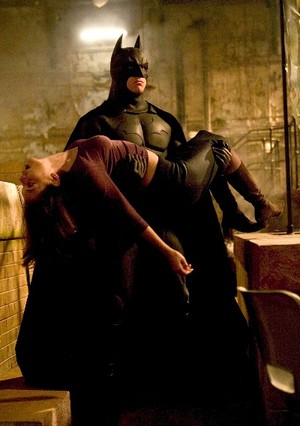
BatmanbeginsThe reason I’m mentioning this now is that this week a movie opens that could turn around the box-office slump… and certainly deserves to. Batman Begins is the best Hollywood studio film of the year so far, in addition to being one of the best super-hero movies of all time, and easily the best Batman movie ever.

Considering the years of trouble Warner Bros had even getting this picture made, what with directors, scripts and stars coming and going on a regular basis, it’s amazing that it turned out so well. In the end, they did everything right: Instead of a schlockmeister director like like Joel Schumacher (Batman Forever, Batman and Robin), they got a gifted filmmaker, Christopher Nolan (Memento, Insomnia); instead of casting a marquee name like George Clooney or Val Kilmer, they cast talented, brooding Christian Bale. And instead of making the villains the real stars of the film, they made the hero the star.

What’s more, the film has real-world relevance. The bad guys are a crypto-organization that wants to wage war on human decadence — but their methods include decapitating prisoners, instilling terror, and unleashing weapons of mass destruction on large metropolitan areas. Hm, sound familiar? 

It’s a terrific film, though some viewers, critics and otherwise, would apparently prefer a return to the first two Tim Burton films, and don’t know what to make of a story in which Batman’s parents were killed by somebody other than the Joker, or where the film is more interested in character development and moral themes than colorful villains, big explosions, and campy dialogue.

One caveat: If you decide to go see Batman Begins this weekend, don’t bring the kids. It’s way too dark and scary for young viewers (a mature 10 or 12 would be the cutoff in my book).

My Batman Begins review

Added: Will Batman rescue the box office? Get the story.

Other stories on the box office slump:  one | two
The Mother Of All "-Gates"

33 years ago today–June 17, 1972–five men were caught breaking into yonder building, leading to congressional hearings that would so dominate television that they would shove off the air all the cartoon programs I, as a young feller, wanted to watch in the afternoons after school.

The building is the Watergate building, and the congressional hearings were over the Watergate scandal.

In case you’re a young feller yourself (or young enough not ot remember Watergate), this is the scandal that (a) led Richard Nixon (he was a president) to resign and (b) led to every subsequent government scandal having the suffix "-gate" applied to it. Watergate was the first.

GET THE STORY.

GET A LIST OF "-GATE" SCANDALS.

The Mother Of All “-Gates”

Watergate33 years ago today–June 17, 1972–five men were caught breaking into yonder building, leading to congressional hearings that would so dominate television that they would shove off the air all the cartoon programs I, as a young feller, wanted to watch in the afternoons after school.

The building is the Watergate building, and the congressional hearings were over the Watergate scandal.

In case you’re a young feller yourself (or young enough not ot remember Watergate), this is the scandal that (a) led Richard Nixon (he was a president) to resign and (b) led to every subsequent government scandal having the suffix "-gate" applied to it. Watergate was the first.

GET THE STORY.

GET A LIST OF "-GATE" SCANDALS.

Buddhist Medidation For Christians?

A reader writes:

I am emailing you about a question concerning
Catholicism and Buddhism.  I am aware that several Buddhist
beliefs cannot be reconciled with the teachings of the
Catholic Church, Christ’s true Church.  And, I am aware that
Buddhism holds somethings as truths in common with the
Church.  It appears to me, at least on my college campus, is
that Buddhism (as a class) is very popular mainly because of
the meditations (zazen).  What is the Church’s teaching on
incorporating such meditation ways (not what is meditated
on, but the way it is done)with the Faith?

It seems to me that there is something "not-right"
about expecting all people to become catholics AND to
forsake their own culture so as to replace it with a heavily
European influenced Catholicism.  If there is nothing wrong
about how buddhists or hindu meditate or pray, can that also
be carried over into one’s faith life?  It seems that it has
been done so in the past such as the rosary, aristotle,
plato, etc.  Of course the process by which this would be
done would be that anything that is contrary to the True
Faith would be tossed out, but those things that are merely
ways of meditation/prayer, could be adapted into the Faith.

I hope you are able to answer the question that I am
asking and I hope that I did not ask it in too confusing of
a manner.  I do not want for you to doubt my faith in Christ
and the Catholic Church because of my interest in how other
religions practice their faith.  I hope to hear back from
you!

You are correct that Buddhism, or what people regard as Buddhism, is popular today, but I don’t think it’s simply the fact that Buddhism has meditation that is what makes it attractive. Christianity also has a tradition of meditation. I think Buddhism in significant measure is a cultural fad. Buddhism seems mystical and exotic to Westerners, who then get caught up in a spiritual analog to the saying "The grass is always greener on the other side of the fence."

That being said, the Church does recognize that there are ways in which the practices of other cultures can be harmonized with the Christian faith. The process of doing this is known as "inculturation." As you indicate, elements of other cultures that are in conflict with the Christian faith have to be weeded out, but parts that are not in conflict can be retained.

This is similar to the Christian assimilation of elements of Platonic and Aristotelian philosophy. (I’m not sure why you put the Rosary in that list, though.)

Meditation tends to be a religious practice, and it is especially difficult to harmonize anything coming from another religion with the Christian faith since there is a danger of indifferentism or syncretism. Attempted fusions of that nature can even result in people sliding into the other relgion. Thus assimilating elements of the practices of other religions is much more dangerous than assimilating non-religious cultural practices.

In regard to meditation in particular, I suggest that you read the document

INSTRUCTION ON SOME ASPECTS OF CHRISTIAN MEDITATION,

which was released in 1989 by the Congregation for the Doctrine of the Faith and signed by Cardinal Joseph Ratzinger (now Benedict XVI).