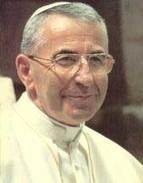
Bd. John Paul I?

Johnpauli_4

It would not surprise me in the slightest if someday the Church canonized all of the popes of the twentieth century. During the first few centuries of Christianity, God blessed the Church with saintly pontiffs to lead us through the Age of Martyrs (the first non-saint pontiff was Liberius in the fourth century), and it seems fitting that he would grant the Church another slew of saintly popes for the Second Age of Martyrs through which we now appear to be passing.

Already, we have St. Pius X and Bd. John XXIII. Causes have been opened for Pius XII, Paul VI, and John Paul the Great. And, as if in a nod that canonization does not depend on what you do but rather on the person you become by grace, there is even an active cause open for Pope John Paul I, the September Pope of 1978, who is now being reported to be on the fast-track to beatification:

"Pope John Paul I, who died in 1978 after a reign of only 34 days, could be the next addition to the growing list of possible papal saints.

"The beatification process for the Italian pontiff has moved swiftly ahead since its 2003 launch, the official in charge of the cause said in an interview marking the 27th anniversary of the pope’s death.

"’We have testimony of an apparent miracle which we are evaluating and which we are thinking of presenting to the Vatican,’ Monsignor Giorgio Lise told a Catholic website."

GET THE STORY.

Interestingly, I have only been able to find discussion of John Paul I’s possible beatification on stridently radical traditionalist sites, where there is the usual teeth-gnashing over "Vatican modernists … obviously trying to canonize the whole New Religion by putting each and every one of their leaders on the road to ‘sainthood’" (source) and bewailing of a supposed desire by the Church to "canonise these popes to prove the holiness and rightness of Vatican II" (source).

Why the news of JPI’s road to beatification has only appeared to come to the attention of those who sneer at the possibility, I don’t know, but I decided to rectify the situation by posting notice of it here.

From The Onion

Every blue moon or so, I’ll log in to The Onion just to see if they have anything funny. They usually do. Occasionally, they have something brilliantly funny. Unfortunately, they schmutz up their comedy with so much foul language and offensive content that it’s not enjoyable or recommendable, and so I seldom go there.

But here’s a good piece I just found:

Congress Abandons WikiConstitution

September 28, 2005 | Issue 41•39

WASHINGTON, DC—Congress scrapped the open-source, open-edit, online version of the Constitution Monday, only two months after it went live. "The idea seemed to dovetail perfectly with our tradition of democratic participation," Senate Minority Leader Harry Reid said. "But when so-called ‘contributors’ began loading it down with profanity, pornography, ASCII art, and mandatory-assault-rifle-ownership amendments, we thought it might be best to cancel the project." Congress intends to restore the Constitution to its pre-Wiki format as soon as an unadulterated copy of the document can be found [SOURCE].

The problem of finding an unadulterated copy is more difficult than you might think since the fact is that we’ve had a functional WikiConstitution for a while now. For the last number of decades, nine black-robed hackers have been logging in without authorization to made changes in American constitutional law without going through the democratic process spelled out in the document itself.

Um. . . . That’s Not Hatred

CHT to the reader who alerted me to the following story.

It seems that the Washington Nationals have suspended a volunteer chaplain for nodding his head in response to the wrong question.

The question was put to him by player Ryan Church, who was asking advice about his former girlfriend, who happens to be Jewish.

According to Church, he’s what happened:

"I said, like, Jewish people, they don’t believe in Jesus. Does that
mean they’re doomed? [Volunteer chaplain] Jon [Moeller] nodded, like, that’s what it meant. My
ex-girlfriend! I was like, man, if they only knew. Other religions
don’t know any better. It’s up to us to spread the word" [SOURCE].

Following this, the Washington Post got ahold of the story and published a front-page piece on it, following which Moeller was suspended as chaplain and Church issued an apology in which he distanced himself from "call[ing] into question the religious beliefs of others"–something that he apparently had just done!

The suspension and apology followed complaints from Rabbi Shmuel Herzfeld, and Orthodox rabbi in Washington. According to the WaPo story linked above, Rabbi Herzfeld stated that "the locker room of the Nationals is being used to preach hatred."

Elsewhere he is quoted as saying: "The Nationals did a good job about bringing hate into the locker room."

This might surprise some, but in principle I don’t have a problem with the Nationals suspending Chaplain Moeller. If they’re a private organization, they can have whatever kind of chaplain they want, including none at all. They also have the right to tell whatever chaplains they may have that "There are certain subjects we don’t want you to go into when you’re here; if you feel that you can minister to the players under these conditions, fine; otherwise, you’ll need to conduct your ministry elsewhere."

If the Nationals has such a policy and Chaplain Moeller was in violation of it then it is fair to suspend him. If they don’t have such a policy but are choosing to implement one now then Chaplain Moeller should have the policy explained to him and then he should be allowed to decide whether or not he feels he can minister under those conditions.

I do take exception to the remarks attributed to Rabbi Herzfeld, however. It is not "hatred" to propose a particular set of criteria for salvation and then conclude that those who do not meet those criteria are not saved. That’s a theological opinion, and it may be right or wrong, but it isn’t itself hatred.

Hatred might motivate it. A person might be drawn to a particular set of criteria because he hates a group and wishes to exclude them from salvation. But the mere fact that an individual concludes that some people aren’t saved is not itself evidence of hatred.

I don’t know how much experience Rabbi Herzfeld may have in talking with conservative Protestants, but there are a great many of them who are in no way motivated by hatred for the Jewish people, yet who believe that all Jewish people will be lost unless they accept Jesus as the Messiah.

The vast majority of them are not motivated by hatred in coming to this conclusion. They come to it because they sincerely believe in the necessity of Christian faith for salvation, and they happen to believe in a this necessity in an un-nuanced way that leads them to conclude that all who lack explicit Christian faith are unsaved.

That’s a theological opinion–one that I and my Church regard as inadequate–but it’s not an expression of hatred.

In fact, as evidenced by the somewhat inarticulate Mr. Church, it’s often serves as the occasion for showing love. Though human sinfulness can get in the way even here, it is in principle an act of love to share with someone what they need to be saved. It’s a spiritual work of mercy, and the belief that all non-Christians are doomed is often the occasion among conservative Protestants for renewed calls to reach out to them and share with them what they will need to be saved, for they are recognized as people who God loves and who he wants to save and who Jesus also died for. Conservative Proestants are regularly taught that people of other faiths are no better or worse than they themselves are and that all stand in need of God’s mercy.

I say all this as one who many conservative Protestants would not count as a Christian.

Many would regard me as automatically doomed because I am a Catholic. There is often even more antipathy toward Catholicism than toward Judaism in their circles because Catholics are believed to represent a false Christianity. By striking "closer to home" as it were, Catholicism is perceived as a much greater theological threat than Judaism.

But those conservative Protestants who believe that I am doomed because I am a Catholic don’t hate me.

They may disagree with and even loathe the faith to which I subscribe, but I’m not going to go around accusing them of "hate" just because they think I don’t qualify for salvation as they understand its terms.

There are far too many false accusations of hatred and "hate speech," and they have contributed to the development of a culture of victimization that threatens the fabric of American society.

Fundamentally, it is a disservice to the truth and to society to go around proclaiming "Hate! Hate!" where there is no hate.

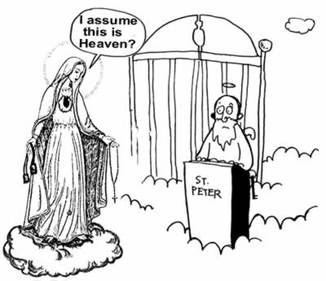
DUTCH TAX SHELTER: Witchcraft 101

The Netherlands, the country that has legalized everything from prostitution (WARNING: Evil file format! [.pdf]) to euthanasia, is now giving tax breaks to student witches:

"Dutch tax authorities have allowed a woman to deduct the 2,210 euros it cost her to take a one-year course in witchcraft, an inland revenue official said Wednesday.

"The 39-year actress and artist learned how to use crystal balls and prepare herbs, and also spells and other witchcraft skills at the course held in the country’s northwest.

"’The woman used the training in order to start … giving workshops, so she used it to extend her professional knowledge,’ the tax official told Reuters.

"Margarita Roland, who gave the course and whose Web site (http://www.heksehoeve.nl/) [Editor’s note: The site is in Dutch and its URL was published by the source article. –MA] shows her with a broomstick and pointed hat, said she teaches apprentices all they need to know to become a witch, using magic as a force for good.

"’A witch is a wise woman or man who knows about the magic of life in general and the magic of the earth in particular," said Roland, known as the ‘witch of Appelscha’ after her home town."

GET THE STORY.

Does anyone have any idea how the Netherlands became the center of kookiness in Europe?

The Planet That Couldn’t Come In Out Of The Sun

Sunstorm_1If a study currently being reported on holds up, a major crack in the global warming rhetoric has just developed.

Standard global warming rhetoric holds (a) that the earth is getting warmer on average and (b) that this is due to a buildup of "greenhouse gasses" in the atmosphere.

There are problems with both of these assertions, and a new study reluctantly points out a problem with the second.

The authors of the study are still advocates of global warming theory, but they concede that it appears that a significant chunk of global warming appears to be due not to greenhouse gasses but to something that most definitely warms the earth: the sun!

According to the study 10 to 30% of the warming "documented" in the last twenty or so years is due to changes in the sun’s activity.

That’s a striking first admission.

Future admissions might include that more than just 10 to 30% is due to solar activity–or even that the earth hasn’t warmed as much as we think. (There is reason to think that the data we have may not be reliable.)

LiveScience carries a brief story on all this, and as usual LiveScience is firmly in the standard global warming camp (as reflected in the article), but it’s still worth your while to

GET THE STORY.

Catholic-Orthodox Sacramental Issues

A reader writes:

I have been asked to sponser a young man for his confirmation. I am catholic, and he is attending a catholic school. However he was baptised in a Greek Orthodox church many years ago. The priest at our parish is saying that that was not valid and he can’t be confirmed and shouldn’t be receiving Holy Communion. I thought as long as someone was Baptised in the name of the Father, Son and Holy Spirit with water, that the Catholic church recognized it.

Does the Greek Orthodox church Baptise in the Name of the Father, Son, and Holy Spirit?

It does, and Greek Orthodox baptisms are valid. I suspect that what is happening here is a miscommunication.

The priest is probably not saying that the boy’s baptism isn’t valid. He’s likely saying that he is not allowed to confirm the boy or even that it would be invalid if the priest attempted to confirm him.

Here’s the deal: Catholic priests are only allowed to give three sacraments to those baptized into an Orthodox Church: penance, the Eucharist, and holy anointing. They are not allowed to confirm them. Here’s the relevant passage of canon law:

Canon 844 §3. Catholic ministers administer the sacraments of
penance, Eucharist, and anointing of the sick licitly to members of Eastern
Churches which do not have full communion with the Catholic Church if they seek
such on their own accord and are properly disposed. This is also valid for
members of other Churches which in the judgment of the Apostolic See are in the
same condition in regard to the sacraments as these Eastern Churches.

In light of this, it makes all the sense in the world for the priest to say that he can’t confirm the boy (unless the boy is converting to the Catholic faith and the priest is empowered to receive him into the Church).

It is less clear why the priest would say that he should not be receiving Communion if he is seeking it on his own and is properly disposed. The priest may be thinking of the sacramental discipline of the church to which the boy belongs, though for its part the Catholic Church would not object to him receiving Communion under the noted conditions.

“PRIVACY, Senator!”

HERE’S AN INTERESTING PIECE IN THE L.A. TIMES.

I’m not sure what’s more interesting about it–its content or the fact that it appeared in the L.A. Times at all.

The author takes to task California Senator Dianne Feinstein and others like her who display what he dubs "machisma."

Of course, you’re familiar with machismo–insensitive masculinity that frequently leads to blunt, silent behavior.

The author of the piece seems to conceptualize machisma as an insensitive femininity that frequently leads to blunt, talkative behavior. In particular, it leads to demands that others talk about their feelings.

EXCERPTS:

Feinstein asked Roberts how he would handle right-to-die cases. She told him to answer "as a son, a husband and a father." She wanted a personal, emotional response, not the cool logic of a jurist. Contrary to instructions, he answered dispassionately and not as a son, husband or father. She was displeased.

Her question was offensive on a human level, for reasons having nothing to do with the judicial context. She demonstrated a disturbing and widespread phenomenon: A powerful person insists that someone’s private feelings must be spread out for public viewing, like rugs in a Mideast bazaar. Roberts’ feelings as a father, son and husband are none of the country’s business.

"Macha" characters delight in emotional disembowelment; in ordering their victims to let it all hang out. But lots of people have no desire for heart-to-hearts with strangers in public, much less on national TV. Macha is just as toxic as macho, or more so, because it’s harder to laugh off. "How do you feel?" has become a standard media question, a substitute for eliciting actual information. Oprah and her imitators use it; news reporters covering hurricanes use it. Macha helps demolish the emotional walls that protect people, just as hurricanes demolish their physical walls.

In the long-ago age before macha, you called a person Miss Hepburn, say, until explicitly invited to use her first name — which helped English recapture the ancient distinction between "thou" (once the friendly, easygoing form of address among friends) and "you" (for addressing strangers or superiors). Lacking this distinction, English is all sweatsuits and no tuxedos.

When two people were not on a first-name basis, that fact indicated what kind of behavior was suitable and what wasn’t. No child presumed to call an adult by his or her first name; no doctor did so with a patient. Friendships moved forward in small, graceful steps instead of lunges. Keeping a respectful distance and recognizing authority made the world not cold and forbidding but comfortable, reassuring.

In school, my boys have often been harassed by macha teachers demanding that they tell the class their feelings. One teacher had the nerve to tell one of my sons that his book report must "critique without judging" — and she marked him down for trying to analyze what was good and bad in the story instead of saying which passages got him all choked up. (How many teenage boys do you know who like getting all choked up — or talking about it?)

Granted, the demand strikes different people in different ways. Some students welcome it. My boys don’t. Lots of people don’t. For a person in authority to insist that lower-downs reveal their emotions is an abuse of power, a form of emotional groping that can leave the targets feeling violated and mad as hell.

That’s the truth!

The author is on to a real social phenomenon here. I don’t agree with everything he says (notably, I don’t agree AT ALL with his assertion that Sen. Feinstein is "a sensible person who usually says sensible things"–but then this is the L.A. Times).

It is ironic that Sen. Feinstein’s probings of Judge Roberts’ emotional life constitutes a violation of what most of us would regard as private matters that we have a (moral) right to keep private.

Isn’t Sen. Feintein supposed to be kinda big on a right to privacy?