Marriage, Divorce, Remarriage, Controversy, Canon Law

Ed Peters has a new piece on his blog regarding a dustup that has apparently occurred in some quarters regarding remarks made by Cardinal Mario Pompedda.

As Ed points out, it isn’t altogether clear precisely what the Cardinal said.

Unfortunately, it looks like some may be spinning what the Cardinal said to support unrestricted access to Communion for divorced and remarried couples.

HERE’S A STORY GIVING SOME SENSE OF THAT.

Based on what I’ve seen Cardinal Pompedda reported as saying, he didn’t say anything like that.

What he is reported as saying is that civil divorce is not automatically sinful (it’s not) and Catholics who have been civilly divorced and civilly remarried are not excommunicated (they’re not)–so he’s right on both counts.

But these facts alone do not mean that one is qualified to receive Communion. There’s a difference between being excommunicated (a canonical censure applied by the Church for a handful of grave offenses against faith and morals) and being unqualified to receive Communion (which any ol’ mortal sin causes). The mere fact that one is not excommunicated thus does not mean that one has a right to receive Communion.

Civilly divorcing may or may not be mortally sinful (it depends on the individual case) but for Catholics to remarry in an invalid civil ceremony and then having conjugal relations is a gravely sinful act that will disqualify one from being able to receive Communion, even if it does not trigger the canonical censure of excommunication.

MORE FROM ED.

Shadow Pope

Cdlratzinger_1

According to Italian press reports, Pope Benedict has been raising eyebrows in the Eternal City by making night visits to the residence he kept when known as Joseph Cardinal Ratzinger:

"At about 9pm a plain, dark car carrying 78-year-old Pope Benedict and his private secretary, Don Georg Gaenswein, swirls out of a side door of Vatican city. It then doubles round in the back streets before arriving at 1 Piazza Citta Leonina, a hall of residence for senior Church figures and the Pope’s home as a cardinal for almost 24 years.

"A Vatican security guard is always waiting in front of the apartments in a pedestrian zone tucked behind St Peter’s Square. The Pope gets out of the car disguised in the plain black priest’s robes he wore when he was the Catholic Church’s senior theologian.

"Wearing a black hat and with his head down, he opens the wooden door himself, as he did for all those years, and tiptoes inside followed by Don Georg.

"’Its is not a question of just dashing in for a few minutes to grab a bag or a book,’ La Stampa said. ‘He spends at least a couple of hours there.’"

Labre_2

GET THE STORY.

Although the Italian press is notorious for its unreliability, which means that the report probably should be taken with the proverbial grain of salt, I find myself charmed by the idea of the Holy Father slipping away from the Vatican dressed as a simple priest. It reminds me of his namesake and birthday patron St. Benedict Joseph Labre, who was known as the Beggar of Rome and who used to wander the streets of the Eternal City in a sort of perpetual pilgrimage.

Amabo Te

Down yonder some folks were asking about a Latin equivalent for "please" and someone wrote:

Doesn’t Latin have "amabo te"? That’s what I learned, anyhow…

Another person then wrote:

This subject was discussed before on JA.O, and I also asked about "amabo te." I think Jimmy said it wasn’t really used that much.

I don’t recall saying that "amabo te" isn’t used much, though that’s certainly true in prayers. One reason why may be that–I am given to understand–"amabo te" is considered distinctive of women’s speech, but most prayers in Church historically have been lead by and composed for men.

The fundamental thing, though, is that "amabo te" is not a particle, the way "please" is. "Amabo te" is an idiomatic phrase used to express entreaty, but not a particle of entreaty. Literally, "amabo te" means "I will love you."

Every language has ways of expressing entreaty, but in some languages (like English) we have a particle we do it with and in other languages (like Latin) they have a phrase (or other devices) they do it with.

Also, I don’t know that it’s a very Christian sentiment to use "amabo te" in prayers.

I for one would feel *even less polite* saying to God "I will love you if you do this for me" or "Do this for me and I will love you."

I want to love God whether he does it for me or not.

To a native Latin speaker "amabo te" might possibly have lost its literal resonance (the way "roll out the red carpet" has lost its literal resonance for most native English speakers), but I’m not a native Latin speaker, and putting "amabo te" in prayers I say in Latin would totally call attention to its literal meaning in my mind.

Translating it literally into English prayers would be even worse.

Cy, The Cyclops Kitten–UPDATE

Cy_kitten_1Wow. I wasn’t expecting that!

A few days ago I did a post about Cy, the cyclops kitten. The post generated a few comments, but then a couple of days later–for reasons best known to Bill Gates–the search feature at MSN.com decided to list my post as the top thing in the search results for anyone who searched for "cyclops kitten."

The result was that I got SIXTY THOUSAND hits in one day. That’s like twenty times what I normally get. The next day–a slow-traffic Saturday–I got more than thirty thousand hits.

WOW. (I’m glad that TypePad isn’t charging me extra for my bandwidth overages, which are already substantial.)

In the process of getting that many hits, over a hundred comments got posted on the thread in a single day (which is probably a single-day record, but not a most-comments-ever record).

Reading the comments is fascinating, particularly because they are made by a much broader cross-section of Internet users than the folks who normally read my blog. Some individuals commenting used handles that revealed them to be Gigantic Idiots, and they got their posts swiftly unpublished. Others used rude language, but not so rude that they got unpublished.

Many of the comments were about how awsome Cy is. SAMPLES:

DUDE!!! This cat is freakin awsome…real or not. If this is a true coincidence, rock on Cy!

i think it’s kind of cool in an odd way. he’d be great in a movie.

Strange, but beautiful. I really wish he could’ve lived. Would’ve definitely been a cool cat to have.

OMG! I love him! I SOOOOOOOOO wish he would have lived… poo[r] thing though… no nose? Well anyways I think he is adorable.

i think this is the absolute cutest thing i have ever seen!! i dont
normally like cats but this one took my heart as soon as i saw it…it
really upsets me tht he died..well thts all i have to say except its
the cutest thing ive ever seen

I think Cy was adorable in his own right.. I would’ve loved him.  *kisses* to Cy.. RIP

*R.I.P Cy* i feel so bad for him and hes soo cute. Kinda looks more
of a cute little monkey than a cat. Too bad he only lived one day. I
would have wanted to take him in. Hes so adorable, but maybe its good
that he went because he would be in all of pain and misery if he lived,
because people would gape and his obnormality. I feel so bad.
If u think hes ugly, u are seriously disturbed.

Many people seemed to invest a mystical significance in Cy, speculating that God may have sent him into the world to teach us a valuable lesson and redeem us from the cynicism and lack of wonder in our society today:

Reading people’s reactions to something that strays from the "norm" just reinforces my cynisism towards the world and reminds me of the emptiness and cruelty of people. Like Chrissy says, God loves us all and all living things have a purpose. Cy’s purpose seems to have been to bring out the warmth and loving instincts in some but sadly expose the coldheartedness of most others.

for some strange reason god wanted us to see him for a reason. Everything comes in all different shapes and sizes with some deformation but this little precious was here for us to see anything is possible.

One person wondered if Cy could see his own future. (I may be reading into this comment, but I assume this was a jest based on the archetype of the blind prophet, since Cy was apparently blind.)

Even an atheist was prompted to consider whether Cy might be a product of divine intervention:

Whilst i am a strict aithiest, i have only sincere hopes that lil’ cy has gone to a better place than the earth that doomed him.

I can really appreciate what his presence has done for everyone, it
kind of broadens the perspective of life as we know it…was this
divine intervention or simply an accident? Either way, its all
positive, positive, positive. Makes you think dosent it?

Many also speculated about Cy’s eternal reward in heaven and getting to meet him there:

It really is a shame you didn’t get to amaze people once more when you
grew up, but I’m sure you’re waiting in Limbo for the Holy day when all
the worthy will be accepted into the Lord’s Kingdom. Then again, who
the heck am I to make this statement.

God bless this little baby!
He’s in heaven now having a hay day chasing all the mice he can and sleeping with angels.

my first thought was, "o my" and probably a lot of peoples first
thought was the same. god bless that little tyke and we’ll see you on
the other cy.

Many posters wondered whether this might not be a Photoshop trick–something that had occurred to me after I first saw the picture–and that started a debate between the Cy believers and the Cy unbelievers.

The argument between the Cy believers and the Cy unbelievers was eerily reminiscent of debates about religion.

Some expressed simple faith in his existence:

I believe Cy was alive, until someone proves otherwise, why dobut. Poor
thing to have so many people say some of the things they are saying
about it.

Some Cy unbelievers insulted the intelligence of the Cy believers, and some Cy believers pronounced shame upon the Cy unbelievers for their lack of faith.

Some Cy believers even argued that it doesn’t really matter if Cy is real or not because he touched all of our hearts so much.

Oh ye of little faith!

While I don’t have personal proof, the best evidence I have is that Cy is real.

First, HERE’S A FOLLOW-UP STORY FROM THE AP DETAILING THEIR RESEARCH INTO THE STORY.

Among other things the story mentions is the name of the medical condition that Cy apparently suffered from: holoprosencephaly (which loosely translated would be "whole forebrain-ism"). This is a real medical condition which occurs when the forebrain fails to divide into hemispheres, and it often results in facial deformities, particularly cyclopia and problems with the nose.

If you don’t believe me, HERE’S WHAT THE NATIONAL INSTITUTES OF HEALTH HAS TO SAY:

The least severe of the facial anomalies is the median cleft lip (premaxillary agenesis). The most severe is cyclopia, an abnormality characterized by a single eye located in the area normally occupied by the root of the nose, and a missing nose or a proboscis (a tubular-shaped nose) located above the eye. The least common facial anomaly is ethmocephaly, in which a proboscis separates closely-set eyes. Cebocephaly, another facial anomaly, is characterized by a small, flattened nose with a single nostril situated below incomplete or underdeveloped closely-set eyes.

Some readers in the combox helpfully pointed to THE SNOPES.COM PAGE ON CY (Snopes.com is a site devoted to debunking or verifying urban legends), which considers the Cy story true.

Snopes also says:

Cyclopia (or synophthalmia) is a birth defect in which a normally two-eyed animal is born with only a single fused eye, generally disproportionately large and centered on the face above the area where the nose would usually appear. Typically in cyclopic births the nose is either absent or present as an appendage located above the single eye. (Eyelids are also generally absent in such births, which explains why the eye of the one-day-old kitten pictured above is open even though cats are usually born with their eyes shut and remain in that condition for the first week or two of their lives.)

Another reader posted a link to A PAGE ABOUT A CYCLOPS GOAT, WITH PICTURES OF IT FROM MULTIPLE ANGLES.

The follow-up AP story linked above mentions that Cy’s owner sent the chip from her digital camera to the AP and it contained additional photos of Cy, taken from different angles. It also had the Cy photos in sequence with other photos in a way that the AP felt would have been very hard to fake.

Another thing it mentions (and which was the original reason that I didn’t link it after the Photoshop question was first raised) is that the woman who was Cy’s owner has kept his body in her freezer in case scientists want to study it. (She has also said the will NOT sell it on eBay.)

When I first read that, I thought, "Ewww. Gross." But on further reflection, after all the furor about whether or not Cy is real, preserving his remains maybe wasn’t such a bad idea.

Gross or not, this is a note of credibility. A Photoshop hoaxer would have said "I put the body in a dumpster and it was carried off to a dump from which it can never be recovered," not "I have the remains in my freezer and am willing to donate them for scientific study."

It seems to me, unless proof to the contrary is provided, that Cy was most likely a real kitten who suffered from holoprosencephalopathy and cyclopia–just like many other creatures (including some humans) have.

God bless you, Cy, and Rock On!

READ HOW CY TOUCHED PEOPLE–AND SPARKED ARGUMENTS–IN THE ORIGINAL POST’S COMBOX.

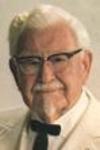
Col. Sanders: Cruel To Chickens?

Colsanders_1

PETA, the People for the Ethical Treatment of Animals, is on the warpath again, this time charging that a bust of Colonel Harlan Sanders, founder of the fast-food chicken franchise KFC, is "a monument to cruelty" — to chickens, that is.

"Pamela Anderson is leading a charge to remove a bust of KFC founder Colonel Harland Sanders from the state Capitol.

"The actress called the Kentucky native’s likeness ‘a monument to cruelty’ to chickens in a statement issued by People for the Ethical Treatment of Animals, the animal rights group.

[…]

KFC spokeswoman Laurie Schalow called the move to oust the colonel ‘just another misguided publicity stunt by PETA in their attempt to create a vegan society.’"

GET THE STORY.

Star-for-a-day celebrities such as Ms. Anderson may keep the publicity mill churning by making ridiculous statements about "cruelty to chickens" for a thirty-second soundbyte on Entertainment Tonight, but when it comes to real injustice — such as one million unborn children slaughtered in the U.S. every year — they are either conspicuously silent or conspicuously marching as Celebrity Guests at rallies to promote the injustice.

Which leads me to believe that it is not the cause de jour that matters so much as the public image and the publicity.

Dancing Around The Seal

According to the Associated Press:

A judge has ruled that a monsignor in the Roman Catholic Archdiocese of Los Angeles must submit to deposition questions in the far-reaching clergy abuse case.

In his order, Los Angeles Superior Court Judge Haley Fromholz writes that Monsignor Michael Lenihan cannot assert "clergy privilege" to avoid revealing whether he heard confessions of a deacon accused of sexual abuse.

Fromholz writes that "the penitential privilege protects ‘a communication made in confidence"’ but "does not prohibit the disclosure of the fact that the communication occurred."

What Ed Peters wants to know is: Why does the court want to establish whether or not Msgr. Lenihan heard the deacon’s confession. As long as the seal of confession is respected, one cannot legitimately infer anything about what the person may or may not have confessed.

Ed even gives a list of things that CAN’T legitimately be inferred from the fact a person confessed. (A very interesting list, that I suggest you read.)

The problem is that not everyone recognizes just how little can be inferred from the fact that somebody has been to confession. This means that the fact-finders in the case might assume too much regarding the implications of the fact that the deacon did or did not go to confession.

By trying to force the priest to say whether or not he heard the deacon’s confession, the judge is doing something that may skew the verdict of the case.

Further, the judge is seemingly needlessly provoking a Church-State conflict, because canon law may plausibly be read as requiring the priest NOT to admit whether or not he heard the deacon’s confession (that’s a topic for another post). If canon law requires this of the priest then the First Amendment of the U.S. Consitution would protect the priest’s right NOT to disclose this information in court.

The judge in the case has thus put the court on a collision course with the First Amendment for seemingly no purpose, given how little can be inferred from whether or not somebody went to confession.

We’ll have to see what happens in this case, but in the meantime

GET THE STORY

and

GET ED’S ANALYSIS OF IT.

The Power Of Grayskull

Hemandvd

Michelle here.

Since getting my DVD player operational last month, I have been starting to collect TV shows that I have loved. Most of my new acquisitions are shows for grownups, naturally enough, but one is my favorite cartoon show as a kid: He-Man and the Masters of the Universe.

Looking back on the show from the perspective of an adult, I can now see why my parents dismissed it as a thirty-minute toy commercial. It was. It was also extremely corny. I often can’t stop giggling when He-Man yells, "I HAVE THE POOOW-ERRR!" The animation is somewhat crude by today’s standards and it is fascinating how often the animators relied on stock images, especially during the transformation scenes.

But what makes the show interesting to me as an adult is how grounded the stories are in morality. Now, He-Man was famous for tacking on a little morality speech at the end of each episode, but that isn’t what interests me. The episodes themselves had stories that made important moral points, some of them often startlingly Christian in nature.

In one episode, the female protagonist Teela is bemused when He-Man risks his life to save the evil Mer-Man. Why did he do it? she asks. He-Man responds that all life is precious, even an evil one. In another episode, archvillain Skeletor and his henchmen cast a spell to summon an evil creature from another dimension so that they can use the creature to conquer Eternia. Much to their dismay they find that they cannot control the creature they have summoned and must turn to the good guys for help in getting rid of it.

Powerful stuff, with a message kids today would do well to hear.

For more information on the DVDs that are currently available, check out the following fan site, apparently maintained by a practicing Christian:

CastleGrayskull.org

Please?

A reader writes:

1.  Thank you very much for your blog.  I have learned so much from you.  Your commitment to the blog must require huge amounts of time – thank you, thank you, thank you.

My pleasure. Glad to be of service.

2.  My daughter has become involved with the Baptist church in Oklahoma City.  She has no computer and thus no e-mail.  I send her material that I develop on various subjects pertaining to the differences between Catholicism and Batptistism (?!).  Sometimes you have wonderful stuff and I would like to print it out and mail it to her.  OK with you?

Yeah, sure. No prob. That’s standard practice. Everybody assumes that folks will be printing off their stuff.

3.  Sometime if you have nothing else to write about and are so inclined, please explain why we never use please in our prayers – seems rude to me!

It does to me, too–when I stop to think about it–but there actually is a reason for this.

"Please" is what’s known as a particle of entreaty–that is, a short word that never changes its form and that is used to make requests (or commands) sound more polite.

If I’m not mistaken, "please" is ultimately derived from an earlier expression in English like "Be thou pleased" or somesuch.

But as a result, it’s an artifact of English. Not all languages have equivalents of please, or–if they do–they don’t use them as much.

Contemporary Aramaic, for example, does not have an equivalent of "please." Nor does Latin from what I can tell.

Hebrew did. It’s got the particle na, which shows up at the end of hosanna. That na on the end is a particle of entreaty to make the request for God to save us sound more polite.

But our English prayers don’t tend to be based on Hebrew prayers using na. They’re much more frequently based on prayers (in Hebrew, in Aramaic, in Greek, and especially in Latin) that don’t use particles of entreaty, and so that don’t get translated with "please" in them.

To people who speak languages without particles of entreaty–or which use them infrequently–it doesn’t sound rude to make a request without saying "please," but I know–it can drive us English speakers nuts, especially those who are well-mannered.

Sound And Fury, Signifying Nothing

Even some with firmly established liberal credentials are taking note of how pointless the way the Democrats are handling the Alito confirmation hearings.

E. J. Dionne writes:

A listless intellectual fog had fallen over the Senate hearing room on Tuesday, the first full day of questioning for Judge Samuel Alito before the Judiciary Committee. As one Democratic senator strode out to the hallway during an afternoon break, he leaned my way and said: “We have to hit him harder.”

The senator was expressing frustration over a process that doesn’t work. It turns out that, especially when their party controls the process, Supreme Court nominees can avoid answering any question they don’t want to answer. Senators make the process worse with meandering soliloquies. But when the questioning gets pointed, the opposition is immediately accused of scurrilous smears. The result: an exchange of tens of thousands of words signifying, in so many cases, nothing — as long as the nominee has the discipline to say nothing, over and over and over.

That doesn’t stop Dionne from criticizing Alito or saying what he thinks the Dems should do to try to stop his confirmation, but he acknowledges how empty the exercise has been.

GET THE STORY.

Meanwhile, on the other side of the political divide, the Wall Street Journal notes that "Borking as lost its bite":

The grand hulk of Ted Kennedy ranted that he wanted to subpoena the papers of former National Review publisher William Rusher to get to the bottom of Samuel Alito’s membership in the Concerned Alumni of Princeton. At this moment, one sensed that perhaps at last the ghost of Robert Bork had finally been laid to rest [JIMMY NOTES: Bork is quite alive, so this is an odd metaphor as phrased]. Borking was once a Democratic smear tactic. This week–amid intellectually exhausted and politically befuddled Democrats–it became a laugh track.

GET THE OTHER STORY.

Neocatechumenal Update: So Much For The “Private Letter” Argument

Recently Pope Benedict met with a bunch of families who are part of the Neocatechumenal Way who are going to be going to do mission work in various places, especially in Latin America.

As expected, he said very nice things to them.

He also discussed the matter of the liturgy:

He then went on to emphasize the importance of the liturgy in evangelization: "Your long experience can well confirm how the centrality of the mystery of Christ, celebrated in liturgical rites, constitutes a privileged and indispensable way to build vibrant and lasting Christian communities."

The Pope then referred to norms concerning the celebration of the Eucharist recently emanated, specifically for the Neocatechumenal Way, by the Congregation for Divine Worship and the Discipline of the Sacraments. "I am sure," he said, "that you will attentively observe these norms, which are based on liturgical texts approved by the Church. By faithful adherence to all Church directives, you will render your apostolate even more effective, in harmony and full communion with the Pope and the pastors of dioceses."

GET THE VATICAN INFORMATION SERVICE STORY.
(CHT to the reader who e-mailed.)

Now, you may recall that recently here on this blog Mr. Giuseppe Gennarini, American spokesman for the Neocatechumenal Way argued the following regarding the letter from Cardinal Arinze that contained these norms:

  1. This is a private letter whose real contents are known only by
    Cardinal Arinze, Kiko Arguello, Carmen Hernandez and Father Mario
    Pezzi. Any use of a private document to enforce a public policy is
    completely illegitimate and improper.

I responded with a number of points demonstrating the invalidity of this argument (read them here).

Now we have Pope Benedict himself publicly referring to the norms and telling members of the Neocatechumenal Way to obey them.

Any suggestion that the norms are perhaps not to be implemented because they are part of a "private letter" is, therefore, toast.